VISUAL STUDIES / SERIES
Dark Matter
Doors open wide, relationships need space
The Box makes passage possible, but the images repeatedly leave us facing a hand searching for a handle, a face watching, and a table testing the possibility of closeness. This study examines how the meaning of boundaries changes between glass, mirror and door, and how the body must still negotiate its position even within a space that promises limitless expansion.
We may see someone clearly through glass and still be unable to reach them. We may sit at the same table while the distance between two faces remains greater than the distance between two hands.
Four forms of faces and passage
The reflected city, the group on the Box, the corridor between two faces, and features divided anew by color.
A city reflected on a door larger than its traveler
The silver box gives the city a surface on which to appear, while Jason stands at its door much smaller than the surrounding facade. Rectangles repeat inward, turning the doorway into a miniature of the structure containing it, as the flashlight cuts sideways across the foreground. Barren ground and a pale sky gather the design around cool tones, then the white title anchors the base with a clarity that contrasts with the setting’s ambiguity. The idea does not require us to choose an original city and a reflected one; it is enough that urban space has become a surface carried on a closed body. The poster gives passage an architectural scale and leaves the person responsible for one small step before this expanse.
Seven people on an unstable foundation
The seven characters line up on the surface of a huge box, but they do not agree on a single direction to look. Their different turns open conflicting paths within the group, and the white suit gives the central figure a prominence that does not coincide with Jason’s position nearer the foreground. Beneath their feet, a dark facade extends wider and taller than their bodies, while its right edge visually erodes into orange dust. The city retreats to a lower horizon, making the characters seem raised above the world they are supposed to inhabit. The design makes their gathering legible without promising shared aims, placing everyone on a foundation that suggests strength while its edges expose the fragility of their stability.
A narrow corridor between two large faces
Jason and Daniela’s faces occupy most of the poster, with a small corridor forming between them and leading to orange light and a running figure. The difference in scale confines the journey to the distance between familiar features, rather than making it an independent background. Jason looks in a direction closer to the viewer, while Daniela’s gaze travels right, so their visual pairing retains a difference in attention. The corridor picks up the warm light around the face on the left, while the other edges dissolve into green and black. The design’s strength is that the story’s breadth passes through a particular human relationship: the running body is small, and the faces defining the meaning of its pursuit are larger than the road itself.
A color boundary divides repeated features
The profiles repeat in a horizontal band crossed by vertical boundaries that shift the color between orange and pale green. These divisions do not always match the outline of a head: the same features can continue through two tones, and one color can unite parts of two faces. This unsettles attempts to count the people or establish a complete image of each, while the eyes, noses and mouths remain clear enough for recognition. The black above the group leaves a broad space that isolates the repetition, and the white title gathers its base into a stable line. The design presents identity as a pattern that can be rearranged, drawing tension from the way resemblance remains readable even after the face’s unity has broken down.
The posters are read as independent visual designs, separately from the series frames.
What remains on either side of the door?
Twenty four readings of the arrangement of bodies, light, hands and boundaries within the image.
The sequence moves between broad masses and close details, and between the warmth of encounters and the coldness of scrutiny. Each frame has its own argument, and the full image can be opened with its title and reading. The study includes images of covered bodies, weapons and visual references to the season’s events.
A box keeps its darkness amid the light
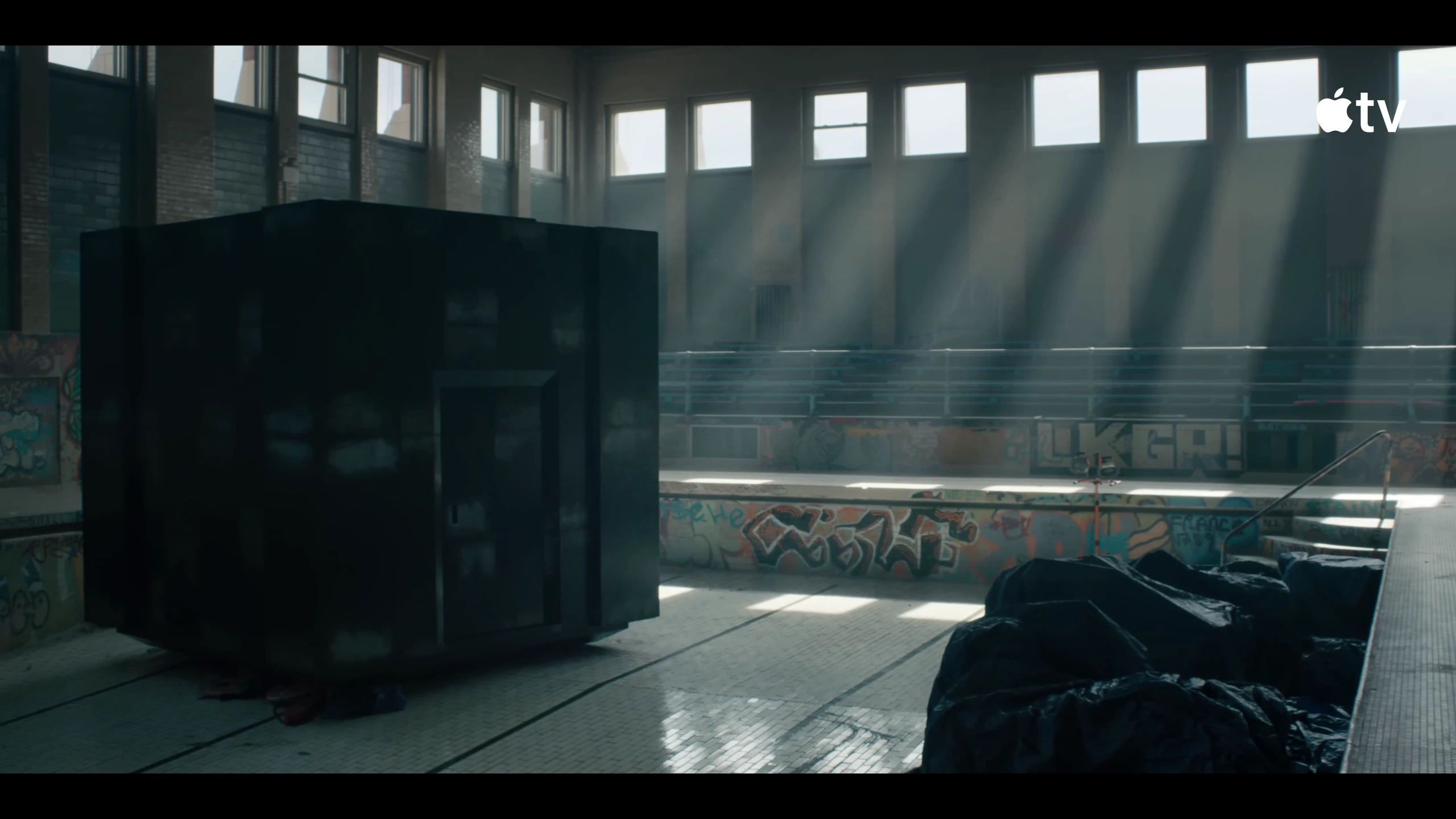
Light from the windows cuts across the pool floor and terraces, but gives the black box no equivalent transparency. Its surface remains a closed mass among clear lines that lead the eye into the space, and the rectangle of its door repeats within its facade without revealing what lies beyond. On the right, dark coverings gather over the seats, countering the architecture’s regularity with soft, irregular masses. This difference makes the box more solid and isolated from its surroundings. Strangeness takes shape here in broad daylight: we can understand the room and read the traces of its neglect, while the object at its center resists interpretation despite its closeness and clearly defined boundaries.
Papers crowd the space of head and bed
The head and shoulders occupy the center of the foreground, facing a wall scattered with papers of different sizes. Their contents cannot all be read clearly, but their distribution is enough to show research that has left the desk and spread into the bedroom. Two lamps surround the human mass, and the bed appears at the edge, keeping the room’s restful functions present beneath this expansion of paper. The man hides some notes from us while directing his whole body toward them; we stand behind an interest we do not share. Preoccupation takes a spatial form here, as private space becomes an open surface for questions and the possibility of relaxation retreats to the image’s edge.
Four watches around a shared space
Faces disappear, and four watches enter a small space surrounded by wrists and fingers. The overhead angle gathers their owners into an incomplete circle, while differences between the watches and sleeves preserve a particular trace of each body. The displays come close without merging into one device, making coordination an action that requires everyone’s participation. The image alone cannot establish that the numbers match or explain the purpose of the gathering, but the arrangement of hands makes time a physical subject placed between people. Trust acquires a visible form: each person reveals the instrument that keeps their time and accepts a connection between their rhythm and the rhythms of others.
Three faces share what lies beyond the frame
Jason, Daniela and Charlie stand beside one another across a horizontal line, looking in the same direction near the viewer’s position. This shared orientation gives the family a momentary unity, while their faces retain clear differences in tension and attention. Jason occupies a broad area with his dark coat, Daniela stands between him and Charlie, and the son’s layered clothing adds lighter colors at the edge. Behind them, the staircase rises into a darkness that prevents a full reading of the route, while cold light rises from the lower foreground. The sense of threat forms through their simultaneous wait for something concealed: we see a group facing outward without yet knowing how the response will divide them.
A hand approaches across a familiar table
Jason stretches his arm across the table toward Daniela’s hand, while her eyes lower to the point of approach. The distance between their faces remains greater than the distance between their hands, creating a limited connection that does not settle whether their words have reached their aim. The black kettle weights one side of the foreground, and the mug before her marks a domestic time that can be slowed down and inhabited. Kitchen objects and books also surround the encounter without overwhelming it. The table becomes a small place of negotiation: a shared object supporting their arms and allowing closeness while keeping each person on their own side with the hesitation they carry.
Court markings arrange the covered bodies
From a clearly elevated position, the covered bodies appear in a row beside the yellow marking on the court floor. The windows and two basketball hoops still testify to the room’s earlier purpose, while broad spaces separate the people now standing there. The white repetition moves attention from a single body to a whole arrangement, then the heads exposed at the ends of the coverings restore something particular to each figure. The cold floor reinforces this contrast between the orderly examination and the weight of what is being examined. The image’s strength lies in everyday architecture keeping its familiar signs while people are redistributed within it through a harsh relationship between those who stand and those who remain still.
An examination tool enters the face’s space
A line of light cuts across the woman’s face near her nose, opposite a cylindrical instrument held by a gloved hand entering from the right. The two come close enough to make skin an object of measurement, while the man behind remains blurred, present more through watching than participation. The blue green tone drains warmth from the skin and connects it with the surrounding surface, yet the eye remains a precise point of resistance and attention. The shot does not fully reveal the test’s result or scientific nature; it defines a relationship between a still body and a procedure entering its space. Separating the clear face from the blurred witness leaves the person being examined more exposed to scrutiny than the others.
A sharp glance before an open door
The woman fills the left foreground and looks back toward our viewing position, while the man sits farther away at the open door of the box. Her sharply defined features give this turn priority over his blurred details, although the black doorway behind him forms a larger mass in the composition. Green grass extends around them under soft daylight, placing suspicion within a scene that outwardly permits rest and sitting. Their presence is divided between a body ready to keep watching and another that has adopted a more settled position. This difference needs no direct confrontation to become perceptible; distance, clarity and the turn of a head are enough to make sharing a place different from sharing the same degree of ease within it.
Fingers test the silence of a closed surface
Jason’s eye and fingers draw close to a small metal disc attached to a dark surface, reducing the whole action to the relationship between face, tool and barrier. What lies behind the surface remains concealed, and the narrow space gives us no context explaining the room or its location. The metal catches enough light to heighten its presence within the dark green, then the line of the finger guides attention to the precise point of contact. The position can be read as an attempt to extract knowledge from a side that does not permit sight. Tension depends on the delayed answer: the focused eye and taut hand establish the effort, while the barrier keeps its silence and solidity before this very close approach.
A metal restraint over layered photographs
Photographs overlap on a single surface, with metal handcuffs in front of them catching light along their curve. A child appears in one photograph and a person carrying a bag in another, but the images cutting across each other prevent any life within them from becoming complete. The restraint links these visual fragments with the idea of holding and fixing, setting the past’s openness to interpretation against a tool made to restrict the body. The image does not identify the handcuffs’ owner or establish a legal relationship with the people photographed, so the reading stays within this juxtaposition. What draws attention is the transformation of printed memories into material that can be gathered and sorted on a table, where a life becomes a file examined by someone absent from the frame.
A city divides at a band of light
A warm vertical band cuts through the blue city, changing the density of buildings and the intensity of light within sharp, identifiable boundaries. Sky and water connect visually on either side, but the middle area presents a more crowded and glowing space, preventing the scene from being treated as a uniform view. This is a transitional image in which the combination of two pictures is visible, so there is no need to assume a physical division within the depicted world. The pause offers a chance to compare the city with itself through color, scale and arrangement. The vertical boundary becomes the site of the eye’s work, asking us to connect adjoining parts while also revealing the difficulty of considering them one place.
A helicopter seeks room between facades
The side of the bus fills the right foreground, and tall facades recede into a vertical corridor with a helicopter at its center. The pronounced tilt of the architectural edges makes the place feel doubly narrow, while the flying body appears trapped between glass and the nearby dark mass. The window frame conceals part of the city, so movement reaches us from a restricted position rather than through a free aerial view. Pale tones and scattered light reduce differences between surfaces, making it harder for the eye to find a clear opening. The city’s intimidating force comes from relative scale and crowded directions: a vehicle associated with freedom appears here inside a network of visible obstacles.
Closed eyes before an open corridor
Daniela stands within a long succession of dark doors, holding a white lamp brighter than any surrounding surface. The repeated rectangles lead the eye into the corridor’s depth, but her closed eyes stop this movement at her face: the place permits a forward look, while the character temporarily withdraws from using it. The lamp lights her fingers and part of her features, leaving the rest of her body close to the background’s blackness. Through this division, light becomes a limited resource carried by a hand, rather than a guarantee of understanding the path. The shot draws its strength from the meeting of open distance and closed eyes, where physical presence can remain still while attention turns inward.
A mirror brings the man into the confrontation
Daniela’s arms extend toward the viewer’s position, while the mirror behind her brings Jason back into the image on a deeper plane. The composition gathers the two without placing them face to face within the immediate space; the confrontation reaches us through the gun’s direction and the man’s reflected image. A wooden frame surrounds his reflection, and the lamp sits on the right, keeping signs of home around an action that threatens its familiarity. The warm colors also give the tension extra force because they preserve the appearance of a room suited to everyday life. Recognizing a person becomes part of the place’s crisis: a familiar face in the mirror and a face before us unable to trust what it sees.
A high angle divides the entrance to a home
We look down at the woman, so her upward gaze meets the lines of the entrance and floor, which divide around her into overlapping rectangles. Her white clothing gives her a clear center within the network of dark edges, while the phone screen adds a small blue patch near her hand. The room extends behind her, but the nearby wall’s frame conceals much of it and makes the watching position felt. Her look alone cannot identify who stands above her or what she awaits, and that lack remains part of the effect. The home’s organization can be read, yet the angle of approach leaves its occupant exposed to a higher presence we cannot see.
Transparency separates more than it connects
The man stands on the left and the woman on the right, facing each other across a transparent surface crossed by reflections and fine vertical lines. We see both relatively clearly, but the person near the woman reaches toward the handle, giving the boundary a practical function beyond its visual shape. Empty space widens between the faces, and the same blue light gathers them without erasing their different positions. The paradox is that sight is possible, while access requires another action that may open the door or keep it closed. The barrier becomes a test of the limits of closeness: looks can pass through it, while the body remains governed by the side on which it stands.
An open palm at the edge of danger
The woman raises an open palm beside her face, and a second, larger, less distinct hand enters from the foreground, crowding the short distance between us and her with two similar gestures. Her eyes remain directed beyond the image’s right edge, and her open mouth and tense brows combine into an expression of anxious waiting. Darkness surrounds the face, while cold light separates strands of hair from the background and reveals their dampness. The position gives her body no clear power to attack; exposed fingers show what is in the hand rather than concealing it. This arrangement places us before an attempt to communicate under pressure, where showing a harmless palm becomes a visible action preceding any possible understanding.
One hand braces, the other seeks a handle
Charlie fixes one hand high on the door’s surface and reaches the other toward a lower point, dividing the effort between bracing himself and trying to open it. His face approaches the vertical edge, and the blackness on the other side leaves what lies beyond unknown. The light sleeve’s texture differs from the hard surface, and this contrast lets us follow the body’s position even in low light. We do not need to see the destination to understand that passage requires a physical test of the door. The frame gives an everyday action unusual weight: the first hand seeks balance in the present, while the second reaches toward a possibility whose contents the eye cannot yet verify.
A face pauses within the movement of passersby
Daniela advances in a pale coat whose tone remains close to the stone of the building behind her, but her clearly rendered face separates her from the passersby receding in the background. The movement of her hair and parted mouth leave a small interruption within the busy daytime scene, while other bodies move in directions that do not meet her gaze. The image does not need an empty or dark city to create isolation; the difference in attention between the character and the people sharing her street is enough. Space around her head lets us sense public life continuing beyond her private anxiety. Separation becomes a question of rhythm here: the place maintains its habits while one face pauses at something we cannot see.
Two women at the edge of a shared appearance
The doorposts frame the two women, but one receives a position in front and a more exposed face, while shadow and the edge cut across part of her companion’s presence. The same opening gathers them and distributes visibility unequally. The red bag and yellow shirt add two clear colors to the woman in front, making her readiness to move legible through the things she carries. The background remains a dense darkness that does not explain their point of departure. The reading centers on the threshold as a narrow shared space, where two people can arrive together while one reaches the encounter with the outside first, along with whatever decision or definition it may require of them.
Leisure colors beneath a burning trail
Blue, green and pink shirts and summer hats fill the base, while a burning trail cuts across the daytime sky above the crowd’s heads. Bodies turn upward, united by the act of watching before we can know each person’s response. Showing backs rather than faces lets us share their viewing position and prevents us from assigning the group a single emotion. Thin masts meet the diagonal smoke trail, linking the leisure setting to a sign that disrupts its order. The paradox relies on the cheerful colors retaining their full force: an ordinary day’s appearance does not change as soon as danger emerges, and the possibility of catastrophe remains suspended above life continuing below.
Small candles beneath the experiment’s ceiling
An oval table gathers glasses, plates and candles, while a broad industrial space of metal surfaces and blue edges rises behind it. The small flames create a low, warm center that does not reach most of the room, making hospitality seem a local arrangement added to a place not designed around it. The man sits below the standing woman’s eyeline, and the difference in height again makes the conversation unequal despite their shared table. A dark, angled object also rests near the center, interrupting the orderly dining implements. The shot conveys the social ritual’s ability to borrow a strange place while retaining the visible trace of what that ritual cannot warm or make entirely familiar.
A shoulder resists the narrow lit opening
The hand clings to a lit vertical edge, and the face and shoulder turn in opposing directions under the strain. The woman remains behind the man on a lower level, while the space between their bodies and the door’s boundaries narrows almost enough to prevent us from reading the room. Slanted light cuts across their features and leaves broad areas of clothing in darkness, revealing resistance through particular patches of skin and fingers. The image does not explain the source of the force acting on them, but makes its bodily effect tangible. The opening that usually promises escape becomes a point of temporary confinement: passage depends here on the hand’s ability to hold on and the small distance the body can wrest from the edge.
A stable box in a splintering image
The box rests near the image’s center as bright fragments rush around it between tilted architectural masses that share no single horizon. Lines spread diagonally toward the edges, while the small object retains boundaries we can follow and a facade darker than its surroundings. This creates a temporary anchor for the eye amid a density that almost destroys its ability to judge scale and direction. The still image alone cannot settle the nature of what is happening or the order of its movement, but it reveals the compositional paradox clearly: the thing associated with passage appears more stable than the world containing it. The image closes the relationship between container and surroundings when coherent boundaries become a rare possibility in a space whose signs are coming apart.
Boundaries we see, relationships we build
Hands redefine distance at the watch, table and handle, while surfaces redefine the person between photograph, mirror and transparent barrier. Passage remains imaginable, while small details establish what can actually be shared within a space.