VISUAL STUDIES / SERIES
Ted Lasso
Small distances that build a team
A pitch can hold an entire group, while closeness begins with a hand, a seat, or a turn of the head. In these images from the fourth season of Ted Lasso, we examine how bodies stand alongside one another, and how an individual's position changes between training, work, friendship, and the crowd, until the team's image emerges from the spaces people make for one another within the frame.
The study includes visual references to events in the season.
Two people share a seat without any visible conversation, an adult lowers their body to meet a child, and someone leans over so another person can find a place in the picture. The group takes shape through these small changes in distance, height, and attention.
Three images of proximity and belonging
A group approaches the viewer, a strand of hair connects two faces, and a portrait stands before stadium seating that awaits its audience.
A team approaches the viewer's position
The figures in front approach the lower edge, and the ball rests beneath the hand of the woman on the left, while the broad laugh of the player opposite occupies a prominent area on the right. Ted remains between them on a slightly deeper plane, and the other characters rise behind their heads in an informal arrangement resembling a group preparing for a photograph. Shades of blue unite the clothes and sky, while patches of red and yellow provide differences we can follow within the group. The white title leaves ample space above them, preserving the faces as the main focus below. The design presents the group through varied expressions and degrees of proximity, and gives the new faces a position in front from which they can share the show's image with its familiar characters.
A strand of hair redraws a familiar mustache
The strand of hair crosses the space between the two faces and visually settles over Ted's mustache, creating a playful physical connection without their gazes meeting. He tilts his face upward with a slight smile, while the woman turns toward him with greater reserve, keeping their different responses part of the joke. Their similar clothes bring the bodies together, and the whistles near the bottom repeat their coaching role. The large scale of the features also makes the simple device clearer against a blue background with few details. The design draws on an easily recognized personal feature, then makes it open to change through another person's presence, introducing the new pairing with a quick visual gesture that preserves each person's way of receiving closeness.
Still faces before stands awaiting a crowd
The five faces look toward the viewer in an arrangement closer to a formal portrait, with Ted and Rebecca leading a row centered behind them by the woman in training clothes. The red seating and roof give the location a clear axis, and the club name above the group places its belonging within a recognizable architectural structure. The faces show different degrees of smiling, while the stances retain a steadiness absent from the more crowded ensemble poster. Rebecca's yellow outfit stands out among the blue sportswear, bringing different positions together in the image without making their appearance entirely uniform. The design gives the team a presence worthy of a serious introduction, and makes the empty stands behind it an expansive space for an audience that has yet to take its seats.
These readings examine the posters as designs distinct from the frames, while preserving each image's original composition and proportions.
The place we leave for someone else
Twenty four readings of stances, hands, faces, and ways of occupying a shared space.
Training, waiting, work, and encounters alternate in a visual sequence independent of the story's chronology. Each frame has its own argument, and the full image can be opened to continue reading within the viewer.
Different steps advance within one line
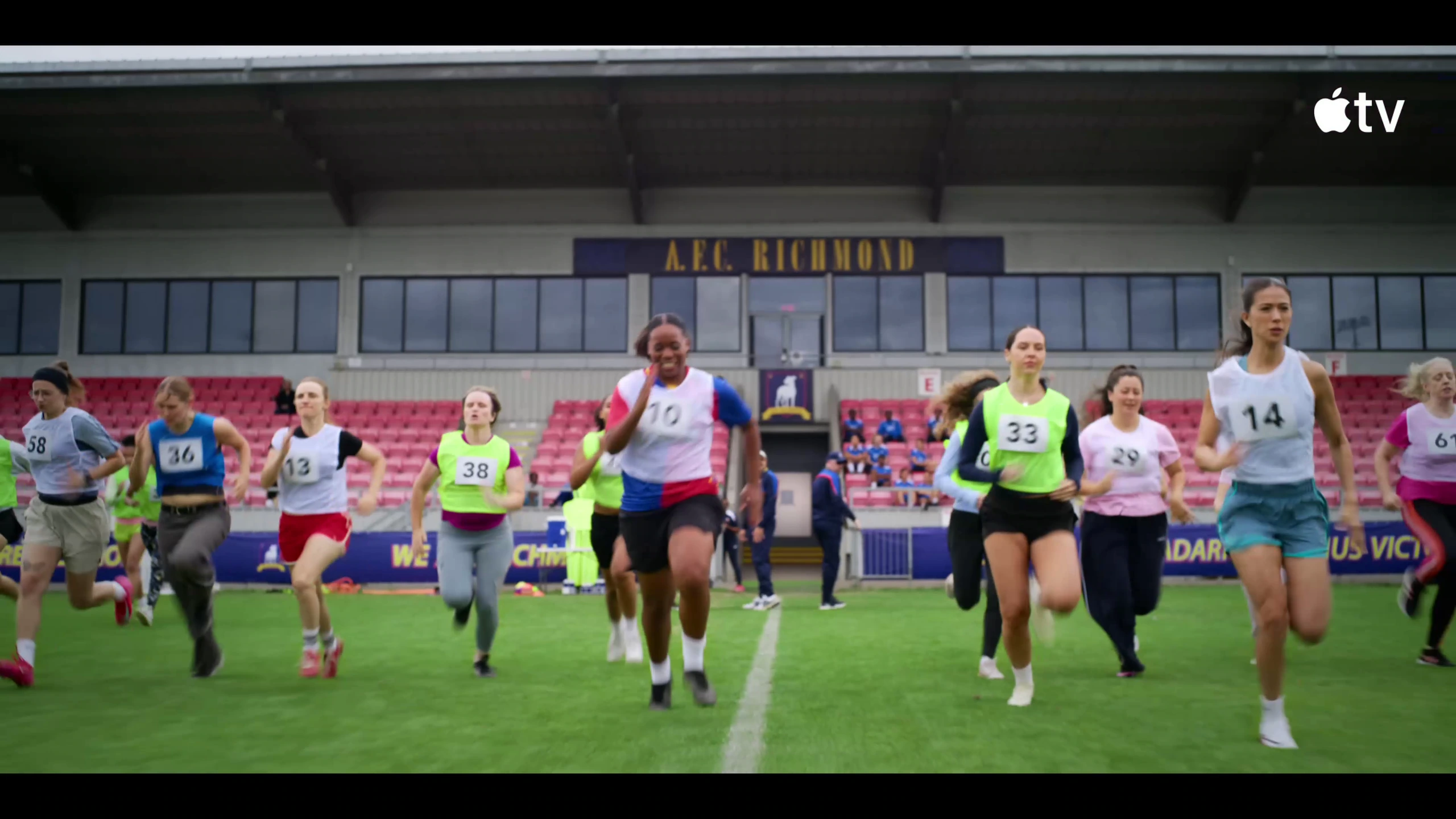
The players advance toward the viewer in a broad line, but their feet and arms do not share a single phase of movement. Small differences give each body its own rhythm, while the numbers and training clothes bring everyone together within a common task. Parts of the line extend beyond both edges, making the group seem larger than the area the frame has chosen to show. Behind them, the stand's facade and the club name settle into horizontal lines that give the forward movement a fixed reference. The image of the team arises from a shared direction occupied in different ways, and the wide shot allows us to see that participation without reducing the bodies to identical movement or giving one player the entire center of attention.
A small paper above the place of return
The yellow paper reaches the center of attention before the face does, because Ted turns his back to us and faces a doorway surrounded by clear shades of blue. His head points toward what lies ahead, while the open door leaves a dark space that reveals no details of the next room. The lightness of the paper, fixed at its corners, contrasts with the rigid frame and surrounding lockers, making the motto seem like a simple thing that has managed to retain its place within the setting. The shot does not need to show the returning person's features to make recognition part of the experience; we read the environment with him. The return becomes an encounter between a body entering the space and a sign that has been waiting above the same threshold, steady and visible from a distance.
A doorway places Roy among the club's colors
Roy stands within the rectangle of the gray doorway, surrounded by blue shirts and red panels that make the setting's affiliation readable before anyone speaks. His arms, held slightly apart, differ from the dark shirt's close fit around his body, giving the stance a readiness to advance that has not yet become a specific gesture. The space in front of him remains broad, while the frame behind him confines the source of his appearance. This distance lets us wait to see how the encounter will change as he approaches. His presence gains strength from the combination of a familiar figure and ordinary, recognizable boundaries; the door presents the person all at once, leaving what he will do with the space ahead as part of the anticipation within the image.
A face enclosed between two large sheets
The two sheets rise on either side of the face, their edges approaching the features until the eyes and mouth form a small center between two pale surfaces. We cannot read what the pages contain, but their different angles are enough to make comparison a visible action. His eyes move sideways and his mouth remains slightly open, shifting the papers' importance from their hidden contents to the response they provoke. The glasses make the direction of his gaze clearer, while the close framing removes most of the room's details. The composition's lightness comes from the difference in scale between the person and what he holds; ordinary papers take over the foreground, and their owner seems required to find an answer within the narrow gap they have left for his face.
Clasped hands in a symmetrical office
The lamps and paintings behind Rebecca establish an almost symmetrical order, making the tilt of her head and her interlaced fingers more prominent at the center. Her gaze rises away from the desktop, while ordinary objects remain arranged on it: a paper bag, a cup, and writing tools. The high chair gives her an official position, then the nearby details return her body to an ordinary stretch of time that might include food, waiting, and hesitation. Her relationship with the person opposite is established by an indistinct fragment entering the left foreground, so authority alone is not the subject of her stance. The frame presents someone within a stable arrangement, and the small movement of eyes and hands gives that arrangement a readable human response.
A sofa accommodates two informal postures
From above, the pink sofa looks like a flexible space that the two bodies have divided according to their need to recline. Ted's legs extend diagonally, while Keeley's bend at the other end with the laptop resting on her, keeping a tool of work present within two postures far removed from sitting at a desk. The rug and nearby table repeat the same color, and this continuity makes the blue and brown clothes more distinct than the boundaries between pieces of furniture. Intimacy emerges from the ability to share space without adopting a uniform posture or facing each other directly. Each person retains their own area and direction, and the seat's curve gives them a visual connection that accommodates difference rather than asking them to hide it.
A clear number and a face asking to be heard
The large number on the player's chest identifies her quickly within training, but the closeness of her face and the direction of her mouth shift attention from her numerical position to what she is trying to say. The other person's shoulder enters from the right foreground, leaving her clear space to speak while hiding their features from us. Behind her, two players stand out of focus near the net, allowing the group to continue as a distant setting for the individual exchange. The surrounding green space helps separate her head from the clutter of objects and makes the slight turn easy to follow. Here we see the value of moving closer within the story of a large team: the image can give one person time and a face after she has been merely a number moving among others.
One clipboard between three different stances
Beard occupies the middle of the group with his head lowered toward the clipboard, while the woman on the left folds her arms and Ted stands on the right with his hands in his pockets. The blue clothes unite all three people, then their stances give each a different way of participating in the moment. The woman's gaze turns toward the center, while Ted's smile remains more open to the space opposite, and the pen becomes the center of tangible action between them. The paper does not reveal what he writes, so the reading stays with the distribution of attention itself. Shared work consists of watching, recording, and waiting alongside one another, and the composition can bring these roles together without turning the team into three copies of the same behavior.
Glass separates stillness from movement inside
The woman stands at the edge of the tactics board in a relatively quiet posture, while the arms of the two people behind the glass move in directions that fill the room with gesture. The vertical support divides the surface into two areas, and the transparency lets us see everyone while keeping their standing positions separate. The magnetic dots arranged on the board add another model of the group, still and orderly in front of more active bodies deeper in the image. The contrast works between three kinds of presence: a nearby person watching, two people interacting, and markers that reduce the team to positions. The frame makes different relationships to action clear, reminding us that sharing an environment does not mean having the same degree of participation in every encounter.
A long corridor between a backward glance and a departing figure
Roy turns his head toward the depth of the corridor, giving us his back and a limited view of the side of his face, while Keeley recedes as a smaller figure at its far end. Doors and colored bands repeat on both sides, their lines leading toward the distance separating the two people. No hand reaches out and they do not face each other, so the turn alone carries the trace of continued attention after the other person has moved away. Even lighting keeps the setting clear, and the difference comes from scale and direction of movement more than from shadow. This organization allows us to read a relationship through what remains of it within the space: someone can follow the other with his eyes while his body stays in a position he has not yet begun to leave.
A shared seat within an expansive wait
Ted and Beard sit alongside each other in a small part of the corridor, while dark edges and nearby glass occupy a broad area in front of them. The bench brings their bodies to the same height, and their hands differ between interlaced fingers and resting near the knees, preserving each person's rhythm within the shared pause. A horizontal light above them adds to the background's order, and the image gives neither conversation nor its direction a clear center. Companionship becomes visible even without a major action; it is enough for the two to keep nearby positions within a stretch of time that seems extended. The viewer's distance adds a quiet layer to the encounter, as we see them together from outside the space they have chosen to occupy side by side.
A red jacket isolates a rhythm within the crowd
The red jacket gives Beard a distinct mass among people whose clothes and features overlap in a warm, less defined background. His head lowers toward his chest and his hand stays raised with fingers spread, creating a short path of movement within his own body instead of extending toward a particular person. Activity surrounds him on every side, but clarity and color give him visual time separate from the group. We can feel the stance's rhythm through the arrangement of head, palm, and shoulders, while the precise reason for the gesture remains beyond what the image establishes. The shot succeeds in keeping the individual readable within the crowd, sharing the location without exactly matching the movement of those who fill it around him.
Two microphones give the stance clear boundaries
The microphones rise from either side of the foreground toward Keeley, creating two diagonal boundaries that direct the eye to her face and white shirt. The dark suit gives her stance a formal order, then the pink tie adds a detail finer than the large blue and red areas behind her. Her gaze points forward and her mouth occupies a brief moment of speech, while her hands disappear below the edge rather than competing with her face to carry the response. The composition puts us in the position of receiving an address, while keeping the speaker exposed before the instruments amplifying her voice. Public participation becomes an activity with a form different from everyday intimacy; the body is relatively still, and speech is the action the setting has been prepared to present.
A hand crosses the distance over a small table
The two people face each other on opposite sides of a small table, and Rebecca's fingers approach the man's chin across the space occupied by the glasses and lamp. The objects create a vertical axis in the middle, while her hand crosses this arrangement and gives it a specific physical connection. The faces lean inward, and the divided window behind them remains a more orderly reference than the touching movement. Daylight allows us to read their eyes and smiles without isolating the encounter from its setting, keeping intimacy part of an ordinary, clearly visible arrangement of seats. The detail's value lies in its smallness; the meaning of the distance between the chairs changes when a few fingers can cross it, while each person retains a separate position around the table.
Overlapping hands and a face that retains its hesitation
Keeley's arms wrap around Roy from behind, and their hands gather in front of his torso in an area brighter than most of the dark clothes around them. Roy lowers his eyes toward the point of contact while her face appears close to his shoulder, making touch the center of a relationship that does not rely on a direct exchange of looks. The wall and line of lights lead into a long distance behind them, then their shared mass stops that extension in the foreground. His face retains a degree of tension despite the bodies' contact, allowing care to exist alongside hesitation within the same image. The composition shapes closeness as support that can be received before a comfortable expression or a final answer to what occupies the character has been reached.
A nearby post and a body reaching into space
The goalpost and net approach the right edge, while the goalkeeper's body extends diagonally across a broad area of sky. The difference in scale brings together a fixed boundary extremely close to us and a suspended body with no visible support beneath its feet. The light green draws the eye away from the stands, and the arms lead toward a space above the image's center. This instant does not show the outcome of the attempt; the tension gains its weight from the distance still ahead of the limbs. Our viewpoint places us inside the area the goalkeeper is responsible for defending, so we read the effort from the goal's own side, where the boundaries seem clear and reaching them at the right moment remains the responsibility of a single body.
A body advances before the eye follows
The Richmond player approaches the lower edge, her arms spreading in two directions to preserve her body's balance as she surges forward. The opponent appears smaller behind her, and the difference in distance leads us to read pursuit before we need to know the attack's timing or result. The ball touches the image's boundary, directing attention toward a position almost leaving our field of vision, while the head and shoulders settle in a higher, clearer area. The low angle gives the movement a scale that competes with the stand's architecture behind it. Advancing becomes a bodily process distributed across several limbs, and the eye must bring face, arms, leg, and ball together to understand an action that cannot be reduced to the foot alone.
Joy exceeds the frame's upper boundaries
Ted's arms surge upward until the image's edge cuts them off, and his mouth opens wide in a face that comes forward ahead of the others around him. Raised hands repeat behind him, but different scales and directions of movement prevent the responses from becoming identical copies. The red frame of the team bench surrounds the group, making the bodies' surge beyond its lines more prominent. We see an effect passing between people alongside one another, while the event that prompted it remains outside the shot. The vitality comes from an emotion larger than the space prepared to contain it: a hand exits above, a face appears between two shoulders, and a seated body below participates in its own way within the same continuing response.
A stand gathers responses at different speeds
The rows fill with raised hands, open mouths, smiles, and eyes still following what lies ahead, making the response seem distributed across different small moments. The direction of the gaze unites most of those present, while clothes, ages, and sitting postures preserve a distinguishable presence for each person within the crowd. Bodies sink or rise according to their positions between the seats, so the stand's architecture becomes the basis for arranging faces into readable layers. The image does not need to show the pitch to make its effect clear; it is enough to see how an event outside the frame reorganizes attention inside it. The audience takes shape through sharing a single direction while retaining varied ways of displaying, receiving, and passing enthusiasm to the person nearby.
A piece of cloth connects two ages
Mae extends her hand with the cloth toward the boy, who gives us the side of his head, and the small object draws a diagonal connection between two faces different in age and clarity. Her features carry a restrained smile, and her eyes stay directed toward the person in front of her, while warm lights surround the encounter with soft patches that do not compete with the hand. Limiting the boy's presence to the foreground lets us read the gesture from the side receiving it, while his complete response remains outside the image. The relationship gains its substance from an everyday action that can be exchanged within the setting. The cloth carries the trace of ordinary use, and makes care visible through a simple movement directed from one person to another.
A body lowers until the gazes come closer
The woman bends her knees and lowers her torso toward the child, changing the difference in height between their heads and bringing her face closer to his eye level. The child keeps standing, while the taller body takes on the effort of approaching, so care appears here as a decision with a muscular form and a specific distance. Cones, poles, and water bottles line up behind them, and the empty stands remain part of an environment prepared to train a larger group. The wide image lets us see the entire change in stance instead of settling for a close smile. The pitch becomes a place capable of accommodating a small person's rhythm when someone present changes their body position to give him an encounter in which he does not have to raise his head very far.
Arms cross the boundaries of a formal stance
The embrace gathers the two bodies into a single mass before the doorway, and their arms wrap around each other's backs until it is difficult at first glance to separate one shirt's boundaries from the other's. Their palms remain clearer at the edges, identifying points of support within the overlap. The yellow paper stays in its place above them, while the relationship beneath it shifts from two people facing one another to a contact in which directions intersect. Most of both faces is absent, so the bodies carry the encounter's meaning instead of relying on an expression we can read in full. The shot gives belonging a tangible form, making the familiar setting a background for an action that closes the distance which had allowed each person a separate stance opposite the other.
Two laughs within an arc of arms
Rebecca's arms form an arc around Keeley, and their heads draw close enough for their two laughs to become a shared center in the foreground. One face lowers toward the shoulder while the other rises above it, combining the embrace of the body with the clear presentation of expression. Jewelry and pale clothing reflect some of the warm light, while the brown seats leave a steady area around the movement for the eye to rest. Closeness here does not depend on their eyes pointing in one direction; each can turn her face slightly away and the connection remains clear through arm and shoulder. The frame gives intimacy its density through the coincidence of touch and laughter, with the two characters sharing a narrow space without either losing her own expression within it.
Irregular rows for a shared picture
People gather at several levels, from a knee on the floor to a bending body and a face rising above shoulders. This arrangement accommodates many faces without rigid rows, while arms, scarves, and finger gestures create short connections between parts of the group. Many faces turn toward the camera, and the responses preserve their differences between laughter, shouting, and smiling. The club scarf gathers a clear name above some heads, while everyday clothes remain more varied than training uniforms. The team's image expands here through the way it is made: one person lowers their body to reveal a face, another leans over to enter the frame, and obtaining a visible place becomes an action that requires the cooperation of surrounding bodies.
An image expands as bodies adjust
A team is formed by more than everyone's presence in the same place. A hand offers support, a backward glance retains a trace of someone who has moved away, and a body changes its height to come closer. In the final group photograph, making room for someone else becomes part of how everyone appears together.