VISUAL STUDIES / FILMS
The Dog Stars
Spaces for movement, boundaries for living
The aircraft’s wing reaches towards the sky, and the fence interrupts the path of our gaze towards the body, while closeness takes shape through a hand reaching for headphones or a shoulder beside the dog. In these images, we read how attention is divided between watching the outside world and sharing a small space with someone else, and how everyday objects carry some of the meaning of survival.
The aircraft may stand nearby while the fence remains a place to wait. An entire landscape can open up while closeness begins with a small movement of the hand.
Companionship before a larger world
Four designs moving between assembled faces, open sky and bodies diminished by a city.
Companions sharing space but dividing their gazes
White lettering occupies the upper part of the poster, before the faces diminish in scale from Hig in the foreground to Cima farther away, with the older Bangley and Jasper present within the same grouping. Their gazes point in different directions, making the gathering seem founded on sharing a space rather than collectively facing a single point. Mountains and damaged structures connect the characters to a cold world, interrupted by patches of warm fire below. Differences of scale give the viewer a quick route towards the principal faces, while retaining a clear place for the dog beside the nearest face. The advertisement’s identity forms around companionship tinged with readiness: bodies stand together without relating to their surroundings in identical ways.
Grass reclaiming the fallen city's base
Towers with sections missing rise in the middle background, while grass and white flowers fill the poster’s base around Hig and Jasper. The title retains an independent space in the sky, leaving the visual competition to grey architecture losing its coherence and nearby plants rich in detail. The plane appears small between these levels, so the vehicle of departure recedes before the presence of the two companions in the foreground. The distribution of scale creates a clear paradox: the city’s traces remain enormous, but the life whose features we can grasp lies below them and outside their former order. The meeting of greenery and ruin gives the advertisement a double promise, combining the possibility of continuing with the impossibility of restoring the urban scene as it was.
An expansive sky around a body ready to travel
The man occupies the right side in profile, with his backpack visible behind him, while the dog takes up a small part of the base. Blue and stars surround the body from several directions, and the design leaves a space to his left wider than the area he occupies. Orange touches the edges of his face and clothing, separating them from the cold surroundings without dispelling the sky’s expanse. Placing the title near the top connects the name with the open field of vision above the figure. The idea of the journey takes precedence here over the image of urban collapse. The poster sets a person carrying his belongings and a small companion against an expanse difficult to contain, making differences of scale the basis for a dual feeling of isolation and possibility.
A path taking companionship toward silent architecture
A man and a dog walk away from us along a road occupying the centre of the poster, its edges directing the eye towards a facade with repeated arched openings. Beyond that level stand eroded towers many times larger than the two figures, multiplying the distance between nearby companionship and a city too vast to encompass. The title sits low at the base and crosses part of the road, leaving the scene above it open to the ruins. Greenery creeping in along the sides gives the route the appearance of a passage brought back into use outside the old city’s traffic. The dramatic promise comes from moving inwards and concealing both faces: we follow a relationship moving before us without possessing its participants’ expressions or any guarantee of what awaits behind the facade.
Posters are read as independent designs. The selected poster identifies the cover.
The distance between caution and closeness
Fourteen independent readings of selected frames.
An editorial visual sequence of selected frames. Select an image to enlarge it and read its commentary.
An arm resting on a boundary that stays closed
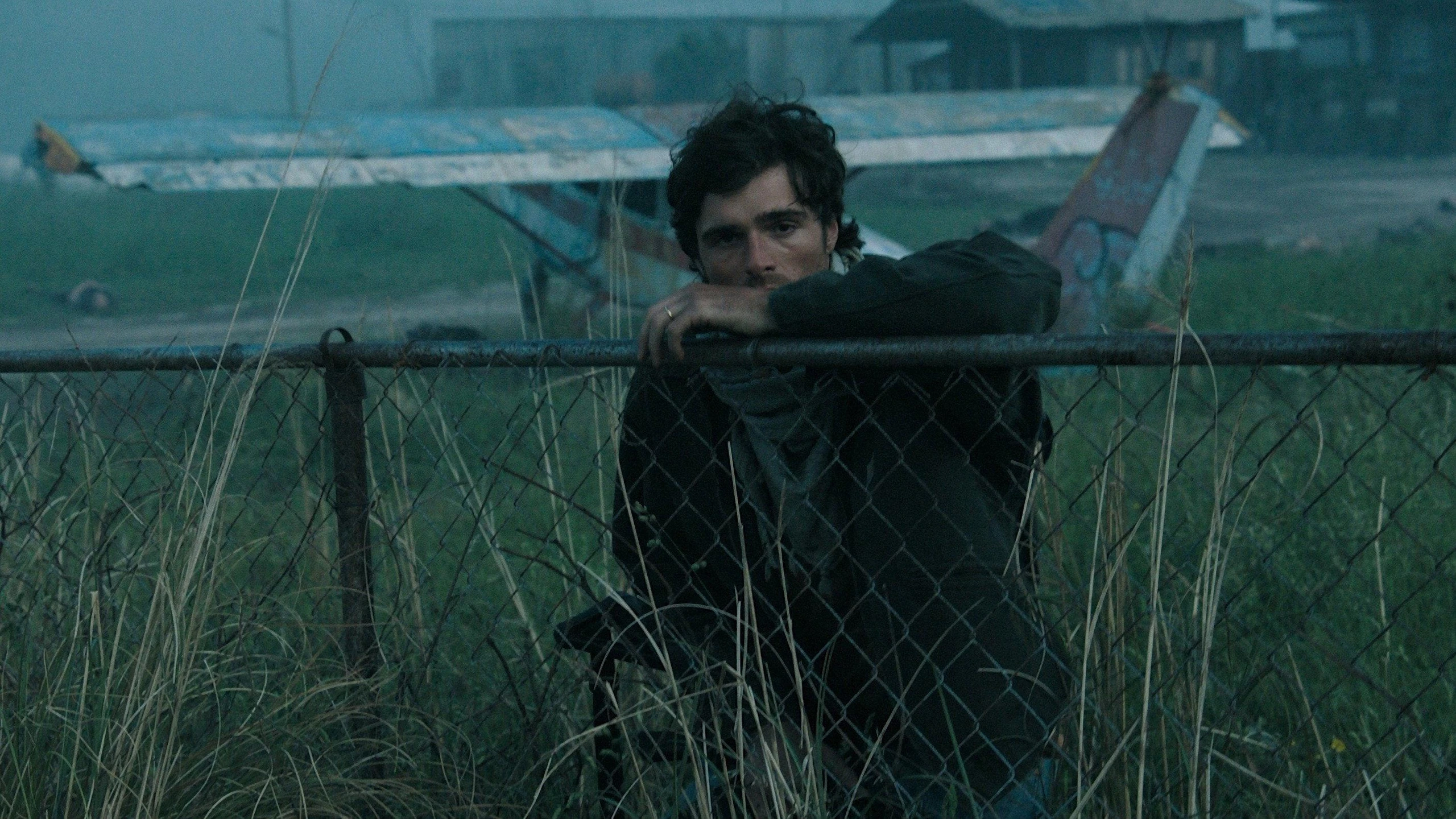
The wire fence extends across the foreground, and Hig rests his arm on its upper rail until his mouth comes close to the level of his elbow. Behind him, the plane appears among grass and buildings, but remains separated from him by layers of lines, metal and vegetation. Blue unifies these spaces without erasing their differences, leaving the body close to a means of movement yet distant from using it. Leaning on the fence acquires meaning through this particular arrangement: a boundary that our gaze can cross remains a place to stop. His facing gaze gives the person a presence within a mesh cutting across his torso, while the tall grass completes the feeling of a place that permits waiting more than it encourages departure.
A smile leaving speech outside the frame
The image brings Cima’s face close enough for the headphone wire to appear as a line descending beside her jaw and neck, while the trees retreat into soft green areas. Her eyes turn towards a low point outside the frame, and her lips retain a slight smile that does not open into laughter. The headphones give this attention a path different from spoken confrontation: the object and the face’s position allow us to infer listening, without knowing from the image alone what reaches her ears. The shot’s delicacy lies in retaining an unfinished expression open to several meanings. Moving closer becomes a way to notice a small response while leaving its cause beyond the gaze’s direct control.
A face watching from behind the weapon
The weapon and its scope occupy the foreground as an indistinct horizontal mass, while Bangley’s face rests behind them on a more legible plane. This barrier cuts across our view before we reach the eyes, linking observation to an instrument of defence even when no gunfire occurs within the image. The green background retains a calmness at odds with the solidity of the black shapes, without giving us enough information to judge the place’s safety. The frame gains its effect from this ordering of priorities: the face and its alert expression are visible, but access to them passes through the weapon. The man’s relationship with the outside world is thus defined by a barrier that allows looking and readiness to repel at the same time.
Fire creating a third center for the encounter
Hig and Cima sit on opposite sides of a small fire, whose flame settles between the directions of their bodies instead of letting either face monopolise the centre. Smoke occupies part of Hig’s figure, while Cima’s hands remain around a red mug that echoes the stripe running along the plane behind them. The relationship forms from objects in use and shared ground: the fire and the mug give the encounter a material reason to last. The plane works as a horizontal line gathering both people into one space, although it carries the possibility of leaving that space. The frame succeeds in making closeness visible through the arrangement of sitting positions and objects, before we need to explain it through emotional words.
An upright body before bodies without faces
An armed woman stands at roughly the middle distance, while bodies lie across the foreground and burnt structures break the mountain’s outline behind her. The low angle and lighter sky give the standing figure a clarity unavailable to most of the fallen: we read her posture and the direction of her weapon before we can distinguish their faces. This disparity creates a powerful impression of violence, but also reveals the limits of how individuality is distributed within the frame. The survivor receives a distinct form and a centre of attention; the corpses become visual weight by which the scale of what happened is measured. Cold colours and smoke keep her upright presence burdened with violence, without turning the scene into a pure celebration of survival.
A companion filling the space before a knee
Jasper advances on the left until he nearly occupies the height of the seated figure behind him, while Hig clasps his hands over his knee nearby. The man looks upwards beyond the frame, while the dog faces an area closer to our position. Proximity connects them without imposing a single direction of attention. Bright grass spreads around them, and the industrial structures behind remain smaller and less present than the texture of the fur and the puffy jacket. These proportions give companionship an everyday weight: the animal’s body occupies a real place within the human posture, changing the shape of his sitting position and the limits of his empty space. The image draws its warmth from the physical familiarity visible in this adjacency.
Cracked glass framing the faces' closeness
Cracks in the glass spread from a nearby point low in the foreground, then cross the space separating Cima’s face from Hig’s in branching lines. Both sit within a warm, cramped area, and his gaze towards her makes a relationship legible despite the barrier. The figure behind remains less distinct, confined between the cabin’s vertical frames. The composition combines human closeness with a material trace of damage on the surface through which we see: the faces share a place without the path of our gaze towards them becoming clear. The scratches give the encounter tangible fragility, retaining a sign of danger within the image’s construction even in the presence of a softer expression.
Two postures negotiating the distance of trust
Hig makes his sitting position compact by drawing up his knees and wrapping his arms around them, while Cima sits slightly higher and lets her hands extend as she talks. The composition places them on separate rocks within a wide green space. Enclosure therefore comes from how each body occupies its position rather than surrounding walls. Their gazes connect despite the different scale of their movements: an attentive face within a closed posture meets hands that extend speech into space. The even background helps keep this difference clear. The frame succeeds in showing a relationship not yet settled, where closeness can begin through mutual attention before the degree of physical openness becomes alike.
A book lifting light toward an alert face
The book rises to conceal the mouth and part of the nose, while the eyes look upwards beyond the open page. The face catches cold light from below that emphasises the forehead’s creases and leaves the sides of the head darker; the window edges behind repeat the book’s vertical divisions. Reading coexists with a state of attention that does not settle on the text: the body holds something close, but the gaze follows something farther away. This paradox gives the familiar object an unsettling effect without revealing the cause of vigilance. The frame’s particular character comes from separating the paths of the hand and the eye, keeping the book as a partial screen for the face rather than making it sufficient proof of reassurance.
Two bodies sharing the edge of concealment
Hig lowers himself behind the plants on the left, while Jasper’s head remains a little higher on the right. Their gazes approach a shared direction, and the man’s hand holds at the dog’s neck, linking their positions within a common line of attention. Grass conceals part of the foreground but leaves both faces visible, giving us a degree of sight suited to cautious observation. We do not see the danger’s location, but the composition defines our relationship to it through the lowered body and the companions’ cohesion. What distinguishes the frame is that protection appears visually reciprocal: the hand embraces the nearby space, while the dog’s ears and gaze advance towards what the man is trying to explore.
A wing occupying more space than its owner
Hig leans against the aircraft’s structure, and its yellow panels thrust from the right foreground towards his body. Rows of rivets and the curved join give the metal surface tangible weight, while the wing extending left opens a strip of sky around his head. The composition combines an open exterior with a settled posture: a hand in a pocket and a leaning body arrest movement beside a machine usually associated with travel. This opposition can be read as a distance between possessing a means of departure and using it. The image succeeds by keeping the plane present as a body occupying space and supporting the man, while retaining its promise of movement beyond this moment of standing still.
Hands sharing a small interval of listening
Hig extends his arms towards the headphones at Cima’s head, while she keeps her hands close to her ears and lowers her gaze. The composition gathers four hands around a small object, turning care from a feeling we assume into a precise action coordinating the distance between the bodies. The curve of the arms repeats the bend of their sitting positions, giving closeness a practical balance despite Hig moving into her space. The yellow plane behind them remains a broad band of colour set against the delicate foreground movement. The image does not tell us what they hear, but lets us see participation in preparing to listen. This particular quality gives the encounter a tangible effect beyond simply placing two people close together within a romantic frame.
A turn placing attention beyond the frame
Hig leans his torso forwards and turns his face to the right, while his near shoulder remains a clear mass low in the frame. The skin’s sharpness differs from the fluid green background, keeping our reading at the eye, eyebrow and slight tightening of the mouth. The image does not show the other party, so listening becomes a possibility inferred from the gaze’s direction and bodily posture rather than dialogue we hear. This absence gives the encounter an open space: what draws his attention is present in its effect on the face and absent from our field of vision. The restrained expression avoids a predetermined emotional outcome, retaining hesitation between caution and attraction towards what lies beyond the edge.
An aircraft joining two grounded figures
The plane’s yellow body extends from the right almost to the man’s position, and its sloping support directs the eye towards the ground where the dog stands near his legs. Directions of attention repeat towards the left, creating a link between the companions without direct touch. Stains and scratches on the metal give the machine a presence as an object in use, set against the wood and accumulated belongings by the building behind. The setting brings together tools of movement and signs of habitation and daily work: the plane is parked within a network of material relationships. The image can therefore give continuing life a practical form: a person, an animal and a means of transport temporarily share a single patch of ground.
The space we share
Distance changes meaning between a weapon that precedes a face, a fence that cuts across a body, and a hand approaching headphones. What connects these images is the different ways a person allows an object or another person to share their space.