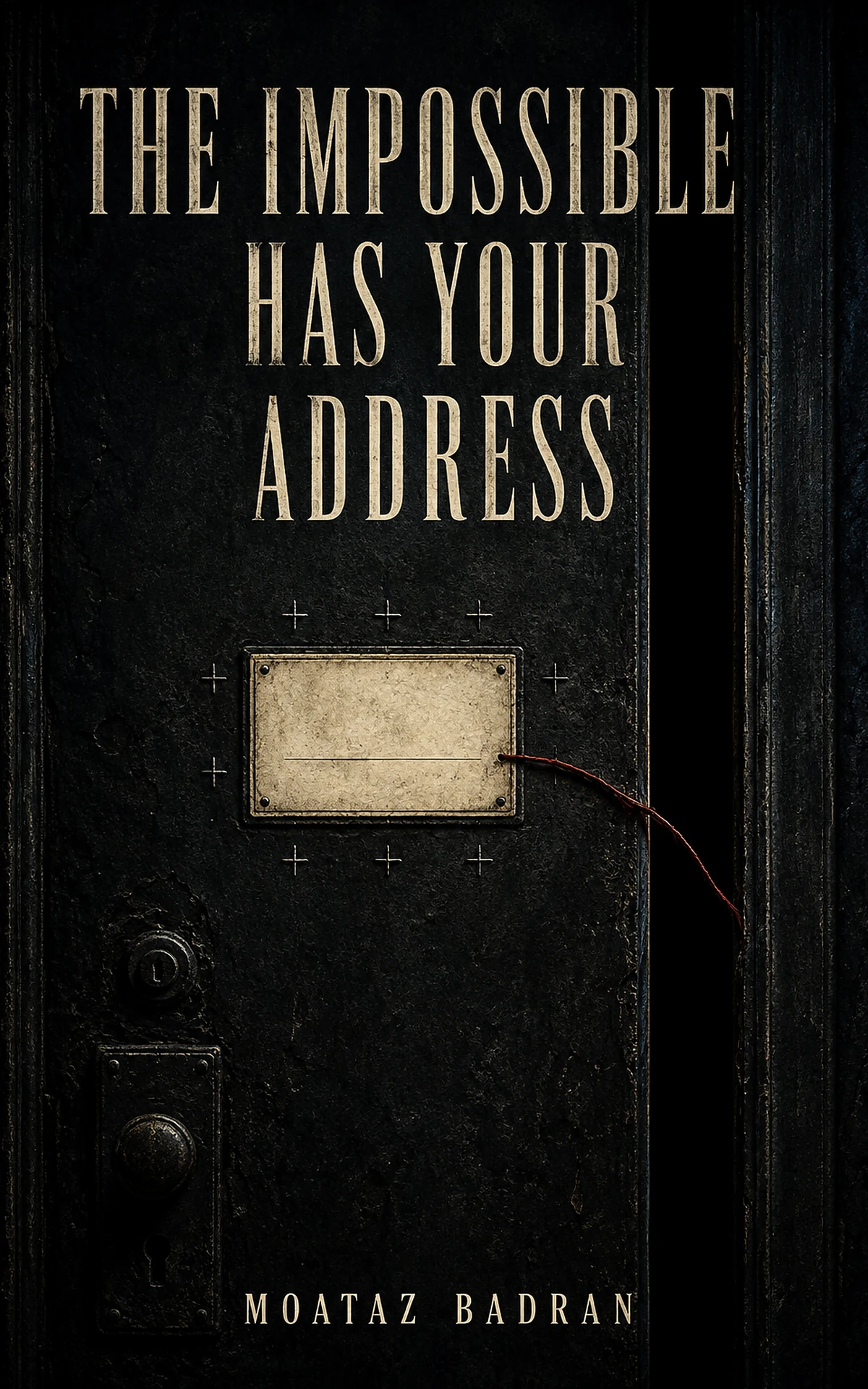
THIRTEEN STORIES OF IMPOSSIBLE RULES
THE IMPOSSIBLE HAS YOUR ADDRESS
Book and excerpt in English
An adult horror collection of thirteen independent stories. Letters arrive before houses are built, records describe impossible organs and ordinary systems continue working after reality stops obeying them.
Inside the book
Thirteen independent stories begin with familiar things: a letter, a record, a workplace, a way home. Then an impossible rule appears, and ordinary systems keep functioning as if nothing has changed.
The collection moves through body horror, psychological dread and hostile places. The excerpt below opens the first story, where letters arrive bearing addresses the city does not recognize.
Who is it for?
For adult horror readers who enjoy independent stories and strange premises with tangible consequences.
READING EXCERPT · ORIGINAL TEXT
Story One · Letters to Houses Not Yet Built
By eight on Monday morning, the Valecross Dead Letter Office had already swallowed the weekend.
Canvas carts crowded the central aisle from the loading doors to the opening room. Damp envelopes leaned against cartons with split corners. A label printer chattered somewhere behind the metal cabinets, stopped, then chattered again, though no clerk stood near it. Overhead, one fluorescent tube blinked at a slower rate than the others, giving every third row of shelving the appearance of moving by an inch.
Imani Rook worked with her coat unbuttoned and both sleeves pushed to her forearms. At thirty-four she was taller than most of the clerks, narrow through the shoulders, with dark, warm skin and black hair cut close enough that the white light found the shape of her head. Years of lifting trays and prying apart glued paper had strengthened her hands without thickening them. She used those hands now to flatten a water-warped customs form beneath a sheet of glass.
“Audit team is due at ten,” Odel Fen called from the far end of the aisle. “Anything without a valid route goes to disposal. No epics today, Rook.”
Odel was fifty-eight, soft around the middle, and permanently marked by the office. Violet ink lived in the grooves beside his nails. He spoke to the staff in a patient, paternal register that made every instruction sound like a favor he would later regret granting.
Imani held the form toward the desk lamp. “The declared contents say machine bearings. The stain is vegetable oil.”
“Then the bearings had lunch.”
“The sender reused an agricultural manifest.”
“Disposal.”
She set the form in the fraud tray instead.
Odel watched her do it. His mouth tightened, but before he could begin the speech about throughput, a sorter called from the loading doors.
“Ms. Rook? You need to see this.”
The sorter had found the bundle beneath a sack of returned utility bills. Thirteen envelopes were tied together with gray cotton cord, not postal twine. They were all the same dull cream, their flaps swollen by moisture, their addresses written in different hands. No postage appeared on any of them. Each bore a machine routing strip along the lower edge.
Imani read the first exterior address.
4 Orison Lane, Dovren Reach, Valecross.
The others named Thresher Walk, Latch Row, and three streets she had never seen on a city route. Every envelope carried a lot number in the upper right corner, faintly impressed into the stock as if another document had once lain on top of it. She arranged them under the desk lamp. The impressions ran from 01 to 13.
Odel came up behind her, smelling of coffee and old stamp-pad solvent. “Developer samples.”
“Without a return address?”
“Marketing department got creative.”
Imani entered Dovren Reach into the postal index. The name produced no district, no construction route, no reserved street sequence. She opened the municipal planning portal. There was no development file there either.
Then she scanned the machine strip on the first envelope.
The postal terminal accepted it.
A parcel record filled the screen: district reservation, thirteen delivery points, service classification pending. The creation date was eleven months earlier. Imani checked the system clock, then the audit history. The record had not been backdated. According to the server, the postal service had reserved addresses for a development the city had never approved.
End of excerpt. The story continues in the book.
Continue reading on Amazon ↗© 2026 Moataz Badran