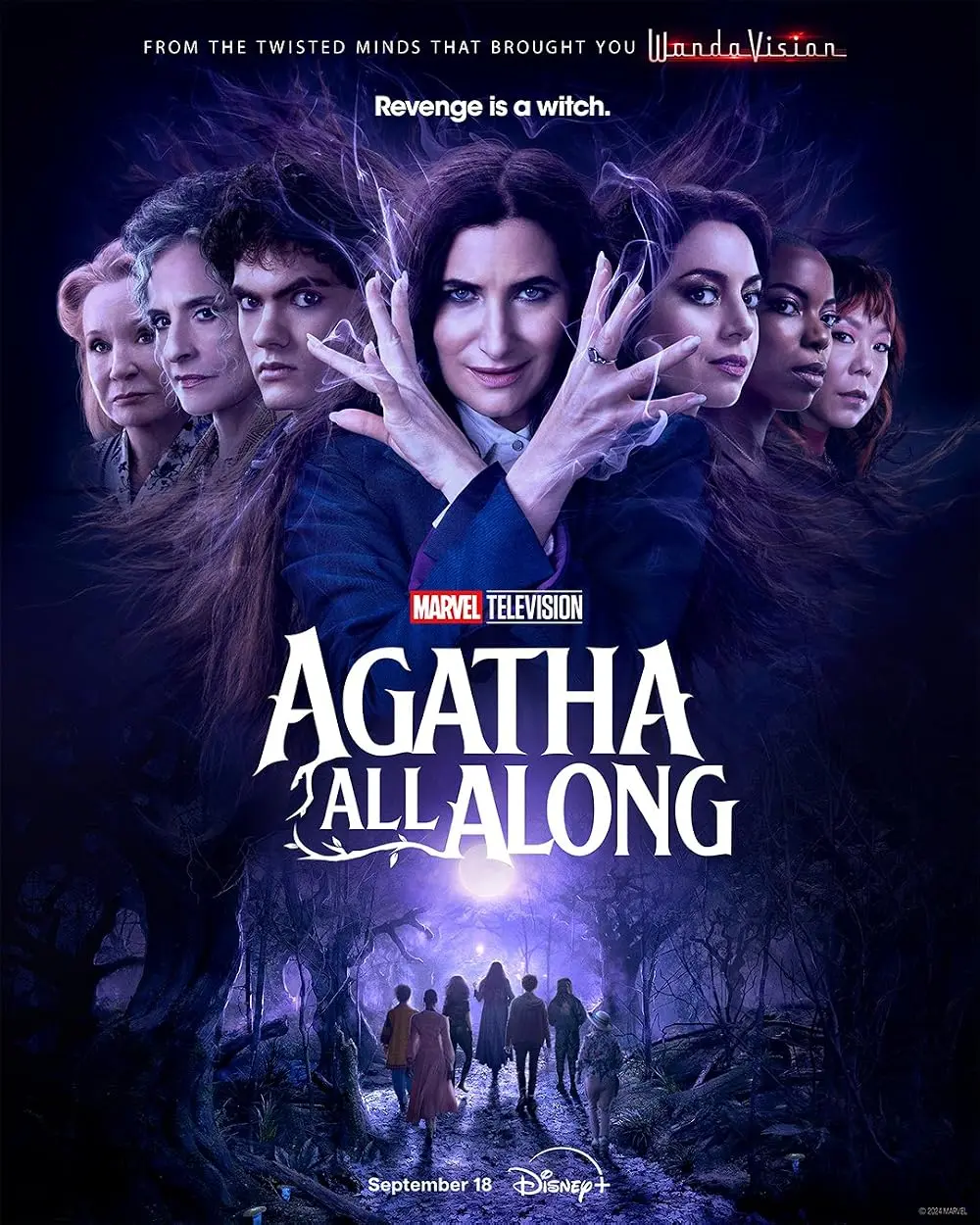
The review
The Witches' Road as dramatic structure
The season is organized around Agatha's journey along the Witches' Road, with each trial testing a different skill, wound or relationship within the coven. This gives the episodes a clear ritual pattern while allowing the story to move between mystery, fantasy adventure and flashes of horror.
The final episodes deepen the tragedy but also reveal the strain in the design. Closing Agatha's history, clarifying Billy's identity and opening doors for future Marvel stories compete for limited space. The setup for what comes next occasionally weakens the emotional completeness of the season in front of us.
Agatha: villainy with a human wound
Agatha remains selfish, manipulative and hungry for power, but the story refuses to make those qualities her entire identity. Her past with her son Nicholas gives the character grief she cannot comfortably confess, complicating every apparent attempt at redemption.
The revelation that she used even her motherhood within a cycle of luring witches and taking their power is deliberately uncomfortable. It does not absolve her; it shows how love and exploitation have occupied the same life, making her more compelling than a cleanly redeemed antihero.
Billy, Jen and the search for self
Billy's journey is built around uncertainty: power arrives before a stable understanding of who he is, and the Road forces him to confront death, family and responsibility. The image of preparing himself before entering the mortuary-like room gives his search for identity the shape of a decision rather than a simple reveal.
Jen's recovery of her power offers a parallel story of liberation. Discovering the source of the binding spell transforms freedom from a gift into an act of self-recognition. The bright, almost artificial space around that moment contrasts effectively with the darkness that has defined the Road.
Rio, death and an unfinished relationship
Rio is one of the season's most attractive ideas: death given charm, desire and menace. Her connection with Agatha should be the emotional and philosophical axis of the story, shifting between love, resentment and inevitability.
The series does not give that relationship enough room. Rio's movement between vengeance and reconciliation remains partially unexplained, while some identity and representation choices can feel stated more directly than they are organically integrated into the drama. The result is powerful chemistry without a fully developed dramatic history.
Symbols, rooms and visual rhythm
The Road works as a symbol of trial, purification and transformation, while each room reshapes that idea through a different period, color system and threat. Homes, ritual spaces and the morgue combine ordinary architecture with magical signs, making production design an active part of characterization.
The direction alternates measured close-ups in emotional confrontations with handheld instability during the trials and faster cutting in pursuit. The contrast often works, though some confrontations need greater visual acceleration, and several night scenes are so dark that carefully prepared detail is lost.
Performances and music carry the spell
Kathryn Hahn balances malice, comic control and buried vulnerability without making Agatha easier than she should be. Aubrey Plaza gives Rio a physical and vocal boldness that combines attraction with danger, while Joe Locke makes Billy's uncertainty emotionally accessible.
Strings, recurring character motifs and the songs associated with the Road give the season much of its identity. The score can create grandeur around conflict and intimacy around confession, even when the plotting itself is moving too quickly to give every revelation its full weight.
Final verdict
Final verdict
Agatha All Along is an engaging, darkly playful journey through power, grief and uncertain identity. It does not answer every question or fully earn every relationship, and its future-facing Marvel obligations sometimes interrupt the spell. Still, strong performances, imaginative rooms and a memorable musical identity make the Road worth walking.
AUDIENCE VOTE
Do you agree with the MB rating?
Choose once from this browser. You can change your answer at any time.