The review
One decision reaches four hundred years forward
The Cultural Revolution material gives the cosmic conflict a human origin. A scientific choice born from violence, disillusionment and historical trauma becomes the first movement in a catastrophe that later generations must inherit.
The promise that the enemy will arrive in four centuries is dramatically clever. The threat is too distant for ordinary fear yet immediate enough to reorganize science, politics and every idea of responsibility toward the future.
Science translated into human conflict
The screenplay alternates between academic explanation and intimate drama. Visual demonstrations, virtual environments and character debates make difficult ideas legible, while personal loyalties prevent the series from becoming a lecture.
At times the compression is visible. Concepts that deserve contemplation arrive beside urgent plot revelations, forcing the dialogue to explain and dramatize simultaneously. The clarity is admirable, but the pace can reduce intellectual wonder to information.
A countdown against certainty
The countdown seen by selected characters turns time into a private form of terror. It represents scientific knowledge collapsing under an impossible observation and transforms an abstract conspiracy into something that occupies the body and vision.
Flickering stars widen the same anxiety to the scale of the sky. Science, usually the instrument used to measure reality, becomes the battlefield on which reality itself appears to lie.
An ensemble facing the end of certainty
The scientists and international defense forces gradually learn that no individual discipline can answer the threat. The story's emphasis on collective work gives its apocalypse a practical dimension: humanity must cooperate across lifetimes, even when no living planner will see the result.
Jess Hong gives Jin Cheng intelligence and emotional vulnerability, while Zine Tseng and Rosalind Chao create a continuous, deeply human portrait of Ye Wenjie across time. Some supporting roles remain functional, but the ensemble generally keeps the scale grounded.
Making impossible ideas visible
Close-ups of eyes make the countdown physically oppressive, while broad transitions across landscapes and eras connect a past decision to a future crisis. The direction moves between intimate fear and cosmic abstraction with notable confidence.
Advanced visual effects convert theoretical structures into dramatic spaces rather than decorative demonstrations. The most effective images do not merely explain physics; they show what it feels like when the laws holding reality together can no longer be trusted.
Ambition greater than complete control
The editing usually keeps multiple timelines and storylines coherent, although a few transitions are abrupt. The score provides scale and emotional pressure without overwhelming the scientific mystery, and the production design moves convincingly between historical realism and speculative environments.
The season's greatest strength and weakness are the same: it wants to carry enormous intellectual, historical and emotional material at once. Not every character receives equal depth, yet the effort produces a scale rarely attempted in contemporary television science fiction.
Final verdict
Final verdict
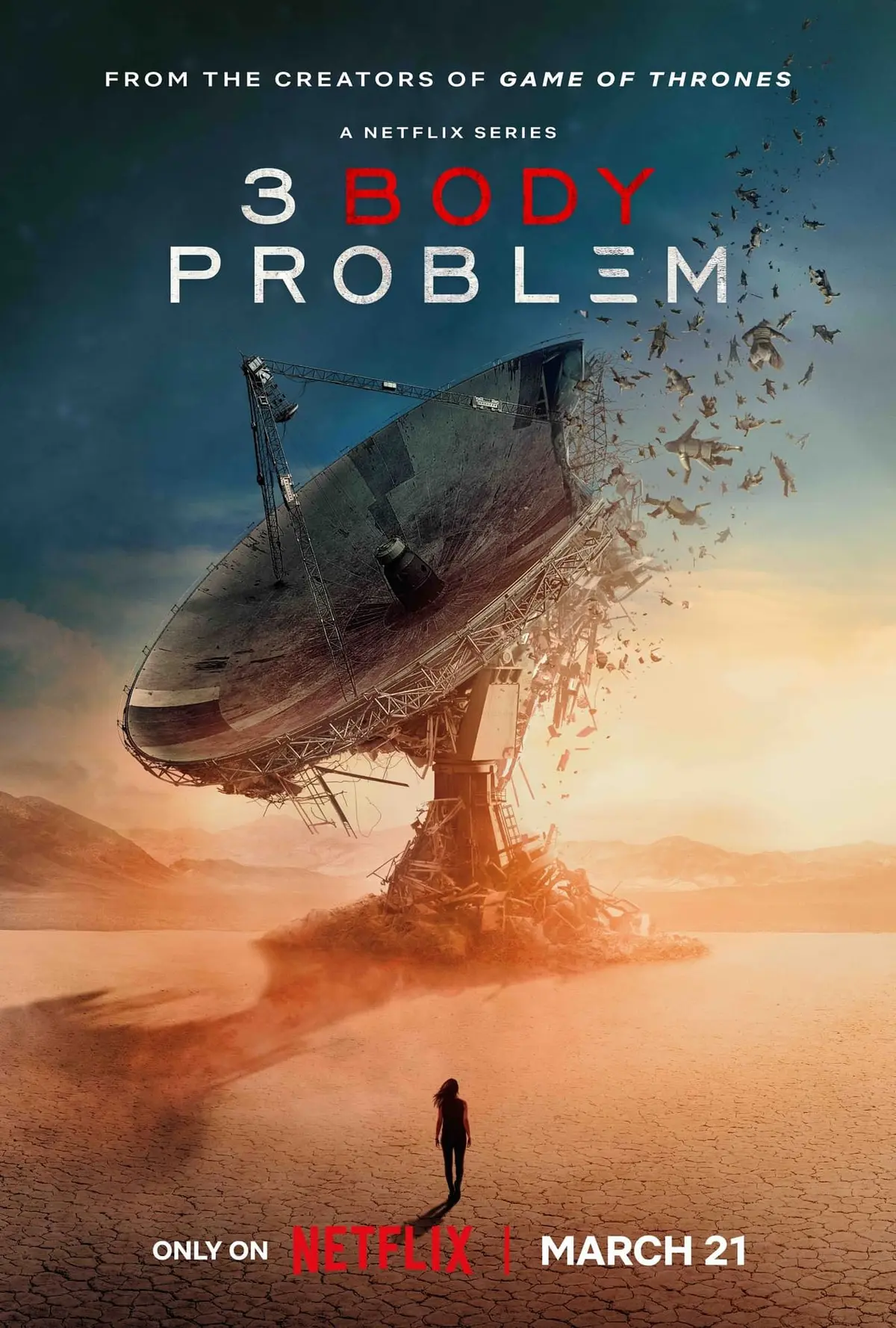
3 Body Problem is a daring attempt to turn a complex literary universe into accessible television without abandoning science, philosophy or human grief. Its machinery sometimes shows, but its central question remains powerful: what can people build today for a future they will never live to see?
AUDIENCE VOTE
Do you agree with the MB rating?
Choose once from this browser. You can change your answer at any time.