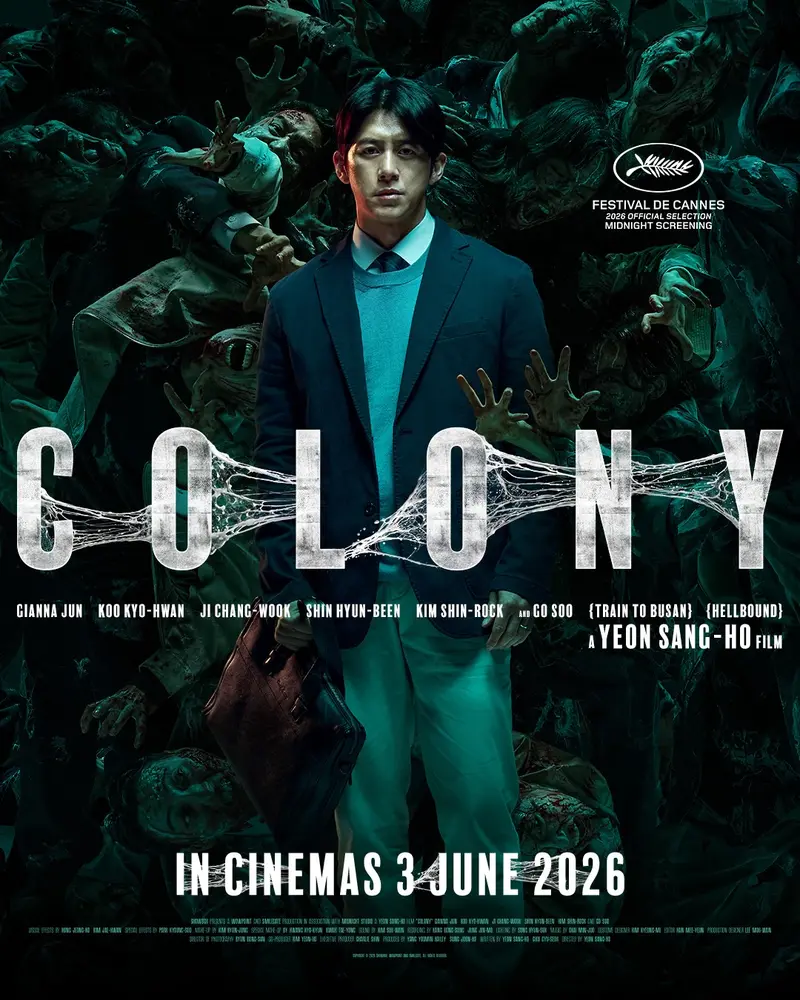
The review
An outbreak that learns
One of the film's smartest decisions is refusing to waste time before the crisis begins. The story opens at a scientific conference run by Chains Bio, then quickly seals the building after Dr. Suh Young-chul releases a biological weapon capable of linking transformed humans into one mind. From the outset, the direction is clear: this infection does not create a collection of separate beasts. It creates a single human network.
Every infected person learns, and the entire group benefits from that knowledge. This is precisely what makes the chases exciting: any mistake made by the survivors can become information delivered to every creature in the tower. The movie therefore asks more than how people can escape monsters. Its better question is what happens when the monster learns from every escape attempt.
Kwon Se-jeong thinks before she fights
Kwon Se-jeong is the central character, but she is not a conventional heroine built around physical strength and direct confrontation. Her real power is analysis. That choice fits the film because this threat requires someone willing to understand its laws instead of merely running from it. At first, Se-jeong appears emotionally detached, observing disaster through a researcher's mind rather than experiencing it as a human being.
The film gradually dismantles that image. Kyu-seong's death becomes a crucial point in her arc, forcing her to confront the fact that she is not as isolated as she pretends. One of the movie's better human ideas appears here: the person who seems least interested in others is ultimately the one who keeps trying to save them. The transformation and its emotional foundation are present, but the screenplay does not give them enough time to land with their full force.
Suh Young-chul and the contradiction of equality
Suh Young-chul is the film's most interesting character in concept because he does not regard himself as evil. He genuinely believes that humanity suffers from failed communication and that eliminating the barriers between people can create a new stage of evolution. The problem is not that this belief has no logic inside the film's world. It is the way he enforces it. He wants to eliminate human conflict by eliminating individual will.
That contradiction is his strongest feature. Suh speaks about equality and connection while preserving his position as the controller of the collective. He wants a world in which nobody stands above anybody else, then becomes the one person who directs everyone. The movie could have made him more complicated than an angry scientist convinced he owns the final answer, but even in this limited form his ideology is stronger than that of many conventional zombie villains because it is inseparable from the monsters' central mechanism.
Who is Monkey Number One?
The effort to locate the origin of the network produces the film's most compelling reveal. After learning that killing the first infected creature might affect all the others, the survivors assume Kang Woo-cheol is the starting point. Killing him changes nothing. The real answer is that Suh himself is Monkey Number One. That makes him more than a man carrying a vaccine; he is part of the system he created.
His relationship with the infected changes after he is bitten, allowing him to direct them more explicitly. This is also where the rules become shaky. The screenplay never persuasively explains the difference between Suh seeing through the infected and later commanding them. The idea is exciting, but its laws remain unclear. Ambiguity can be useful when deliberate; here, it sometimes feels more like a gap in the writing than a carefully designed mystery.
The monsters evolve while people repeat themselves
The clearest weakness is the behavior of several characters. The film wants us to believe the infected are constantly evolving, yet the humans sometimes act in ways that make the audience want to shout at the screen. They expose plans in front of the threat, make irrational decisions, repeat similar escape attempts and then seem surprised when the collective adapts.
The problem is most visible in the middle, when the rapid opening gives way to a chain of failed plans that return the characters close to their starting point. At times, the story seems to be stretching conflict to fill two hours. Hyun-seok and his sister Hyun-hee restore some human strength. Their bond is more honest than many of the film's relationships because it depends on simple behavior rather than thematic explanation: one person trying to protect another. A film about communication and humanity works best when it embodies those ideas in relationships instead of explaining them aloud.
The infected give the film its identity
The infected are what truly distinguishes Colony. Their movement is not limited to sprinting at victims. They begin with spasms and unstable animal behavior, then gradually stand and move with greater coordination as the collective mind develops. They use the information acquired by one body across the whole group, becoming something more specific and dangerous than ordinary zombies.
Practical effects and makeup make the bodies tactile and convincing rather than relying entirely on digital effects. Some of the movie's best images show the infected gathered in absolute stillness, like living statues waiting for one signal. Those tableaux translate the hive-mind idea into a physical image the audience can immediately understand.
An intelligent ending executed too conveniently
The ending tries to bring the movie's central ideas together. Se-jeong discovers that blood can make the infected perceive her as one of them, then turns their collective behavior against them through the Ant Mill principle, trapping the group in a repeated circle after it loses direction and distinction. It is a clever solution because it grows from the nature of the collective intelligence.
Its execution is more artificial. The arrival of the fire, the creatures' fixation on the image on the bus and Suh's death occur so quickly that the resolution feels less persuasive than it should. The ending is not bad, but it is too modest for the concept on which the whole film was built. A final suggestion that one infected body may have moved again feels more like a door left open than a necessary final note.
Communication or the death of individuality?
This is where Colony could have become far better. It poses a major question: if humans could share knowledge and thought directly, would that be genuine evolution, or would they lose something essential once individuality disappeared? Suh believes a collective mind can end conflict and misunderstanding, but the film does not give him enough room to confront the other half of his argument. If nobody retains an opinion or decision of their own, what value is there in ending conflict?
The idea remains in the background while the film chooses motion and excitement over deep philosophical exploration. That is not automatically a flaw, but it makes the result less affecting than its premise suggests. Colony is ultimately a survival thriller with an intelligent philosophical shadow rather than a fully developed argument about communication and personhood.
A tower transformed into a living maze
Director Yeon Sang-ho knows how to construct chaos without losing control of it. The building becomes an essential part of the experience. A sealed high-rise makes vertical movement part of the story, and every floor creates a new environment for escape and pursuit. Spacious offices and shopping areas gradually give way to narrow corridors, security rooms and industrial zones.
That visual progression serves the tension. The tower stops feeling like a backdrop and becomes a maze in which every corner may be a trap and every door may hide a group of infected people. Cold light, glass architecture and long hallways create an inhuman atmosphere. As the characters move closer to danger, the frames tighten and the feeling of suffocation intensifies.
There are moments of handheld instability, but the action remains readable in most sequences. That matters in a horror film driven by speed; physical chaos can easily become visual confusion. Colony usually keeps geography, movement and threat legible, and that clarity lets the energy of the first half land.
Final verdict
Final verdict
Colony is a distinctive horror thriller whose greatest achievement is turning collective intelligence into a physical threat and allowing the infected to learn instead of remaining a crowd that simply runs after people. Direction, cinematography, makeup and movement give the film real energy, especially in its first half. The characters, however, are less affecting than they need to be; several decisions are unconvincing, the middle loses momentum and the themes of communication and individuality remain an intelligent background rather than a complete dramatic argument. Its central problem is that it owns an idea worthy of a bolder film, perhaps even a series, but ultimately chooses to be a survival chase before becoming a philosophical work. There is still more than enough tension and invention to make the experience enjoyable, even if it does not leave the mark this concept could have left with stronger characters and deeper attention to its questions.
Your turn
Was Suh right that humanity needs a collective mind to stop destroying itself, or is the loss of individuality another kind of death?
AUDIENCE VOTE
Do you agree with the MB rating?
Choose once from this browser. You can change your answer at any time.