The review
An adaptation built as a literary mosaic
Each episode borrows the title and dramatic DNA of a famous Poe work, allowing attentive viewers to anticipate the shape of the next death without knowing exactly how Flanagan will modernize it. Familiar images (the premature burial, the body behind a wall, the black cat, the swinging blade) are reassembled inside one continuous family history.
Poe's poetic language also enters the dialogue, particularly through Roderick and the memory of his former wife Annabel Lee. The references are not merely decorative. They create the sense that the entire series is spoken in conversation with a writer whose imagination joined grief, romance, poverty and death.
A dynasty built on pain
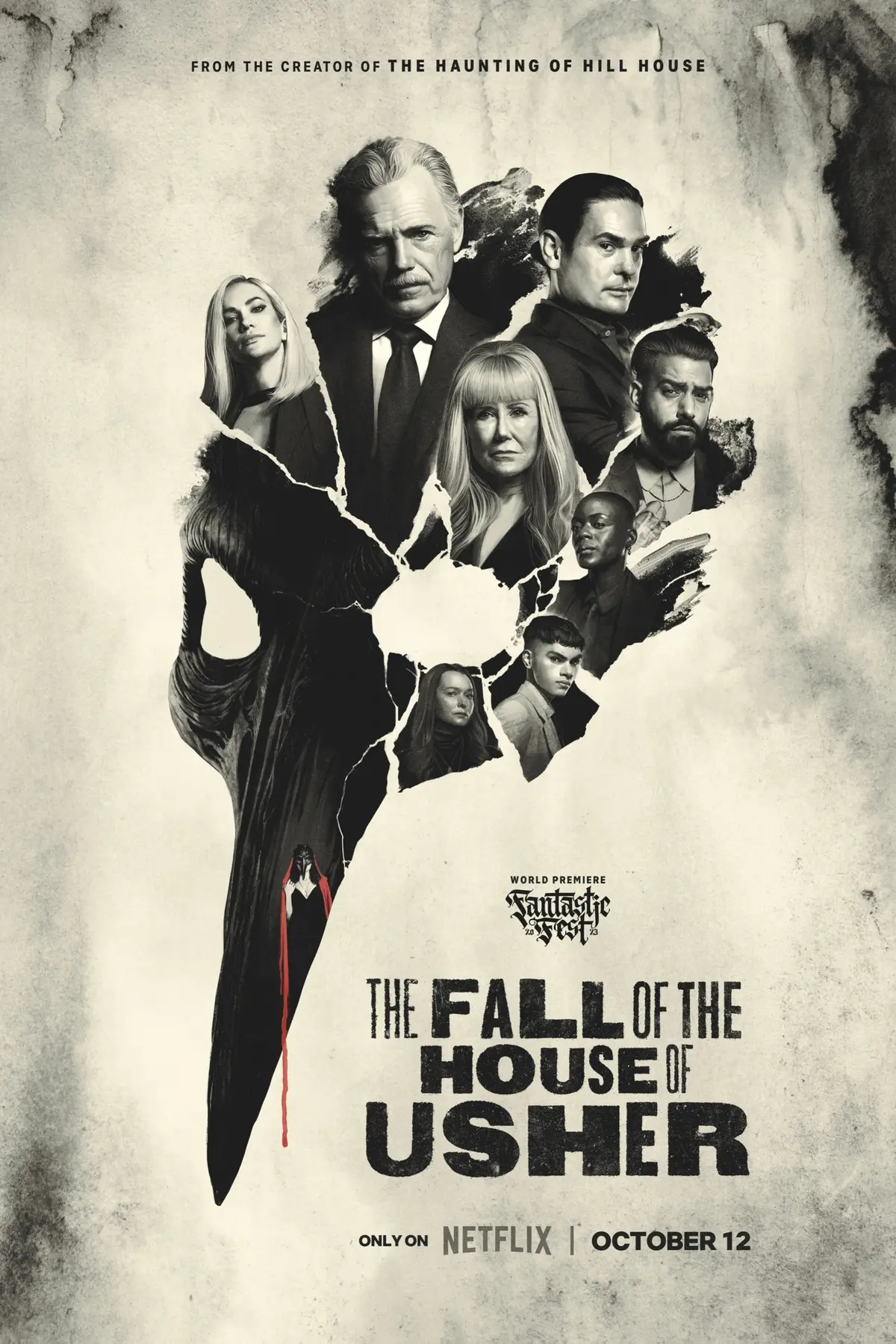
Roderick Usher and his sister Madeline stand at the head of a pharmaceutical empire accused of profiting from an addictive painkiller. Prosecutor C. Auguste Dupin has spent years trying to expose the damage, and the suggestion that an informant exists within the family turns six privileged heirs against one another.
Roderick later invites Dupin to the decaying family home and confesses how the deaths connect to a choice made decades earlier. The frame gives the horror the rhythm of testimony: a dying patriarch tries to order his crimes into a story, only to discover that storytelling cannot silence conscience or cancel consequence.
Poetic justice written on the body
The heirs' deaths are designed as moral consequences rather than random shocks. A daughter who treats vulnerable patients as material for an untested procedure dies through the heart; another, consumed by status and narcissism, is destroyed through mirrors; a son whose suspicion becomes physical abuse meets a blade with equally merciless force.
Flanagan does not ask us to mourn these people as innocent victims. Their punishments are spectacular, but each is rooted in the harm they inflict while family attorney Arthur Pym protects the machine around them. Horror becomes an exaggerated form of accountability in a world where money has blocked ordinary justice.
Four timelines, one collapsing house
The visual language separates childhood in the 1950s, ambition and crime in the 1980s, the recent week of the children's deaths, and the present confession. Lighting, color and production design guide these transitions so smoothly that a structurally complex narrative remains easy to follow.
The ruined house is more than a nostalgic gothic location. It is the physical end point of a family that constructed modern luxury over an unburied crime. Contemporary offices, laboratories and parties may look polished, but the old house waits underneath them as the architecture of truth.
An ensemble that understands the game
Flanagan surrounds the Ushers with performers who understand the mixture of melodrama, grief and macabre humor. Carla Gugino gives the mysterious Verna elegance, menace and emotional ambiguity, while Mark Hamill turns Arthur Pym into a controlled, intimidating presence whose restraint is more dangerous than shouting.
Roderick and Madeline are played by three sets of actors across different ages. The casting depends not only on visual resemblance but on behavioral continuity: ambition, defensiveness and hunger remain recognizable even as experience changes how the siblings carry them.
A production firing on every level
The direction balances slow dread with direct shocks and refuses to let the literary structure become visually static. Costume, makeup, practical effects and large-scale visual effects collaborate to give every heir a distinct world before that world turns against them.
The series is consistently confident in tone. It can move from corporate satire to family tragedy and then into graphic horror without losing its central idea: an empire built by converting other people's pain into wealth will eventually be forced to feel the full weight of that pain.
Final verdict
Final verdict
The Fall of the House of Usher is a forceful modern reconstruction of Poe rather than a straightforward adaptation. Its literary architecture, moral clarity, nightmare imagery and committed ensemble turn eight episodes into one sustained story of guilt, privilege and payment. From production design to performance, the series rarely stops operating at full strength.
AUDIENCE VOTE
Do you agree with the MB rating?
Choose once from this browser. You can change your answer at any time.