The review
Organized chaos across three movements
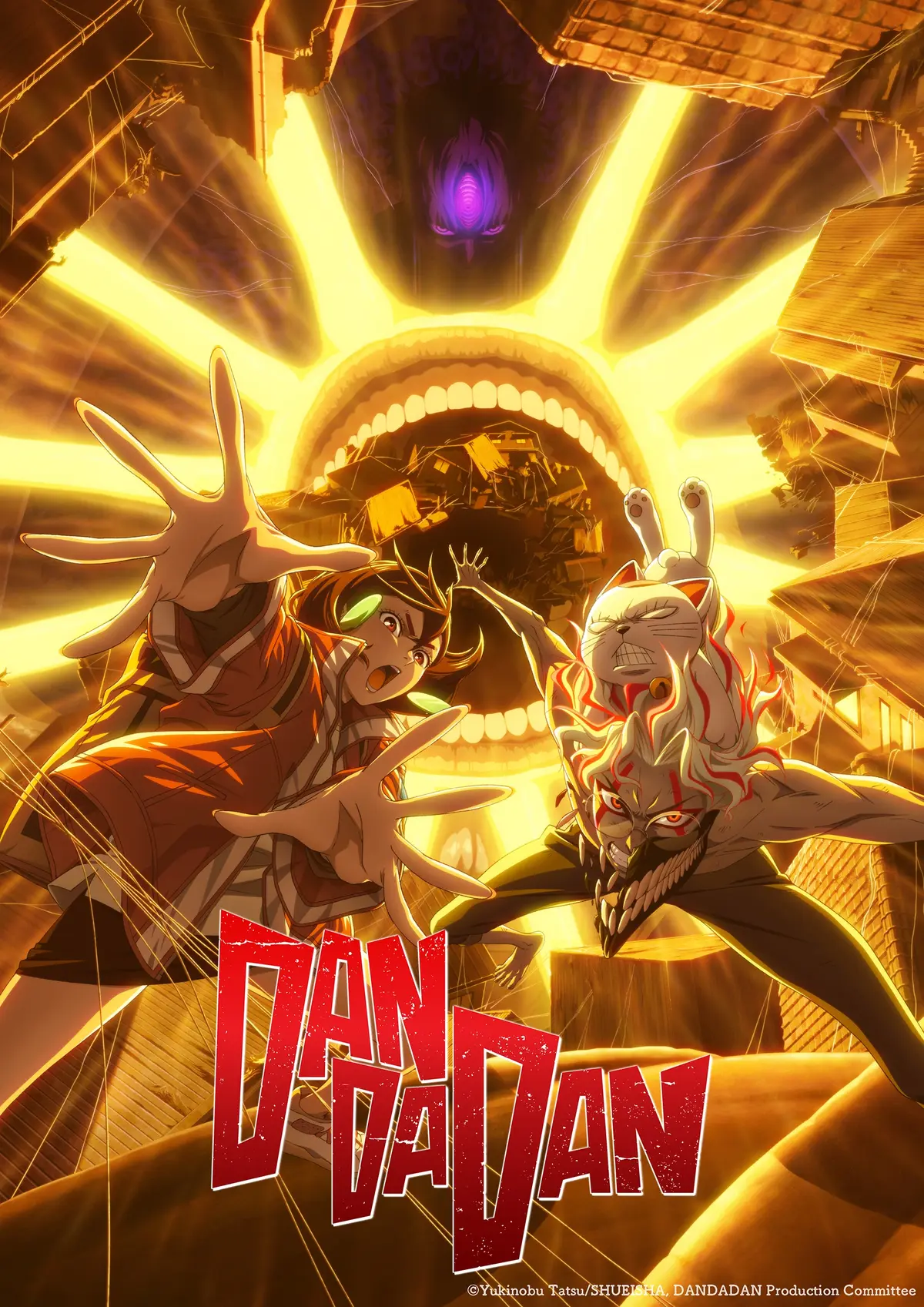
The haunted-house material and the Evil Eye arc form the season's dramatic body before the last third suddenly erupts into a space-kaiju spectacle. That shift can feel abrupt, but it follows Dandadan's internal law: the story values emotional continuity more than generic consistency, allowing tragedy, musical exorcism and giant-robot absurdity to exist in the same breath.
Evil Eye: a monster that must be understood
The season's strongest writing belongs to the imprisoned child who watched life from a tiny window, was sacrificed and returned as an avenging presence. Evil is treated not as an abstract force but as the consequence of human cruelty. The solution is equally unusual: Evil Eye is contained and negotiated with, not erased, making coexistence itself the moral victory.
Some middle episodes extend this arc beyond its ideal length, and the restoration of Okarun's lost ‘golden balls’ recedes into the background. Still, the slower rhythm gives Jiji and the entity sharing his body a daily tension that turns the absurd hot-water/cold-water rule into a surprisingly useful dramatic mechanism.
Momo and Okarun keep the world human
Their relationship advances through looks, hesitations, held hands and fear rather than declarations. The embrace after battle is one of the season's most honest peaks because it allows vulnerability to interrupt spectacle. The final alien kiss smartly mirrors an earlier image with a new emotional wound, sending Momo and the audience into the next season unsettled.
Jiji's charisma works beautifully against the hostility of Evil Eye, while Seiko, Taro and the wider supernatural ensemble serve comedy without stealing the center. Aira is the clear exception: her reactions repeat more than they evolve.
Animation and sound that change genre on command
Season two improves on the first not only in fights but in tiny bodily reactions: a shoulder turning away, a hand stopping short, a face trying to hide fear. Psychic confrontations use violent color shifts and distorted frames to show emotion rather than merely power, while the animation's deliberate roughness gives impact to Okarun's clashes with Evil Eye.
The voice cast separates embarrassment, rage and tenderness with precision, especially in Jiji's dual performance. Music moves between horror, comedy and romance without breaking the whole, and the musical-exorcism episode is a remarkable act of adaptation. Only the densest climaxes occasionally bury dialogue beneath effects.
Final verdict
Final verdict
Dandadan's second season sometimes slows too much and jumps too abruptly, yet it compensates with emotional depth, fearless direction and animation alive even in ordinary conversation. Its madness works because the people inside it remain recognizable. The shocking ending promises a third season that may be wilder still.
AUDIENCE VOTE
Do you agree with the MB rating?
Choose once from this browser. You can change your answer at any time.