The review
Power and the price it demands
The screenplay begins from a complicated position. Rowan returns after Lasher's birth not only as a mother, but as the bearer of a new force that resembles both a curse and an intoxicant. The season repeatedly frames power as a gift whose price is hidden inside the person receiving it.
The story advances along two parallel paths. The internal path follows Rowan's power, her confused morality and the inherited guilt of Mayfair blood. The external path expands the Talamasca, introduces Moira, restores Julien and enlarges the threat of the Scottish family. The two lines create scale, but do not always move with the same dramatic force.
Rowan and Lasher: horror mistaken for romance
Their relationship should be toxic, mutually manipulative and built on fear, appetite and the temptation of authority. At its strongest, it becomes the season's central moral horror: Rowan cannot fully separate maternal instinct, supernatural attraction and her hunger for control.
The problem is that the writing sometimes frames the bond as a tragic love story. That choice softens the ethical horror and makes Rowan's shifting behavior feel inconsistent rather than disturbingly complicated. A more controlled tone could have turned the relationship into the show's most unsettling weapon.
Julien arrives with blood and history
Julien is more than a conventional villain. He resembles an ancient priest of power who knows that blood is both a path and a currency. His presence turns the family's past into a living curse and gives the mythology a colder, more purposeful antagonist.
He arrives too late to receive the space his history deserves. The season gains energy whenever he appears, but often uses him to accelerate the plot instead of allowing his influence to reshape it gradually.
The Talamasca promises a larger universe
The Talamasca plot should provide a force capable of balancing the Mayfair family. Instead, it often sits like a thin outer layer over the central conflict. Its institutional mystery is intriguing, yet the season rarely grants it enough authority to alter events decisively.
Sip nevertheless becomes an effective bridge toward Anne Rice's wider universe. The connection expands what the series may become, even if this season treats that potential more as preparation than as a fully integrated dramatic line.
Rowan grows while the supporting cast recedes
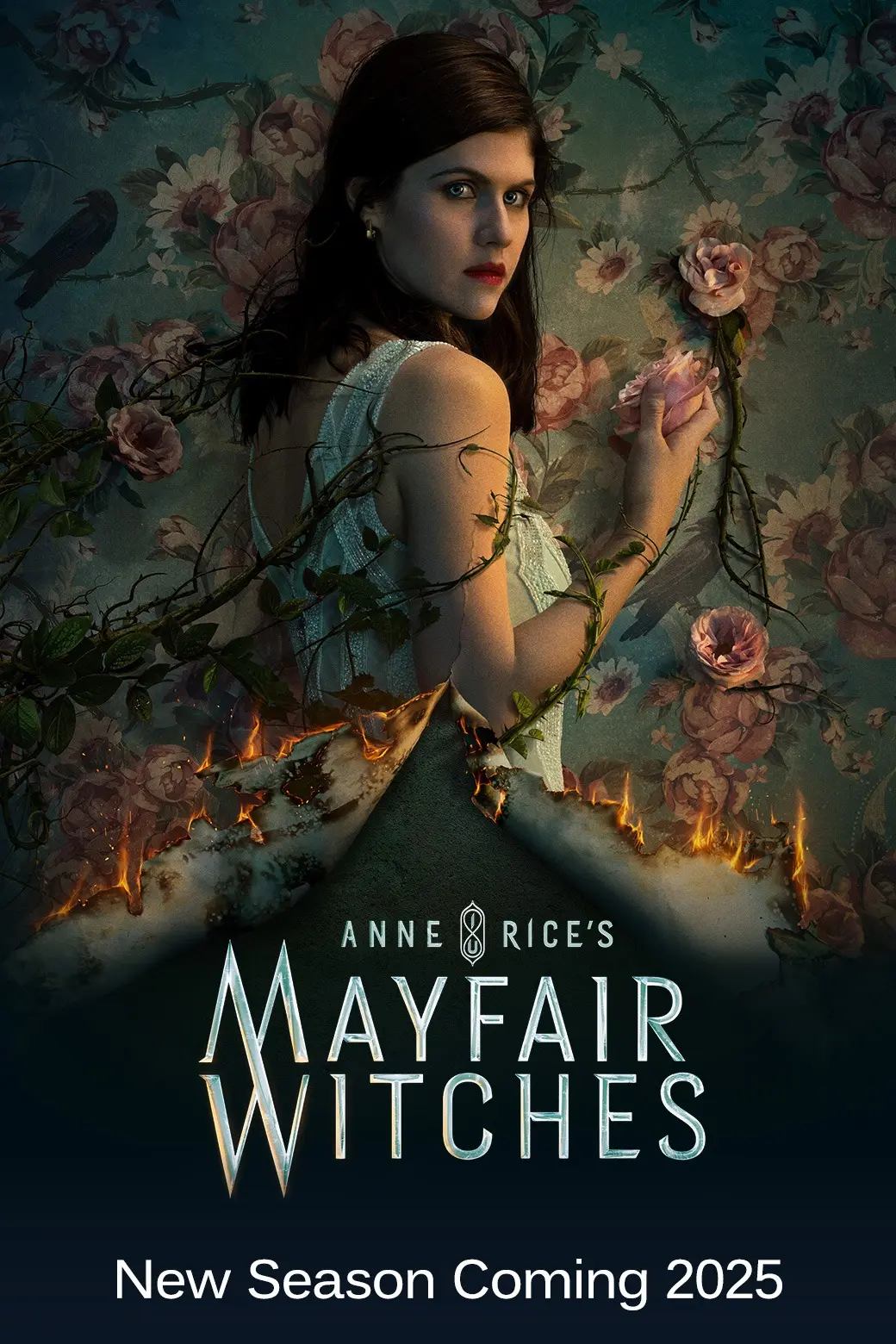
Rowan is the season's most developed figure. She stands between the desire to control power and the fear that power is already controlling her, between distorted motherhood and an attraction that becomes obsession. Her ambiguity gives Alexandra Daddario more complicated material than the first season offered.
Other characters pay the price. Jojo needs a deeper line before being marginalized, Gifford receives too little time, Dolly Jean appears as wisdom on demand and Sam remains functional rather than dramatic. Moira and Julien stand out because one brings the violence of reading minds and the other brings the cold weight of bloody history.
Is power a gift or an infection?
This is the question at the heart of the season. Mayfair blood carries power through generations, but also repeats desire, sacrifice and inherited violence. Magic is less a collection of abilities than a disease of lineage.
No one escapes that inheritance, including Rowan, Lasher, Julien or the children raised as future sacrifices. The idea gives the season genuine thematic unity even when individual plotlines lose focus.
Visual ambition exceeds dramatic control
Rapid aging, ritual sacrifice, hallucinations and the twisted brutality of the Mayfair house give the season stronger horror imagery and more confident lighting. The technical improvement is visible, and several images possess the feverish gothic quality the material needs.
The momentum repeatedly fades between those images. Conflicts are recycled, mythological ideas are flattened before they can mature and several decisions feel designed to keep the story circling. The season looks more complete than it is written.
Strengths and weaknesses
Stronger visual horror, a formidable Julien, meaningful development for Rowan, improved craft and a clearer connection to the Immortal Universe show what the series can become when its mythology and character work move together.
Marginalized characters, an inconsistent Rowan–Lasher bond, forced decisions, uneven pacing and underused mythology keep that promise from becoming a fully coherent season. The ingredients are present; the spell remains unstable.
Final verdict
Final verdict
Season two ends with the sense that the story is finally approaching its true power, even after structural stumbles and weakened subplots. As the threats grow and the door opens toward the Talamasca and a larger universe, the main conflict feels as though it has only just begun. Mayfair Witches still has the necessary potential; it simply has not mastered its spell.
AUDIENCE VOTE
Do you agree with the MB rating?
Choose once from this browser. You can change your answer at any time.