The review
The ambition to understand a monster
The screenplay begins with Gein as a broken son trapped between a dominating mother, isolation and severe mental illness. It follows a familiar movement from wounded childhood through psychological collapse toward violence, hoping to reveal how the human being disappeared inside the legend.
That structure offers a valuable opportunity for tragedy, but the writing frequently chooses graphic display over analysis. Rather than living patiently inside his fractured perception, it turns pathology into spectacle and the character into a symbol of depravity more often than a credible human study.
Psychology reduced to a horror template
The series invokes schizophrenia, dissociation and sexual identity, but rarely handles them with sustained precision. The balance between victim and perpetrator collapses whenever extended images of bodily obsession take over, replacing psychological complexity with a caricature of madness.
The familiar ingredients (a religiously extreme mother, an isolated child and a gradual descent) echo earlier horror narratives without always finding a new dramatic language. The show wants the pattern to explain Gein, but repetition can feel like predetermined diagnosis rather than discovery.
Symbols drowned by explicit imagery
The mother functions as an original source of guilt, the female body as an image of lost identity, and the grave as both enclosure and a grotesque rebirth. These symbols could sustain a disturbing interior portrait.
Instead, direct and repetitive shock often exhausts their meaning. One of the rare exceptions is Gein's confrontation with the camera, which redirects judgment toward the spectator and asks whether consuming horror can itself become a form of complicity.
History reshaped for sensation
The series invents or heavily fictionalizes crimes, relationships and encounters, including sensational material involving hunters, romanticized victims and Ilse Koch. Such choices intensify the horror but move the work away from dramatized history toward speculative exploitation.
Fiction is not inherently a failure in a historical drama, but the ethical line becomes fragile when real victims and perpetrators are reorganized primarily to deliver shock. The series rarely signals clearly where documentation ends and invention begins.
A fractured timeline inside a fractured mind
Flashbacks initially connect childhood wounds with adult behavior, giving the story a psychological rhythm. As hallucination, memory and reality increasingly overlap without reliable markers, however, fragmentation becomes decorative rather than illuminating.
The intent is understandable: the audience should experience uncertainty from inside Gein's perception. Excess turns the technique against itself, making it harder to distinguish meaningful subjectivity from narrative confusion.
The true-crime audience in the mirror
The strongest idea is a critique of the culture that turns killers into entertainment brands. By making Gein aware of the gaze upon him, the series asks whether the monster is the criminal, the art that makes him iconic, or the audience unable to look away.
The contradiction is that the show condemns exploitation while practicing it. Its moral self-awareness appears in flashes, but the images surrounding those moments remain deeply invested in the same appetite they criticize.
Performances carrying uneven writing
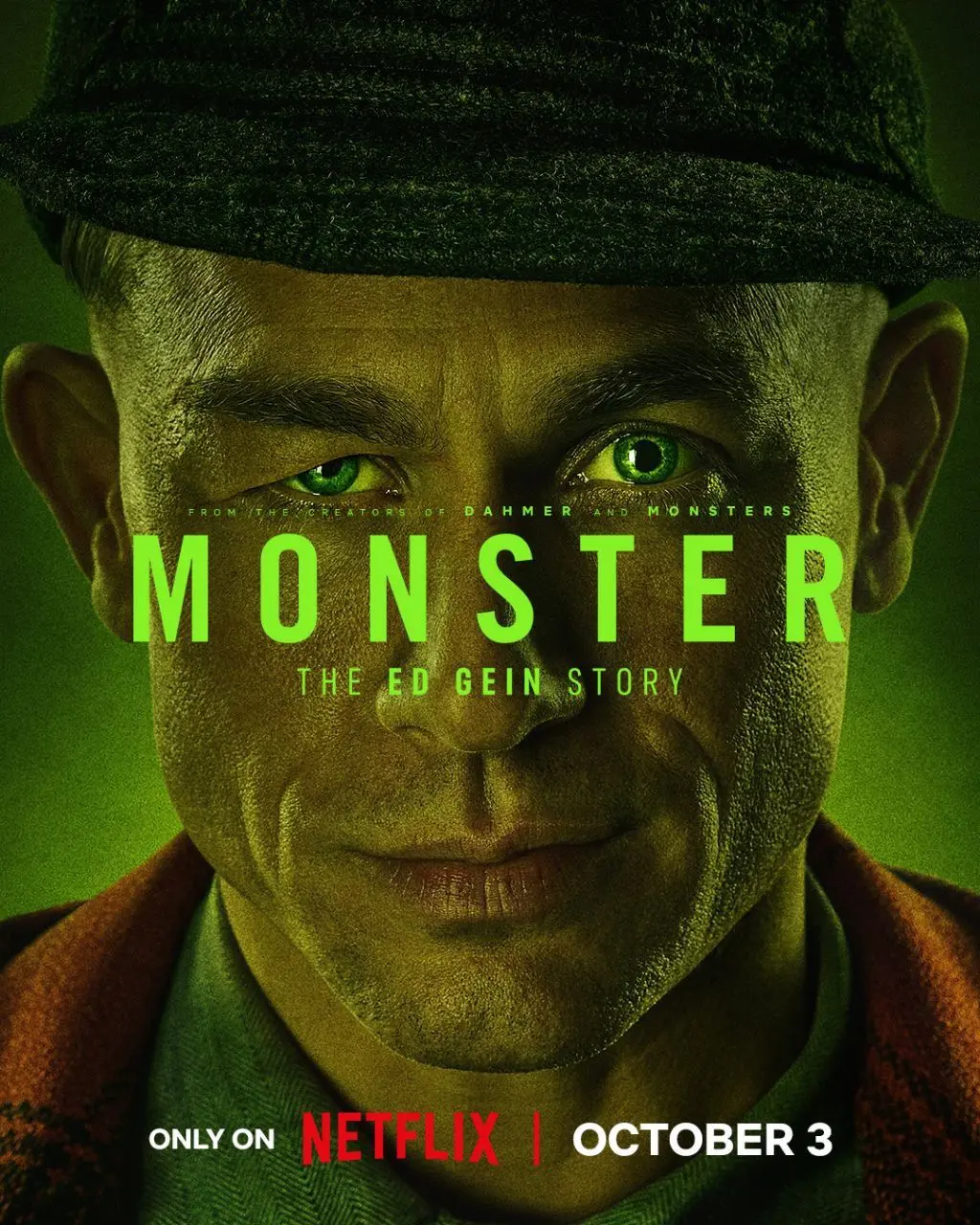
Charlie Hunnam gives Gein substantial physical and internal tension, suggesting conflict even when the script flattens him. Laurie Metcalf's mother is an imposing presence, although she is written more as a permanent shadow of religious cruelty than as a fully developed tragic person.
Several secondary figures exist mainly to accelerate violence or carry symbolism. Dialogue grows increasingly direct in the final third, explaining ideas about monstrosity that would have been stronger if left inside performance and image.
A daring work with an ethical fracture
The taboo subject, Hunnam's committed performance, occasional symbolic precision and critique of media fascination give the season undeniable dramatic energy. It takes risks that invite argument rather than passive consumption.
Graphic exploitation, historical distortion, unstable tone, heavy dialogue and a chaotic chronology keep it from becoming the psychological study it promises. Its deepest weakness is moral duplication: it feeds on the violence it asks the audience to question.
Final verdict
Final verdict
Monster: The Ed Gein Story walks a narrow line between art and exploitation. It wants to understand a ruined human being, but often ends by displaying the monster more forcefully than examining him. Disturbing, repellent and undeniably provocative, it may be viewed as shameless exploitation or as a warped mirror of true-crime culture, and that unresolved contradiction is both its identity and its failure.
AUDIENCE VOTE
Do you agree with the MB rating?
Choose once from this browser. You can change your answer at any time.