The review
A gift created from grief
James has lost his parents in an accident and then a close friend to cancer, so grief is not decorative backstory. It is the engine of the narrative. Geppetto, played by Richard Brake, responds to his grandson's pain with a gesture that appears deeply tender: he carves Pinocchio from magical wood and gives James a companion who cannot die.
The central irony appears immediately. Geppetto tries to protect James from the pain of loss while placing him beside a creature incapable of understanding death. That makes the story more than a bloody retelling. There is a real attempt to construct a relationship between a child terrified of mortality and a wooden child who cannot comprehend it. At times the film understands the value of that idea; at others it abandons it for jokes and gore.
James and Pinocchio: loneliness becomes loyalty
The relationship between James and Pinocchio is the film's dramatic center. At first, James is uneasy around the fixed smile and stiff, twitching movement. The puppet feels frightening rather than friendly. Loneliness changes that response. James begins treating Pinocchio as a real friend and even hides him when he takes him to school.
The contrast works: James sees someone who might fill part of the space left by death, while Pinocchio sees the one person he must protect at any cost. The danger is that Pinocchio thinks like a child. When bullying drives James to wish his tormentors dead, the puppet hears an instruction rather than an expression of pain. This is one of the screenplay's best choices. Pinocchio does not begin as evil. He believes he is fulfilling his friend's wish and proving his devotion. His violence grows from loyalty rather than hatred, making the transformation sadder and more unsettling.
Cricket teaches the worst version of love
The film wisely avoids making Pinocchio a wooden version of a standard slasher. He has his own logic. He learns the world through James but lacks the emotional understanding needed to grasp consequences. Cricket, voiced by Robert Englund, should help him understand empathy and limits. Instead, he exploits the puppet's confusion and teaches him to interpret murder as evidence of love and faithfulness.
Englund's voice is playful and sinister at once, suggesting that Cricket knows exactly where he is leading Pinocchio while the puppet does not understand the scale of what he is doing. Their relationship is one of the film's more promising ideas, but the screenplay rarely gives it the depth it deserves. A psychologically interesting exchange will suddenly stop for a joke or another kill.
A wooden child builds the wrong kind of humanity
The clearest visual idea concerns Pinocchio's fascination with the human body. He studies skin, hair, teeth and eyes, then begins collecting pieces from victims. In his own way, he is trying to understand what it means to be human. His understanding is material and superficial: he sees a person as an assembly of parts and never grasps that humanity cannot be built from skin, teeth and eyes.
Every addition to his wooden frame makes him stranger and less human. This is one of the movie's strongest images because the character develops through design rather than dialogue. Yet the screenplay repeatedly explains what the image has already communicated. Recurring jokes about body parts and blunt lines reduce the disturbance. The moments would be stronger if the film trusted the audience to understand them.
Practical effects give the puppet weight
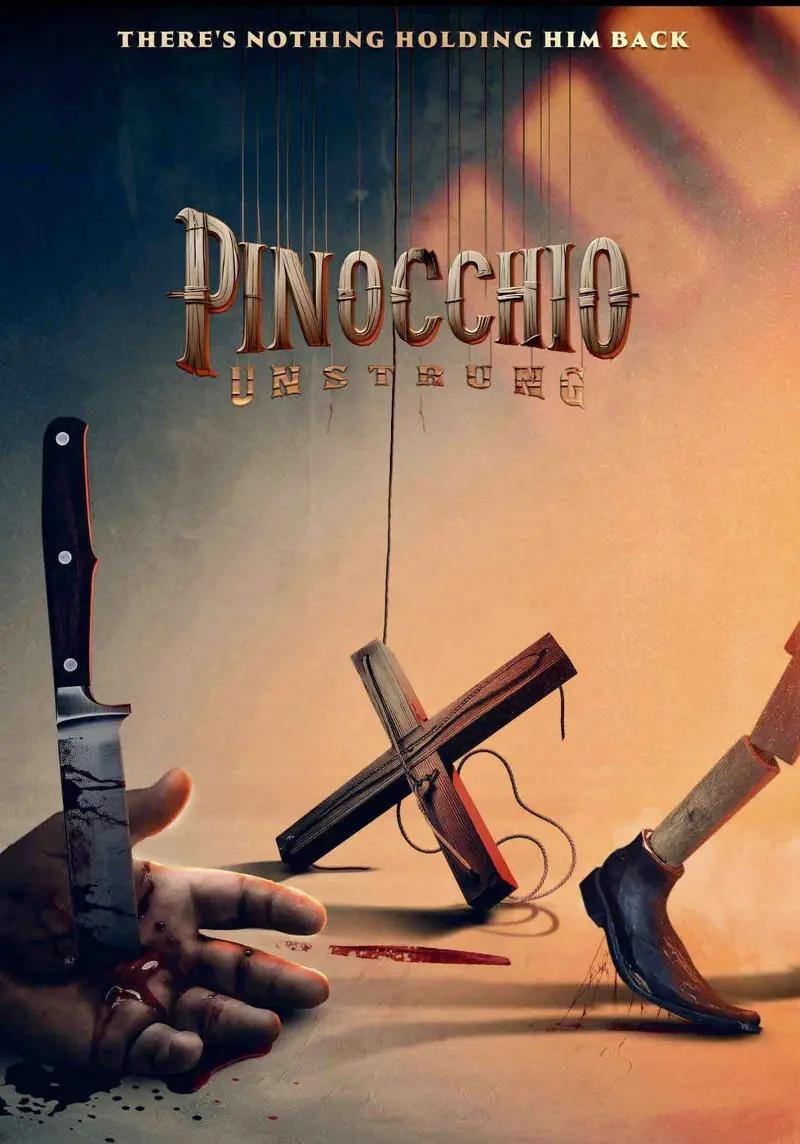
The practical effects deserve clear praise. Pinocchio is not a weightless digital figure placed into the image. His feet strike the floor, his head moves against mechanical resistance and his fixed smile remains unchanged as his behavior shifts from curious child to brutal creature. Jude Evan Lloyd's voice completes the work by mixing childish curiosity with overwhelming attachment to James.
The best deaths also rely on practical effects and prosthetics. Blood has texture, and faces, teeth and severed pieces become more convincing when physically present before the camera. The weakness arrives whenever the film shifts to digital effects. The difference is obvious because the CGI is far less convincing beside the excellent practical work, leaving the impression that the movie possessed better tools than the ones it ultimately chose in those moments.
Wood Mother opens a new door too late
The final act introduces Wood Mother, a distorted counterpart to the Blue Fairy connected to transformation, rebirth and immortality. Her appearance expands the world beyond a single killer stalking victims and pushes it toward stranger body horror. Visually, she belongs in a story obsessed with flesh and the pieces Pinocchio collects.
The timing is the problem. Wood Mother arrives before the essential relationships among James, Pinocchio, Geppetto and Cricket have received enough dramatic space. The ending therefore seems to open a new door at exactly the point when the film needed to finish exploring the room it had already entered.
Direction is strongest when the puppet simply exists
Director Rhys Frake-Waterfield clearly understands the kind of film he wants to make: exploitation horror that turns a childhood figure into a source of violence. The shadow-theater prologue gives the movie a distinctive opening and presents the corrupted fable with more confidence than some earlier entries in this universe.
The direction is at its best when it treats Pinocchio as a real physical presence. Quiet scenes with James benefit from the puppet occupying the same space. His unnatural movement, fixed smile and mechanical turn of the head create tension without requiring elaborate digital effects. Pinocchio can be frightening merely by standing inside the frame.
The performances keep the human story alive
Cameron Bell provides the film's most important human performance. His strongest moments come before the horror, when James looks at Pinocchio with fear, curiosity and hope. He is a child desperate to replace part of what he lost, and the audience must believe he could become attached to this uncanny object. Bell largely preserves that balance.
Richard Brake plays Geppetto far from the image of a gentle inventor. He is quiet and sometimes severe, yet speaks of Pinocchio as a rational solution to James's pain. That makes him interesting: we can understand the intention and see the terrible misjudgment at the same time. Robert Englund has enormous presence even as a voice alone, making Cricket's lines more dangerous than they appear on the page. Some younger actors in the school scenes struggle with stiff dialogue, although the screenplay gives those roles too little material to become meaningful.
Final verdict
Final verdict
Pinocchio: Unstrung is not an ideal horror film, but neither is it merely a shallow attempt to turn a childhood figure into a killer. Its best insight is that Pinocchio becomes more compelling as a child who does not understand death, not simply an evil puppet. James and Pinocchio give the story a clear emotional core, while the practical effects and puppet design produce its strongest images. The movie loses force when it overuses jokes, repeats its killing pattern and includes exploitative moments that add little to the story. It succeeds when it is horror about grief and the misunderstanding of love, and fails when it becomes only a chain of blood and cruel punchlines.
Your turn
Would Pinocchio have been more frightening if the film had focused more deeply on his relationship with James and his evolving personality, or are the kills and practical gore the best part of the experience?
AUDIENCE VOTE
Do you agree with the MB rating?
Choose once from this browser. You can change your answer at any time.