The review
A beginning that refuses to wait
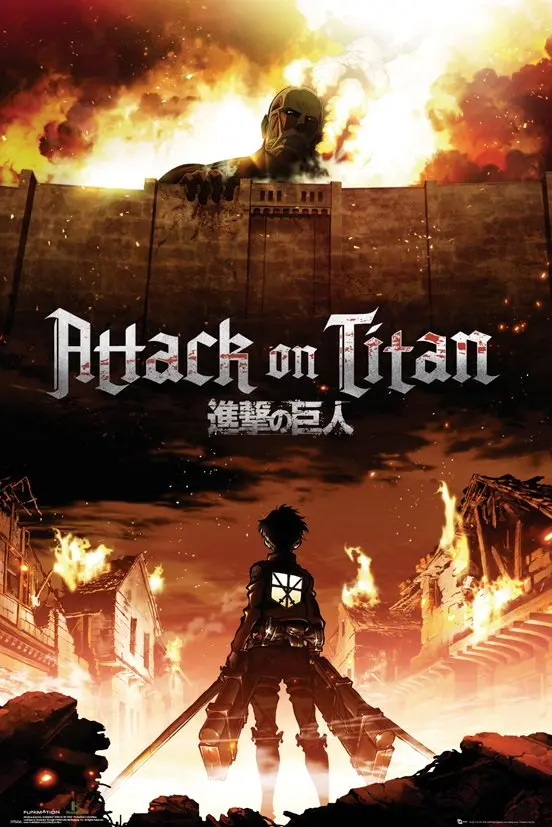
The first episode does not spend hours explaining the walls before threatening them. The Colossal Titan appears, safety collapses and Eren's life is reorganized by loss. World-building arrives through consequence, making curiosity and fear advance together.
This urgency continues across the series without turning into empty commercial shock. Major revelations alter the meaning of earlier scenes, allowing the story to grow from survival horror into a study of nations, memory and inherited violence.
Freedom becomes the central battlefield
At first, freedom means reaching the world beyond the walls. Later it becomes political independence, historical truth, personal agency and finally the terrifying question of whether one person's liberation can require another people's destruction.
The philosophy is powerful because it emerges from choices rather than lectures. Dreams of the sea, military orders, betrayals and mass violence all carry different definitions of freedom, none of which remains morally simple.
A world with rules and real consequences
Titan abilities, military technology, geography and political systems are revealed gradually, but the narrative does not casually violate them to rescue a favorite character. This consistency turns danger into something the viewer can measure and trust.
No rank guarantees survival. Deaths arrive quickly and permanently, yet the strongest losses are not numbers; they change command, morale and the emotional direction of those who remain.
An enormous cast with unforgettable identities
Armin's intelligence and dream of seeing the ocean make imagination a strategic force. Mikasa combines extraordinary combat skill with a painful loyalty to Eren, while Levi hides grief and exhaustion beneath discipline and precision.
Erwin is one of the medium's great commanders because his inspiring language never removes the cruelty of the decisions he makes. Even Hannes, first seen as a drinking guard, receives a brief arc that transforms him into a figure of courage, debt and tragedy.
Eren: protagonist, weapon and warning
Eren's construction is the series' most radical achievement. His rage begins as an understandable response to horror, then passes through revelation, power and isolation until the desire for freedom threatens to become an absolute justification for destruction.
Agreement with his choices is not required for interest in him. The writing makes his transformation legible without making it comfortable, turning the central hero into the most severe test of the ideas that first defined him.
Dialogue that thinks under pressure
Conversations carry strategy, fear and philosophy at the same time. Military plans are explained with clarity, but the greatest dialogue often occurs inside the characters, where courage, despair, hatred and love argue before a body moves.
Speeches such as Erwin's work because the series has already shown the cost of the words. Inspiration is never abstract; it asks frightened people to walk directly toward death.
Music and motion at legendary scale
The score knows how to produce urgency, grief and military grandeur without becoming interchangeable background. Themes arrive at precise moments and turn battles into emotional events whose sound remains recognizable outside the series.
The vertical maneuvering equipment lets animation behave like a three-dimensional camera flying through a dangerous city. Character faces communicate terror and decision with equal care, while Titan designs remain uncanny because they combine human features with scale, emptiness and impossible smiles.
A modern anime landmark
Production changes across the years alter texture, but the scale of the visual ambition remains remarkable. Weapons, uniforms, cities and bodies are designed as parts of one coherent military and historical world.
Its influence comes from more than spectacle. Attack on Titan proved that a mass-audience anime could sustain long-term mystery, political transformation and moral discomfort while still delivering some of the medium's most exhilarating action.
Final verdict
Final verdict
Attack on Titan is one of anime's greatest complete experiences: thrilling, brutal, philosophically ambitious and emotionally unforgiving. It begins with humanity hiding from monsters and ends by asking whether the monsters were ever outside the walls. For its writing, characters, music and animation, it remains essential viewing.
AUDIENCE VOTE
Do you agree with the MB rating?
Choose once from this browser. You can change your answer at any time.