The review
Three battles form the dramatic architecture
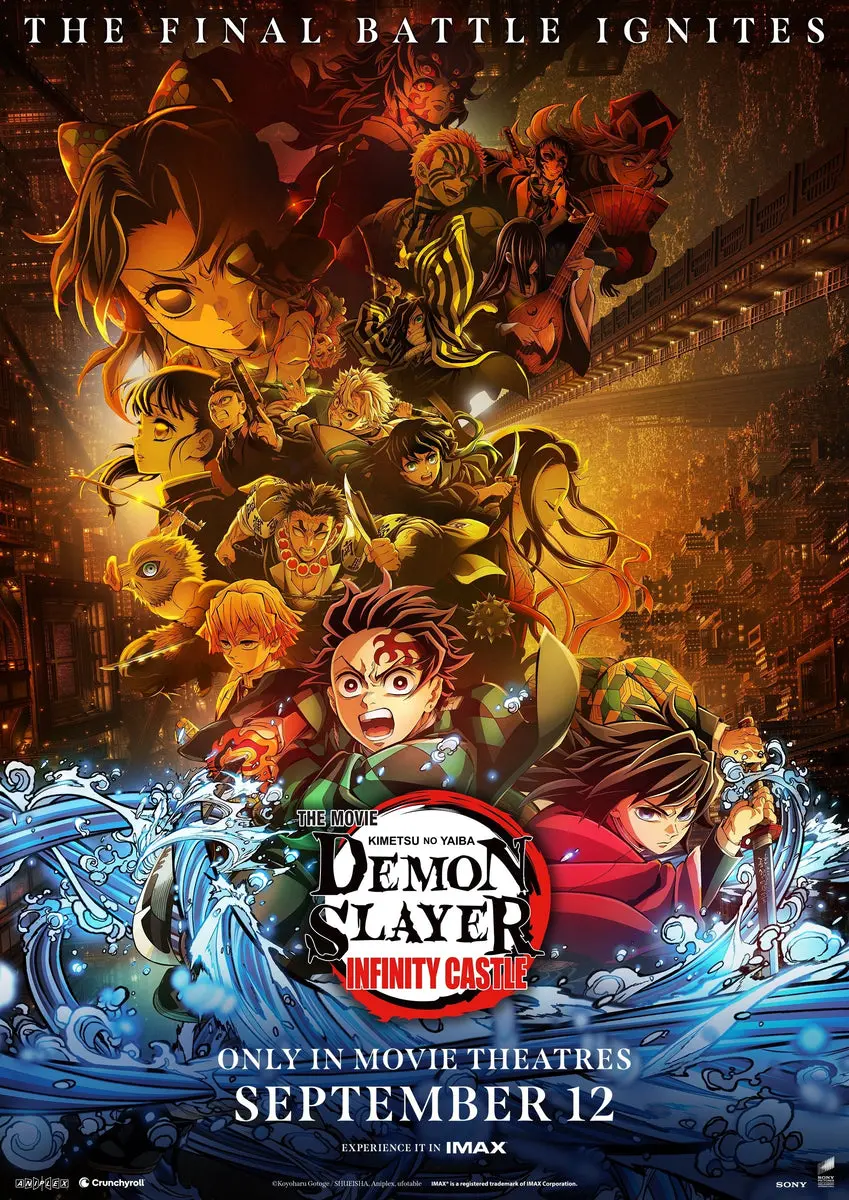
The screenplay centers on Shinobu versus Doma, Zenitsu versus Kaigaku and Tanjiro with Giyu against Akaza. Each duel has a distinct emotional grammar: personal revenge, betrayed brotherhood and the recovery of a demon's human past. The design is loyal to the manga and rewarding for followers, but resembles an extended arc more than a self-contained film with its own beginning and conclusion.
Flashbacks deepen motives, especially Akaza's, and complicate the line between human and monster. They also interrupt momentum at points where combat is at its hottest. Because this is one part of a trilogy, the ending suspends rather than resolves, asking the viewer to value the journey and wait for closure elsewhere.
Heroes and demons receive equal emotional attention
Tanjiro remains the moral center but appears more mature and decisive. Shinobu turns intelligence and poison into an extension of grief, while Zenitsu finally converts fear and comic history into focused purpose. Akaza is the film's greatest dramatic achievement: opening his human memory creates compassion without excusing the horror he has caused.
The castle becomes an antagonist
Impossible corridors, rotating rooms and dimensions rearranged by Nakime's biwa make space itself hostile. Camera angles violate ordinary orientation while digital depth and hand-drawn character work remain readable. The castle swallows fighters, separates allies and ensures no battle can settle into a familiar arena.
Animation, voices, editing and music at cinematic scale
Haruo Sotozaki and the animation team use saturated color, impossible geometry and digital effects to turn every major exchange into moving illustration. The voice cast gives collapse and rage an emotional truth, with Akaza's performance particularly effective at joining outward brutality to buried tragedy.
Editing keeps three battles legible despite their density, and the score combines orchestral scale with modern electronics to give each confrontation a different pulse. The same flashback transitions that provide feeling occasionally slow the action, but the audiovisual achievement remains overwhelming.
Final verdict
Final verdict
Infinity Castle is not designed as an introduction or a final answer. For newcomers it may be beautiful but bewildering; for committed viewers it is the long-awaited opening of a reckoning. Its fights, tragedy and visual invention confirm Demon Slayer as a cultural and technical phenomenon, leaving the audience suspended inside the castle and hungry for the next chapter.
AUDIENCE VOTE
Do you agree with the MB rating?
Choose once from this browser. You can change your answer at any time.