The review
An encounter that tests character before testing strength
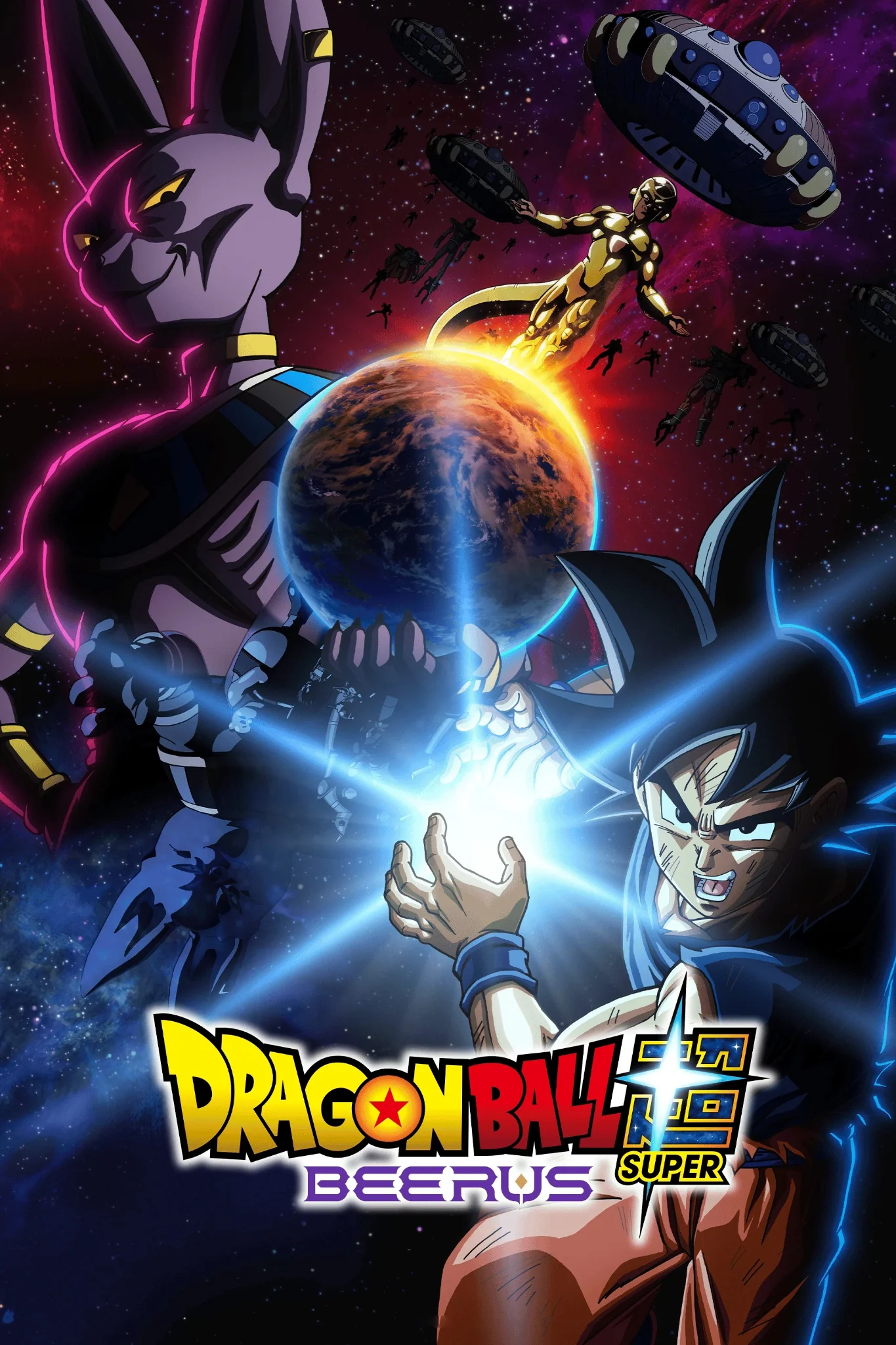
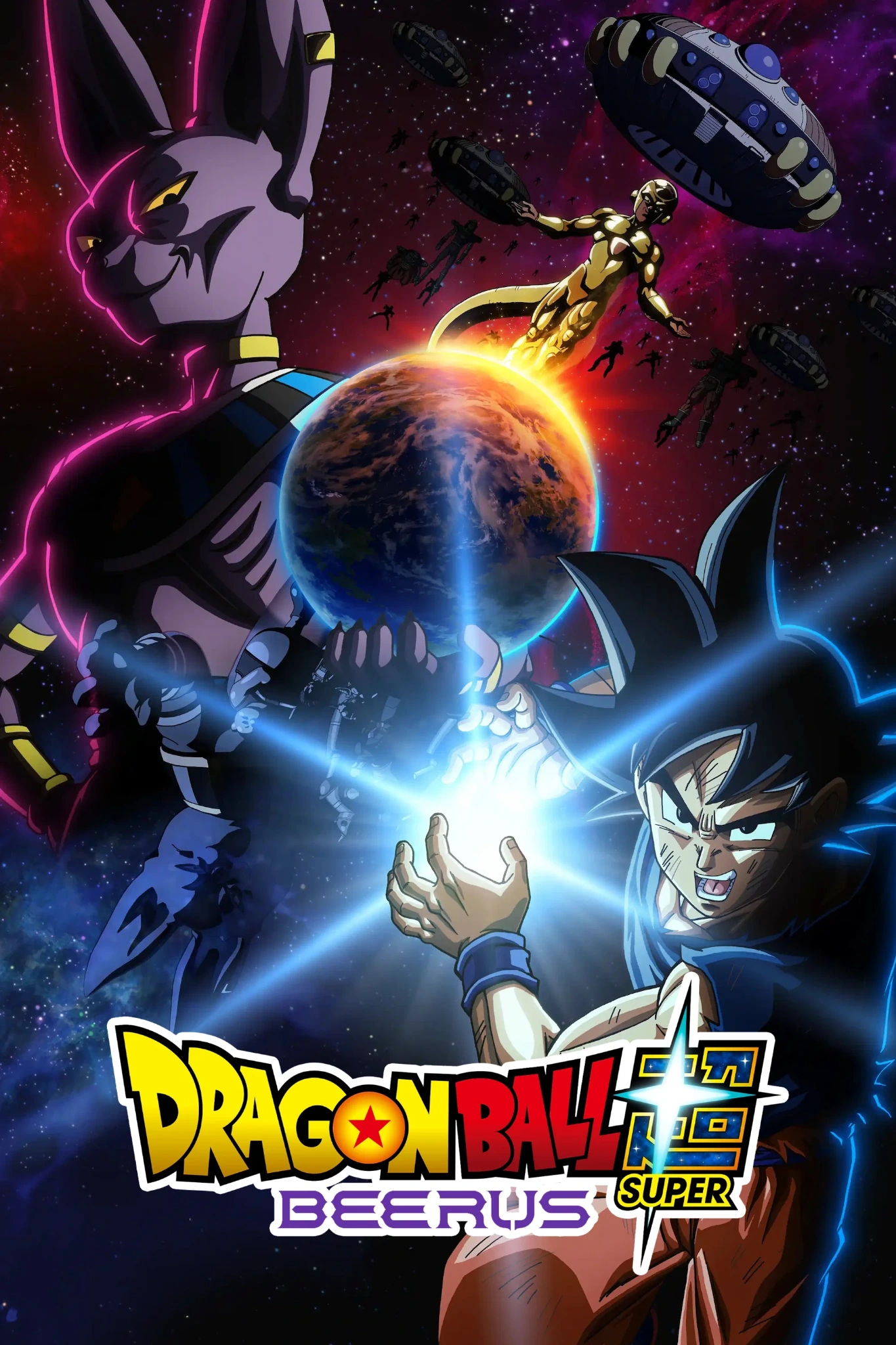
Beerus and Whis set out to find the Super Saiyan God who appeared in Beerus's dream. Their search takes them to King Kai's planet, where Goku is staying. This brief setup matters less for the information it adds than for the way it distributes reactions among those present.
King Kai sees the God of Destruction's arrival as a danger that a casual action could set off, and his anxiety feels proportionate to what we know of Beerus's destructive power. Goku, meanwhile, approaches the situation as a fighter unable to resist testing himself against an extraordinary opponent.
The difference between the first character's panic and the second's curiosity creates a light tension mixed with comedy, without stopping the story to explain why we should be afraid.
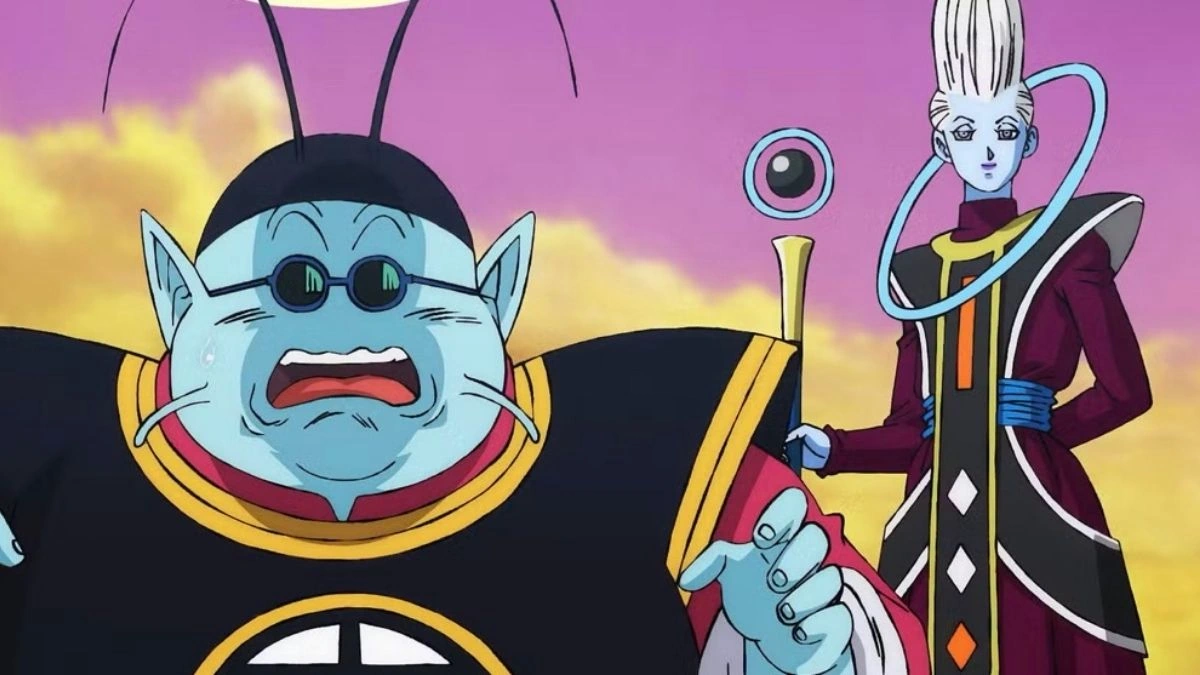
More cleverly, Beerus does not respond to Goku's spontaneity with the expected anger. He notices this fighter's unusual behavior, but does not necessarily see it as an insult deserving punishment.
The episode does not settle the reason for his calm. It could be curiosity about Goku, an understanding of his guilelessness, or simply boundless confidence. What matters is that Beerus is not trapped within the image others have constructed of him. He has a personality of his own whose reactions are not easily predicted.
Before the exchange of blows begins, then, the episode presents three attitudes toward the same power: King Kai fears it, Goku wants to test it, and Beerus possesses it without needing to prove it.
This simple distribution makes the meeting livelier than a conventional introduction to a battle the audience is waiting for.
Beerus: authority without a raised voice
One of the episode's best decisions is that it does not try to magnify Beerus through shouting or a long series of showy attacks. Instead, he meets almost everything Goku does with an infuriating economy of movement.
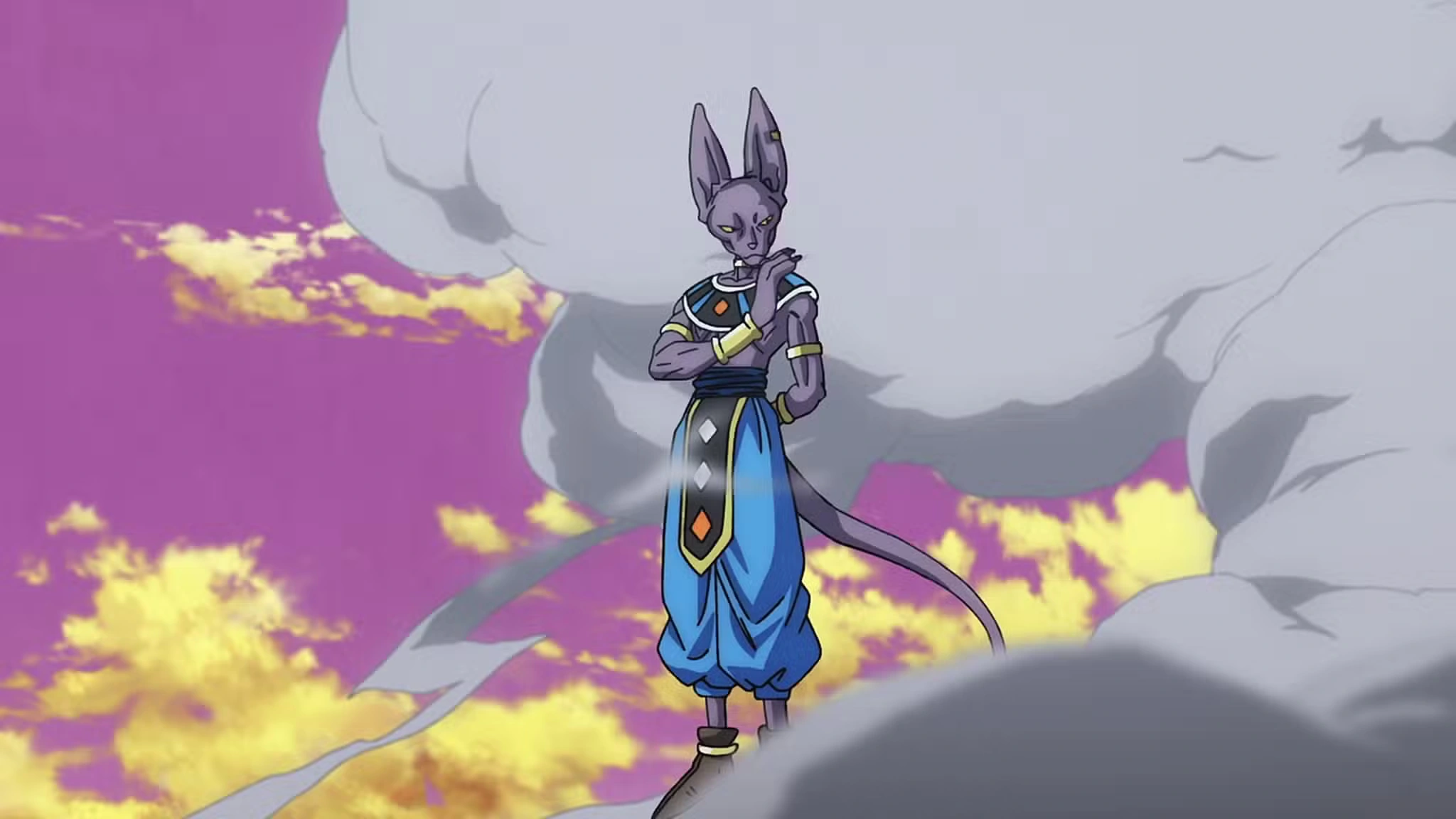
He watches with his hand near his chin, tilts his gaze as though examining something unfamiliar, and avoids attacks with a smile or an indifference that sometimes extends to yawning and closing his eyes.
These gestures reveal the mischievous feline quality that gives him a distinctive humor without making him less dangerous.
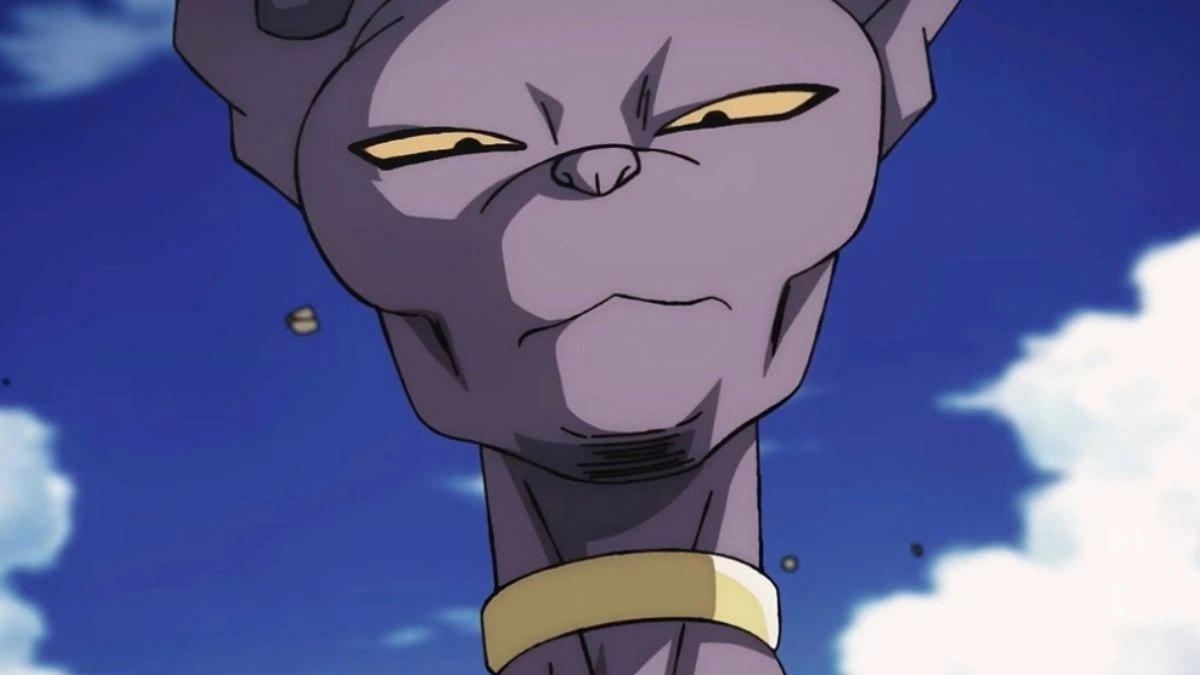
Body language becomes a measure of power.
Goku needs major physical changes and constant forward momentum, whereas Beerus needs only a small step or a movement of his head. The contrast makes power tangible rather than leaving it as information supplied by dialogue.
As Goku becomes more impetuous, Beerus's responses become calmer, until it is clear that they are not fighting with the same degree of seriousness.
This gives Beerus something beyond the role of an opponent whose defeat we await. He seems to enjoy the discovery and may be mildly surprised by what he sees, but he maintains a distance that makes him difficult to read.
We sometimes laugh at his coolness, then remember that it belongs to someone who can end the confrontation whenever he chooses.
The result is that Beerus has the strongest presence, not because he moves more than everyone else, but because he alone can afford not to move.
Goku's transformations: visual escalation reveals a greater gap
Goku begins by calling on his Super Saiyan transformation without exaggerating it as a new achievement.
This is a point in the current treatment's favor. Once a fighter has mastered an ability, entering it becomes natural and does not require reenacting the struggle of discovering it.
The choice makes Goku seem more mature and in control of his abilities. It also gives the confrontation more room to explore how those powers are used, rather than merely celebrating their appearance.
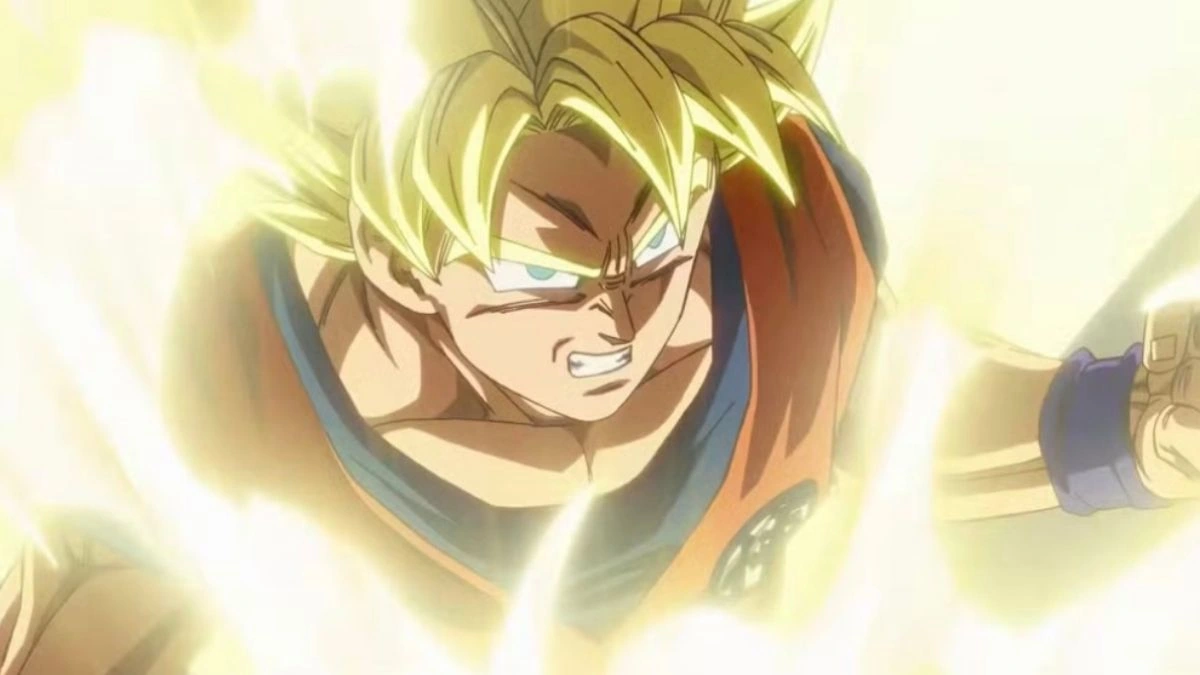
The second stage, Super Saiyan 2, provides one of the episode's most successful contrasts.
Goku's charge and its violent impact on the ground suggest that the confrontation has reached a higher level, while Beerus emerges as though nothing has bothered him at all.
The gap between the attack's appearance and the calm response creates the joke and explains the balance of power at the same time.
Even the small detail of Beerus touching the energy aura and feeling its electrical spark serves an important purpose.
The energy is more than glowing lines around a character. It has a presence that can be interacted with. The effects become an extension of what happens between the fighters rather than decoration pasted over the shots.
Then Goku reaches Super Saiyan 3.
The episode gives this transformation substantial visual and sonic space, with waves of energy and lightning extending along Snake Way. We feel that Goku has exhausted what he can show in this encounter, and that the escalation should finally have a visible effect on his opponent.
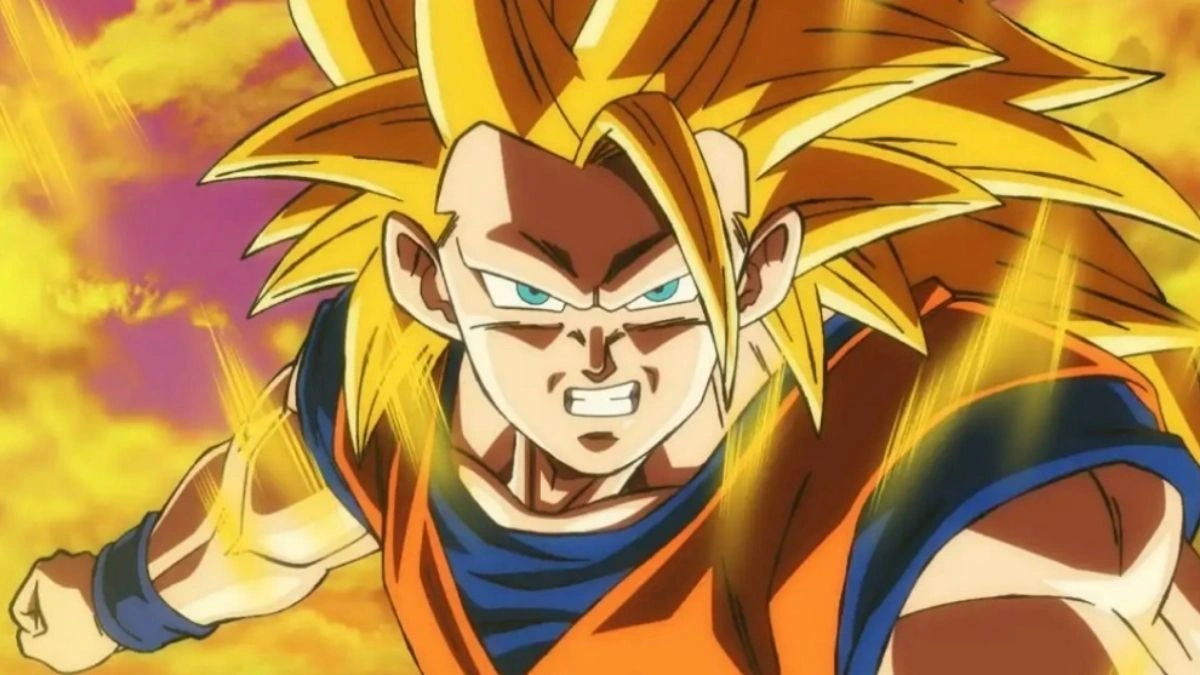
The response, however, is small to an almost mocking degree.
When Beerus decides to intervene more seriously, a few movements are enough to bring Goku down.
This ending does not invalidate the transformation. It changes its function: instead of promising victory, it becomes a tool for measuring the enormous distance between them.
From this perspective, the episode does not diminish Goku. It uses our knowledge of his strength to make Beerus's superiority more powerful.
Why does the confrontation feel bigger this time?
The visual improvement extends beyond smoother bodily animation.
Blows and transitions between positions are clearer, and the auras and lightning are more defined. The eye can follow the action without becoming lost in crowded effects.
The background also feels less empty than in the older treatment.
Golden clouds mixed with a purple sky give King Kai's planet a grander atmosphere, as though the environment itself were helping introduce a new scale of power.
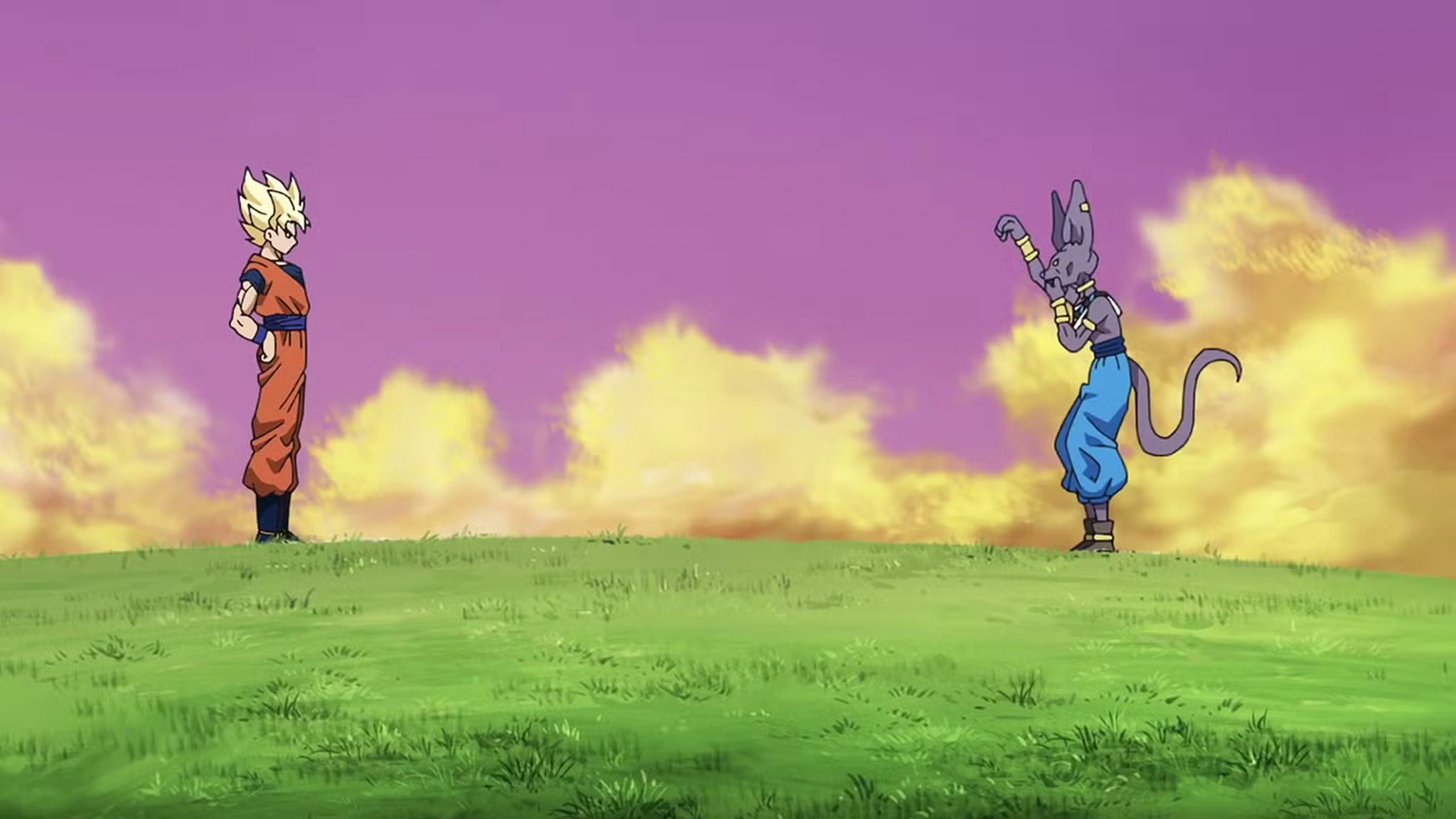
This is more than a cosmetic addition. The larger the space around the fighters feels, the stranger the difference becomes between the power Goku unleashes and the composure Beerus retains.
Sound supports this approach, especially in the buildup to Super Saiyan 3.
The music gives the escalation a weight that makes Goku's subsequent fall more cutting. Shortening some comic pauses also allows the action sequence to maintain its momentum.
The improvements in color, effects and composition clearly aim to restore a sense of the scale of these supernatural powers, rather than merely conceal the drawing problems of the earlier version.
Still, substantial improvement should not be confused with reinventing every shot.
Some passages benefit from redrawing and redirection over earlier material, while the entire Super Saiyan 3 fight has not received new animation from beginning to end.
This limit is particularly apparent because the transformation itself reaches such a high standard that we want the same visual care throughout the clash that follows.
The imagery can therefore be considered one of the episode's main successes without claiming that every part achieves the same degree of renewal.
Cleaner pacing... but what have we lost along the way?
One of the episode's clearest strengths is how quickly it reaches the confrontation both the characters and the audience are waiting for.
Supporting scenes that were spread through the earlier treatment have been reduced, including the Pilaf Gang's adventures and some preparations for Bulma's birthday party.
For this particular episode, the compression works well.
We do not wait long for Goku and Beerus to meet, and the tension between the mysterious guest's arrival and the start of the test is not dissipated.
Even Goku's steps toward his opponent receive an appropriate measure of anticipation without being prolonged for no purpose.
Removing lighter scenes is not a virtue in itself, however.
Comedy and everyday details are not always filler in Dragon Ball. They give the characters lives outside combat and make danger more effective because it intrudes on a world whose small habits we know.
We therefore need to distinguish between scenes that genuinely obstruct the pacing and those that establish the world's spirit and give relationships room to breathe.
What we can say now is that the compression benefits episode two. Whether it will preserve the balance of the whole journey is not something this episode alone can settle.
It is also fair to note that humor has not disappeared. It has moved closer to the heart of the confrontation, from King Kai's terrified reactions to Beerus's casual disregard.
The new rhythm is thus more direct without entirely abandoning the work's comic personality.
A battle rich in meaning... and less convincing in variety
Despite the strength of the visual direction, the clash itself is not as rich as the scale of its buildup suggests.
We see punches, evasions and energy blasts, even an attack that pierces King Kai's planet. Yet the battle does not give Goku a clear range of his signature techniques or develop many tactical stages before reaching its outcome.
This choice can be defended dramatically. When the power gap is enormous, inventing successive reversals that suggest Goku is close to victory could weaken the central idea.
Even so, there is a difference between understanding his quick defeat and feeling that the action has exhausted everything it could offer.
The encounter succeeds more as a demonstration of Beerus's character and Goku's current limits than as a fully developed battle with a sustained exchange.
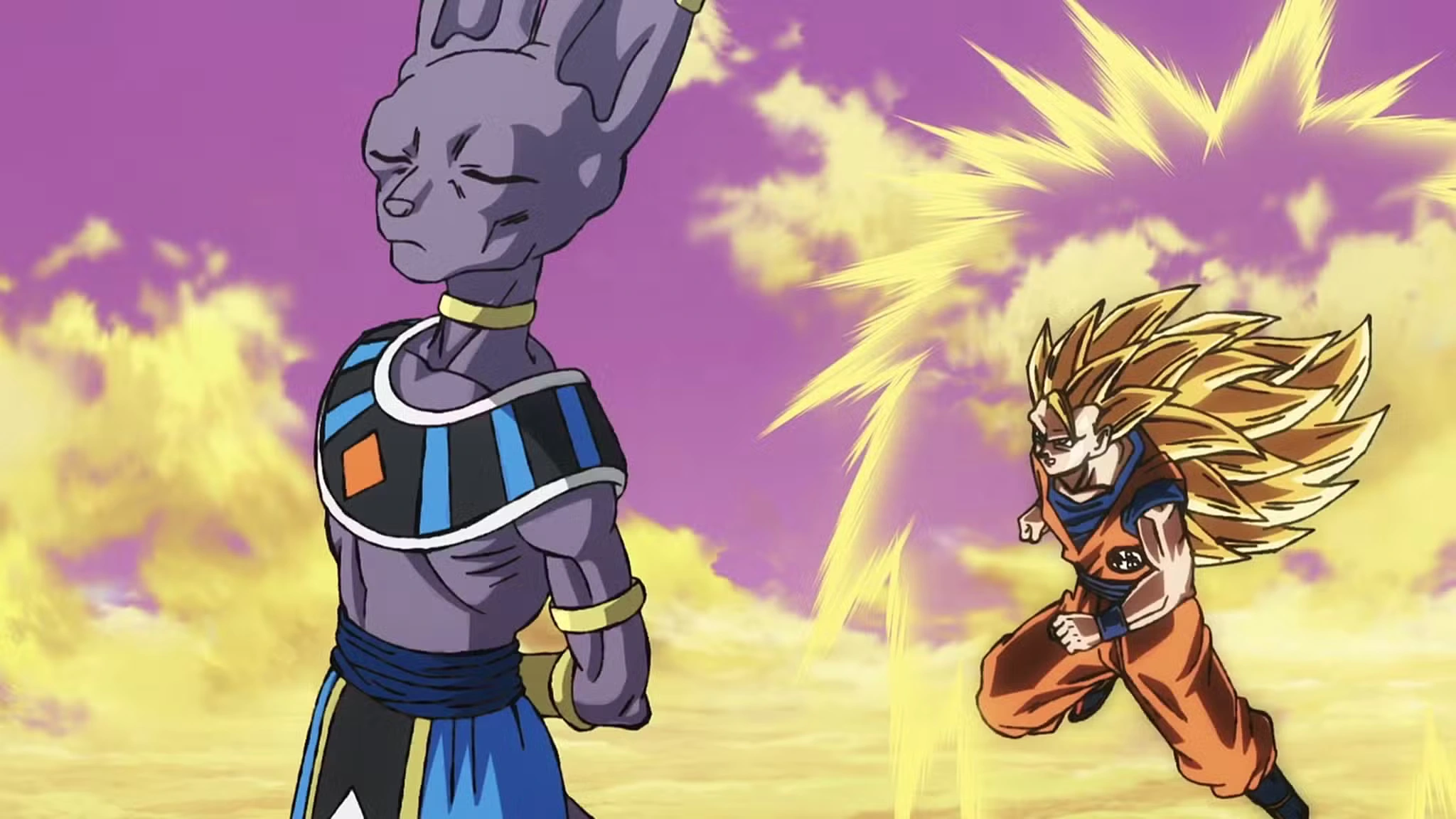
The finger flick that sends Goku flying, followed by his decisive defeat, is therefore an excellent dramatic outcome. The combat preceding it could still have been a little richer without changing the winner.
This is a real reservation that does not cancel the improvement over the 2015 version. It explains why the brilliance of the transformations alone is not enough to make the episode complete.
Perhaps this is the experience's most intriguing contradiction: the more successfully the episode sells the spectacle of Goku and his transformations, the more we feel that the actual clash ends before we have had enough action.
Fewer words open more possibilities
One change is measured through the wording of the dialogue rather than the beauty of the drawings.
In the earlier treatment, some lines around the Super Saiyan 3 transformation suggested that Goku had displayed the absolute maximum of his abilities.
Here, the wording comes closer to presenting the power of this particular transformation, and Beerus leaves open the possibility of other abilities that have not yet appeared.
What does the story gain from this adjustment?
It avoids turning a single line spoken during combat into an absolute restriction on everything we might learn about Goku's abilities in other works, particularly after Dragon Ball DAIMA's presentation of Super Saiyan 4.
We must distinguish, however, between removing a possible contradiction and confirming a new fact.
These lines do not by themselves establish Dragon Ball DAIMA's place in the timeline or declare that Goku possessed a particular transformation during this encounter.
They simply leave room for interpretation that the old wording constrained.
This care is useful because retelling a familiar work becomes stronger when it revisits its internal logic rather than merely recoloring the image.
The adjustment's impact within the episode remains limited, however. It is a valuable detail for viewers interested in continuity, rather than a substitute for the confrontation's dramatic construction.
The overall assessment and final verdict
Episode two offers a confrontation that knows exactly what it wants to say: Beerus is more than an opponent Goku can defeat by raising his level a little. He is a new force that places everything we have grown accustomed to before a different question.
What works best is the interaction between body language, transformations and the compressed pacing, making the opponent's character clear even when he does very little.
The battle, however, does not fulfill everything its buildup suggests. Its movement is limited in variety, and the care devoted to Super Saiyan 3's transformation surpasses the combat that follows it.
These reservations do not erase the vitality the confrontation has gained or the tangible improvement in its presentation.
Our rating for episode two is 7.5 out of 10.
Final verdict
Final verdict
An entertaining and visually strong episode that turns defeat into a moment of character revelation rather than diminishment. It needed a more complete clash, however, to reach the level its transformations promise.
Your turn
The question is yours: was Goku's rapid defeat the best way to establish Beerus's authority, or would you have preferred a longer battle that fully explored Goku's abilities before deciding the outcome?
AUDIENCE VOTE
Do you agree with the MB rating?
Choose once from this browser. You can change your answer at any time.