The review
The real question is why they keep driving
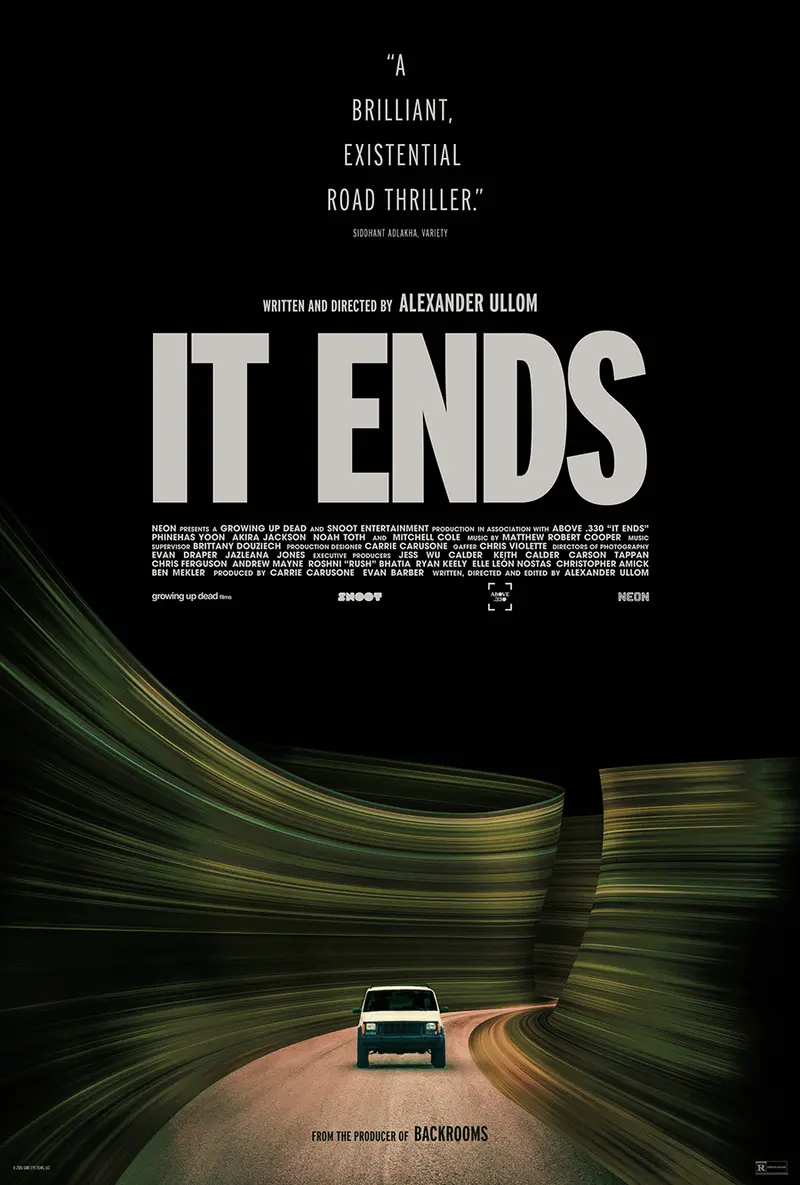
The premise is extremely simple. Four recent graduates drive out at night for one final meal, then the road becomes endless. Fuel does not run out, exhaustion disappears and every route that should produce an exit returns them to the same impossible movement. Whenever they stop, a hostile crowd emerges from the forest.
The power does not lie in asking what is happening to them. The stronger question is why they cannot stop continuing. Horror moves from an external threat to a condition of life: constant movement becomes necessary because nobody knows what stopping will unleash.
The road is not a setting: it is the argument
The road is the film's most effective idea. These four people have just left education, the stage supposedly opening into the future. Instead of finding a clear direction, they encounter a straight road without an end. The image is simple and powerful.
Education, employment, promotion and stability form the conventional route we are told will eventually lead to a better life. It Ends asks what happens if the route itself is the problem, if you keep moving, working and waiting for the point at which life becomes better, only to discover that no progress has occurred. The car becomes more than a vehicle for survival. It resembles modern working life: perpetual motion, a brief rest and then a return to the same road.
Four ordinary people, four responses to uncertainty
The characters are not horror archetypes or extraordinary heroes, which is a clear strength. James is the most analytical. He treats the situation as a puzzle to solve, revealing a person unwilling to accept that events may be meaningless. Phinehas Yoon is particularly effective when James tries to maintain calm while his sense of helplessness grows.
Tyler, played by Mitchell Cole, is more practical and less willing to turn the crisis into an adventure. That places him in recurring conflict with James: one wants to impose control, the other is more willing to admit control may be impossible. Akira Jackson's Day exists between hope and uncertainty, wanting an explanation while fearing that none exists. Noah Toth's Fisher uses humor as a defense. The joke becomes a natural way to delay confronting reality rather than a tonal escape from the film.
Most importantly, the four feel like friends with shared history rather than strangers assembled by a screenplay. Ordinary jokes, friction and shifting alliances make the car emotionally credible before it becomes metaphysically impossible.
The group becomes part of the threat
The film gives little priority to defining the people emerging from the forest. That decision will frustrate some viewers but serves the central idea. The real danger is not whether the crowd consists of zombies, spirits or something else. It is that the characters cannot understand the world around them.
As the journey continues, the friendships change. Casual conversation and minor disagreement become tests of trust. Every person begins interpreting the crisis differently, and the question expands beyond how they can escape. Can they continue together at all? The group is no longer only a set of people facing the conflict; it becomes one of the places where the conflict lives.
The impossible rules keep the metaphor alive
The road clearly does not obey natural law. The exact beginning of the disruption remains unknown, and the film provides no complete explanation. This is deliberate. A creature, scientific experiment or defined force would transform the story into a puzzle with a solution. Leaving the cause open makes the experience itself the subject.
An endless road resembles a future without guarantees. The characters can stop for short periods but must eventually resume motion. The parallel with ordinary life becomes explicit: work, rest briefly, then work again. The duration of the break changes nothing because the road remains waiting.
Making a car visually alive
The largest directorial challenge is obvious: how can a visual film be made from four people sitting in a car? Ullom finds strong solutions. The camera refuses to treat the vehicle as a fixed box, using narrow angles, over-the-shoulder frames, mirrors and close details throughout the interior.
Seats, belts, interior lights, the sound of a door opening and hazard indicators all become dramatic components. The film does not need continuous spectacle to generate tension. Sometimes one small mechanical sound inside a silent car is enough.
Daylight reveals that darkness was never the problem
Cinematography prevents the limited location from becoming visually repetitive. Night inside the car creates suffocation, while an open road in daylight should create freedom. The film reverses that expectation. Light never means an exit.
Strong daylight makes the road more uncanny because it proves the problem was never darkness. The impossible world remains fully visible. The contrast serves the central proposition: no environment is truly safe, and clarity does not automatically produce understanding.
Sound turns the vehicle into part of the nightmare
Sound is one of the strongest horror elements. Hazard indicators, the open-door chime, forest noises and sudden silence create tension without constant loud music or a stream of jump scares. The film understands that silence can be more disturbing than noise.
When sound stops, the audience begins monitoring every small detail and waiting for the next disturbance. The car, initially a shelter from the crowd, starts to sound like another mechanism inside the nightmare.
Repetition is both method and weakness
The editing evolves with the ordeal. Faster cuts accompany the early discovery of danger, then shots lengthen and movement begins repeating. The change fits the theme because the film wants the audience to feel the boredom and circularity experienced by the characters.
The strategy cuts both ways. Repetition makes us inhabit the loop, but some passages create the impression that the movie itself is circling the same point. The central idea is already clear and strong; several repeated beats could have been shortened without losing meaning.
Ambiguity will divide the audience
Viewers waiting for a clear explanation may leave frustrated. Why does the fuel continue? Why does normal exhaustion disappear? Why is the road endless, and what is the crowd in the forest? The film answers none of these questions conclusively.
If the film is approached as philosophical horror using uncertainty to serve a wider idea, the absence of explanation becomes part of the experience. It works best when we stop demanding a literal cause and treat the road as a metaphor. Even then, questions about the world's internal logic remain. Some viewers will reasonably feel that ambiguity is being used to avoid difficult answers rather than to deepen the story.
Final verdict
Final verdict
It Ends is neither horror for horror's sake nor a mystery designed to answer every question. It is a film about the feeling of moving continuously without knowing whether movement is progress. That idea affected me more than any literal explanation for the people in the forest could have done. The road is the central character: an unseen future, work whose destination is unknown and the continuing effort to convince ourselves that something must wait at the end. The film's best decision is refusing to make escape the only solution and instead asking whether continuing to drive is always better than stopping. Repetition sometimes tests the patience, and the world may be too undefined for viewers who need firm rules, but the limited setting, natural friendships, visual control and precise sound create a thoughtful existential road nightmare.
Your turn
Did you read the road in It Ends as a symbol of work and life after graduation, or do you prefer it as an unexplained horror mystery? Was the ending's ambiguity a strength, or did the film need more answers?
AUDIENCE VOTE
Do you agree with the MB rating?
Choose once from this browser. You can change your answer at any time.