The review
An administrative task becomes a moral crisis
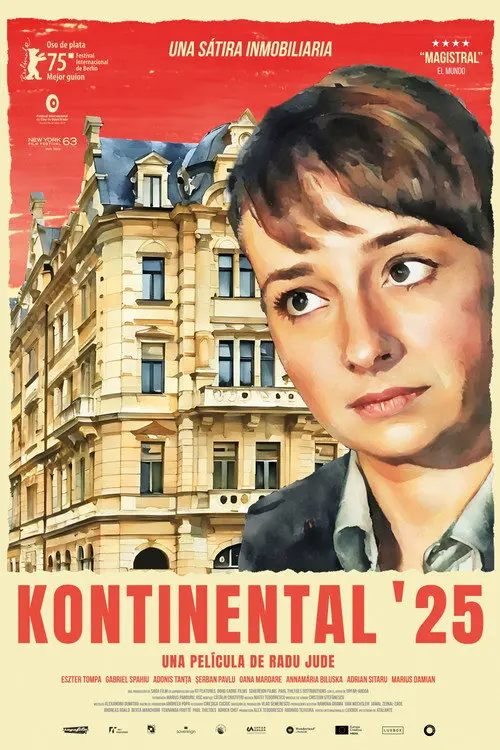
The film refuses the easiest moral arrangement. Ion is not reduced to a symbolic victim of a cruel system, and Orsolya is not presented as a villainous employee who enjoys enforcing orders. When she is assigned to persuade him to leave, the matter initially appears simple and bureaucratic. His death transforms that small task into an ethical wound that follows her through the rest of the film.
That choice matters because the film does not merely announce that the system is bad. It asks the more difficult question of how long a person can say that they were only following instructions. Institutional procedure may distribute responsibility across departments and documents, but it cannot prevent a single conscience from recognizing a human consequence.
Orsolya understands the wrong, and that is why it hurts
Ion may be the center of the opening tragedy, but Orsolya becomes the film's true center. She was once a law professor and is now an enforcement officer, suddenly confronted with the human outcome of a decision she originally treated as a work assignment. Her problem is not an inability to distinguish right from wrong. She understands the distinction. That is precisely why the guilt begins.
There is no conventional transformation from evil to good or coldness to feeling. Orsolya believed she was doing her job, then began replaying the incident and asking where her responsibility ends and the system's begins. This is more realistic and more disturbing because the film refuses to give her a comforting answer.
Ion holds on to the last place that recognizes him
Ion needs little dialogue for us to understand the scale of his fall. He once had a better life and now survives by gathering discarded objects, moving along the city's margins and asking others for help. The film avoids turning this into melodrama. There is no aggressive effort to extract tears. The camera observes him with the plainness of a real person encountered in the street.
His early appearance among mechanical dinosaurs creates a clear visual metaphor: something from an older world survives inside a modern environment that no longer knows what to do with it. Refusing to abandon the basement is not simple stubbornness. It is a refusal to surrender the last thing that makes him feel he still occupies a place in the world. His final choice becomes tragic because it exposes how few alternatives society left him.
Legal innocence cannot quiet the conscience
After Ion's death, Orsolya receives reassurance that she is not legally responsible. The film immediately separates law from conscience. A bureaucratic system often depends on the promise that if each formal step is performed correctly, any resulting harm becomes acceptable or at least nobody's personal fault. Kontinental '25 rejects that comfort.
Orsolya may be officially protected, but she cannot protect herself from guilt. She repeats the story to different people as though searching for a version she can believe. She never finds one. The repetition is not merely a way to deliver information; it is the shape of her psychological state, a mind continually returning to the same point because no retelling can change what occurred.
Radu Jude gives the city an unpolished surface
Radu Jude's direction appears extremely simple but is carefully calculated. Shooting on a mobile phone gives the film a raw, unpolished texture suited to a world that does not need conventional visual beauty. The camera does not beautify the city. Old buildings, streets, construction sites and exhausted spaces remain visibly themselves.
The city is part of the subject rather than a neutral setting. Cluj changes before our eyes, its older architecture visibly losing a battle against new projects. Redevelopment is not shown through statistics or speeches alone; it is written across walls, excavations and displaced bodies.
Long takes create attention and test patience
Static, extended takes and long conversations are among the direction's most visible choices. Their strength is that they force the audience to remain inside the situation. Music does not constantly dictate feeling, rapid cutting does not compress silence and camera movement does not manufacture tension. Sometimes a person continuing to speak is the entire scene.
The weakness is equally clear. The film becomes very slow, and some conversations continue longer than their dramatic value, especially when the same ethical question is repeated from multiple angles. For me, the pace often serves the film's moral discomfort but does not always preserve the same power.
Dry comedy makes the tragedy stranger
The mixture of dry comedy and tragedy is one of the film's most interesting traits. An ordinary or sarcastic conversation can suddenly become painful. The humor does not soften the tragedy; it makes it stranger, reflecting the fact that life continues to produce absurd moments even during disaster.
Jokes are not included only to entertain. Sarcasm reveals how people face crisis: some joke, some justify and some become indifferent. Comedy therefore becomes part of the social criticism rather than a break from it.
Architecture tells the story without dialogue
The visual contrast between old buildings and new construction is among the film's strongest elements. The comparison nearly summarizes the whole argument without explanation. The past remains visible but retreats, and the new city rarely asks what it leaves behind.
The spaces around Ion, including the area with mechanical dinosaurs, look like remnants of a world that has lost its function but has not yet disappeared. The image itself comments on the story: economically unproductive things remain present only until somebody finds a profitable reason to replace them.
Mechanical animals in a world of replacement
The mechanical dinosaur and robotic dog are memorable visual details. Their presence inside a harshly realistic world adds absurdity while serving the central theme. The dinosaur is a piece of the past turned into a manufactured display object. The dog offers another image of a world in which the living thing can be replaced by a product that performs the same function.
That aligns with a city in which objects and places are increasingly valued as economic tools. The symbols are not always explicit, and some viewers may find them stranger than meaningful, but they remain among the film's most distinctive images.
Performances grounded in small behavior
Eszter Tompa plays Orsolya through detail rather than large emotion. She does not spend the film collapsing or screaming her guilt. Tension appears in speech, silence and the compulsion to explain the incident again. That restraint makes the character more truthful.
Gabriel Spahiu builds Ion largely through physical presence. Poverty and isolation require no extended speeches. His body inside neglected spaces communicates the condition immediately. The film repeatedly trusts actor and camera more than explanation, and that trust is among its best qualities.
Editing that refuses to hurry
The editing is not designed to move the plot forward as quickly as possible. Scenes sometimes continue after delivering their essential point. Semi-documentary passages and sections not built around conventionally scripted dialogue make the film feel less like a closed story than a record of a real society in transition.
Again, the choice cuts both ways. It creates the film's identity and can also make the audience feel that the production is testing patience more than necessary. Viewers who resist contemplative cinema and extended conversations may find the experience especially demanding.
Final verdict
Final verdict
Kontinental '25 is about the moment a person discovers that following rules does not make them innocent of the consequences. Its greatest strength is refusing to define Orsolya as either an ideal heroine or an obvious villain. She is a human being trapped between work and conscience, and that gray territory gives the film its weight. Excessive slowness and an insistence on long conversations can make it difficult for viewers who do not enjoy contemplative cinema. But for an audience willing to accept that rhythm, the film offers a clear position, a distinctive visual method and the ability to transform a small incident into a larger question about the city, the individual and responsibility.
Your turn
Was Orsolya simply an employee enforcing the law, or does what happened to Ion make her morally responsible regardless of the instructions she followed?
AUDIENCE VOTE
Do you agree with the MB rating?
Choose once from this browser. You can change your answer at any time.