
The review
Paula: a woman who cannot afford to fall apart
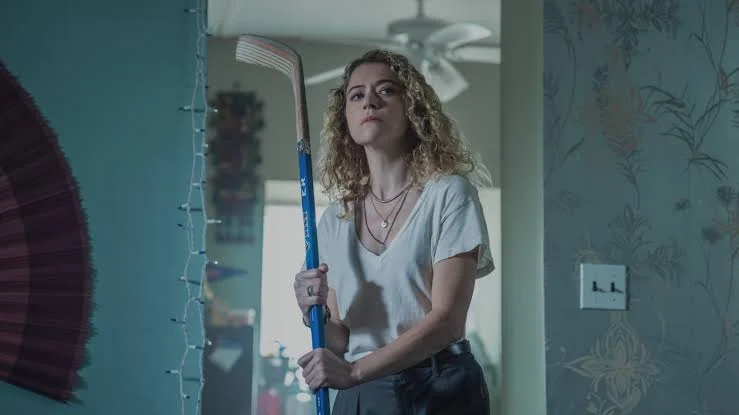
The first thing that struck me about the series is that our protagonist Paula does not need to become involved in a crime for her life to be exhausting.
She is a divorced woman who works as a journalistic fact checker and is fighting for custody against her former husband Karl, who wants to move their daughter Hazel to another city.
At the same time, she tries to hold on to her job, deal with a boss who constantly demands more, get her new home ready and take care of her daughter's school and sports commitments.
Everything in her life requires time, effort and attention, while nobody seems willing to ease the burden.
This is what makes her virtual relationship with Trevor, the young man she pays to communicate with online, important.
The series presents this relationship as more than physical desire. It is a temporary escape from loneliness and psychological pressure. Paula finds someone who listens to her and gives her attention that is missing from her daily life, even if the relationship involves payment.


More importantly, she believes she can control its boundaries, choosing when and for how long they communicate before returning to her responsibilities.
The paradox is that the only space she thought she controlled becomes the greatest threat to her stability.
When she becomes involved in the case of Trevor's murder, she has to face real danger without any of her earlier problems disappearing.
This is one of the series' smartest ideas.
Life does not stop when a person faces a catastrophe. There are still work appointments, family obligations and personal disagreements, even if someone is trying to kill you.
For me, this idea gives the events a different kind of tension from traditional crime series. It makes us feel that Paula did not enter a dangerous world from nowhere. She was already living under pressure that could almost break her.
When the victim becomes the accused
Another aspect I liked is how the series reverses Paula's position within the case.
She begins as a witness to a serious assault and tries to tell the police what happened, but does not get the response she expects.
Detective Sofia treats her account with suspicion, initially assuming that she may have been the victim of a scam.
As blackmail emerges and the murder is discovered, Paula becomes a suspect instead of simply being someone seeking protection.
This change gives the story a strong source of suspense, but also reveals a deeper problem.
Paula fears that details of her private life will become a weapon used against her in the custody battle. Her social reputation therefore becomes part of the danger alongside the criminal threats themselves.
The series raises an important question about the judgments society makes about other people's private lives, particularly mothers.
Why can a woman's attempt to find some happiness become evidence used to question her ability to care for her daughter?
I think this was one of the work's most promising ideas, giving the crime a clear social dimension.
But the series does not always explore it with the depth it deserves, sometimes moving quickly to the next threat or new surprise.
Even so, this conflict helps us understand why Paula sometimes acts hastily or without thinking things through.
She is not only trying to uncover the truth. She is also trying to stop her entire life from collapsing.

Tatiana Maslany: the performance that carries the entire series
If there is one element that makes Maximum Pleasure Guaranteed worth following even when the writing falters, it is unquestionably Tatiana Maslany's performance as Paula.
Maslany portrays someone living in an almost constant state of anxiety and exhaustion, but does not rely on exaggerated emotion to communicate those feelings.
What I liked most about her performance is her ability to move naturally between different psychological states.
One moment she tries to appear confident in front of her daughter. In another she is flustered before the police, then returns to work as though nothing has happened, even though her mind is occupied by the danger pursuing her.
What is effective is that these changes do not feel artificial.
Maslany uses facial expressions, anxious looks and even moments of silence to reveal how much pressure the character is carrying.
She also has a clear ability to deliver dialogue spontaneously, as though the words are coming to her in the moment rather than being lines written in advance.
This makes Paula believable even when she makes decisions whose logic is hard to accept.

But this also exposes one of the writing's problems.
Some of Paula's decisions seem excessively reckless, particularly after she has faced several situations threatening her life. It is sometimes difficult to believe that she does not learn caution as quickly as the circumstances demand.
Nevertheless, Maslany maintains our sympathy for the character because she does not try to present her as a perfect heroine or a professional investigator.
She is an ordinary woman experienced in fact checking who tries to use that skill to understand what is happening around her. She remains a human being vulnerable to mistakes, fear and confusion.
For me, this is the first season's greatest acting achievement.
Mallory and Karl: characters who reveal another side of the conflict
Among the supporting characters, I consider Mallory, played by Jessie Hodges, the most interesting.
At first, Mallory seems simply to be Karl's new wife, the woman who has become part of the life Paula lost after the divorce.
It would have been easy for her to remain a conventional character whose purpose was to increase the tension between them.
But as the episodes progress, we discover that her character is more complicated than it first appears.
Behind her calmness and calculated behavior lie suppressed anger and feelings she does not express directly.
Jessie Hodges conveys this through a quiet, convincing performance that preserves the character's mystery without making her feel empty.
Karl, played by Jake Johnson, represents a different kind of pressure in Paula's life.
He is busy building his new life, yet seems unwilling to understand the scale of the responsibilities his former wife carries.

What is striking is that the series does not need to make him evil to reveal the impact of his behavior.
It is enough to show how selfishness and indifference to another person's circumstances can turn a family disagreement into a constant source of tension.
Dolly de Leon also plays Detective Sofia with a sardonic tone and weariness toward her work, giving some scenes a different flavor.
But these characters do not all receive the same space, and this is where the uneven quality of the writing begins.

Suspense: a series that knows how to make you watch the next episode
One of Maximum Pleasure Guaranteed's greatest strengths is its ability to keep viewers constantly anticipating what comes next.
The series uses relatively short episodes to deliver rapid developments and endings that leave questions pushing you to continue to the next episode.
The events do not remain confined to a single murder.
They expand to include blackmail, chases and threads of a conspiracy involving financial interests and people with more influence than Paula expects.
These expansions keep events moving, particularly when surprises successfully change our expectations about where the story is heading.
I think the series generally succeeds in managing this escalation.
But it sometimes falls into a clear problem: assuming that increasing the number of dangers necessarily makes the suspense stronger.
In some episodes, threats accumulate until the events feel excessively crowded.
The screenplay also sometimes relies on illogical decisions by its characters simply to allow another confrontation or keep the danger going.
This weakens the sense of realism that the series successfully established at the beginning.
Suspense becomes more affecting when we feel that characters act from convincing motivations, rather than simply because the plot needs another surprise.
Despite these observations, the overall pacing remains one of the reasons the series is appealing, even when its developments are not all equally strong.

Black comedy: does the mixture of laughter and danger work?
One quality that gives the series its own personality is its combination of dangerous situations and ordinary daily details.
Paula may be busy escaping a real threat, but she is still expected to go to work, take care of her daughter's soccer practice or deal with endless household responsibilities.
This contradiction creates suitable ground for black comedy.
The idea is not to diminish the seriousness of what is happening, but to reveal the strangeness of a life that forces people to continue fulfilling their responsibilities regardless of the circumstances.
There are moments when the series makes this contradiction funny and painful at the same time.
But the combination of comedy and crime is not always balanced.
Some scenes move from severe violence to light comic situations so quickly that the tonal change feels uncomfortable.
Some jokes are also not strong enough to ease the tension or give the situation a new meaning.
I think the series needed greater control over its tone.
Black comedy works best when it emerges from the characters and situations, rather than feeling as though it was added simply to lighten the atmosphere.
Even so, this mixture gives Maximum Pleasure Guaranteed an identity different from traditional investigative series, though not every attempt succeeds.

Supporting characters and a mystery that loses some of its power
Although the series has a promising collection of characters, some roles do not receive the development they deserve.
This is particularly clear with Paula's colleagues Jerry and Rudy.
Their presence is often limited to asking questions or supplying information that helps viewers understand details of the case.
The problem is not the actors' performances. The screenplay does not give them sufficiently clear personalities.
They could have been used better, particularly because the workplace itself is an important part of Paula's life.
Part of this problem also applies to the characters involved in the central conspiracy.
As the mystery expands, we expect the forces responsible for the events to become more complicated and interesting. But some villains remain closer to conventional images of corrupt people pursuing money and influence.
This makes the truth behind the conspiracy less interesting than Paula's journey to uncover it.
The series also introduces ideas about exploitation, greed, betting and the effects of psychological trauma, but does not give them all a complete dramatic treatment.
This reveals the difference between having a large number of topics and analyzing them deeply.
The ending maintains our curiosity about what might happen later, but also leaves a sense that some threads have not received enough closure.
For me, the first season would have benefited from giving its main story greater completeness instead of relying on a final surprise to open the door to a continuation.

Strengths and weaknesses
The principal strengths are Tatiana Maslany's performance, the convincing psychological construction of Paula, the sustained suspense and the ability to turn daily pressures into an essential part of the crime and mystery experience.
The principal weaknesses are the uneven supporting characters, some unconvincing decisions, an imperfect balance between comedy and violence and a conspiracy that ultimately does not match the suspense preceding it.
Final verdict
Final verdict
Ultimately, I find the first season of Maximum Pleasure Guaranteed an enjoyable experience full of tension, worth watching for fans of crime, mystery and black comedy. The series' real success lies not in presenting an exceptionally complicated mystery, but in making the life of an ordinary woman trying to survive her daily responsibilities the foundation of a story whose dangers escalate unpredictably. It could have been better if it had developed its supporting characters, given the central conspiracy greater depth and controlled the transitions between comedy and violent scenes more precisely. But it remains a series that knows how to attract attention and makes excellent use of its lead's presence and her ability to make viewers care about her fate. My rating for the first season of Maximum Pleasure Guaranteed: 7.5/10.
Your turn
My final question for you: was Paula a victim of circumstances beyond her control, or did some of her reckless decisions help turn her crisis into a larger catastrophe?
AUDIENCE VOTE
Do you agree with the MB rating?
Choose once from this browser. You can change your answer at any time.