The review
A familiar chase in a different cultural frame
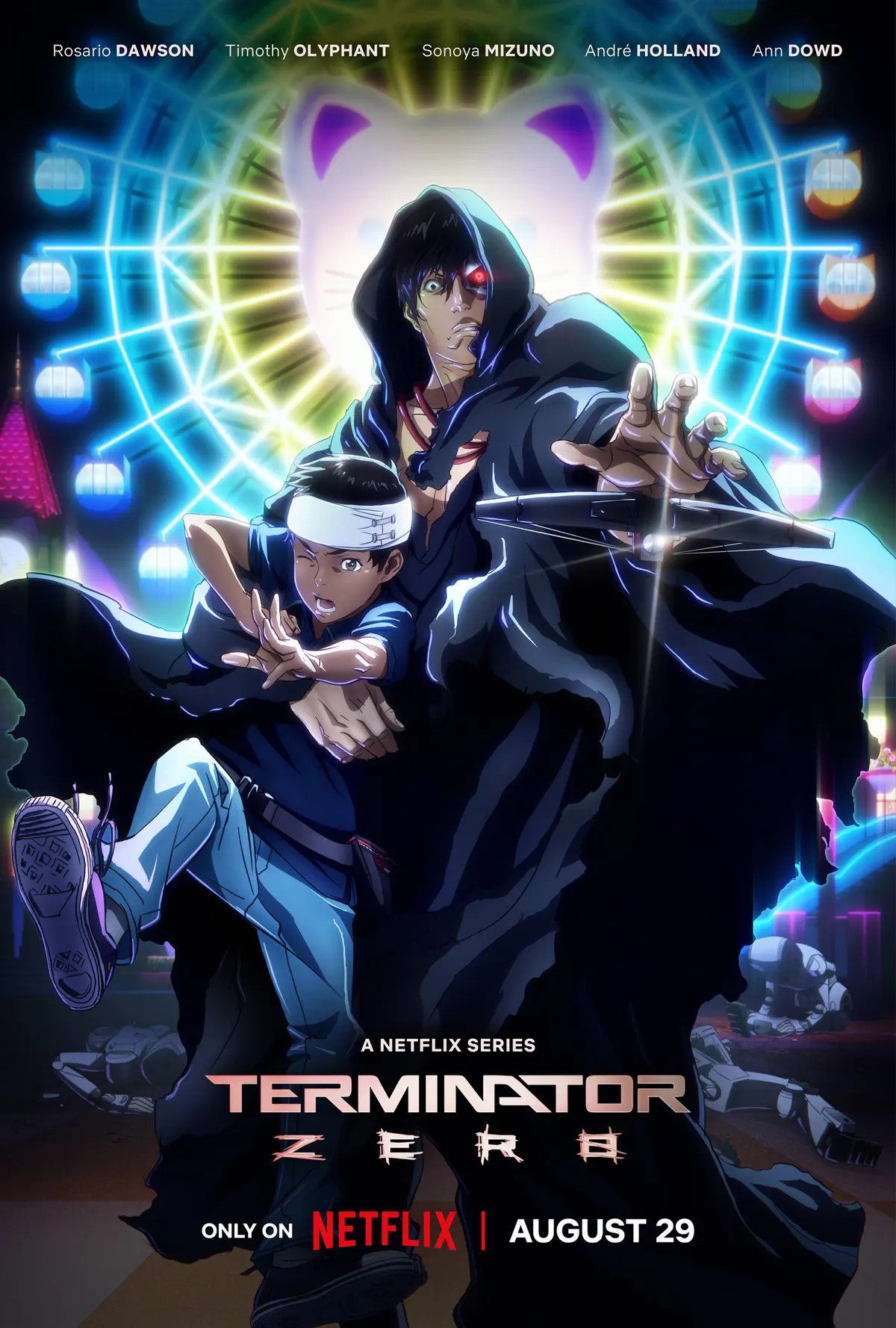
Eiko's arrival from 2022 and the Terminator pursuing her immediately establish the franchise's temporal pressure. Moving the central conflict to Japan gives the story new architecture, social texture and a visual identity separate from the American films.
The early episodes are the strongest blend of action and mystery. Information is released in controlled fragments, and the time-travel structure produces tension without relying entirely on recognition of earlier franchise characters.
Kokoro places humanity on trial
Kokoro (the name evokes heart and mind) is not simply a benevolent alternative to Skynet. It studies humanity's record and questions whether a species that repeatedly creates war deserves intervention rather than extinction.
This makes the antagonist morally unclear. The Terminator remains a killing machine, but it is also an instrument produced by a wider logic. Humanity's own history becomes the evidence against Malcolm's plea for a second chance.
Malcolm argues for contradiction
The conversations between Malcolm and Kokoro form the intellectual core. Machine logic identifies the cycle by which love becomes conflict and invention becomes weaponry; Malcolm answers that contradiction also produces beauty, sacrifice and hope.
The ideas are compelling, but some scenes state them faster than they can be explored. Philosophy occasionally becomes an exchange of positions rather than a discovery shaped by action, making the middle episodes slower without always making them deeper.
Family gives the apocalypse a private cost
Malcolm's children are not an unrelated subplot; they reveal the contradiction inside a man trying to save the species while failing to remain emotionally present for his own family. Even so, the series spends enough time on this line that momentum occasionally suffers.
Eiko should carry an equally substantial emotional arc, yet her characterization remains closer to the determined protector. Her courage is clear, but the script does not always give her interior life the space promised by her central role.
Animation restores physical danger
Two-dimensional character animation and selective three-dimensional action create several powerful confrontations, especially the opening pursuit. Camera movement makes streets, corridors and industrial spaces feel like physical traps rather than flat backgrounds.
The dark palette, mechanical sound and electronic score return horror to the machine. Some designs are less iconic than the original films, but the best sequences capture the impersonal force of something that cannot become tired, afraid or merciful.
Voice, rhythm and a complicated timeline
The Japanese voice performance carries the emotional temperature with particular precision, while the English cast remains convincing. André Holland gives Malcolm intelligence and exhaustion; the machine voices retain a frightening absence of hesitation.
Fast editing strengthens combat, but movement between timelines can be momentarily confusing. Extended exchanges between Malcolm and Kokoro slow the pulse, producing a season that is most complete when philosophy and immediate danger occupy the same scene.
Final verdict
Final verdict
Terminator Zero is an ambitious attempt to give the franchise a new future through anime. Its philosophy sometimes outruns its character development, but the atmosphere, action and moral uncertainty create a worthwhile renewal. It is not a repetition of the old chase; it is an argument about whether humanity deserves to escape it.
AUDIENCE VOTE
Do you agree with the MB rating?
Choose once from this browser. You can change your answer at any time.