The review
Human beings behind impossible masks
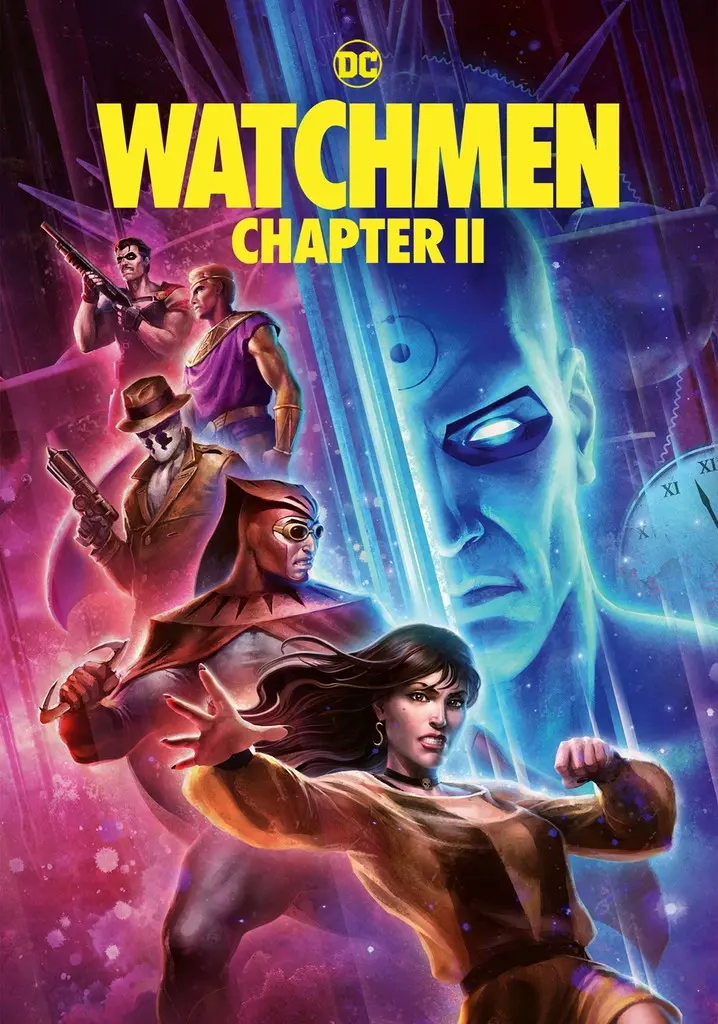
Dan Dreiberg's return to action is a recovery of purpose rather than proof of physical superiority. Rescuing people with Laurie allows both to feel useful after years of disillusionment. Their vulnerability establishes Watchmen's central truth: the mask does not remove the person; it amplifies what the person is trying to hide.
Rorschach, Veidt and incompatible justice
Rorschach sees morality in black and white and refuses compromise even when compromise appears capable of preventing extinction. His death at Doctor Manhattan's hand is the logical end of a principle stronger than survival. Adrian Veidt occupies the opposite extreme: he murders millions to manufacture a shared threat and calls the resulting global unity success.
The brilliance lies in refusing a comfortable verdict. Veidt is not a conventional villain and Rorschach is not a safe hero. One saves the world by violating it, the other preserves truth at the risk of destroying the peace. Their conflict is an ethical wound the film deliberately leaves open.
Doctor Manhattan and the improbable value of life
On Mars, Jon Osterman's detachment briefly yields to wonder as Laurie's existence reveals the staggering improbability of any individual life. Yet his final departure confirms that recognition is not reunion. His cosmic viewpoint can appreciate humanity as a miracle without becoming human again.
Faithful adaptation, compromised motion
The screenplay compresses material intelligently and integrates Tales of the Black Freighter as a thematic mirror rather than a detachable appendix. Dialogue preserves the source's philosophical edge, although some emotional journeys (particularly Dan and Laurie's) move too quickly and Martian conversations occasionally repeat their point.
The hybrid 3D/classic animation is clear but not consistently expressive, weakening physical action and certain dramatic pauses. Titus Welliver's Rorschach, Katee Sackhoff's Laurie and Troy Baker's Veidt supply strong vocal identities, while Doctor Manhattan's performance is comparatively flat. Editing is effective; the functional score lacks a musical idea equal to the moral catastrophe.
Final verdict
Final verdict
Watchmen: Chapter II is a thoughtful, largely faithful animated conclusion whose philosophical force exceeds its visual consistency. Its lasting achievement is not solving the dilemma but making every solution morally unbearable. Imperfect animation and understated music reduce the impact, yet the film remains rich material for reflection long after its final compromise.
AUDIENCE VOTE
Do you agree with the MB rating?
Choose once from this browser. You can change your answer at any time.