The review
Slice of life without a conventional knot
Totsuko's encounter with Kimi and her blue aura leads to a search, a friendship with Rui and the formation of a band. Those events are arranged as emotional impressions rather than a rising chain of obstacles. The late revelation functions as a gentle climax, but minute seventy does not feel substantially more urgent than minute twenty.
Seeing color is wisely left unexplained and used as a metaphor for emotional perception rather than a supernatural puzzle. Music likewise becomes an alternative language for belonging, not a route to fame. These choices show confidence, but the near-absence of conflict deprives the characters of pressure capable of transforming them.
Friendship as comfort rather than collision
The trio's relationship avoids jealousy, competition and large emotional confrontation. That creates a rare atmosphere of safety and adolescent tenderness, but also keeps supporting emotions close to the surface. Dialogue is natural and softly improvised in tone, yet few exchanges alter the course of a relationship.
Watercolor cinema and the animation of small gestures
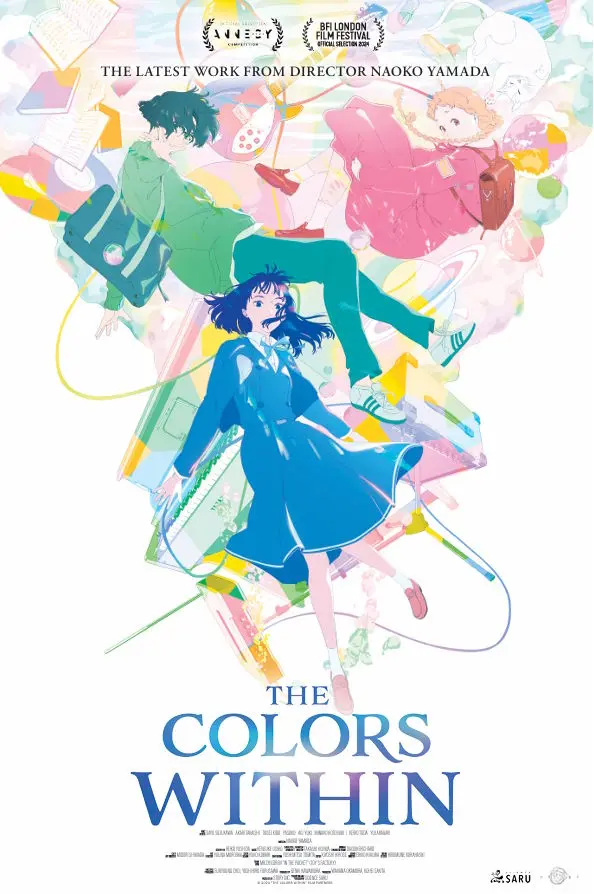
Soft watercolor palettes, thin lines and indirect light make the film resemble a diary remembered more than a world observed. Animation does not chase spectacle; it studies the bend of a back, an eye avoiding contact or fingers hesitating above guitar strings. The craft is exquisite, but the repeated stillness can make visual poetry feel dramatically stationary.
Voices, editing and music that whisper
The Japanese voice performances communicate fragility without display and fit the characters' restraint, though they rarely receive a scene designed to become an unforgettable vocal peak. Editing maintains one slow pulse throughout, an intentional choice that weakens attention in the second half because no contrasting rhythm arrives.
The score is dreamy, light and almost designed to evaporate. Band performances are charming but never become the dramatic culmination they might have been. The music accompanies connection; it does not decisively transform it.
Final verdict
Final verdict
The Colors Within resembles early morning light: beautiful, quiet and quickly gone. Its sensitivity, gentle characters and visual intelligence are genuine, and the ending finally reaches a moment of emotional truth. Had that dramatic clarity been distributed across the film, this could have been profound. As it stands, it is a lovely experience, no more, but certainly no less.
AUDIENCE VOTE
Do you agree with the MB rating?
Choose once from this browser. You can change your answer at any time.