The review
First the crime, then the remorse
The violent opening refuses to leave Robin's past as a vague confession. He and Little John return to killing, the Hendrie family answers by burning the farm, and Robin is gravely wounded while John appears to die. We are made to watch the brutality before being invited into the wounded man's silence.
That order matters. If the past were only dialogue, sympathy would come cheaply. By placing the crime in front of us, the film makes every later act of kindness morally unstable. Robin may change, but the audience is not permitted to forget whom his change arrives too late to save.
The priory between life and judgement
Robin reaches the Priory of St. Clement unconscious and hides behind the name Randolph while Sister Brigid tends him. The cold, expansive exterior gives way to warmer colour and a tighter frame. The priory feels less like heaven than a waiting room between life and death: he has received neither forgiveness nor punishment, only time without a sword in his hand.
The film deliberately slows to his pace: learning to walk with a crutch, helping with small tasks and living beside the sick. The stillness suits a man preparing for death, but it also becomes repetitive. Too many scenes restate the same idea: Robin suffers, remains silent, then attempts one modest good deed.
Margaret and the inheritance of the bow
Little Margaret arrives after her father's death carrying anger she cannot use. Robin protects her, teaches her to skin a rabbit, make a bow and fire an arrow. Their bond contains the film's most beautiful and dangerous idea: he wants to give the child strength, but the only language he knows is the one that made his own history bloody.
The bow can ensure survival or begin revenge. Robin tries to interrupt a cycle using the very instrument that sustained it. Margaret opens a human part of him, but her affection cannot erase his role in destroying her family. Care and inherited violence occupy the same object.
Godwyn and the one chain he might break
A boy calling himself Arthur reaches the island, but an injured eye makes Robin suspicious. He is really Godwyn, Hendrie's brother, and he has come for revenge. The expected duel never arrives. Robin asks him to return to the family that remains and not turn an entire life into retaliation.
This is Robin's first truly moral act because it is neither spectacular nor self-glorifying. He cannot restore the dead or retrieve the arrow he fired, but he might prevent another child from surrendering a life to the same appetite. The film wisely gives no guarantee that one conversation will heal grief; it offers only the possibility of another road.
Guy and Brigid: the victims who survived differently
The leper Robin befriends is revealed as Guy of Gisborne, an old enemy who recognised him from the beginning. Guy bears illness and death as facts rather than grievances demanding revenge. He is the model Robin needs (a man who left conflict behind) but his death removes the only person who fully understands the life Robin is trying to escape.
Brigid's revelation is harsher: she has been healing the man responsible for burning her husband and children alive. She does not call that loss a blessing and does not forgive it away; she says only that she built from the pain a life of service. Jodie Comer gives the silence force, though the script too often makes Brigid a witness to Robin's journey instead of the owner of an equally complex one.
Death, confession and an arrow in the air
Robin asks Brigid to help him die, and when she opens a vein he refuses the chance to stop the bleeding. Is that submission to judgement or one final escape from the work of living with guilt? The film offers no easy absolution. He does not die in heroic battle, Marian is acknowledged as part of the invented legend, and no companions sing his greatness.
Before dying, he tells Margaret who he is and how her father died, then guides her final shot. The arrow she releases into the air is farewell, independence and threat at once. Robin tries to kill the legend yet may create a new one in the child who remembers him. A person can repent, but cannot control what later hands will do with the tools and stories left behind.
A deconstructed myth inside a familiar western
The film argues that legend itself can be violent. Turn a killer into a hero and his victims vanish; print the beautiful story and the ugly truth is buried. Yet after dismantling Robin Hood, the narrative rebuilds a familiar figure: the ageing gunman seeking late meaning, accompanied by a surrogate child and hunted by his past. The shadow of Unforgiven, The Shootist and Logan is difficult to miss.
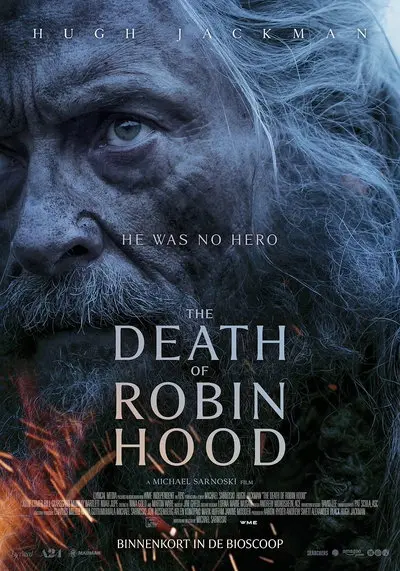
Hugh Jackman makes killing look like muscle memory and later seals remorse under exhaustion. The reserve is appropriate, but sometimes emotional distance masquerades as depth. Little John's early disappearance also costs the film a relationship that might have illuminated the old Robin. These choices create severity and loneliness, though not always intimacy.
A wounded landscape and violence without pleasure
Shot on 35mm in Northern Ireland, the exterior world is mist, snow, mud and punishment. The warmer, tighter priory suggests healing without ever becoming safe. The contrast can be overly direct (cold for violence, warmth for reflection) but it gives the film a strong physical identity.
Combat is heavy, exhausting and ugly. Blades damage bodies, arrows prolong suffering and fire presses against faces. The film does not want skill to become entertainment while victims disappear. Music occasionally overstates what the images already communicate, and the long monastic stillness sometimes becomes inertia, but the refusal to romanticise violence remains one of its most successful choices.
Final verdict
Final verdict
The Death of Robin Hood is powerful in conception, beautiful in image and serious in its moral questions, though neither easy nor completely balanced. Its violence hurts rather than thrills, and Robin's bond with Margaret holds a compelling tension between care and inherited harm. But the film keeps its emotion sealed for too long, stretches the priory passages and gives Brigid less inner life than she deserves. Its reward is not conventional excitement or a heroic end, but the question it leaves behind: can a person truly change after the damage has become greater than anything he can repair?
AUDIENCE VOTE
Do you agree with the MB rating?
Choose once from this browser. You can change your answer at any time.