The review
The wine bottle is never just a wine bottle
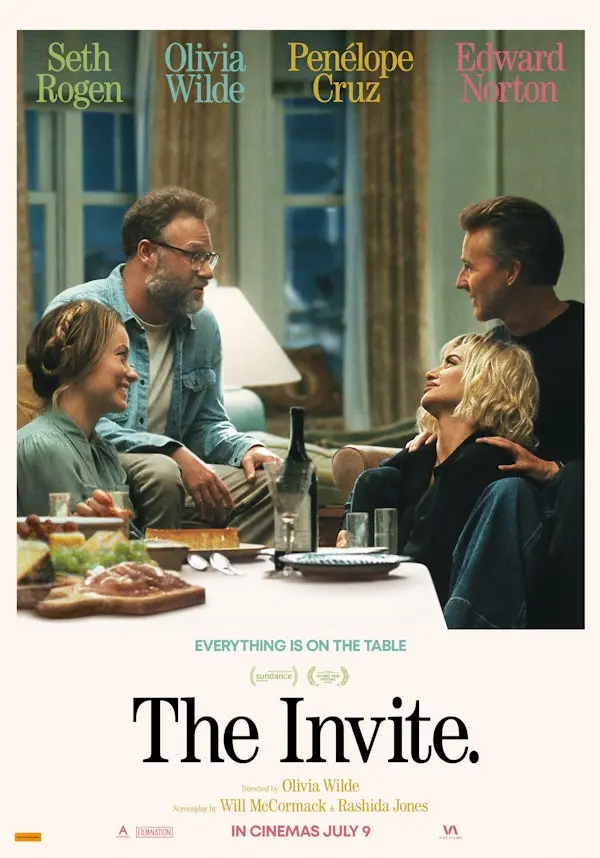
The film establishes the crisis between Joe and Angela before the guests arrive. She is angry because he forgot the wine; he claims he did not even know there was a dinner. The argument is trivial only on the surface. Like many conflicts in long relationships, it carries years of feeling unheard, of one person carrying the emotional load while the other behaves as though nothing happened.
No one announces that the marriage has been collapsing for years. We read it in tone, glances, the silence after a sentence and the speed with which both are ready to explode. That naturalism makes the opening especially effective and gives every later confession a history that seems to predate the film.
Joe and the version of himself he cannot hear
Seth Rogen gives the film's strongest performance. Joe is sarcastic, defensive and often cruel, yet the writing refuses to reduce him to a bad husband designed to make Angela automatically right. His hostility grows from a deep sense of failure: the musical life he imagined never arrived, and he now teaches music in his old family home while the piano has become an object no one is allowed to touch.
When Hawk finds a record by Joe's old band, the embarrassment is not simple nostalgia. Music has become evidence of the person Joe believed he would become. Rogen expresses that grief not through open sadness but through jokes, contempt and attacks on everyone else, the defensive language of a man who cannot tolerate being reminded of his own abandoned self.
Angela wants to be seen again
Olivia Wilde plays Angela as the social stabilizer. She wants dinner to succeed, the neighbors to like them and Joe to stop before every humiliating remark. Her instinct is always to smooth the room and preserve the image of a normal marriage, but the cost is that Angela herself has begun to disappear inside that image.
Her admission that she sometimes stands at the window knowing other people can see her is not only provocation. It reveals a need to feel visible, to be more than a wife and mother inside a frozen relationship. Pína and Hawk fascinate her because they appear to offer a life with more freedom, presence and desire.
Pína and Hawk are not the answer
The neighbors first appear to be the opposite of Joe and Angela: candid, relaxed and comfortable with unconventional rules. The film improves when that polished alternative begins to crack. Pína's confidence sometimes sounds like a defense brief for her way of living, while disagreements with Hawk reveal that freedom does not remove insecurity or power struggles; it merely gives them another form.
Edward Norton makes Hawk more than an eccentric man with a self-chosen name. Once the story behind that name and his former wife emerges, Joe's mockery suddenly feels much crueler. The shift captures the film's central truth: everyone at the table carries a history the others cannot see, and every confident judgment is made with missing information.
The proposition exposes the original marriage
Pína and Hawk accepted the invitation believing the evening might lead to an encounter between all four of them. The misunderstanding creates the film's most uncomfortable comedy, but it is only a device. The real question is why the idea awakens so much curiosity in Joe and Angela. A stable marriage might have laughed it away; theirs treats it as a door into everything they have avoided discussing.
The attempted partner swap collapses into injury and humiliation, underlining that no new person can repair what the original couple refuses to confront. When we learn Joe and Angela have not been intimate for more than a year, every earlier detail (the window, the jealousy, the upstairs sounds) changes weight. The comedy becomes a sad study of two people who may not hate one another and therefore find separation even harder to name.
Performance carries what direction overstates
The first half thrives on social discomfort: a sentence that should not have been said, an attempted repair that makes it worse, a stare and a long silence. The four actors understand this rhythm, especially Rogen, whose Joe can turn every salvageable moment into a larger disaster.
The direction initially underlines the tension too aggressively through unstable camerawork, unusual framing, reflections and music that tells us a scene is uncomfortable after the actors have already done so. The film becomes stronger when the style calms down and simply leaves four excellent performers in a room together.
A truthful problem deserves a less tidy answer
Pína eventually frames the choice simply: begin again and fight for the marriage, or admit that it has ended. The principle is sound, but the screenplay sometimes makes separation feel clearer and quicker than the complexity it has built. This is a long marriage, a shared daughter, accumulated damage and two people who visibly still share a bond. A beautiful sentence cannot resolve all of that.
The piano ending works precisely because it refuses a final verdict. After the confessions and shouting, Joe and Angela share a quiet moment and the film does not tell us whether they will remain together. That uncertainty is more honest than a neat answer. It accepts that a marriage can be damaged, meaningful and undecided at the same time.
Final verdict
Final verdict
The Invite is a film of acting and conversation before anything else. It needs no spectacle, elaborate locations or manufactured surprises; it puts four people in one house and removes the layers they use for protection. Its fairest achievement is refusing to make Pína and Hawk the correct model or Joe and Angela the failed one. Every person has chosen a way to live, and every one is hiding something. The direction occasionally distrusts the simplicity of that idea and the proposed solutions can feel narrower than the characters, but the ensemble gives the evening genuine history, hurt and humor. The final quiet at the piano understands what the film knows at its best: some relationships cannot be saved or ended by one perfect sentence.
Your turn
Do Joe and Angela still have something worth saving, or did the dinner merely reveal that their marriage had ended long before either admitted it?
AUDIENCE VOTE
Do you agree with the MB rating?
Choose once from this browser. You can change your answer at any time.