The review
A fractured memory and an uncertain beginning
Nolan refuses a straight voyage. The present folds into Troy, Ogygia, Ithaca and Telemachus's search, while different witnesses build competing versions of the past. The idea is sound: Odysseus does not possess his life as one complete memory, so neither do we. The story assembles itself as he does.
Execution is less convincing in the first act. The movement between places and time periods delays emotional attachment; rather than entering the voyage, we initially work to locate ourselves inside it. Once the film allows its longer adventures to breathe, it becomes far more absorbing. The fragmented design is intellectually interesting, but a clearer, more emotionally immediate opening would have served it better.
Odysseus, hero and author of his own suffering
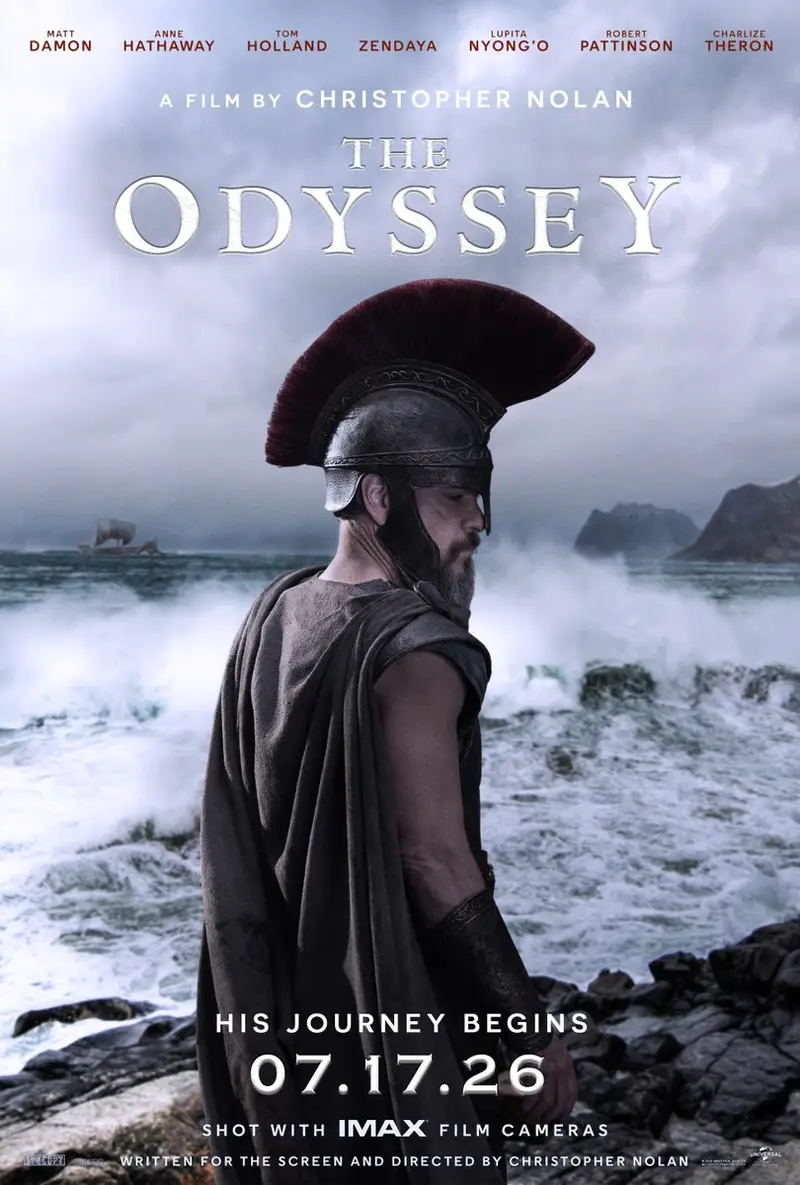
Matt Damon plays Odysseus as brave and ingenious but also vain, impulsive and dangerously convinced that he knows best. He taunts the Cyclops when escape is already possible and chooses the route past Scylla knowing some men must be sacrificed. The gods punish him, but he is never merely their victim. Pride, curiosity and command manufacture part of the suffering he carries.
Damon's restraint suits a man who no longer knows whether he wants his throne or simply somewhere to stop. Exhaustion sits convincingly in his face. Yet the same control sometimes creates distance: we understand Odysseus's torment more readily than we feel it. The personal journey never consistently achieves the heat of the visual one.
Troy, faith and the manufacture of glory
The film's sharpest reinterpretation is the Trojan Horse. What legend celebrates as military genius becomes a symbol of deception, disposable soldiers and religion used to cover massacre. Agamemnon's monumental armour does not express true power so much as his need to look chosen by power. He invokes the gods while violating what they supposedly sanctify.
Power, the film argues, need not be sacred; it only needs to persuade people that the sacred selected it. War then gives monsters a moral vocabulary. Killing becomes duty, deception becomes genius and anyone outside the story becomes an enemy. The horse does not merely win a city. It begins the process by which a crime is rewritten as glory.
Sinon and the men erased by legend
Sinon is the film's most moving invention. Presented at first as the man who heroically sells the Trojan Horse deception, he is later revealed as a poor young substitute used by Antinous and then by Odysseus. He dies believing his sacrifice may help his family, only for the promise and his name to disappear beneath the commanders' legend.
Their encounter in Hades strips war of song and leaves the dead to speak. Sinon is not asking to be called a hero; he is furious that he became a small gear in somebody else's war. Odysseus later assumes his name in Ithaca and kills Antinous while invoking the betrayal. It deepens the revenge but does not absolve the king, who was part of the lie and can only acknowledge the debt too late.
Telemachus, Penelope and lives left waiting
Telemachus knows his father only as a song. His search through the testimony of Menelaus and Helen steadily changes that inherited image. Their eventual meeting is beautifully indirect: Odysseus hides under Sinon's name, but the old dog Argos recognises him, wags his tail and dies. The animal sees the man behind the legend before the son can.
Tom Holland is affecting but receives limited independent development. Anne Hathaway gives Penelope strength despite a similarly restricted part. She is besieged inside her own home, weaving time and using the bow challenge to expose truth, yet (as often in Nolan's work) the women remain mirrors or stations along a man's path. Calypso, Circe, Athena, Helen and Penelope matter, but Penelope in particular deserved to be a full partner in the narrative rather than the homeland awaiting return.
An anthology of monsters, memory and sound
The voyage lets Nolan move among cinematic modes. The Cyclops approaches cave horror but runs too long and too dark. Circe's transformations become effective body horror. Hades is among the film's finest passages, a vast emptiness in which guilt is more frightening than fire. The Sirens are built brilliantly through altered sound, while Scylla and Charybdis turn navigation into a brutal question of whom a leader chooses to lose.
The variety is exhilarating and uneven. Some episodes feel complete; others seem like necessary bridges. Ludwig Göransson's score and an extraordinary soundscape give arrows, surf and the final bow physical weight, though the music occasionally pushes feeling too hard. This is a film designed to be heard through the body, even when spectacle begins to overwhelm drama.
The massacre at home and the myth left burning
Ithaca contains the film's most sincere quiet moments, then turns the bow challenge into an extended action massacre. The sequence is lucid and thrilling, but it exposes the film's deepest contradiction: a work that condemns male violence also gives the audience enormous pleasure in watching Odysseus deploy it. The tension may be intentional, yet the direction celebrates the killing more than it interrogates it.
Odysseus finally gives the throne to Telemachus and sails west with Penelope to honour his men and atone. He has rescued his family but not yet himself. The closing image of the Trojan Horse burning turns the icon of ingenuity into the origin of collapse. Songs will preserve Odysseus, but they will edit the blood, enlarge the hero and tempt later generations to repeat the lie.
A cinematic event larger than its dramatic effect
Real seas, boats, caves and landscapes give the production a weight green screens rarely provide. Troy, Hades and the maritime passages contain images made for IMAX, and the huge cast reinforces the sense of occasion. Yet scale does not make every scene great. Some images are unnecessarily dark, and at times the production seems impressed by its own magnitude.
Its phenomenon status makes sense: Nolan, a foundational myth, practical spectacle, major stars and a communal theatrical experience. But popularity does not cancel criticism, and lack of complete awe is not a failure to understand. Some films become events because they are masterpieces; others because they arrive at exactly the right cultural moment. This one combines real quality with an event larger than its final emotional effect.
Final verdict
Final verdict
The Odyssey is a good and ambitious film, exceptional in passages, but it did not overwhelm me as a complete work. I admire the craft and understand why audiences have turned it into an event. Its strongest achievements are the rethinking of Troy, Sinon, Hades and the stories that convert crime into glory. Its weakest are the hesitant opening, uneven episodic rhythm, emotional distance and a solemnity that rarely lets the tale breathe. It is not a bad film surrounded by empty hype; it is a genuinely good film surrounded by a phenomenon larger than its effect. That is not a contradiction. It is the difference between measuring success and measuring the experience.
AUDIENCE VOTE
Do you agree with the MB rating?
Choose once from this browser. You can change your answer at any time.