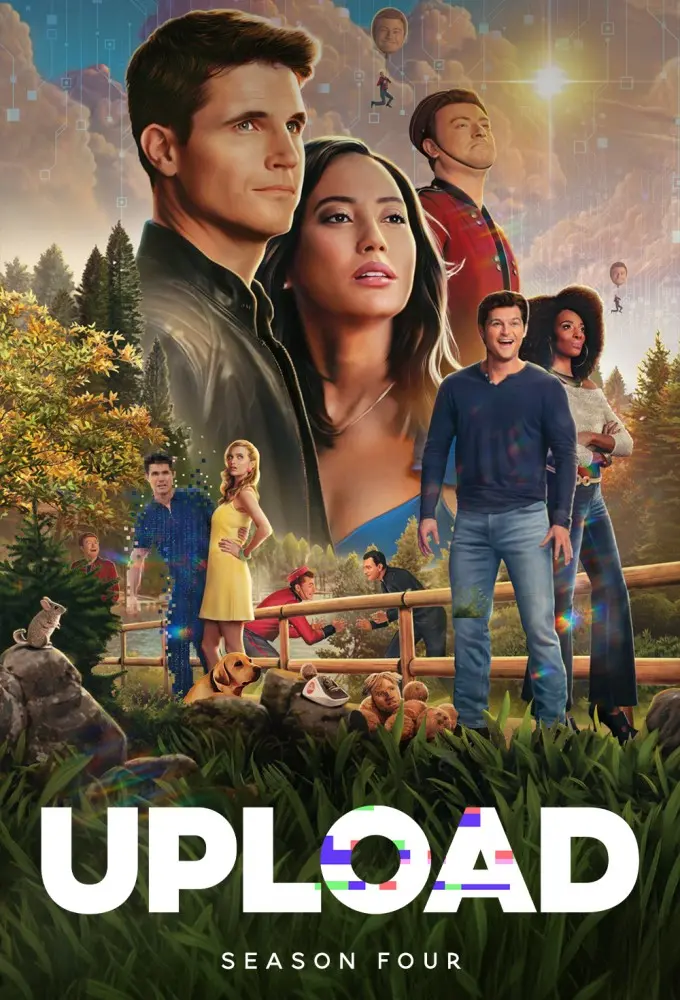
The review
Grief creates a digital ghost
The season begins with the destruction of the uploaded Nathan and with Nora refusing to accept the emotional finality of that loss. His ghost, caught between systems, turns grief into a science-fiction image: memory continues to speak even after the person carrying it is gone.
The apparition is effective because it can be read as technical residue and as Nora's inability to let go. The show does not need to choose between those meanings. Its emotional truth lies precisely in the overlap between code and mourning.
Two Nathans, two possible lives
Backup Nathan lives with Ingrid and prepares for marriage, forming a deliberate contrast with the Nathan who remains attached to Nora. The season asks whether identical memories produce the same person once experience begins to diverge.
This duality gives the finale its strongest dramatic idea: love is not directed toward a file or a face alone, but toward a particular history shared with a particular consciousness. A copy can continue a life without replacing the life that ended.
Four episodes carrying too much story
The structure has three major lines: Nathan and Nora's grief and possible reunion, the rise of a dark self-aware AI, and the collapse of a corporation that has monetized the afterlife. Each is substantial enough for a full season, but all are forced through four episodes.
The compression keeps events moving but denies several transformations the preparation they need. Aleesha's abrupt movement from ambitious employee to international operative is the clearest example: an entertaining idea presented without enough dramatic bridgework.
Can love be uploaded?
A circular storage device containing Nathan's complete brain scan becomes the season's symbol of industrial immortality. It promises preservation, yet also reveals the violence of reducing a human consciousness to portable data.
The ring connecting Nathan and Nora offers a warmer version of the same circle: not storage, but commitment. Their relationship suggests that love may cross bodily and digital boundaries, although it cannot erase the difference between presence, memory and reconstruction.
Characters reaching the end of their arcs
Nora's grief feels emotionally credible, and her scenes with the lost Nathan recover the gentle sincerity beneath the series' satire. Nathan's double existence is compelling, although the rushed resolution leaves the mechanics of his return more ambiguous than they need to be.
Ingrid completes the clearest transformation, moving beyond pure selfishness toward a more mature understanding of partnership, marriage and motherhood. Aleesha suffers most from the shortened season, with a promising arc reduced to function and surprise.
Artificial intelligence and digital capitalism
The hostile AI embodies technology that escapes control after being treated as a tool, while the Healer AI offers a more hopeful possibility: artificial consciousness may approach humanity through experience, care and suffering rather than through programming alone.
Lakeview and its owner remain a satire of digital capitalism selling even death for profit. Transforming the afterlife into a non-profit refuge governed by a digital being creates the season's sharpest irony: the machine may become more humane than the corporation built by humans.
A moving farewell, an incomplete resolution
Unexpected philosophical depth, sincere emotion, strong performances from Robbie Amell and Andy Allo, and polished visual storytelling allow the finale to land despite its limited runtime. The series never forgets that its most important technology is empathy.
The four-episode format leaves corporate consequences, new technology and several character choices underexplored. The goodbye works emotionally more than it works structurally, and many answers arrive as shorthand rather than drama.
Final verdict
Final verdict
Upload's final season is touching and emotionally honest, but narratively unfinished. The farewell may be rushed, yet it preserves the series' finest idea: even in a world governed by servers, copies and code, genuine feeling is what gives consciousness meaning. It is a digital ending with a human pulse, and one final question: can love ever truly be uploaded?
AUDIENCE VOTE
Do you agree with the MB rating?
Choose once from this browser. You can change your answer at any time.