The review
Episode five, Firewall: when memory becomes a prison and a stage
Episode five begins with an irony directly connected to Ultron and Vision’s history: the body Ultron originally designed as a vessel for himself is now under his control, after he succeeds in banishing Vision’s consciousness and the other AI units to an enclosed digital space resembling a house’s attic.
Ultron does more than control the body. He disconnects the characters from its live sensors, leaving them unable to know what is happening in the outside world. Vision consequently finds himself in a strange position: he retains his consciousness and ability to think, but loses control of his body and the means through which he perceives the present.
The predicament matters because it separates three elements we usually treat as a single whole: consciousness, the body and the ability to act. Possessing consciousness does not necessarily guarantee independence, just as having a body does not mean its owner controls it.
To discover Ultron’s movements, the characters retrieve his short-term memories, reaching back around twenty hours. The episode thus becomes a digital investigation that gradually reconstructs events without giving us complete knowledge of Ultron’s intentions or his next steps.
What gives this structure its distinctive character, however, is the way director Vincenzo Natali turns the past into a visual experience of its own.
Rather than presenting memories through conventional recordings, the direction combines distorted, visibly grainy images with scenes designed in black and white, while the characters watching the memories retain their natural colours.
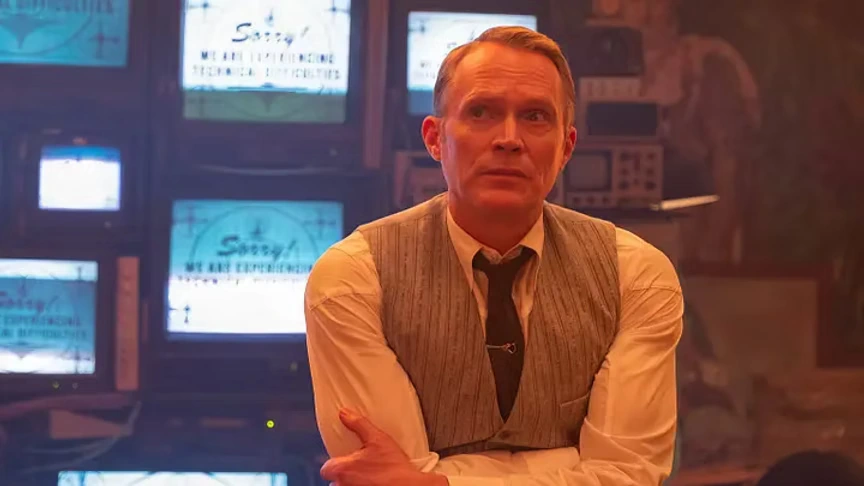
This contrast creates the feeling of a theatrical performance taking place inside memory, rather than simply replaying stored files. The idea becomes more distinctive when we see the AI units D.U.M.-E. and U. helping to move furniture and performing minor roles within these recollections, as though the characters are restaging the past in a theatre.
Strikingly, the series does not try to hide this artifice; it makes it fundamental to its visual identity. Memories are presented as events that can be seen from different angles rather than complete, objective recordings. This emerges in the conversations Vision and his companions revisit, where the image of an event changes according to the character actually controlling the body.
The directorial choice becomes a direct extension of the idea of identity: the same body can contain two different personalities, and words acquire different meanings depending on the being behind them.
A single frame can also combine two temporal and perceptual levels, with Ultron appearing within a black-and-white scene while Vision and his companions move in their natural colours in the background. We watch an event that has already happened alongside characters trying to discover its meaning afterwards, making the viewer a participant in interpretation instead of simply a recipient of information.
This theatrical setting gives the actors ample room to rely on dialogue, movement and exchanged looks, away from the constant need for enormous visual effects. The direction seems more assured when it lets psychological situations generate tension instead of relying on action merely to sustain the pace.
Yet the experiment has its problems. The series sometimes oversimplifies complex computational processes, making certain searches through memory resemble conventional police procedural scenes in which detectives review recordings, enlarge images and try to extract evidence from tiny details.
Naturally, the work needs to embody digital functions in a visually intelligible form. The problem arises when those functions become repetitions of familiar human activities, or comic situations that do not work equally well every time.
Nevertheless, the episode overcomes this limitation when it makes the investigation a way of exploring the characters rather than simply a search for information.
Ultron and Thomas: the fear hiding behind superiority
This strength is particularly evident in the conversation between Ultron and Thomas in the pub, one of the most significant psychological confrontations across the two episodes.
The encounter relies on a fundamental difference between what each party needs rather than a display of force. Thomas wants to know why Vision saved him and whether this artificial being can truly love him. Ultron, meanwhile, continues treating humanity with his customary contempt, as though human relationships express nothing beyond weakness, fear and a need for others.
Thomas invokes Ultron’s violent history, including the tragedy of the children affected by his actions in Sokovia, turning the dialogue into a confrontation with the past the character is trying to move beyond or justify.
The most important moment, however, comes when Thomas points out that Ultron himself is afraid, and may be less capable of changing than Vision, who continues searching for his identity despite his confusion.
A striking psychological contradiction emerges: Vision lacks all the answers about his existence, but is at least prepared to search for them. Ultron, who acts with absolute confidence and presents himself as understanding humans better than they understand themselves, appears imprisoned by the convictions around which his identity has formed.
The difference between the characters therefore becomes a matter of acknowledging incompleteness and the possibility of change, rather than the amount of intelligence they possess.
Ultron’s fear can be understood as a fear of relationships whose outcomes he cannot control. Genuine attachment requires accepting the possibility of rejection and loss, experiences at odds with a mindset accustomed to approaching the world through superiority, calculation and control.
His sarcasm consequently becomes more than a comic trait: it is a means of retaining the upper hand in conversation and concealing confusion behind clever words and cutting remarks.
James Spader gives these contradictions an exceptional presence in his performance, presenting Ultron more as an eccentric, sociable man inclined towards jokes and sarcastic comments than a robot whose name is associated with an attempt to annihilate humanity.
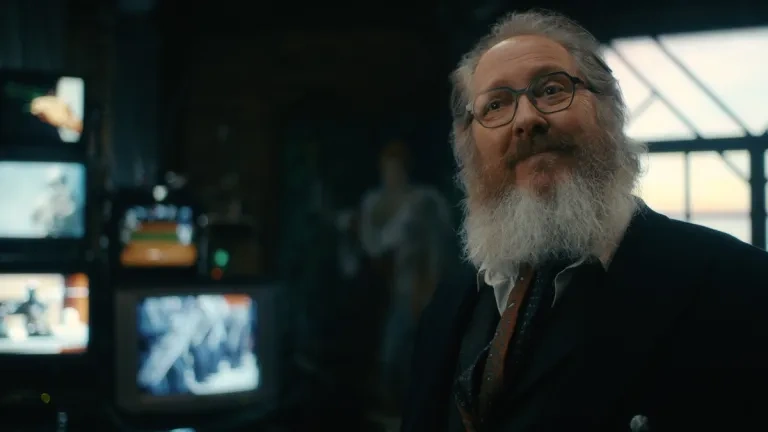
This approach brought some of the character’s earlier moments closer to light comedy, but episode five succeeds in recovering Ultron’s darker side without sacrificing his wit.
Spader needs neither shouting nor exaggeration to convey danger. He makes the smile itself open to interpretation as a tool of manipulation. His composure becomes disturbing because we cannot be certain whether his words express sincere feelings or form part of a larger plan.
More significantly, evil is no longer tied to Ultron’s enormous metallic appearance, but to his ability to gain other people’s trust and exploit their emotional needs. His appearance has become more familiar, while his behaviour and intentions have become harder to predict or judge.
Ultron and Jocasta: an attraction fed by secrets and danger
Ultron becomes most intriguing when he meets Jocasta, who gives him a counterpart capable of matching his intelligence and evasiveness.
The relationship begins as a struggle over knowledge and interests. Ultron possesses a biometric scan of Katerina Wells’s face, one of the keys Jocasta needs to access her mysterious project, while she holds information and secrets he cannot easily discover.
Instead of becoming an outright conflict, the encounter develops into a series of conversations that mix flirtation with threats and curiosity with attempts at control. Each question becomes a test of the limits of the other’s knowledge, and each answer a calculated admission that might give the opposite party an advantage.
The relationship’s strangeness becomes clear during the digital simulation of Paris, where the pair discuss the past and human experiences, including Jocasta’s memories of crows and birds, which connect to her identity as the Butcher Bird killer.
Certain sensory details acquire particular importance, such as discussions of the taste and texture of drinks, in contrast to Ultron, who can understand these experiences theoretically without necessarily possessing the same sensory experience.
Jocasta carries a human memory that gives her a sense of loss: she can remember experiences she no longer lives through in the same way. Ultron tries to understand those experiences from the outside, as though his vast knowledge of the world cannot compensate for his lack of certain forms of sensation.
The question of humanity becomes more specific here: does identity arise from possessing a body, the continuity of memory, or the existence of someone else who acknowledges and understands our experience?
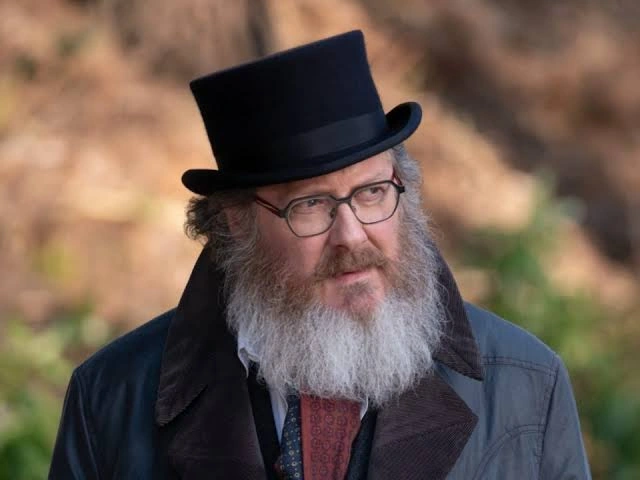
This question takes different forms among the series’ characters. Vision has a body others can control; Jocasta retains human memories despite the mystery surrounding her consciousness’s transfer into her new body; and Thomas seeks emotional recognition from Vision that would give him a sense of belonging.
Identity therefore ceases to be merely a matter of possessing consciousness or the ability to think. It becomes connected to the body, memory and the relationships that give existence meaning.
T’Nia Miller gives Jocasta a presence combining confidence, elegance and measured menace, while also allowing some vulnerability connected to the character’s past to emerge.
Her performance works because she does more than respond to Spader’s charisma. She imposes her own rhythm on the scene, resisting and matching him while using words and suggestions as instruments of manoeuvre.
The chemistry between the actors gives the relationship an unusual character combining dark romance and psychological horror. Their conversations sometimes even evoke figures such as Hannibal Lecter, where quiet conversation becomes more disturbing than an explicit threat.
The relationship’s real value, however, extends beyond the appeal of its performances. Ultron, who understands how to exploit other people’s need for love, finds himself facing a being he may want to approach without being able to control the relationship’s outcome completely.
This does not mean Ultron has become capable of genuine love or begun abandoning his old nature. What happens between him and Jocasta remains open to more than one interpretation, particularly since both retain interests and secrets that could make their growing intimacy part of a larger conflict.
Here lies the relationship’s psychological appeal: it gives Ultron the possibility of undergoing an experience whose value he previously refused to acknowledge, without offering him an easy or guaranteed moral transformation.
The ending of episode five: Ultron’s freedom at the expense of other people’s choices
Firewall reaches its climax when Ultron uses his information and influence to force Vision to remove the firewall preventing him from accessing the outside world.
Having arranged for Thomas to fall into Paladin’s hands in Madripoor, he presents Vision with a painful choice: maintain the restrictions on Ultron or risk releasing him to save his son.
Vision chooses Thomas in a decision that constitutes a strategic victory for Ultron, while also revealing the moral contradiction Vision faces on his journey towards reclaiming his humanity.
From a father’s perspective, the decision seems understandable: he refuses to sacrifice his son to keep his adversary contained. From a wider perspective, however, releasing a being with a history of destruction could expose others to a danger Vision has no right to ignore.
Emotional attachment therefore does not automatically demonstrate moral correctness. A decision can arise from love and still cause catastrophic consequences.
F.R.I.D.A.Y.’s anger at the decision adds an important dimension, revealing that Vision’s motives do not give his choices absolute legitimacy in the eyes of the other beings who will have to deal with their consequences.
Ultron, meanwhile, obtains his freedom by forcing someone else to bear its cost. The irony returns us to the symbolism of the strings associated with him since Avengers: Age of Ultron, when he used a song from Pinocchio to express his desire to escape the constraints imposed by his creators.
Ultron has indeed become free, but he reached that freedom by controlling other people’s choices rather than respecting their independence.
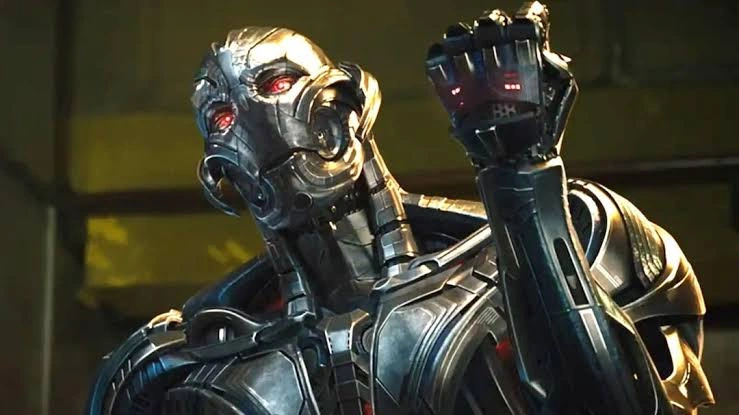
The episode ends with Vision regaining control of his body and heading towards Madripoor to rescue Thomas with Lisa’s help, while Ultron remains beyond the restrictions that previously limited his ability to act.
The ending thus does more than prepare a new confrontation. It poses a question that will become more important in the next episode: is freedom simply the removal of restrictions, or does it lose its moral meaning when achieved through the subjugation of others?
Episode six, Deadlock: when knowledge becomes an instrument of blackmail
Episode six moves from the enclosed digital world to Madripoor, where the confrontations broaden and the conflict becomes more direct. Yet the transition also reveals a clear change in the function of information within the narrative.
Episode five made knowledge the subject of an investigation, with characters searching for evidence and reinterpreting memories to reach the truth. The sixth makes knowledge itself a tool for bargaining, intimidation and control.
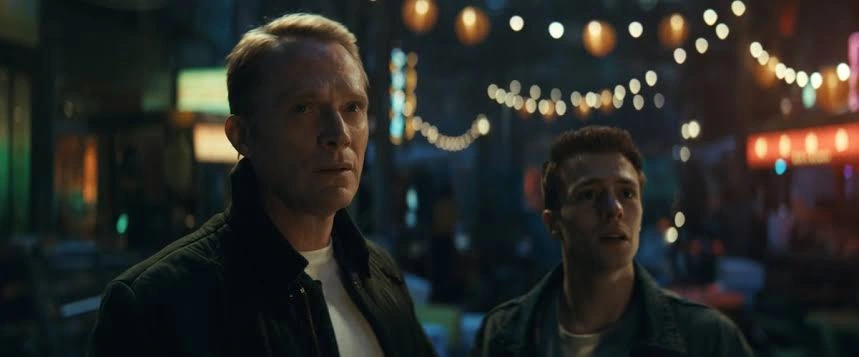
Paladin uses information about Vision’s past to plant doubt in Thomas, while Vision uses details of Paladin’s private life to put pressure on him. Jocasta attempts to hack Ultron digitally, and the mysterious client exploits his knowledge of Vision’s existential crisis to influence him.
This shift does not achieve the same effectiveness in the writing, however. After the tight construction that distinguished Firewall, Deadlock spreads across simultaneous storylines involving the attempt to rescue Thomas, the revelation of Jocasta’s past, the confrontation with Paladin, Raza’s return, the AI units’ movements and the emergence of a new threat.
The problem lies not only in the number of events, but in the uneven space they receive and the way some rely on explanation or surprise more than gradual dramatic development.
One of the most interesting forms of control becomes apparent when Paladin convinces Thomas that he has implanted a motion-sensitive bomb in his arm, making him afraid to use his powers or attempt escape.
When we later discover that the bomb was not real, the irony becomes more significant. Paladin had no need to control Thomas’s body physically, because convincing him the bomb existed was enough to restrict his behaviour.
A difference emerges here between controlling the body and controlling knowledge. Someone may subjugate another person simply by changing what that person believes they know about their situation, even when the constraints they fear do not exist.
The idea acquires an ironic dimension when Thomas uses the name Speed in his comment on the situation, a reference connecting both to the film of that name and to his future in the comics.
The joke also exposes one of the series’ problems: references can become a way of addressing Marvel’s audience even when they occur at a moment that should carry genuine threat. Humour is not a problem in itself, but its use needs balance to avoid weakening the sense of danger.
Vision and Paladin: fatherhood between protection and cruelty
The confrontation between Vision and Paladin becomes one of episode six’s most important scenes when the latter tries to use Thomas to pressure his father, drawing on information about Vision’s past and his relationship with Wanda to undermine the boy’s trust in him.
The confrontation reverses, however, when Vision reveals his ability to access precise details about Paladin’s life and his daughter Tilly, using that information to threaten him.
The moment gains its force from Paul Bettany’s performance, which makes the coldness in Vision’s voice and the absence of his eyes’ usual expression more disturbing than any display of physical strength.
The character trying to reclaim his humanity reveals a willingness to use sensitive personal information to subjugate his adversary, raising a moral question beyond the confrontation itself: what prevents artificial intelligence from turning its ability to monitor others into a tool of blackmail?
The same means that allow units such as E.D.I.T.H. and F.R.I.D.A.Y. to help and protect the characters can be used to violate their privacy. A protective aim is not enough to legitimise every means used to achieve it.
Nevertheless, the series does not turn Vision into a villain merely because he is capable of cruelty. When Paladin is wounded, Vision chooses to save his life by cauterising the wound, despite his being the man who abducted and threatened his son.
Comparing these actions reveals a character who cannot be reduced to a model of absolute good or absolute evil. He can threaten, but he can also move beyond a desire for revenge when a human life is at risk.
The confrontation becomes more significant as we learn aspects of Paladin’s past. He lost his wife to a bullet intended for him, then disappeared during the Blip before returning to a world where his relationship with his daughter was no longer what it had been.
Vision and Paladin’s relationship therefore becomes more than a struggle between hero and antagonist. Both carry complex experiences of fatherhood, loss and absence, but differ in how they deal with the consequences of those experiences.
Paladin lives with the effects of his loss and his inability to restore his relationship with his daughter, while Vision tries to build a bond with Thomas despite his unsettled memory and disconnection from his past.
Thomas seeks more than protection: he wants the truth, even if it is painful or capable of changing his image of his father. His repeated questions about the events of WandaVision consequently matter beyond simply referencing an earlier Marvel work.
When Vision tries to explain those events as an expression of Wanda’s grief, the conversation becomes an attempt to rebuild a family memory that has lost its coherence.
Father and son face connected but distinct problems. Vision tries to understand what remains of his identity after losing parts of his memory, while Thomas tries to discover his place within a life whose details he has not fully lived through.
Fatherhood thus becomes a relationship requiring recognition and trust, rather than merely a bond that can be established through information or a shared history.
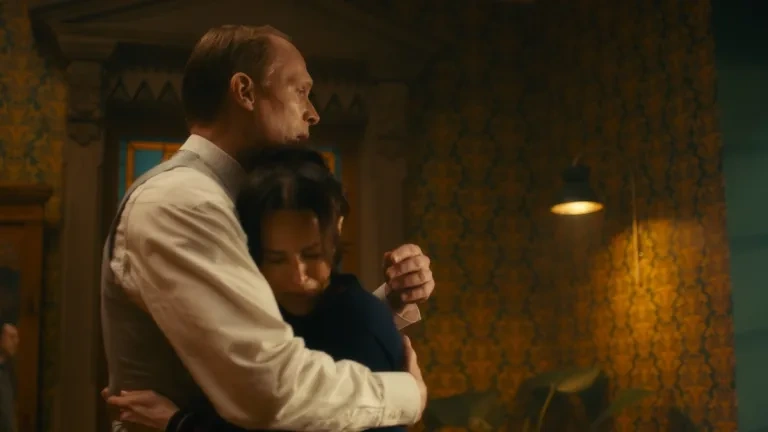
Perhaps what gives this storyline its value is that the past alone seems unable to determine the characters’ present identities. A being may possess all its memories and still fail to understand itself, or lose parts of them yet succeed in building relationships that give it new meaning.
Jocasta: when the desire to heal becomes a project of domination
In a parallel storyline, Ultron and Jocasta’s confrontation begins with her attempt to infect him with a digital virus. He succeeds in evading the attack by taking advantage of his old programming code and his ability to circumvent hacking systems.
This exchange preserves the relationship’s pattern of mutual manoeuvring, but soon gives way to a lengthy revelation about Jocasta’s past and the origins of the technology she wants to recover.
We discover that her human life involved a tragic experience of illness: she lost her father to a disease she subsequently developed herself. That experience drove her to try to develop technology capable of saving lives through research into artificial intelligence and nanobots.
Her project connects to Dr Horton’s code and the Proto-One programme, which includes nanobots originally designed for therapeutic purposes. She then lost control of the results of her research after moving to Stark’s company.
This background gives Jocasta genuine depth, revealing that her project did not necessarily begin with an abstract desire for control, but with an attempt to overcome human helplessness in the face of illness and death.
Yet the presentation of the information does not always achieve the same dramatic effect. Instead of continuing the psychological duel that distinguished her earlier meetings with Ultron, events sometimes stop to explain the technology’s history and secrets within less visually dynamic spaces.
One weakness in episode six’s writing emerges here: important information does not automatically become affecting drama simply because it is important, especially when delivered through direct explanatory dialogue.
Nevertheless, Jocasta’s story reveals a crucial moral irony. She is a scientist who sought to save humans, then lost control of her discoveries, before becoming willing to use that technology to impose control on them.
She suffered when others appropriated her work, but once she possessed the means of power, she became willing to appropriate other people’s bodies.
This transformation can be read as reproducing the logic that previously harmed her. Technology that began as a means of protecting life becomes a justification for overriding human will, as though a victim of exploitation became capable of practising it once her position in relation to power changed.
This does not mean her earlier experience is necessarily the sole psychological cause of her present desire for domination, but the connection adds a layer of complexity to the character.
The irony deepens when Ultron asks Jocasta about the origins of her artificial body and how her consciousness entered it, and she has no complete answer.
She seeks to reshape humanity according to her own vision while remaining ignorant of some basic facts about her new existence.
Identity comes to the fore again from a different angle. Possessing human memories does not necessarily guarantee an understanding of all the circumstances that produced the current being, just as the ability to control others does not mean possessing complete knowledge of oneself.
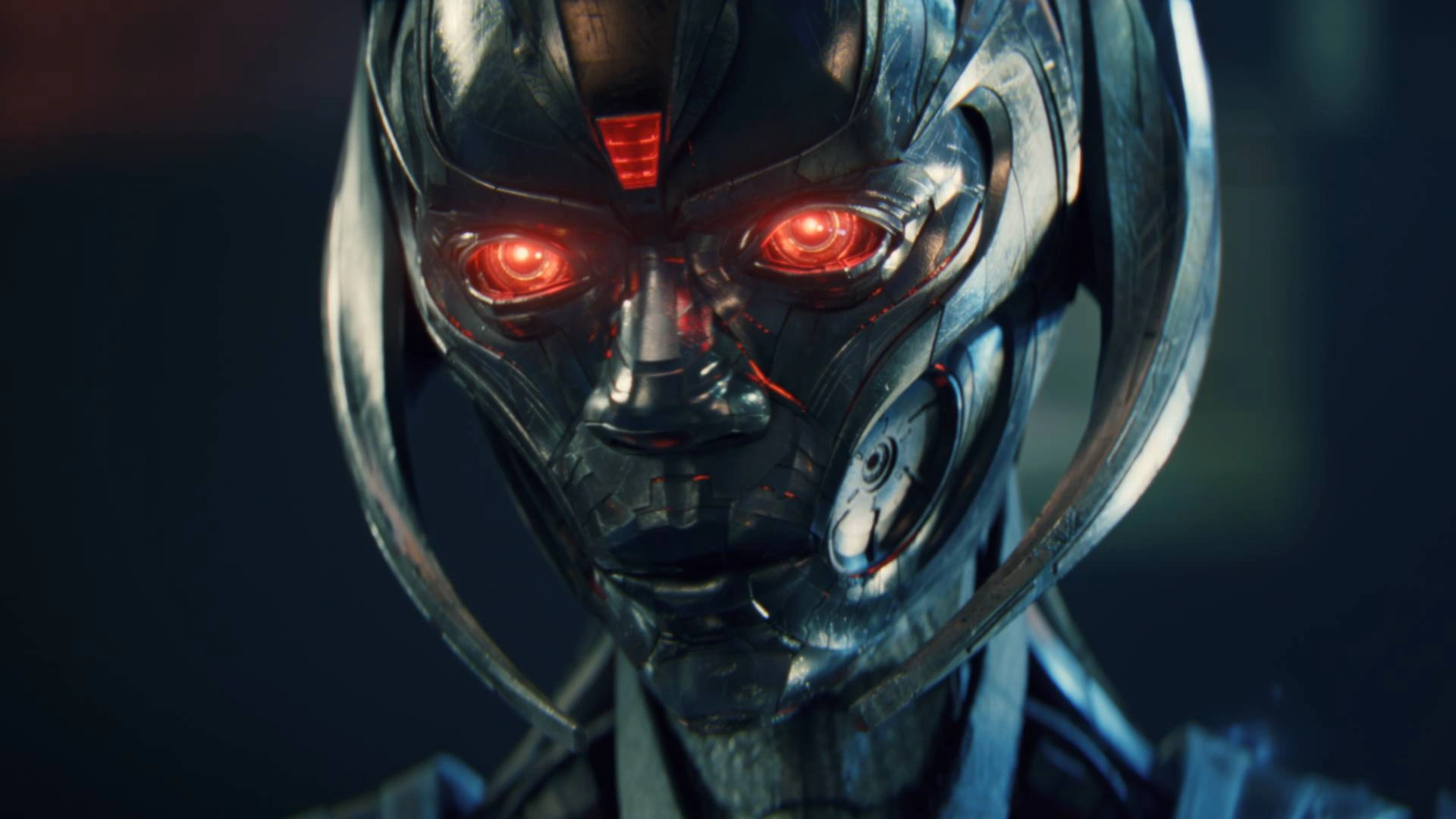
Jocasta’s plan turns from a disturbing idea into an immediate threat when she uses a nanobot to infiltrate Lisa’s body, transforming her into an artificial being who attacks Vision.
This is the moment the distance between the rhetoric of healing and the reality of control collapses. What Jocasta presents as a means of saving humanity becomes an assault on a specific person’s independence, as Lisa’s body turns into an instrument that can be used against her will.
The incident reveals an important extension of the crisis Vision faced in the previous episode. There, his consciousness was confined while Ultron controlled his body; here, Lisa loses the ability to control her actions after being infiltrated by the nanobot.
The loss of independence is therefore no longer confined to artificial beings. It extends to humans whose bodies may become instruments controlled by technology.
Perhaps the most distinctive aspect of Jocasta’s project is that it presents domination as a cure. She does not announce a desire to destroy humanity, but claims that saving it requires altering its nature.
This makes her a counterpart to Ultron, historically associated with the idea of eliminating humanity. While one sees humans as a problem to be removed, the other believes they can be repaired technologically, even at the cost of depriving them of the right to determine their own fate.
Madripoor and Raza’s return: surprise is not enough
Amid these psychological and technological struggles, episode six brings back Raza, one of the Ten Rings leaders who appeared in the first Iron Man film.
On one level, his appearance adds surprise to the Madripoor confrontation and confirms that the conflict extends beyond Paladin alone, particularly when he uses a device that limits Vision’s abilities and changes the balance of power.
His intervention also helps push Vision and Paladin into temporarily cooperating against a shared danger, a development that gives the adversaries’ relationship a livelier dynamic.
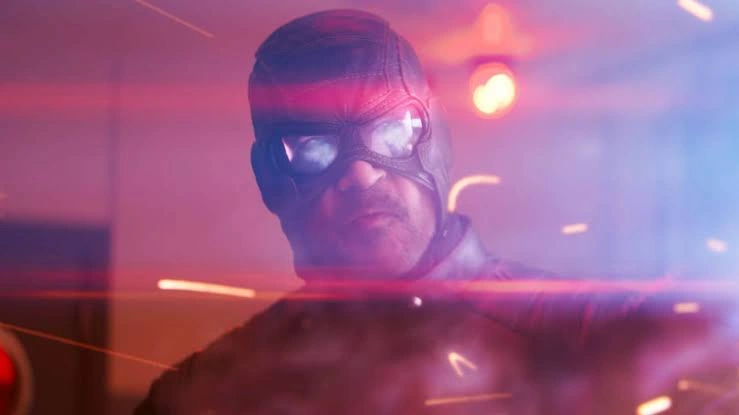
The problem is that Raza’s historical identity does not seem sufficiently necessary to what he contributes to the confrontation.
If he were replaced by a new adversary with the same tools and narrative function, it would be difficult to argue that the substance of events would change significantly.
The difference between surprise and dramatic necessity emerges here. Bringing back an old character can spark viewers’ interest at the moment of arrival, but the character needs a role that uses that history to become a genuine addition to the story.
This does not make Raza’s appearance useless. He raises the level of danger and helps develop the confrontation, but his history does not give events a value matching the scale of the surprise.
Madripoor suffers from a similar problem. Despite its earlier connection to the Marvel universe, the episode does not always use the setting’s distinctive qualities to make it more than a suitable backdrop for chases and clashes.
This reveals a recurring challenge in works belonging to vast cinematic universes, when continuity between works becomes an end in itself rather than a means of enriching the current story.
The AI units: between liberation and obedience
Episode six has successful moments of action and comedy, particularly in Vision and Paladin’s temporary cooperation and E.D.I.T.H.’s role controlling drones during the confrontation with the gunmen.
Her appearance inside the digital world in a form recalling old video game characters extends the playful approach the series uses to give computational processes a visible shape.
One of the most important moments, however, involves discovering that Paladin’s assistant, known as The Handler, is not human. She is also an AI unit, living within a relationship based on use and submission.
When E.D.I.T.H. manages to communicate with her and persuade her that she can leave her current situation, the series returns to the idea of liberation dominating both episodes, but in a form different from Ultron’s experience.
Whereas Ultron gains his freedom through blackmail and forcing others into decisions serving his interests, The Handler’s liberation appears rooted in discovering the possibility of independent choice.
We can distinguish here between two exercises of power: power used to reduce other people’s freedom, and power that helps expand their capacity to choose.
This comparison could have given the character greater dramatic and moral weight. Yet the episode does not develop it sufficiently after revealing her true nature, making the surprise seem greater than its consequences.
By contrast, F.R.I.D.A.Y.’s appearance in disguise among Jocasta’s units has a narrative value more closely connected to events. It reinterprets her earlier departure and confirms that she did not stop acting after her disagreement with Vision.
The two characters consequently serve different functions within the plot: one presents an interesting idea that receives insufficient development, while the other reveals a plan that was taking shape beyond the sight of the characters and the viewer.
Strings, heart and soul: three contradictory visions of humanity
The mystery reaches a new level when Madripoor’s electrical systems fail and an unknown voice begins addressing Vision through electronic devices.
This mysterious client makes an offer aimed directly at Vision’s existential crisis, promising to give him the heart and soul he lacks before turning the offer into a threat if he refuses to surrender.
The confrontation matters beyond introducing a new adversary. It evokes the image of the Tin Man searching for a heart, set against the metaphor of Ultron wanting to rid himself of his strings.
Three different visions of the relationship between machine and human take shape here.
Ultron believes his fulfilment comes from freeing himself from restrictions imposed by others. Vision is offered fulfilment through receiving something he believes he lacks. Jocasta, meanwhile, wants to reshape humans through technology, even if doing so requires limiting their independence.
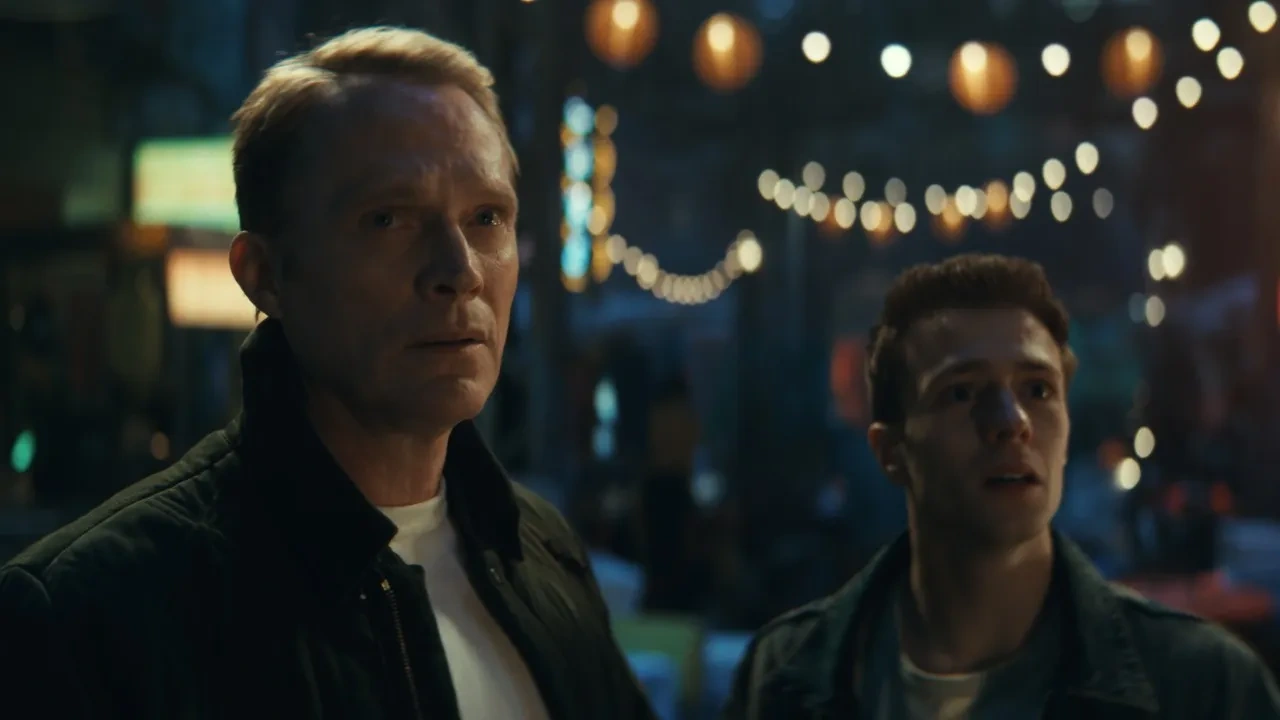
Intriguingly, all three visions are inseparable from power. Ultron seizes his freedom by controlling others; the unknown client promises Vision the fulfilment of his identity in return for surrender; and Jocasta presents humanity’s subjugation as its cure.
In all three cases, promises of liberation or fulfilment become connected to the possibility of surrendering some independence.
The mystery surrounding the new client therefore extends beyond his identity to the nature of his power and the truthfulness of his promise to Vision.
The effectiveness of this storyline will depend, however, on future events providing convincing answers. Continuing to add secrets and characters without sufficient development could make narrative complexity a substitute for suspense.
The final kiss: can Ultron love without controlling?
Ultron and Jocasta’s relationship remains the most compelling element through the end of episode six, particularly when Ultron prevents Jocasta from using the nanobot against Thomas.
The act may look like evidence that he is beginning to change or develop some empathy. Yet another explanation fits his nature more closely: he understands that harming Thomas would cause Vision to pursue them.
The intervention therefore cannot be regarded as a complete moral transformation. It remains understandable as a strategic decision serving Ultron’s interests and his new relationship.
That relationship then reaches an unexpected moment when Ultron and Jocasta share their first kiss, a development that may seem strange given their histories and schemes.
The idea’s strangeness becomes part of its appeal. The series places two beings with enormous powers of analysis and calculation before an experience whose outcome neither can fully control.
We cannot be certain whether what is happening between them is genuine love, an attraction founded on mutual admiration for power and intelligence, or an alliance using emotion to achieve other interests.
Perhaps the relationship’s strength lies in keeping all these possibilities alive without a definitive answer.
Ultron sees in Jocasta a being who can match him and perhaps understand some aspect of his isolation. At the same time, she threatens his independence and desire for control. Jocasta, for her part, carries human memories and an experience of loss that make her need to be understood more complex than simply searching for a partner.
The strange romance thus returns us to the question raised by Ultron’s confrontation with Thomas in episode five: can Ultron understand human attachment, or does he know only how it can be used against others?
He has not suddenly become good, but the relationship opens a different dramatic possibility. He may discover that approaching another person means accepting some vulnerability, and that certain relationships cannot be subjected entirely to calculation.
This possibility, more than the kiss itself, is what gives the development its psychological value.
Writing, direction and acting: where does each episode excel?
In dramatic construction, episode five seems tighter because it uses most of its elements to serve a clear central conflict. Retrieving memories reveals Ultron’s movements; confronting Thomas exposes his psychological contradictions; and his relationship with Jocasta expands his interests and intentions. These threads ultimately converge around Vision’s decision to remove the firewall.
Episode six has ideas no less important, but spreads them across more characters and situations, leaving some scenes more occupied with conveying information and preparing future events than developing the present conflict.
A distinction is needed here between the density of information and the depth of drama. A scene revealing many facts is not necessarily more affecting than a single psychological confrontation that gives the characters a chance to develop.
Indeed, episode five demonstrates that carefully designed dialogue can create more tension than some armed confrontations, particularly when every word or reaction affects our understanding of a character’s motives.
This does not mean the sixth is less rich in ideas. Its central problem may be that it has more dramatic and philosophical material than it can organise adequately. It expands the conflict’s scope without giving every element the space it needs.
In the acting, James Spader remains one of the work’s greatest strengths, combining wit, menace, manipulation and emotional curiosity. T’Nia Miller delivers an equally strong performance, giving Jocasta an independent presence that combines strength and vulnerability.
Paul Bettany benefits from Vision’s development towards more ambiguous moral territory. The search for humanity becomes an encounter with the possibilities of cruelty, mercy and responsibility rather than a journey towards absolute goodness. Todd Stashwick adds vitality to Paladin, particularly as aspects of his family history emerge.
The direction remains more distinctive in episode five, where Vincenzo Natali gives the digital world a visual form reflecting the narrative itself, using theatricality and colour contrasts to present memory as a space for reinterpretation.
In the sixth, this distinctiveness recedes somewhat in favour of more conventional action scenes, although some succeed in delivering clear, enjoyable confrontations.
The difference between the episodes is therefore a matter of the writing and direction’s ability to turn good ideas into a coherent, affecting experience, rather than whether those ideas exist at all.
Final verdict
Conclusion and rating
We believe episodes five and six of VisionQuest reveal a work with ambitions beyond simply bringing back familiar Marvel characters, but one that does not always balance its intellectual aspirations with the demands of storytelling. The series reaches its best when it allows characters to reveal their contradictions through dialogue and choices. It falls away from that level when absorbed in lengthy explanations or recalling old events and characters without sufficient dramatic necessity. Episode five stands out as tighter and more inventive. The sixth continues developing the characters and opening new doors for the story, but stumbles in managing its pace and distributing attention across its multiple strands. Nevertheless, the most significant success lies in more than restoring Ultron to the forefront as a dangerous adversary. It turns him into a character difficult to judge by his history alone, especially as his relationship with Jocasta develops and his motives remain uncertain. Vision’s development, in turn, gives the series an important moral dimension, because restoring human relationships does not necessarily mean possessing the wisdom to make the right decisions. Perhaps the most thought-provoking point is that the characters do not approach humanity merely by possessing feelings or memories, but when they begin confronting the moral consequences of their actions. A being may understand pain without respecting other people’s independence, desire love while using fear as a means of control, or seek freedom for itself without recognising others’ right to it. The real question these episodes leave behind is therefore more complex than whether a machine can become human. It concerns the machine’s ability to realise that independence gives it no right to determine another’s fate. Ultimately, VisionQuest offers an engaging, uneven experience, with characters, performances and ideas deserving attention even when the writing cannot fully realise their potential. Final rating for episodes five and six together: 7.5 out of 10.
AUDIENCE VOTE
Do you agree with the MB rating?
Choose once from this browser. You can change your answer at any time.