
The review
A crowded season searching for its identity
The central problem that began to emerge in the first two episodes is still here. The second season presents us with numerous characters and threats, and almost every character has a story and a conflict of their own that need attention.
There is Dexter, who is no longer content simply to kill criminals but now wants appreciation and recognition for what he does. There is Harrison, who has begun his career with the New York police, Claudette Wallace, who continues pursuing the New York serial killer, and Don Framt, who enjoys tormenting her psychologically. Alongside them is the Five Boroughs Killer, who is beginning to terrify the city.
It does not end there. Joey Quinn’s return adds a new storyline connected to Angel’s death and his attempt to reach Leon Prater, while Charley tries to make amends for her past and help Dexter deal with the killers Prater brought together.
These characters are not necessarily unwelcome additions. Some have clear dramatic potential. The problem lies in how attention is divided among them.
The episode moves quickly from one story to another, as though it is trying to remind us of every thread in the season rather than select a smaller number and develop them more deeply. At times, it becomes difficult to identify which conflict is supposed to be at the center of the episode.
The series does not need to abandon the other characters. Their presence needs clearer connections that make moving between them feel like part of a single story, rather than a constant shuffle among separate ones.
Another problem emerges here: Dexter’s desire for recognition, an important idea at the beginning of the season, almost disappears from the action. We should see how this desire affects his decisions and his way of dealing with the world, but the episode gives more attention to chases and new relationships.
Dexter’s body is no longer what it was
One of the episode’s best ideas is its treatment of Dexter’s advancing age, conveyed through small situations that reveal his physical abilities are no longer what they were, rather than through explicit dialogue or an emotional admission.
The episode opens with a pursuit of the Five Boroughs Killer, who throws a man off a building and leaves his smart glasses behind while escaping. Dexter rushes after him and climbs the stairs in an attempt to reach him, but the chase ends with his failure to catch him.
The scene matters because it confronts Dexter with an obstacle that would not have presented such a problem in the past. He can no longer rely on his speed and strength in the same way, and his body now imposes limits he did not previously have to consider.
This continues through other details: his need to catch his breath after exertion, the pressure on his knee, stopping before climbing more stairs, and even needing new glasses.

These details give the character a different human dimension. Dexter is still dangerous and intelligent, and still capable of carrying out his plans, but the distance between what he used to do and what he can do now has become clearer.
More importantly, the series does not turn this change into a constant complaint. It makes it part of how he responds to situations. When Dexter fails in the chase, it does not mean his abilities are gone. It means he increasingly needs to rely on his intelligence and the people around him.

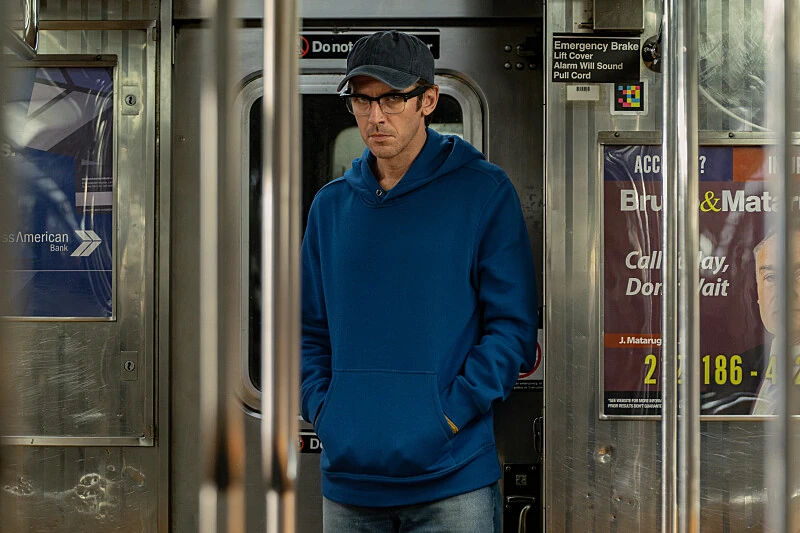
The Five Boroughs Killer, played by Dan Stevens, still needs more development before he becomes a truly distinctive adversary.
We have some hints about his former life: a wedding ring, mugs marked Mr. and Mrs., his repetition of the phrase “Nobody cares” during his crimes, and his concern with picking up litter and putting it where it belongs.
These details may suggest that he has endured a painful personal experience that destroyed his trust in society. Perhaps an important relationship left its mark on him. But the episode does not offer enough to establish his background or explain his motivations.
The problem is not the mystery itself, but that the character does not yet have a presence to match the actor playing him. Dan Stevens has enough presence to make us expect something more exciting, but we are still gathering clues and waiting for the character to develop.
The Sleepy Eyed Stranger and a missed opportunity
Among the killers introduced this season, the Sleepy Eyed Stranger, played by Gabriel Luna, has one of the most unsettling introductions.
His appearance, accompanied by Nine Inch Nails’ The Day the World Went Away, gives him an unnerving identity from the outset. Luna’s quiet, rigid performance also adds to the character’s strangeness.
The problem is that the series does not give him enough time for that opening to develop into a memorable character.
We learn that his name is Ray Ballard and that he does not believe in needing friends or family. He sees human relationships as a weakness. He prefers watching his victims sleep, enjoying the knowledge that they feel safe while actually being under his control.

This creates a fitting comparison with Dexter. Ballard chooses total isolation and sees relying on others as dangerous, while Dexter finds himself in a very different position, having begun to realize that his new relationships are essential to carrying out his plans.
The confrontation becomes more complicated when Dexter discovers that Ballard has brought a living victim named George, whom he intends to kill in front of the people he believes to be Prater’s followers.
The nature of the task changes. Dexter is no longer simply trying to eliminate another killer. He must save an innocent person without allowing the situation to derail his plan.
With Charley’s help, they track Ballard and reach the place where he has hidden George. Dexter succeeds in sedating the killer, then tells Joey Quinn where he can find the captive.
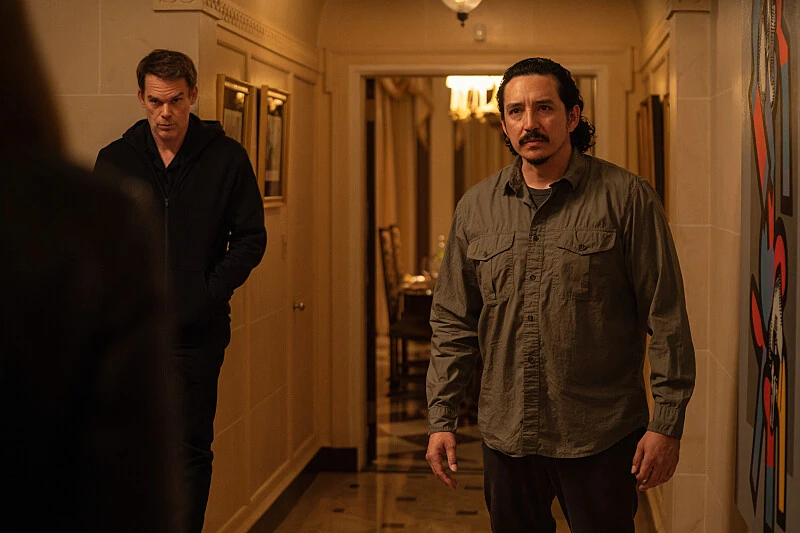
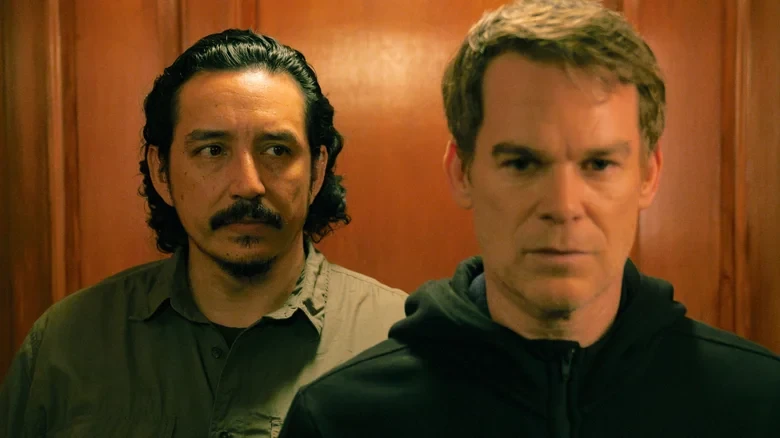
This is one of the episode’s most important moments. Dexter does not do everything himself. He benefits from Charley and Quinn’s help, saving George and disposing of Ballard.
The final confrontation returns us to familiar rituals: the kill table, the plastic covering the space, and the final interrogation before judgment is carried out. Ballard reveals his method of killing, arguing that his victims do not suffer as long as they do not know they are in danger.
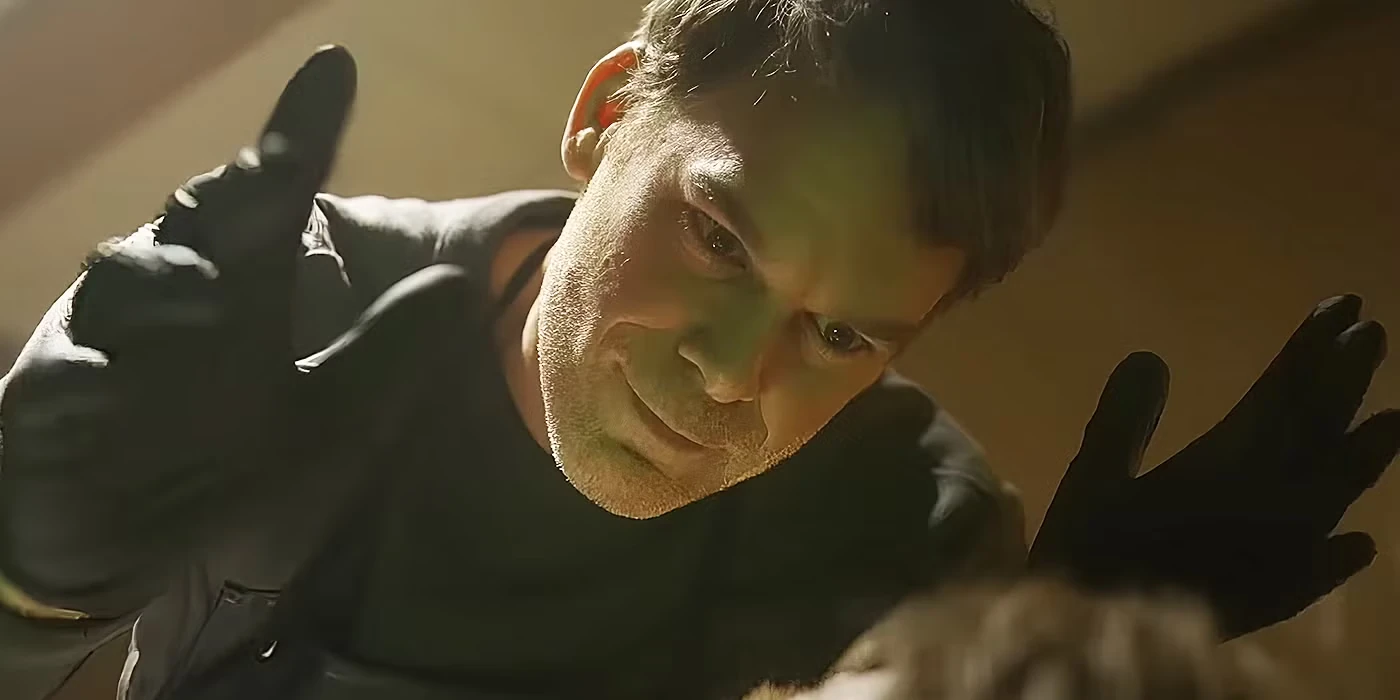
But his journey ends at Dexter’s hands, in front of photographs of his victims.
The problem is that the character’s story ends quickly after his introduction, even though the premise deserved more room. He ultimately becomes another target for Dexter to eliminate, rather than an adversary who leaves a clear mark on the season.
Nevertheless, this confrontation does more than add another murder to Dexter’s list. It helps the episode express its central idea about the move from working alone to cooperation.
Charley and Quinn: Dexter discovers the value of partnership
Dexter’s relationship with Charley is one of the storylines that most needs a clearer direction at present.
The series hints at a possible romance, and they use the story of a fake relationship in front of other people. But this idea is not entirely convincing. It produces some awkward moments and returns us to a kind of relationship we have already seen in the franchise.
Still, I think the best part of this relationship is the practical partnership rather than the romantic aspect.
Charley is not merely an assistant carrying out Dexter’s orders. She has her own goals and wants to make amends for what she did during her years working for Prater. She also has experience and the ability to act, making her useful to Dexter in a way that differs from his previous relationships.
Better still, the episode does not present either as having complete control over the other. They depend on one another, but their trust has not reached the point where they can abandon caution.
Joey Quinn’s return remains welcome, even if his presence raises some questions.
On one hand, it is strange that Quinn returns to Dexter’s life as though their complicated history did not exist. Quinn does not seem preoccupied with Angel’s belief that Dexter was the Bay Harbor Butcher, even though his death was connected to the search for him.
That past could have given their relationship more tension, or at least left a mark on how Quinn treats him.
But Desmond Harrington remains a strong addition. He has a clear presence and knows how to combine overconfidence, practical intelligence, and moral realism. Quinn’s loyalty and direct way of dealing with others also give the character a different energy.
His help in saving George makes his presence more than the return of a beloved character. He becomes indirectly involved in Dexter’s plan and contributes to its success.
This completes the idea connecting Dexter with Charley and Quinn: sometimes help from others does more than make a task easier. It can become the difference between a plan’s failure and its success.
Claudette Wallace and the past of a song she cannot forget
One of the storylines with an intriguing personal background is Claudette Wallace’s pursuit of the New York serial killer.
We knew that the Bee Gees’ Stayin’ Alive had a strange connection to her and that she listened to it constantly. The episode finally explains this connection through a scene set early in her police career.
Claudette was responding to a noise complaint at an apartment, only to discover a crime scene left by the New York serial killer. The song was playing on a record player, stuck in a repeating loop because of blood on the record and needle.
More importantly, she passed the killer on the stairs as he left the building without noticing him. Ever since, that moment has been part of her sense of responsibility for the victims who followed.
We now understand that the song is more than an odd habit or a distinctive character detail. It is a constant reminder of an opportunity she believes she missed.
Don Framt exploits precisely this vulnerability. When he sings the song in front of her in the street, he succeeds in breaking her usual composure. Claudette loses control and shouts at him while he pretends to fall out of his wheelchair and calls for help.

The result is her removal from the New York serial killer case, after her outburst in front of Framt becomes a problem for her.
This is a good moment because it reveals another side of Claudette and shows how years of obsession with a single case can affect her ability to respond when the killer himself confronts her.
Despite this important background, the character remains less fully developed than some of the police characters we have known throughout Dexter’s history.
She has a strong personal case, but that alone is not enough to create an entertaining, fully rounded character. Compared with Angel, Quinn, LaGuerta, Matthews, Doakes, and Angela, Claudette still lacks the same degree of distinctiveness and variety.
Nevertheless, shifting her attention to the Five Boroughs Killer after her removal from Framt’s case could give her different territory to explore, particularly with Olivia’s promise to help her reach the New York killer later.
Harrison and the relationship that gives the episode its real heart
Despite all these storylines, I believe the episode’s most important material lies in Dexter and Harrison’s relationship.
Harrison has begun working in the NYPD’s homicide division and must now deal with a new world that differs from the way his father has traditionally handled criminals.
But the episode does not give him much room. He remains on the margins compared with the other pursuits. Even so, there are important signs that his career could become a real problem for Dexter.
After the chase, Harrison meets his father and begins asking him about what happened in his capacity as a witness. Dexter tries to avoid answering there, particularly because he does not want to draw Claudette’s attention again, and promises to answer later, away from the official setting.
He then returns and gives him some information at their next meeting.
What is interesting is that Dexter, who initially thought his son’s police work could be useful to him, is beginning to discover that the opposite may be true. Harrison may gain access to information or investigations that intersect with his father’s secret life.
This opens the door to a conflict I find more important than most of the season’s other stories: how can these two people maintain their relationship when one works to enforce the law conventionally while the other believes justice sometimes requires different methods?
The ending delivers the episode’s best emotional moment.
With Harry beside him, Dexter gives his son a simple line that carries considerable meaning: “Justice sometimes needs a little help.”
The scene is affecting because we are not simply watching a father advise his son. We are watching a character we have followed for more than twenty years move from the life of a man accustomed to isolation to that of a father whose adult son is trying to understand the world in his own way.
That is the scene’s value. Dexter does not speak to Harrison merely as someone who wants to pass on his method of killing. He tries to explain his view of justice while preserving their relationship.
This transformation matters more than his success in eliminating another killer, and may be among the aspects most deserving of the season’s future attention.
The problem is that the series has not yet given Harrison enough time. The potential conflict with his father seems more exciting than the space he actually receives in this episode.
Final verdict
Final verdict: a good episode stumbling through its crowded stories
Ultimately, I think the third episode of Dexter: Resurrection is entertaining and contains several ideas worth considering, but does not achieve the coherence needed to make all its storylines work equally well. Its main strengths are its treatment of Dexter’s aging, his increasing reliance on others, and the emotional relationship with Harrison in the final scene. Joey Quinn’s return is also a welcome addition, and Desmond Harrington and Uma Thurman give their characters a clear presence. Claudette’s story offers important background for understanding her pursuit of the New York killer, even if it has not yet made her sufficiently compelling. By contrast, overcrowding remains the clearest weakness. The Five Boroughs Killer has not yet developed into a distinctive character. The Sleepy Eyed Stranger’s story ends quickly despite a good introduction. Dexter and Charley’s relationship is still searching for a more convincing form. Meanwhile, Harrison remains sidelined, even though his conflict with his father seems among the season’s strongest possibilities. Even so, the ending leaves a good impression by returning attention to a relationship central to Dexter’s current journey. The episode is not entirely coherent, but it has enough good moments to remain enjoyable and give us a real reason to keep watching, particularly with the appearance of a new target for Dexter: the Jawbreaker killer. My rating for the episode: 8 out of 10. Will Harrison discover the truth about his father, or will their relationship gradually lead him to adopt his own vision of justice?
AUDIENCE VOTE
Do you agree with the MB rating?
Choose once from this browser. You can change your answer at any time.