
The review
Elliot: looking for someone to decide for him
Elliot is twenty-three. He has finished his studies, but has no clear direction in life.
He is in a relationship with Minerva, yet it is almost entirely without intimacy, and neither seems particularly attached to the other.
Even his professional ambitions are unclear.
Then he enters the world of the famous artist Erika Tracy.
For me, this is where the film’s real idea begins.
Elliot is not drawn to Erika simply because she is older and more experienced.
He is drawn to the certainty she represents.
Erika knows what she wants.
She gives orders.
She sets the rules of the relationship.
He, meanwhile, does not even know what he wants to do with his life.
His submission to her therefore becomes more than a sexual choice: it becomes a way to escape the responsibility of making decisions.

Erika: freedom on her own terms
Erika is one of the film’s most interesting elements.
She constantly talks about freedom, about younger generations becoming afraid of desire and self-expression, and about a society she considers overly sensitive to sex and boundaries.
At certain moments, you can understand part of what she says.
The film is clearly interested in defending people’s right to treat sex as a natural part of life, rather than something that must always be hidden.
The problem is that Erika does not stop at her own freedom.
She also wants to control how other people exercise theirs.
That is where the contradiction appears.
Erika talks as though she is freeing Elliot from restrictions.
In reality, she tells him what to do, when to do it, and with whom.
Even the relationship itself begins in the workplace, between a boss who holds the power and a young employee who works for her.
This makes her rhetoric about freedom far more complicated than she wants to admit.
Unequal power and the question of consent
The most important thing in the film is not the nature of the relationship itself, but the imbalance of power within it.
Erika is not a woman Elliot happened to meet in a bar.
She is his boss.
She controls his job.
She has influence.
And she is a celebrity in the field he is trying to enter.
The film establishes this from their very first interview.
Erika unsettles him, makes him feel guilty, then quickly proposes a private relationship, accompanied by a legal confidentiality agreement.
Elliot can say yes.
But he is saying yes within a relationship whose balance of power is already unequal.
Consent therefore becomes a more complicated question than simply whether he agreed or not.
The film understands this, but at certain moments I wished it would take the idea more seriously.

From the relief of submission to dependence
What is interesting is that Elliot is not simply a victim all the time.
He genuinely wants this relationship.
He finds something in it that he has not found in his ordinary life.
When Erika gives him an order, the questions disappear.
He does not have to think about his future.
Or his relationship.
Or his identity.
Someone else is telling him what to do.
This offers him a strange kind of relief.
The film touches on an excellent idea here: sometimes people can feel free by temporarily giving up the need to choose.
The problem begins when that relief turns into dependence.
Elliot can no longer distinguish attraction from love, or submission within agreed boundaries from allowing Erika to run his life.
This is where the relationship starts turning from an experience into an obsession.

Cooper Hoffman: the uncertainty that keeps the film human
Cooper Hoffman is excellent in the role.
Elliot could easily have become irritating or excessively naïve.
Hoffman gives him a childlike awkwardness that helps us understand why he falls into this relationship.
He is not a man entering Erika’s world with a firm grasp of its rules.
He is a young man who wants to feel special.
At times, it is obvious that Erika’s attention matters more to him than the relationship itself.
Hoffman is particularly good at reactions.
The awkwardness.
The hesitation.
The excitement that quickly gives way to fear.
In many scenes, his face says far more than the dialogue.
That matters because the film is so fast and so satirical that it needs someone to preserve its human dimension.

Olivia Wilde: the allure behind the performance
Olivia Wilde, meanwhile, knows exactly what kind of character she is playing.
Erika is neither subdued nor naturalistic.
She is designed to enter a room and make the whole place feel like her stage.
Her clothes.
Her way of speaking.
Her confidence.
Even the way she looks at other people.
Everything about her announces: I am in control here.
Wilde does not try to soften the character to make the audience like her.
Quite the opposite.
The more confident Erika becomes, the more troubling she is.
You begin to understand how heavily her idea of freedom depends on being the person who makes the rules.
The performance works because it is entertaining and slightly exaggerated, while still allowing us to see the exploitation behind the show.
Minerva: Elliot’s old life
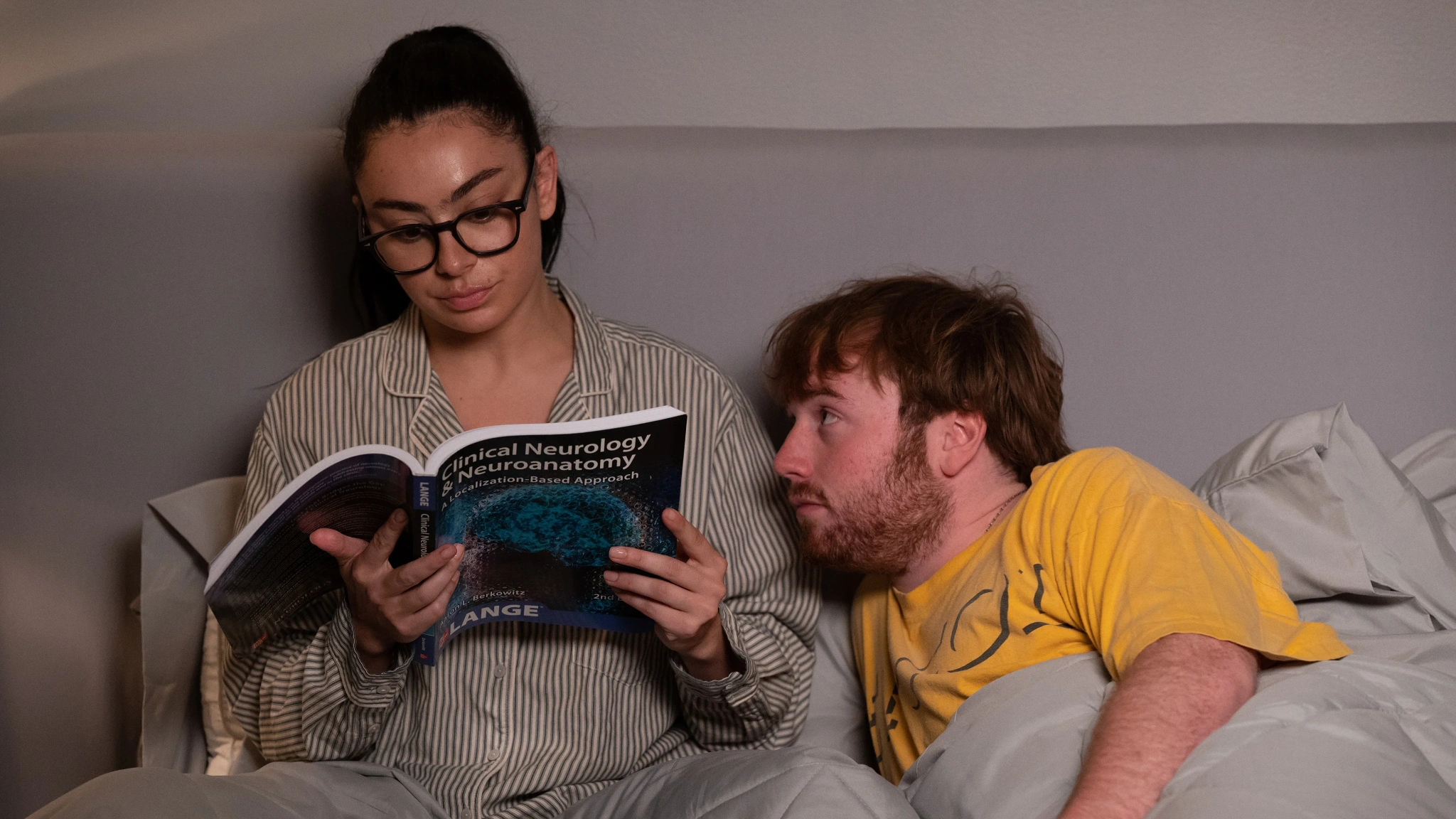
Minerva, played by Charli XCX, is there primarily to illustrate the emptiness in Elliot’s life before Erika.
Their relationship is almost over before either of them admits it.
She is busy studying.
He is emotionally and physically dissatisfied.
Even when they are together, they seem to occupy separate worlds.
That is why I do not think Elliot’s infidelity is the film’s central issue.
The film uses Minerva more as an image of his old life: cold, stable, and offering little that truly excites him.
Erika, by contrast, arrives as complete chaos.
The problem is that Minerva herself gets little room, leaving her more of a dramatic function than a fully developed character.

Apple: the friendship that pays the price
The character I felt deserved much more space was Apple.
She is Elliot’s closest friend.
She lives with him.
She watches from the outside as Erika changes his life.
Then she enters the game herself when Elliot asks her to join a meeting with Erika.
For me, this is where the film truly changes.
Until this point, Elliot can tell himself that everything happening affects only him.
Once Apple becomes involved, the real consequences of Erika’s chaos emerge.
The encounter leaves Apple visibly hurt and humiliated, and her friendship with Elliot subsequently falls apart.

I wanted the film to pause here.
To give this consequence real weight.
Unfortunately, Apple then almost disappears from the center of the story.
This is one of my biggest problems with the film.
The film knows Erika is dangerous, but enjoys her too much
This contradiction is present throughout.
The film knows that Erika crosses boundaries.
It knows the relationship is unhealthy.
It knows that using professional authority in this way is dangerous.
But Gregg Araki enjoys the character so much that the film sometimes seems to celebrate her at the very moment it is criticizing her.
That is not necessarily a mistake.
A character can be both appealing and dangerous.
It does, however, require a very precise balance.
In certain scenes, the comedy, colors, and music make everything so entertaining that the psychological impact on Elliot becomes secondary.
Here I felt the film was a little afraid of becoming heavier than it wanted to be.
The studio: selling an image and redefining meaning
One thing I particularly liked was the workplace design.
Erika’s studio is more than an office.
It is an extension of her personality.
The provocative artworks.
The assistants carrying out strange tasks.
Victor managing everything with complete detachment.
And the feeling that everyone knows how much this world relies on selling an image rather than meaning.

Erika herself talks about art as a game of persuasion.
Value exists because you can persuade other people that it exists.
This applies to her relationship with Elliot, too.
She can redefine control as freedom.
Exploitation as an experience.
And scandal as art.
Art and the relationship operate in almost exactly the same way in this film.
Anything can be sold if you have enough confidence.
Privacy turned into an exhibition
One of the film’s most important moments comes when Elliot discovers that recordings of his private relationship with Erika have become part of her exhibition.
Here, his last remaining belief that what they share is private falls apart.
For Elliot, the relationship has become emotional.
For Erika, even the most private moments can be turned into artistic material.
What makes it harsher is that the act fits her character perfectly.
She does not see herself as having betrayed his trust.
She believes she has made art.
For the first time, Elliot begins to understand that his definition of their relationship and hers were never the same.
The disappearance: scandal as a product
The film opens with Erika unconscious in a swimming pool, then takes us back into the past.
This gives the story the feeling of a crime film from the outset.
We know something bad is going to happen.
The question is how Elliot reached this point.
But when we eventually discover that Erika’s disappearance was itself part of a publicity scheme, the film turns back toward satire.
Erika and Victor have used Elliot, the scandal, the investigation, and all the resulting chaos to increase the value of her work.
The plan succeeds.
The exhibition sells out.
Erika profits.
And Elliot is the person who pays the highest psychological price.
It is a revelation that fits Erika very well.
Even a disaster can become a product in her hands.
Does the ending undermine what came before?
This is where I have a problem.
The film reaches a point that could have been much harsher.
Elliot has been used.
He has lost his relationship.
His friend.
His job.
And he has nearly been accused of a crime.
Then the film jumps into the future, and we discover that he has become successful, too.
He has a show.
He invites Erika on as a guest.
Their game then continues into a strange ending that suggests their psychological bond has never entirely ended.
On one level, I understand the idea.
Elliot has also learned how to turn an experience into a product.
In a sense, he has become more like Erika.
On another level, though, I felt the film was escaping the painful consequences it had established.
Elliot’s growth, or an infection from Erika’s world?
What is interesting is that Elliot is no longer the same young man by the end.
Initially, he waits for other people to decide his value.
Erika gives him attention, and he gravitates toward her.
By the end, he learns to use his own story.
He, too, turns scandals and the past into content.
This is not necessarily a moral victory.
Perhaps he has simply learned the rules of Erika’s world.
I find that reading more interesting than the idea that he emerged from the relationship “stronger.”
He has not defeated her.
He has learned something from her.
The question is whether that amounts to growth or contagion.
Generational differences: caution is not weakness
There is also a very clear thread about the difference between Erika’s attitude to sex and that of Elliot’s generation.
Erika thinks the new generation is more afraid than it needs to be.
The rules.
The boundaries.
The fear of making mistakes.
The anxiety about what others think.
Elliot, meanwhile, tries to explain that the world has changed.
Digital surveillance is constant.
Anything can be recorded.
And any mistake can live forever online.
The film does not give a definitive answer.
That is a good thing.
Erika has a point in some of what she says, but she uses it to ignore crucial questions about power and responsibility.
The young people in the film are more cautious, but caution does not necessarily mean weakness or fear.

Does the film defend freedom or warn against it?
I think the film wants to do both.
It wants to say that people should not feel ashamed of their desires.
At the same time, freedom does not erase responsibility.
Consent is not an open-ended authorization that lasts forever.
A relationship involving control needs boundaries like any other relationship, perhaps even more so.
Erika talks about liberation, but does not always respect those boundaries.
The film becomes more interesting when it stops provoking for provocation’s sake and starts asking who actually holds the power in the relationship.
Direction and color
Visually, the film has a very strong identity.
Gregg Araki fills the screen with vivid colors.
Pink.
Neon.
Leather and latex clothing.
Apartments and studios that sometimes seem to belong to an artwork rather than the real world.
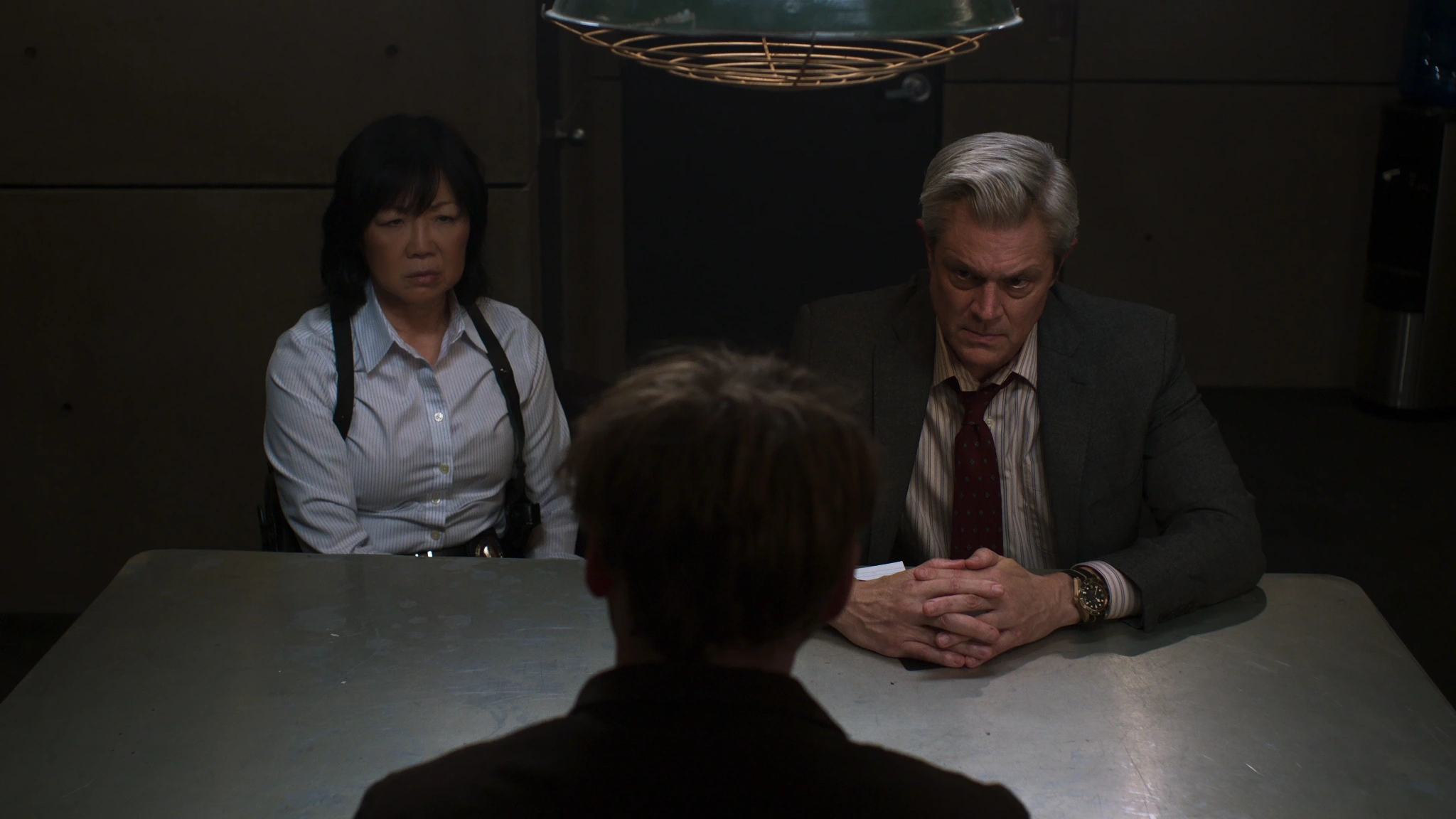
The interrogation scenes, by contrast, are colder and quieter.
This difference works extremely well.
Erika’s world is a continuous spectacle.
The investigation strips events of that surface and places them in a harsher reality.
Costumes as characterization
Erika’s costume design is particularly good.
She never enters a room like an ordinary person.
Every appearance is calculated.
Almost every outfit says something about control.
She does not simply wear clothes: she uses them as part of the continuous performance she presents to the world.
Elliot, by contrast, is much more simply dressed.
This visual difference makes their relationship clear even without dialogue.
One has built her identity completely.
The other is still searching for his.


Comedy: a strength and a weakness
The film is genuinely funny.
The dialogue is fast.
There are eccentric supporting characters.
Johnny Knoxville and Margaret Cho play the interrogation scenes with a seriousness that makes them even funnier.
Even some of the most embarrassing situations are designed to make us laugh.
This keeps the film from becoming a heavy lecture about relationships and power.
The problem is that the comedy sometimes diminishes the consequences.
When someone like Apple gets hurt, or Elliot reaches a real breaking point, the film does not allow those feelings to linger.
It quickly returns to the jokes.
Music and pacing
The electronic music and early-2000s-inspired identity suit the film very well.
Everything seems designed to be fast, glossy, and daring.
The relatively short running time helps, too.
There is little room for stillness.
This suits the film’s overall personality.
But I also think it needed some quiet.
An extra scene or two with Apple, for example, would have given the relationship’s consequences more weight.
The problem is not that the film is too long.
Perhaps it is the opposite.
It has more ideas than its light tone allows it to explore.
Strengths and weaknesses
For me, the greatest strengths are Olivia Wilde and Cooper Hoffman.
Their chemistry is the film’s driving force.
Wilde creates a character you cannot ignore even when her behavior is troubling, while Hoffman makes Elliot human and sympathetic despite his naïveté.
The visual identity is excellent, too.
The film is colorful, fast, and visually different from many contemporary works.
Its ideas about power, desire, and freedom are genuinely interesting.
Its greatest weakness is that it understands the scale of the harm Erika causes, but does not always give it enough time.
Apple disappears sooner than she deserves to.
Minerva is underdeveloped.
And some emotional consequences are passed over on the way to the next joke.
The ending is entertaining, but it slightly softens the harshness of the conflict the film has built.
Final verdict
Final verdict
A visually daring film with ideas more serious than its surface suggests. Its greatest strength is that it does not present Erika and Elliot’s relationship merely as titillation. It uses it to ask about the difference between desire and power, freedom and control, and consenting to an experience versus allowing someone else to reshape your entire life. Olivia Wilde is excellent as Erika, and Cooper Hoffman proves again that he can carry a film through an awkward, imperfect character. But the film enjoys its chaos more than it examines its consequences. When the characters reach genuinely painful emotional places, Araki prefers to return quickly to color, comedy, and provocation. That is why I think it works better as a black comedy and a visual provocation than as a complete examination of the power relationship at its center.
Your turn
Did Erika and Elliot’s relationship feel like a mutually desired experience that spiraled out of control, or does the power imbalance between boss and employee mean it was exploitative from the very beginning?
AUDIENCE VOTE
Do you agree with the MB rating?
Choose once from this browser. You can change your answer at any time.