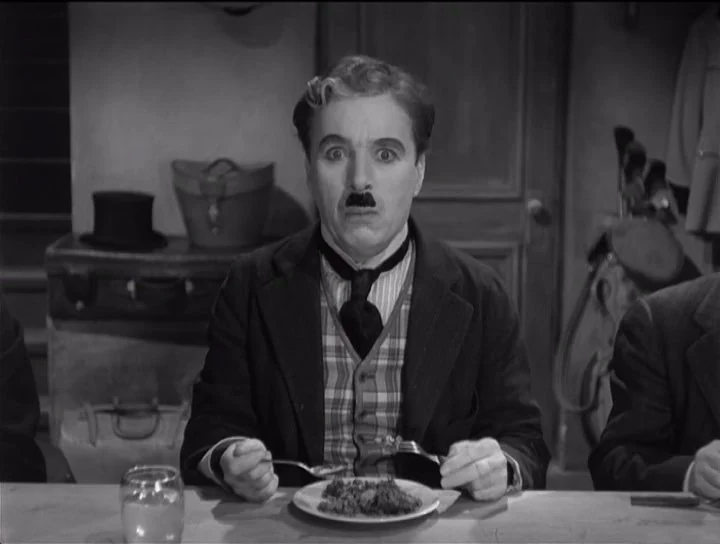
In Modern Times, Charlie Chaplin found an almost impossible way to let the Tramp be heard without giving him a real language. The little man sang before an audience, but the words were a comic mixture without a specific meaning. The body still explained everything, and sound remained an extension of movement.
It was an elegant solution to a problem Chaplin had carried for years.
It could not solve what came next.
His next film would not be about a factory, a machine or a love story whose meaning images could largely carry. This time Chaplin was looking at the rise of fascism in Europe, and at a real man whose moustache and appearance bore a strange resemblance to his own: Adolf Hitler.
The question was no longer:
Can Chaplin speak?
It had become:
What happens when an artist who built his language on silence decides that speech itself has become part of his subject?
With The Great Dictator in 1940, Chaplin made his first feature built entirely around spoken dialogue. For the first time, sound was neither an effect introduced when needed nor a song without a language. Speech became a tool for the characters, a tool for satire and, finally, a way for Chaplin to address the audience almost directly.
The Tramp had spent more than twenty years making the world understand him without words.
Now, when Chaplin truly spoke, speech was more than a technical development in cinema.
It became a public position.
One Face… Two Men Who Are Nothing Alike
The Great Dictator was built around one of its simplest and most effective visual ideas: Chaplin plays two characters.
The first is an ordinary Jewish barber living in a fictional country called Tomania.
The second is the dictator Adenoid Hynkel, an unmistakable parody of Hitler.
The physical resemblance exists, but the film uses it to create a sustained contrast: the same face can seem frightened and marginalised in one character, then inflated with power in the other. Chaplin plays both the barber and Hynkel as the film directly satirises dictatorship and persecution.
Sound becomes part of what separates the two characters.
The barber is closer to the world we knew through the Tramp: the body, face and reaction matter more than eloquence.
Hynkel, on the other hand, has plenty to say.
Speech is not necessarily a means of communication for him.
In his speeches, Chaplin turns language into violent sounds: tone, rhythm and verbal explosions imitate the form of political oratory more than they convey rational substance.
This is an important directorial point.
If we set the meaning of the words aside for a moment, we are left with someone on a platform, an organised audience, microphones, collective salutes, a voice rising and falling, and a body using rhythm to manufacture authority.
Power is presented here as a performance.
The film makes us see that performance itself.
When Sound Becomes Movement
Even as Chaplin entered the age of fully spoken dialogue, he still thought about speech physically.
We see it in Hynkel's delivery: his voice is tied to his face contracting, his chest expanding, his arms moving and his rhythmic outbursts.
A sentence is more than what is said.
It is something the body does.
This links the film directly to everything Chaplin had built before the sound era.
He did not abandon pantomime when he learned to speak. He brought speech inside the same system of physical performance.
We can also see this in scenes that need no speech at all.
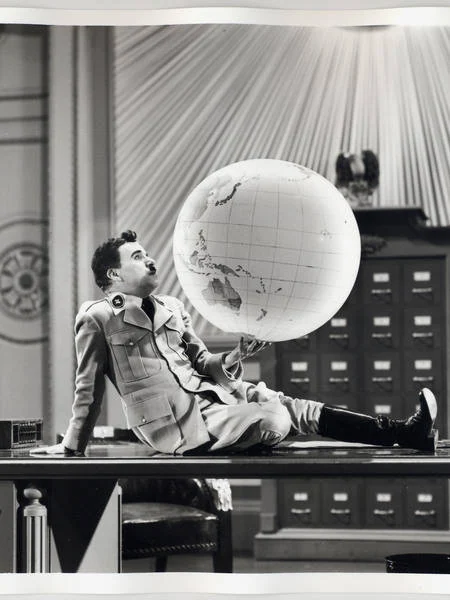
In the famous globe sequence, Hynkel dances with a balloon shaped like the world.
His ambition needs no lengthy explanation.
His body is enough.
He holds the world.
Throws it.
Catches it.
Lets it float.
Then lies beneath it as though the planet were his personal toy.
Music, movement and composition do what Chaplin had done throughout his life: turn an abstract idea into a visual action the viewer can read immediately.
Chaplin also retained close control over the music. He worked with Meredith Willson on the score, and using the Lohengrin prelude for the globe dance was one of his ideas.
The film usually remembered for its final speech does not, in fact, abandon his earlier language.
Images can still mock political ambition without saying a sentence.
This time, however, Chaplin did not want images alone to have the last word.
The Film Arrived While the Real World Was Changing Faster Than the Screenplay
Chaplin began developing the project in the late 1930s, with early drafts already in existence in 1938. Between writing the film and presenting it to audiences, Europe's political context changed rapidly. The Second World War broke out in Europe in September 1939, while the United States remained militarily outside the war at that stage. The Great Dictator opened in New York on 15 October 1940, more than a year before the United States entered the war.
This matters to our understanding of the film.
The satire was not a comment on history that had ended and become safe.
It targeted an existing political regime while war continued.
That does not mean we should turn the story into a myth that Chaplin alone recognised the danger. Europe was already at war, and Nazism and fascism were not unknown phenomena when the film was released.
Its cinematic value lies in something more precise:
Chaplin took the figure audiences knew through physical comedy and placed him within an explicitly political subject that left little room for the narrative neutrality of some of his earlier films.
Quite simply, the film itself entered public debate.
Then Chaplin Broke the Film He Had Built
Most of The Great Dictator can be watched as a satirical comedy with characters and a plot.
Then we reach the ending.
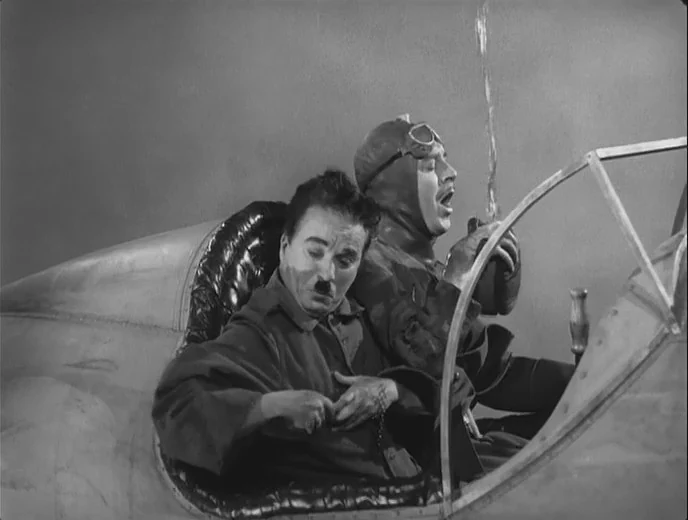
Because the barber and dictator are mistaken for each other, the barber finds himself before the microphone with everyone expecting a speech.
Something unusual happens, even within the film's own terms.
Much of the character recedes.
Chaplin emerges.
In the final speech, the comic mask almost falls away as he speaks directly to the world, calling for peace and tolerance and rejecting tyranny.
The speech went through multiple drafts and extensive revisions. It was not a passing improvisation at the end of filming, but part of a long writing process. Around the film's release, Chaplin was also reported as wanting the audience, at this moment, to stop laughing and listen.
The decision remains cinematically intriguing because it departs from a principle on which Chaplin himself had built so many films.
Throughout his career, meaning had emerged from action.
Here, action almost stops so that speech can come forward.
The face is before us.
The microphone is before him.
The speech is long compared with the film's preceding rhythm.
A viewer can see this shift in two ways: as a moment when words become necessary for the filmmaker, or as an explicit break in the drama to introduce a direct address.
What matters is that the film does not conceal the break.
It makes it deliberately.
For the first time, Chaplin's own voice seems almost more important than the voice of the character he plays.
After the War… Laughter Became Much Darker
Had Chaplin stopped after The Great Dictator, it would have been easy to imagine this period as a political exception within a comic career.
His next major film made that simple reading difficult.
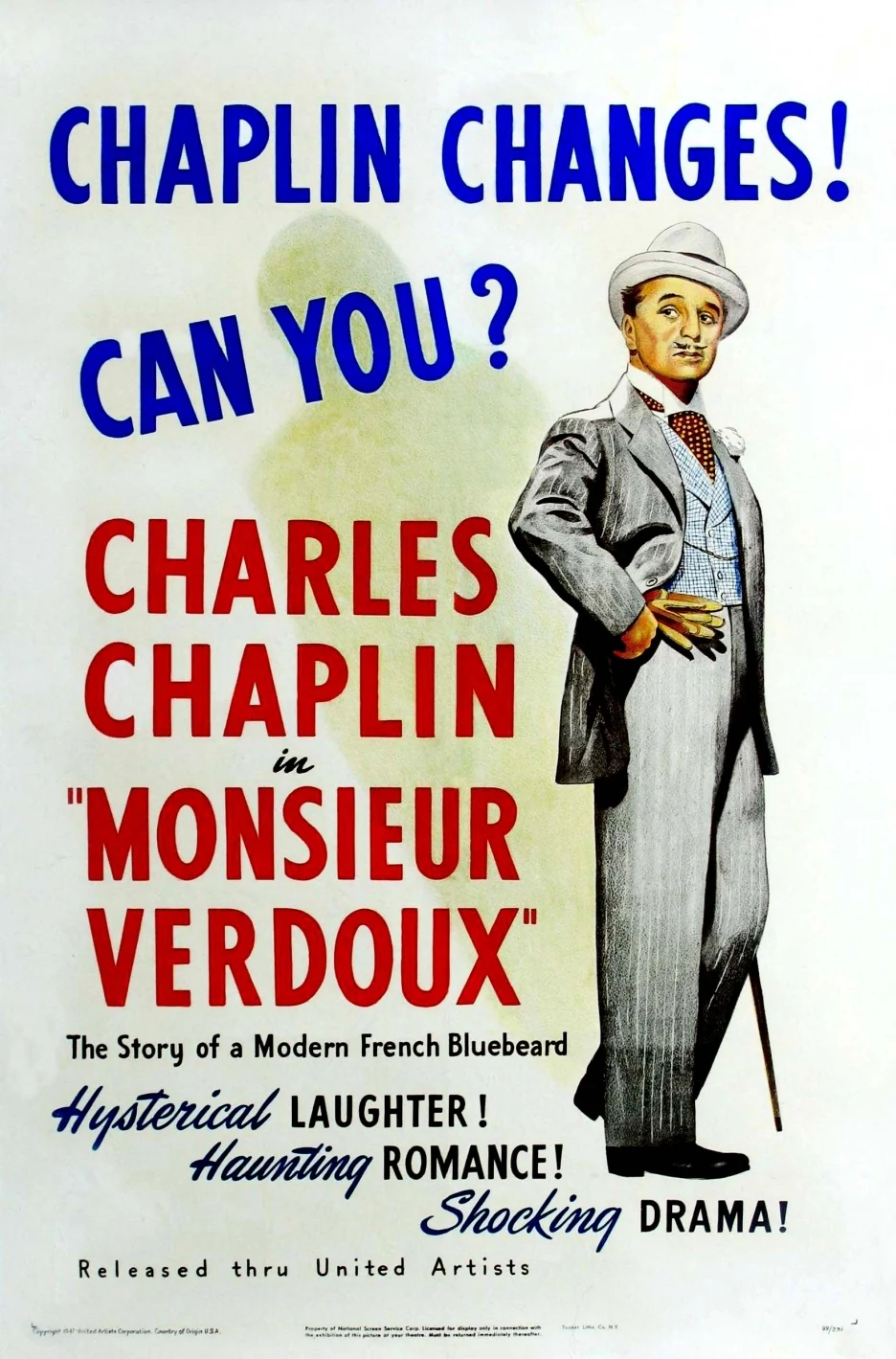
In Monsieur Verdoux in 1947, Chaplin abandoned the Tramp entirely.
No hat.
No cane.
No baggy trousers.
No poor character taking the world's blows and then getting up again.
This time he plays Henri Verdoux, a former bank employee who becomes a killer, marrying wealthy women and murdering them for their money.
The film is not adapted from Ibsen's play An Enemy of the People.
The project originated in an idea Orson Welles brought to Chaplin for a film inspired by the French murderer Henri Désiré Landru. Chaplin bought the idea from Welles for $5,000, and the film's credits acknowledged that it was based on his idea.
The Individual Killer… and a World That Kills in Greater Numbers
Monsieur Verdoux does not need to absolve its protagonist to ask its question.
Verdoux is a killer.
The film does not hide it.
Chaplin places his individual crimes beside a world that has just emerged from a world war that killed millions.
This produces one of the film's most provocative ideas: why does society regard an individual's crime as obvious brutality, while large scale killing in war can become an institution with official language, decorations and economic interests?
This is not a historical fact established by the film.
It is the moral argument Verdoux makes within the work.
The distinction matters.
When Verdoux discusses the difference between an individual murderer and systems capable of killing vast numbers, he offers a satirical and deliberately provocative defence of himself, not a truth the reader must accept.
In terms of cinematic construction, however, we can see a major shift in Chaplin.
In Modern Times, the body was trapped inside the machine.
In The Great Dictator, speech itself became a subject.
In Monsieur Verdoux, dialogue became a tool for moral satire.
The man who had feared that words would give the Tramp a narrow identity now used words precisely to confront viewers with ideas that gesture alone could not convey.
Comedy Did Not Disappear… but It Was No Longer Innocent of Its Effects
Chaplin does not portray Verdoux as a frightening man in the conventional way.
He is polite.
Elegant.
Quiet.
He can be funny.
This is where the discomfort begins.
When a killer is an obvious monster, viewers can easily place him outside their own world.
When a film uses the comic tools associated with Chaplin to make this man charming, flustered or trapped in farcical situations, however, that distance becomes complicated.
We know what he does.
We still laugh sometimes.
The result is not that the film asks us to approve of Verdoux. Comedy itself is put to the test.
What are we laughing at?
Where does sympathy for a character end and judgement of their actions begin?
This is a completely different direction from the Tramp.
The Tramp attracted sympathy because he was usually the weaker party within the system.
Verdoux deliberately exploits others.
Chaplin nevertheless retains his ability to build a scene around timing, the body and irony.
The same filmmaker.
This time, the tool produces a less comfortable feeling.
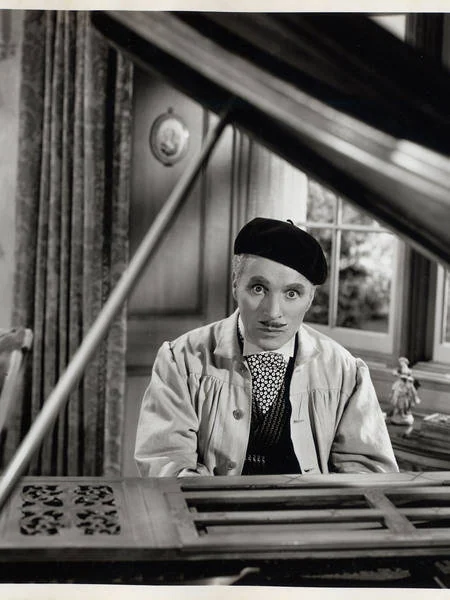
At the Press Conference… the Film Became Less Important Than Its Maker
When Monsieur Verdoux was presented in New York in 1947, Chaplin's reception was not confined to questions about the film.
Questions at the press conference accompanying the premiere went beyond the film. This came as the House Un-American Activities Committee, HUAC, was expanding its investigations into communism in Hollywood.
A common confusion needs to be cleared up here:
HUAC was not "McCarthy's committee".
It belonged to the United States House of Representatives.
Joseph McCarthy was a senator who later became known for separate investigations and accusations in the Senate in the early 1950s.
Both phenomena belonged to the wider context of the Red Scare and the Cold War, but they were not the same institution.
This matters when writing Chaplin's history, because gathering everything under the word "McCarthyism" can distort the institutional sequence itself. HUAC was the committee that conducted investigations into communism in Hollywood in 1947.
Was Chaplin a Communist?
This is one area in which we should not turn a historical accusation into a judgement of our own.
What we can say precisely is that Chaplin was subjected to investigations, accusations and scrutiny over his associations and political positions.
The FBI collected material on Chaplin and investigated his alleged ties to communist organisations in the United States as part of a domestic security file. The published material spans 1922 to 1978. The existence of an investigation does not, by itself, establish that Chaplin was a Communist Party member.
Chaplin himself denied membership.
In 1947, after learning of his summons in connection with HUAC's investigations, he declared that he was not a communist and described himself as a "peacemonger", meaning someone who advocates peace.
He was among those asked to appear before the committee, but his testimony ultimately did not take place.
The precise formulation is therefore not:
"America proved that Chaplin was a communist."
Nor is it:
"Every accusation was fabricated and can be dismissed without investigation."
The more accurate formulation is:
There were investigations, accusations, associations and public positions that American agencies interpreted as grounds for suspicion, while Chaplin denied party membership.
This is the difference between recording history and issuing a political verdict on the reader's behalf.
The Problem Was Not a Single Film
It is very easy to construct a dramatic story that says:
Chaplin made Monsieur Verdoux, angered the government and was expelled from America.
History is more complicated.
By the late 1940s, different factors surrounded Chaplin: his public positions, associations with political causes, his failure to take American citizenship despite his long residence, federal investigations, press disputes, earlier personal and legal cases, and the Cold War context that made political affiliation increasingly sensitive.
Even reactions to Monsieur Verdoux were not only governmental. Some 225 cinemas refused to show the film after a protest by the Catholic War Veterans organisation.
There was no single button pressed by a single film that ended Chaplin's American life.
What happened was cumulative.
Over the years, parts of the American press and political world transformed Chaplin's public image from a global comedian into a figure questioned about his loyalty and positions as much as about his films.
The filmmaker who had fought for years to control the image appearing on screen began losing control of the image people held of him off screen.
1952: Chaplin Was Not Arrested… or Exiled by a Court Sentence
In September 1952, Chaplin left the United States with his family for Europe to attend the London premiere of Limelight.
He was a British citizen, not an American citizen, and needed a permit allowing him to return to the United States. He had already applied for a reentry permit, and correspondence with immigration officials continued during the months before his departure.
After he left, United States Attorney General James P. McGranery announced that immigration authorities would investigate whether to allow him back. If he attempted to enter, his eligibility for admission under immigration law would have to be determined. Readmission remained pending until a hearing could determine his eligibility.
This is much more precise than the familiar claim:
"America expelled Chaplin and permanently banned his return."
There was no judicial sentence of exile.
Chaplin was not an American citizen stripped of citizenship.
The issue concerned his status as a foreign resident and his ability to reenter.
The British Parliament even discussed the matter in October 1952. The official response at the time was that the United States Attorney General had ordered an investigation into his possible readmission, and that no final decision had yet been announced.
Then Chaplin Made His Own Decision Too
It is misleading to portray Chaplin as a passive body simply carried into exile by the authorities.
After the crisis, he decided not to return to the United States at that time.
In 1953, he surrendered his reentry permit and did not intend to return to the United States then.
This does not erase the governmental or political pressure preceding his decision.
It makes the picture more accurate:
The American government made his return conditional on an investigation and new procedures, and Chaplin, in turn, chose not to pursue a return at that stage.
Commenting to the press on the crisis in September 1952, he rejected the idea that he was a party politician and stressed that he wanted to continue making films.
Nevertheless, his position in cinema changed radically.
For years he had his own studio.
His regular workforce.
A production system he understood.
A working network that built his films the way he wanted.
Outside the United States, he would have to work in a different environment.
This was an artistic consequence as well as a political one.
Exile Also Changed the Way Films Were Made
When he made A King in New York in Britain in 1957, he was approaching seventy and no longer had the American studio in which he had established his habits over decades.
Returning to production in rented studios, with a crew that did not share the same long history with him, was difficult.
The subject he chose did not move away from the experience of the preceding years, however.
It moved closer.
Chaplin plays King Shahdov, a deposed European monarch who arrives in New York and encounters advertising, television and modern celebrity. The film then enters political investigations directly when he meets a boy whose parents face problems connected with HUAC, before the king himself also appears before the committee within the story.
We do not need to claim that Shahdov is "Chaplin himself" to see the structural resemblance.
The character can be read as a foreigner arriving in America, trapped between media, politics and suspicion, then forced to deal with a system he cannot control.
Real life and the film are not the same thing.
This time, however, the distance between them is small enough to be clear.
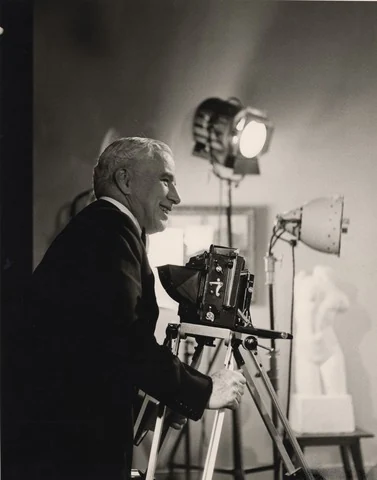
The Camera No Longer Hid Behind Symbolism
In Modern Times, the boss watched the worker from a screen.
We could analyse the scene as an image of power and surveillance without the character naming a real institution.
In A King in New York, the satire becomes more direct.
There is a committee resembling the historical institution in both name and function.
There is an investigation into loyalty.
There is pressure on the child and his family.
The film also mocks another modern world: television advertising, celebrity, cosmetic enhancement, consumption and media that turn people themselves into commodities for sale.
The film cannot therefore be reduced to "Chaplin's revenge on America".
That is a psychological description we cannot establish from the images alone.
More precisely, the film turns several American experiences and phenomena of the 1950s into satirical material, including HUAC, blacklisting, television and consumer culture, and America in the atomic age.
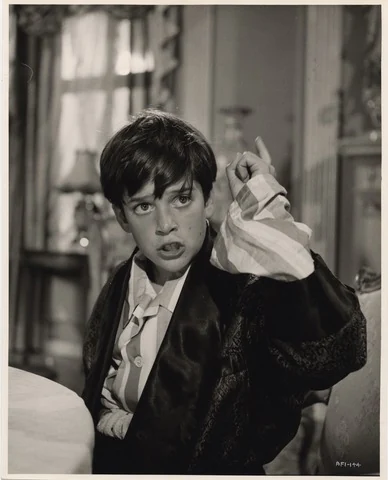
The Irony: A Film About New York Did Not Reach American Audiences for Years
Chaplin made the film in Europe.
He knew an American release was unlikely at that time.
A King in New York was not shown in the United States until sixteen years later, with its first American release in 1973.
The irony of this period is complete.
The artist who had founded United Artists decades earlier to control a film's route to its audience was now making a film about America that could not reach American audiences when it was made.
In part two, his problem had been:
Who owns the film?
In part three:
Who owns the voice?
Here, the question had become:
What happens when you own the film and the voice, but your relationship with the place that made you a star has itself changed?
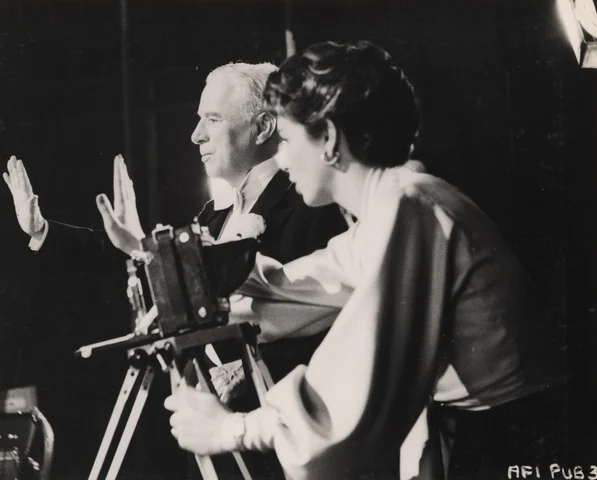
Did Politics Destroy Chaplin's Art?
Framing the question this way leads us to seek a simpler answer than his films allow.
Political controversy, investigations and the crisis of 1952 certainly affected his public life and working conditions.
Saying that "politics destroyed Chaplin", however, turns decades of work into a single causal relationship that is difficult to prove.
Likewise, saying that every film after The Great Dictator was merely a political statement ignores his continuing interest in performance, rhythm, comedy, music and characters.
What we can clearly see is a change in the relationship between the artist and his voice.
At first, the body was enough.
Then he built an independence that allowed that body to work.
Then he resisted dialogue so it would not kill the Tramp's visual language.
When he finally spoke, he discovered that words had very different consequences from movement.
Movement can cross borders easily.
Words enter debate.
They can be quoted.
Challenged.
Linked to a political position.
Their speaker can be placed under scrutiny.
From the Universal Tramp to Charlie Chaplin Himself
Perhaps this is the real transformation in part four.
The Great Dictator was more than Chaplin's first film in which he talked extensively.
It began the collapse of the distance between the artist and his public image.
With the Tramp, Chaplin could hide behind a character without a clear nationality or a language.
With the Jewish barber, Hynkel, Verdoux and King Shahdov, maintaining that distance became difficult.
Each film carried words or ideas that allowed audiences to ask:
Is this what Chaplin believes?
Is the character speaking, or the filmmaker?
Is the satire aimed at a character, an institution or a country?
Sometimes there is no single answer.
The questions themselves, however, became part of the reception of his films.
By the 1950s, the man behind the camera could no longer easily be separated from the man discussed by newspapers and government files.
The Battle Over Sound Ended… and the Battle Over the Man's Lasting Image Began
A long line begins with the boy who learned to tell stories with his body before he knew the camera.
Then the Tramp.
Then the director.
Then the producer.
Then the artist who refused to speak.
Then the man standing before a microphone at the end of The Great Dictator, saying directly what he wanted to say.
After that moment, silence was no longer possible in the same way.
Not because cinema had forced sound upon him.
But because Chaplin himself chose to enter public life through words.
Words brought consequences he could no longer control as he controlled a shot inside a studio.
Investigations.
Accusations.
Controversy.
A crisis over returning.
Then a new life outside America and a film satirising the country in which he had made most of his career.
We are still looking here at the public Chaplin: the artist, the filmmaker, the man making statements, and the figure discussed by the press and institutions.
Another man remains behind that whole image.
A husband.
A father.
A man described by his family in ways that do not always resemble the image millions of viewers knew.
Then the elderly man who, many years later, would return to the place he had left, standing this time neither as an accused man nor a controversial figure, but as part of cinema history itself.
Here begins the final question in our special:
After separating the Tramp from the director, and the director from his political voice… can we truly see Charlie Chaplin the human being apart from the legend that became larger than him?
That is where the fifth and final part begins.
About this series
This special traces Charlie Chaplin’s cinematic origins, artistic independence, relationship with sound, public conflict, and legacy.
All parts of this series are now published.
All Cinema Journal articles