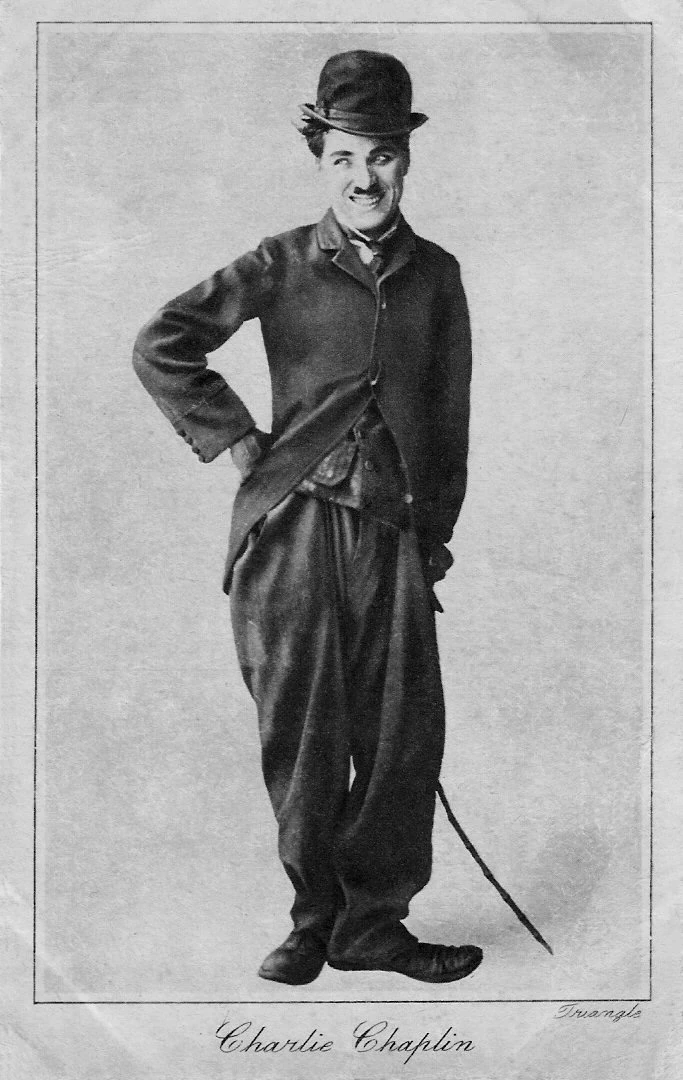
Before Charlie Chaplin became one of the most recognisable faces in cinema, it took only a handful of details to identify his character: a small hat, a short moustache, a bamboo cane, trousers far too loose, enormous shoes, and a slender body moving as though it were trying, at every moment, to preserve its dignity while the world pushed it the other way.
These details created the Little Tramp. Yet the character was more than a funny outfit an actor happened to find in a studio wardrobe. Clothes alone cannot explain the walk; the walk cannot explain the timing; and timing cannot fully explain the peculiar contradiction of a man who looks destitute yet sometimes carries himself with the confidence of a gentleman.
Before the Tramp appeared, Chaplin spent years learning something more important than comedy itself: how to make the body tell a story before it needs words. To understand the character’s birth, we have to return to London: before Hollywood, before the camera, and before anyone knew the name Charlie Chaplin.
A child for whom the theatre was no luxury
Charles Spencer Chaplin was born in London on 16 April 1889 to parents who worked in music hall. His father, Charles Chaplin Sr., was a singer and performer; his mother, Hannah, sang and acted under the stage name Lily Harley. Having theatre in the family did not, however, mean a comfortable or stable life. His parents separated early, Hannah’s health declined, and his father died when Charlie was twelve.
Charlie and his brother Sydney endured severe poverty, had to fend for themselves while still young, and spent periods of their childhood in institutions for the poor. It is therefore tempting to reach for a ready-made legend: “Poverty made Chaplin.”
But that answer is too simple. Poverty explains part of the environment he knew; it cannot, on its own, explain the artist he became. Thousands of children experienced the same hardship without creating the Tramp. What matters more is what happened when that experience met another world alongside it: the theatre.
Theatre remained present at home even when a career on stage became out of reach. His mother would sing, dance, and impersonate performers for her sons. He would sometimes accompany her to theatres and watch from backstage.
An important part of his formation begins here. Imitating someone is not simply repeating their words. First, you have to observe: how do they stand? How do they move their hands? What does their face do before they speak? Where do they place their weight when they walk? What tiny detail makes them recognisable?
This observation of the body would later become one of Chaplin’s most important cinematic tools.
Before addressing the camera, he learned to reach the back row
Chaplin recalled making his stage debut at around five, when his mother’s voice failed during a performance and the boy was sent on to take her place. What matters is not turning that story into a “birth of genius” moment, but understanding the world in which he grew up: one that demanded an immediate understanding of the audience, and the ability to hold its attention through body, voice, and rhythm.
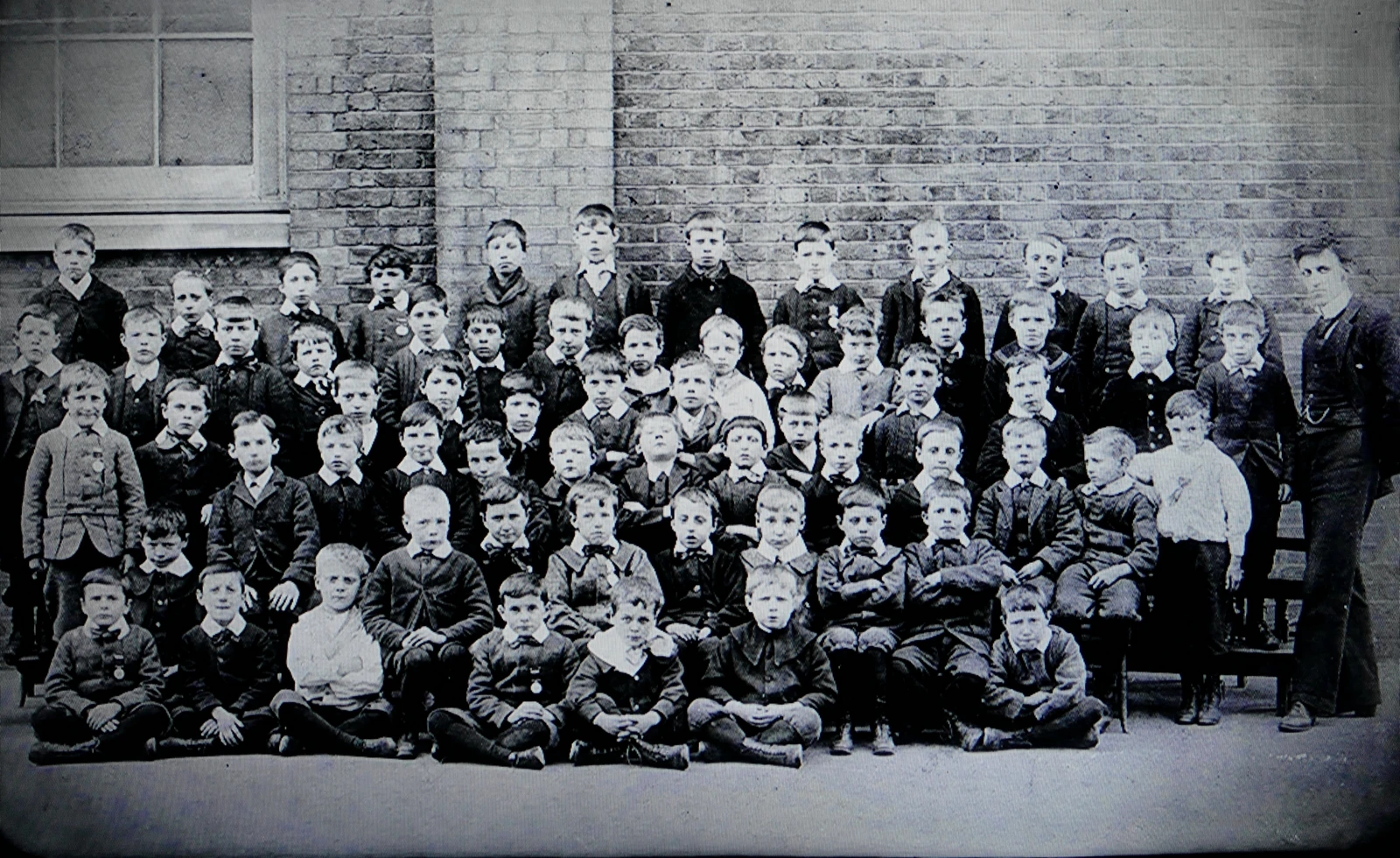
In 1898, at about nine, he joined the children’s dance troupe the Eight Lancashire Lads and began acquiring regular professional experience on the music-hall stage. Dance is no minor detail in this biography.
A performer trained in dance learns that movement has a beginning, a middle, and an end. Half a second can make it precise or awkward. A pause can belong to the movement just as fully as a step.
Physical comedy works through almost exactly the same mechanism.
The gag lies not only in the fall, but in the moment before it.
Not simply in looking at another person, but in the brief delay before noticing them.
Not just in hitting a door, but in the complete confidence with which someone approaches it.
Young Charlie was not, of course, learning “how to become Chaplin.” But without a camera, he was building the tools he would later need in front of one. He subsequently moved into more conventional theatrical roles, including appearances as a boy in stage productions of Sherlock Holmes, before vaudeville led him towards the phase in which his comic identity began to take clearer shape.
Fred Karno: the laboratory before Hollywood
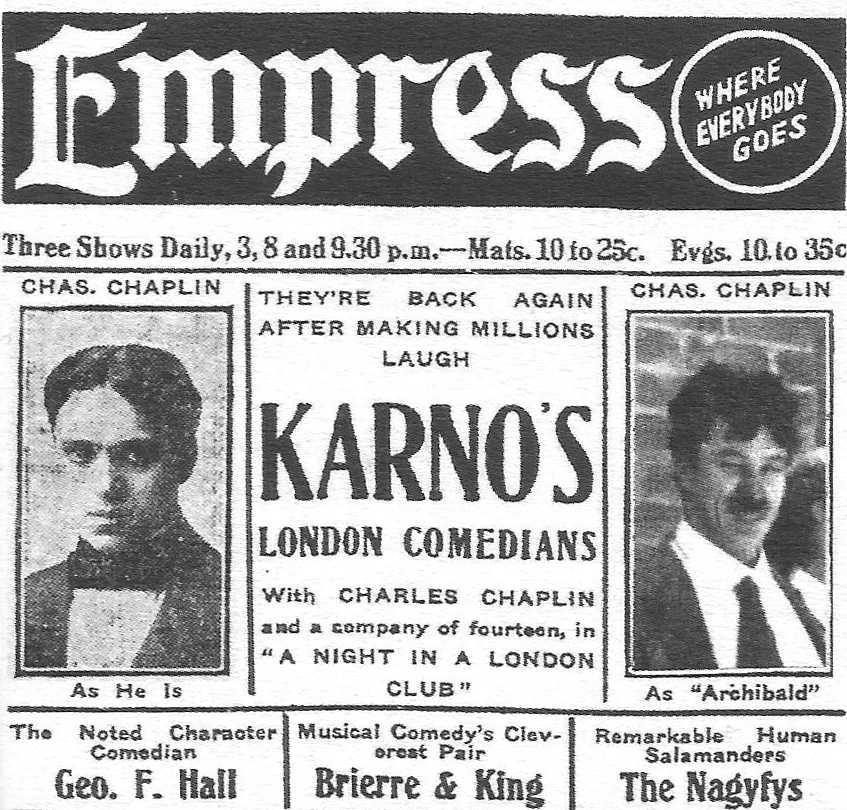
Fred Karno was a crucial stop. His company was more than another job for Chaplin: it was one of the great practical schools of British physical comedy. Through it, Chaplin became a professional comedian touring theatres, rather than a talented child looking for work.
He travelled with the company to the United States in 1910, returning on another tour that began in 1912. Among the performances that drew attention to him was the comic sketch A Night in an English Music Hall. It was during this period that the offer came which would take him from the stage to cinema.
There is an important distinction between comedy built on a written joke and the kind that suited Chaplin. In the latter, an actor can take a very simple action—entering a room, sitting on a chair, picking something up, or trying to walk straight while playing a drunk—and transform it into a sequence of small shifts.
Everything depends on rhythm. Sometimes the spectator sees the problem before the character does. We wait for the collision. Chaplin delays. Then he discovers what the audience already knows. That delay creates the laugh. A stage performer needs a legible body so that movement reaches distant spectators; early silent cinema was about to give this skill an entirely new environment.
The camera could preserve the movement. Film could repeat it before thousands, then millions of people.
When the stage-trained body entered the film machine
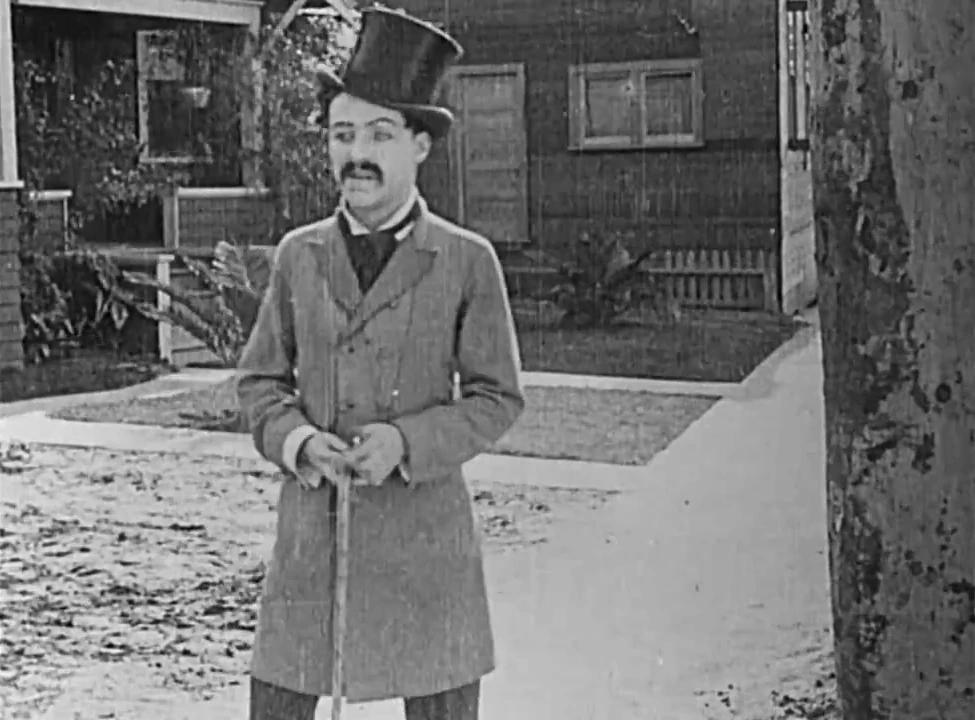
At the end of 1913, after fulfilling his theatrical commitments, Chaplin left Karno’s world to join Mack Sennett’s Keystone Film Company. Keystone belonged to a world radically different from the theatre.
Short comedies were made rapidly, situations were straightforward, chases were plentiful, and the pace of production itself was faster than anything Chaplin had known on stage. His first film was Making a Living, shot in January 1914 and released on 2 February that year. But his character was not the Tramp the world would later recognise. He wore a different outfit, including a top hat, coat, and longer moustache.
That detail matters because it stops us from writing Chaplin’s history backwards. He did not arrive at the studio carrying a finished character in his bag. He was still searching for a form that could work before the camera.
Then came the clothes.
The Tramp’s birth: a more precise story than the familiar legend
One of the most repeated statements in cinema history is that the Tramp “first appeared” in Kid Auto Races at Venice in 1914. This is true if we mean the first time audiences saw him on screen.
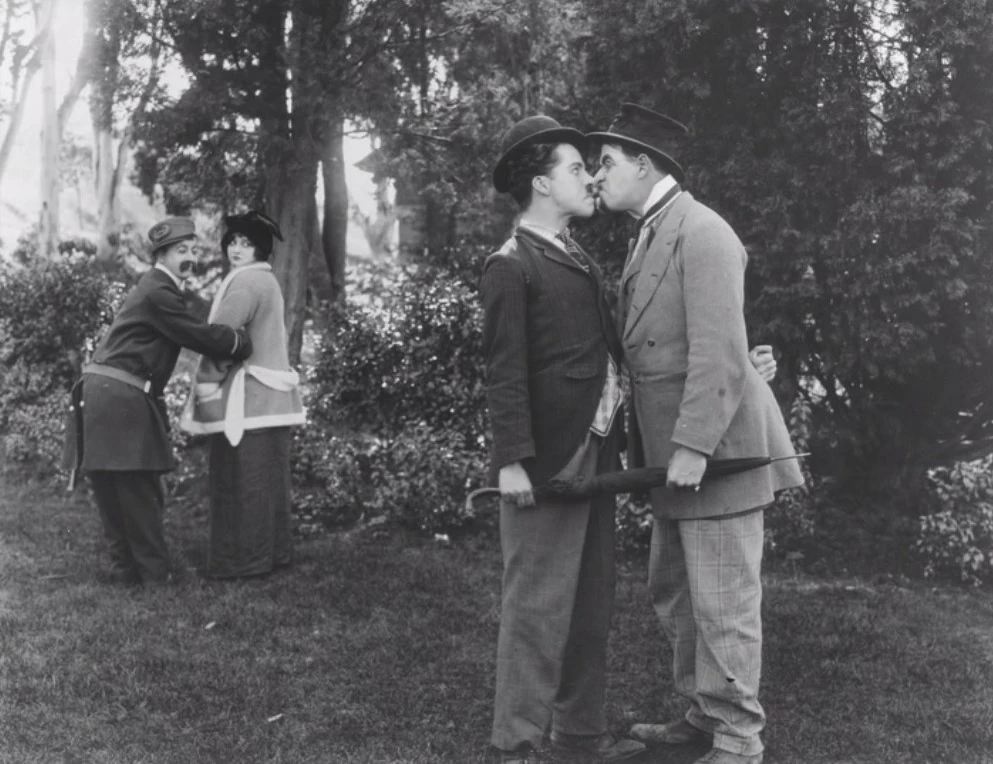
But it is not the whole story. he was first filmed in the costume while working on Mabel’s Strange Predicament. Kid Auto Races at Venice was shot afterwards but completed and distributed sooner: it opened on 7 February 1914, while Mabel’s Strange Predicament opened on 9 February. There is therefore a small but important distinction between the first time he wore the costume before a camera and the first time the public saw it.
This may sound like an academic detail, but it reveals something more interesting about the character’s birth. The Tramp did not emerge from years of design on paper. He took shape remarkably quickly through a set of visual contradictions.
A round derby hat.
A small moustache.
A bamboo cane.
Baggy trousers.
A relatively tight coat.
And shoes far larger than the feet inside them.
This combination was his own, even though its roots included music-hall tramp characters and the real tramps he had encountered in childhood.
The visual genius does not lie in any single item. It lies in the clash between them.
A poor man wearing the remnants of a gentleman
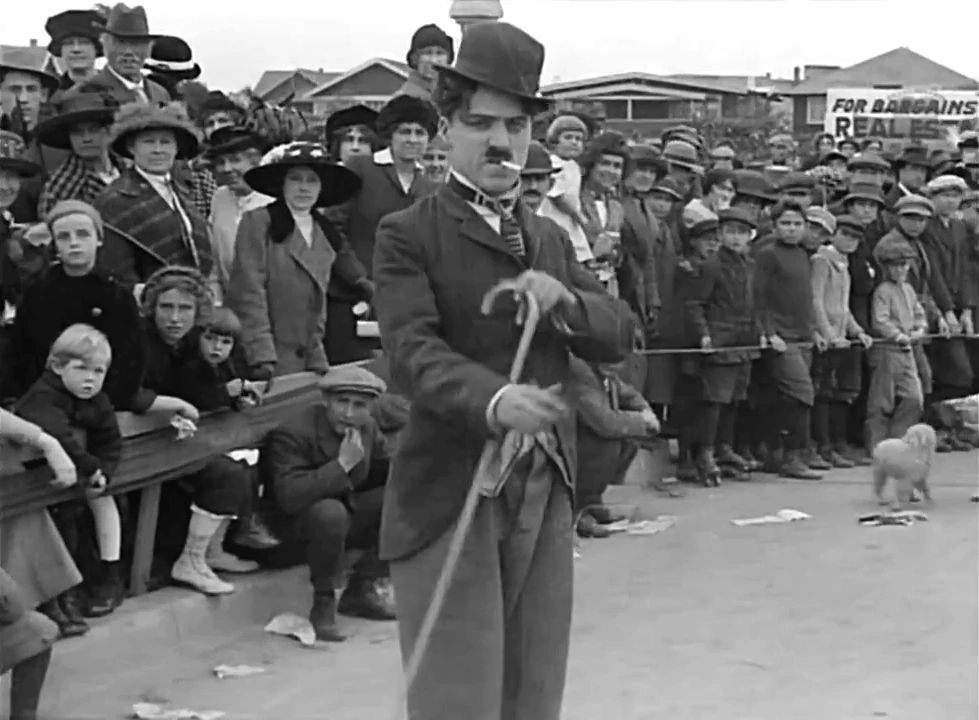
Consider the character without a story. The hat and cane visually belong to someone who wants to look respectable. The trousers and shoes say something else entirely. The coat does not fit the rest of the body. And the moustache gives the face a seriousness at odds with the behaviour we see.
His clothes never quite look as though they belong to him, yet he behaves as if he has selected them with care. This contradiction allows the Tramp to do something harder than merely make an audience laugh: to look frail and self-important at the same time.
When he tips his hat, the gesture is courteous. He sometimes handles his cane as an extension of an elegance he cannot afford. Then he trips over a shoe, and the whole image collapses in a second.
And he rebuilds it. Dignity becomes a physical action. The Tramp does not need to say, “I refuse to look defeated.” Straightening his clothes after a fall, or recovering his walk after an embarrassment, is enough.
This is one reason the character’s design is so cinematically powerful: every item of clothing can become an instrument of performance.
The shoes alter the walk.
The cane redirects the movement.
The hat creates a gesture.
The trousers change the body’s shape within the frame.
We can read the character almost before anything happens.
Why does Chaplin need his whole body?
When discussing film acting, it is easy to concentrate on the face and the close-up. But in physical comedy, getting too close can lose part of the joke. Sometimes the viewer needs to see the relationship between the body and its surroundings.
Where is the chair? Where is the door? How far is Chaplin’s foot from the object he is about to trip over? Who is standing behind him? How much distance must he cover before a movement becomes a problem?
Movement is not decoration added to the performance. Movement is the information itself. A frame that shows enough of the body and its surroundings therefore becomes essential. We do not need to be told the shoes are enormous if we can see their effect on his walk. Nor do we need dialogue explaining that he is trying to preserve his composure if we watch him lose his balance and immediately recover his bearing.
We can see the beginnings of this relationship clearly in Kid Auto Races at Venice. The film is extremely simple: a real children’s race, a crew trying to film it, and a little man who insists on stepping in front of the camera.
But that simplicity makes it a remarkable document. The Tramp is not interacting only with the other characters. He is interacting with the camera itself.
He enters its field of view.
He leaves it.
He comes back.
He tries to be seen.
The real spectators at the race begin to notice this strange man and respond to him. The film actually preserves reactions from some of the people attending the event during filming.
It is almost as though the character was born before an audience that did not yet know it was watching someone who would outlive it by more than a century.
Is the Tramp simply Chaplin’s childhood wearing a hat?
We should be careful here. There is a clear relationship between the environment Chaplin knew and the world his character would be able to touch. Poverty, instability, and real tramps on London’s streets were part of his experience; he also drew on music-hall tramp traditions.
But turning the Tramp into a direct psychological equation would be reductive. It is not:
Poor childhood = poor character.
The character emerged where many things met: social memory, theatrical traditions, physical training, an eye for observation, years of performing before live audiences, and a new cinematic medium that allowed these elements to become an image.
That is why the Tramp could be more than a copy of his creator’s life. He is poor, but not merely a victim. Sometimes a troublemaker, he is also capable of empathy. He tries to behave like a man of society while having no settled place within it.
This contradiction opened the space in which Chaplin would later use comedy to discuss subjects far larger than falls, kicks, and chases. But we have not reached that stage yet.
In 1914, the essential discovery was simpler and more important:
Chaplin had found a body the world could understand.
The character was born—but its creator did not yet own the film
The Tramp’s birth can be reduced to the familiar image of a wardrobe, but that does an injustice to everything that came before. The hat, cane, and moustache would have amounted to little if worn by an actor who did not know how to use silence, distance, timing, and the body.
Before cinema, there was London. Before the camera, there was a stage. Before the Tramp, there was a child who learned that watching others could become a performance; a dancer who learned that half a step could change the rhythm; and a comedian who spent years testing the moment at which an audience would laugh.
When these experiences came together before a Keystone camera, they found the form they had been missing. Yet the character’s birth did not solve the next problem. Having a powerful character does not mean having control of the film in which it appears.
Within a fast-moving system such as Keystone, other people determined the filming, editing, and time available to build the comedy. Chaplin would gradually discover that controlling his body in front of the camera was not enough. If he wanted the character to move to his own rhythm, he needed a greater say behind the camera too.
That is where the next story begins: how the new Tramp moved from being a star inside the cinema machine towards becoming a man who wanted the machine itself to be one of his tools.
About this series
This special traces Charlie Chaplin’s cinematic origins, artistic independence, relationship with sound, public conflict, and legacy.
All parts of this series are now published.
All Cinema Journal articles