By the end of the 1920s, Charlie Chaplin had achieved almost everything he had sought since entering cinema: worldwide stardom, a character audiences recognised from a hat and cane alone, his own studio, extensive control over writing, direction and production, and a distribution company founded with some of the greatest names of his era.
After years of struggling to make films at the rhythm he wanted, he was finally able to do so.
Then cinema itself changed.
The Jazz Singer premiered in October 1927. Contrary to a common description, it was not a fully talking film, but it included passages of singing and speech synchronised with the image. Its success helped accelerate the industry’s transition to sound. Lights of New York followed in 1928 as the first feature to use spoken dialogue throughout. Within a few years, talking pictures moved from a technological experiment to Hollywood’s dominant form.
For many artists, the question was: how do we learn to work with sound?
For Chaplin, the question was more dangerous:
What would happen to the Tramp if he spoke?
Speech was not simply a matter of adding a microphone to an established character.
It could change his nature completely.
The problem was not a fear of technology
It is easy to tell the story this way:
Sound arrived, Chaplin rejected it, and eventually he had to surrender.
But that explanation does not fit very well with what he actually did.
Chaplin did not reject sound.
He used recorded music, synchronised effects, human voices and even his own voice before making a film built around conventional dialogue.
What he resisted for years was something more specific:
Allowing speech to become the Tramp’s principal instrument.
That distinction matters.
The Tramp had become an international character before anyone heard his voice. You could watch his movements in London, Paris or Tokyo and understand much of the situation without needing him to speak a particular language.
The moment he spoke, however, he would have to possess a voice.
An accent.
A language.
And that voice would become a permanent part of the character.
This problem emerged during the preparation of City Lights. Millions of viewers around the world had already imagined the Tramp’s voice. Giving him a single voice and language would impose a definite answer on something that had remained open for years.
So Chaplin’s question was not whether he could record dialogue.
It was:
Did the Tramp need it at all?
City Lights: a silent film in a city learning to speak
When work began on City Lights, silent filmmaking was no longer the industry’s default.
By its release in 1931, talking pictures had become the rule in Hollywood. Chaplin nevertheless made a film relying primarily on pantomime and intertitles rather than spoken dialogue. His production independence was one factor that made such a decision possible when talkies were already dominant.
Yet describing City Lights simply as a ‘silent film’ conceals half the story.
It is not a film without sound.
Chaplin composed synchronised music, added carefully judged sound effects and used the new technology whenever it could perform a function within a gag.
In one famous example, the Tramp swallows a whistle. Its sound, synchronised with his movements, becomes part of the comic situation. Chaplin later described the precision required to synchronise it: this scene alone needed repeated attempts before the whistle sounded at the right moment.
His resistance was therefore not a technical resistance to sound.
It was a choice about what sound should do.
Speech does not explain the image.
Sound enters when it adds something movement alone cannot provide.
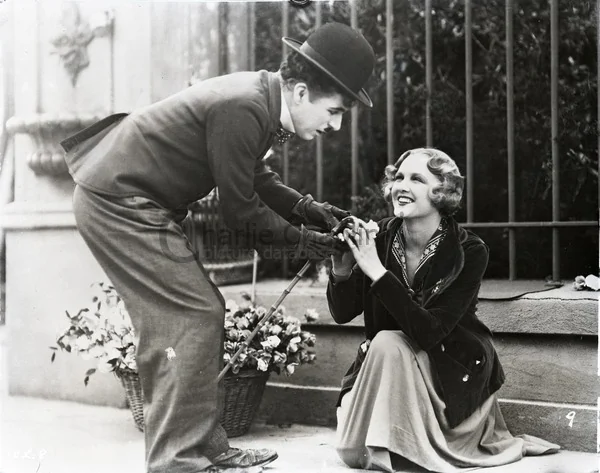
Music became the Tramp’s voice without making him speak
The new technology also gave Chaplin an instrument over which he had lacked complete control during traditional silent exhibition.
Before synchronised recording, a silent film was shown with live musical accompaniment that could vary from one theatre to another.
With City Lights, he could fix the music within the film itself.
It was Chaplin’s first major experience of composing music intended as a permanent part of a film’s soundtrack, then having it arranged and recorded in precise synchronisation with the images.
This matters enormously when we consider Chaplin’s films as works of direction.
Music is not an emotional background added after the scene is finished.
It can become part of the rhythm.
A small step coincides with a note.
A pause in movement creates a musical gap.
A change in melody turns a comic situation into something more tender.
Chaplin thus did something apparently contradictory:
He used the sound revolution to protect the silent cinema he believed in.
Instead of giving the Tramp dialogue, he gave him music more precisely controlled than before.
Why can the body say things that need no dialogue?
The principle becomes clear when we look at how Chaplin constructs a scene.
In cinema built around dialogue, a character can say:
‘I am afraid.’
Or:
‘I do not know what to do.’
Chaplin instead lets the viewer reach that information through the arrangement of the body within the image.
Where does he look?
How long does he hesitate before moving?
Does he approach or withdraw?
What does he do with his hands?
Is he trying to hide his unease from the person facing him?
In City Lights, entire scenes communicate their emotional relationships through differences in how characters move, without requiring verbal explanation.
When comedy enters, the idea becomes clearer still.
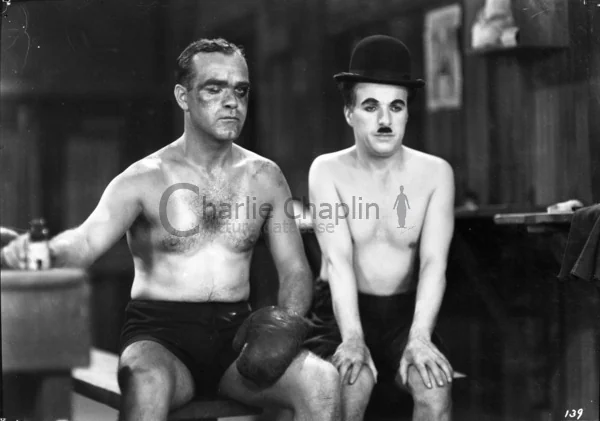
The celebrated boxing sequence, for example, does not rely on a single joke. It relies on a geometry of movement.
Three bodies move within a defined space: Chaplin, his opponent and the referee.
The Tramp constantly moves to keep the referee between himself and the other boxer.
When the opponent moves, Chaplin moves.
When the referee changes position, the whole arrangement changes.
For a moment, three people become something like an organised dance.
If the scene were constantly cut into separate faces, a fundamental part of the joke would disappear.
We need to see the spatial relationship between all three bodies.
The space itself creates the comedy.
Movement is the dialogue.
The shot lets us discover what to feel
The absence of speech in Chaplin has another consequence.
The image does not constantly need to explain itself.
When a character is embarrassed, the camera can remain in place and let the body attempt to escape the situation.
When laughter turns to sadness, the film does not always need a sentence announcing the change in mood.
The change happens in speed.
In the face.
In the distance between two people.
And in the time Chaplin allows the shot to continue.
This is part of why silence in his films is not the absence of a missing element.
It is a complete system of writing.
That made the move to dialogue a genuine risk.
Adding words does not merely add another layer. It can also draw attention away from the details of movement on which the character was built.
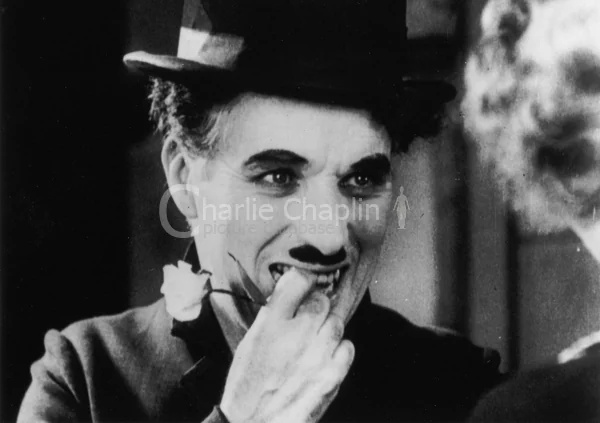
Five more years passed, and sound could no longer be ignored
City Lights succeeded commercially and critically despite its silent approach in an age of speech. Its success did not stop the industry, however.
By the middle of the 1930s, sound was no longer a novelty.
It was a normal part of cinema.
When Chaplin began Modern Times, the question became more urgent.
Would he make a talking picture this time?
At first, the answer was closer to: perhaps.
There were dialogue scripts for scenes in the film, and Chaplin did prepare to shoot dialogue for his character. After a short period of rehearsal, he abandoned the approach and did not continue with the planned dialogue scenes.
This detail changes how we understand the decision.
Chaplin was not ignoring the possibility of speech.
He tried it, then rejected the result for this character.
In the finished film, he found a stranger and more interesting solution:
Let the world speak…
While the Tramp remains almost silent.
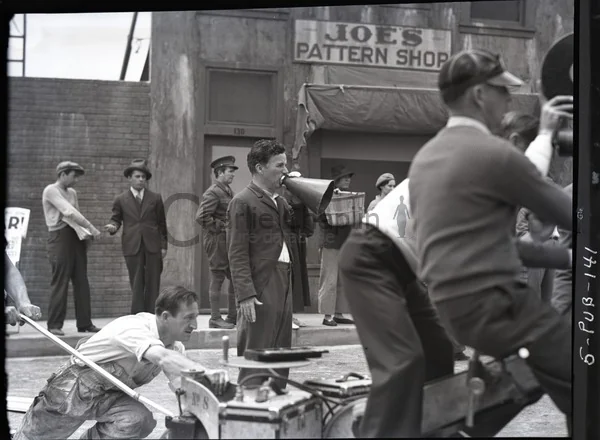
Modern Times is not a silent film in the conventional sense
This point needs a precise distinction.
Modern Times is often described as Chaplin’s last silent film.
The description makes historical sense, but it is not literally accurate.
Released in 1936, the film contains recorded music, synchronised effects, recorded human voices and passages of speech.
It is mostly silent, but includes voices, effects and limited dialogue within the soundtrack.
Modern Times is therefore not a return to 1925.
It knows that sound exists.
It uses sound.
But it refuses to give sound complete control.
That makes its sound strategy more interesting than simply saying ‘Chaplin continued to make a silent film.’
In the factory, the machine owns the voice
From the early passages of Modern Times, we see a world different from the spaces through which the Tramp previously moved.
The factory is ordered.
Its lines are straight.
Its machines are enormous.
Its workers repeat.
Each person’s movement is tied to the speed of something larger.
The Tramp cannot move freely within this space.
His body must match the rhythm of the machine.
He tightens a bolt.
Then the next.
Then the next.
The speed increases.
His body tries to keep up with the line.
The image does not merely use the machine as a background.
The machine organises the frame.
The conveyor’s movement establishes direction.
Its speed establishes the rhythm of the performance.
The worker before it visually becomes another part of the system.
The composition can be read as a struggle between an organic body, naturally unruly, and a geometry that recognises only repetition.
When Chaplin cannot maintain the rhythm, the machine does not stop to accommodate him.
He is the one who must keep up.
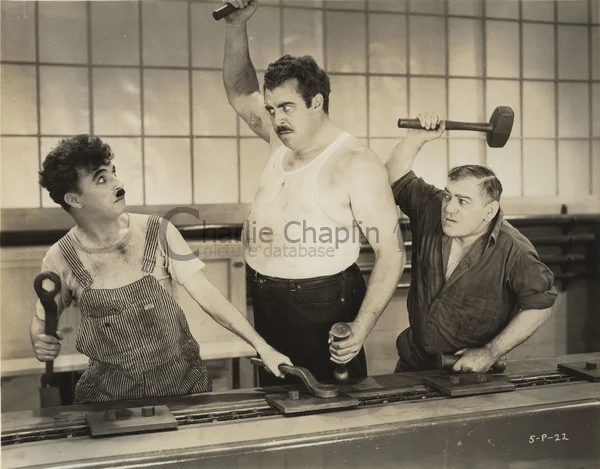
The gag itself becomes the idea
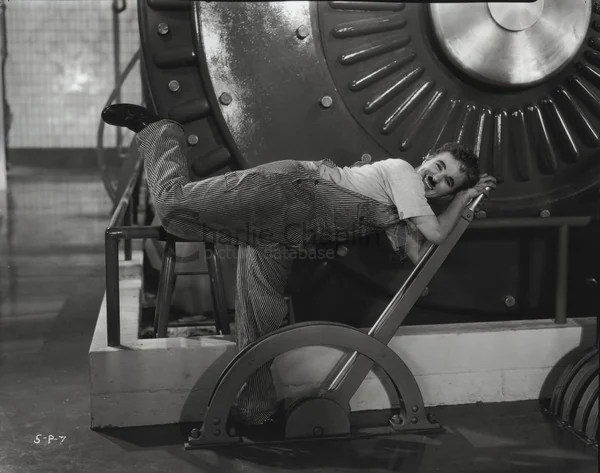
After minutes of repeatedly tightening bolts, the worker’s body continues the action even after leaving the production line.
The movement has entered his muscles.
What was a job has become a reflex.
This is one of the strongest powers of Chaplin’s comedy: the gag is not a commentary laid over an idea.
The gag is the idea.
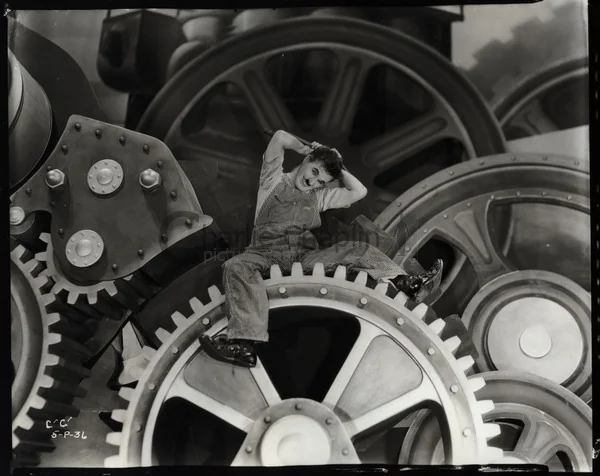
Instead of saying that mechanical work turns a human being into a machine, the film makes Chaplin’s body behave like one.
When the enormous system of gears later swallows him, the image becomes a literal extension of that meaning.
A small human being inside a geometry larger than himself.
Yet the scene never stops being comedy.
This balance matters.
Geometric lines, repetition and speed put pressure on the character. Chaplin’s physical skill turns that very pressure into laughter.
The viewer receives no lecture about industrial labour.
The idea moves before our eyes.
The feeding machine: when saving time matters more than the person
Then comes the machine designed to feed workers.
Its logic within the film is clear: if eating lunch means stopping the worker, why not invent a device that feeds him while work continues?
Once again, Chaplin needs no speech.
The image is enough.
The body is secured in place.
The machine brings food closer.
The movement begins in order.
Then the order fails.
The chaos increases while the worker remains trapped.
If the scene were simply a man eating comically, it would be a gag.
The machine’s presence adds another question:
Who serves whom?
A device supposedly created to serve a person becomes something imposing its own rhythm on him.
Comically, each technical failure makes the system’s owners seek a repair to the machine rather than question the premise itself.
The body is the only thing with no say.
Sound arrives, and it matters who controls it
Here, Modern Times becomes more intelligent in its use of sound.
Its human voices do not appear at random.
Human voices are generally heard through devices. The factory owner addresses workers through a screen; the salesman appears through a recording. Sound enters this world through technology that separates the speaker from the listener.
The result on screen is striking.
The man with power can speak.
The machine can speak.
The recording can speak.
The Tramp, at the centre of all this technology, still has no dialogue.
We do not need to assume that Chaplin devised a theoretical plan for every detail to recognise its effect.
The sound strategy can be read clearly:
Speech belongs more to the system surrounding the character than to the character himself.
When the manager wants the production line to move faster, he does not need to enter the factory.
He appears on the screen.
Image and sound allow him to be present without physically occupying the space.
Technology thus becomes part of the power relationship within the scene, rather than a new invention cinema is simply celebrating.
Why it is wrong to say Chaplin opposed sound
If he rejected technology merely because it was new, he would not have spent so much time designing music and effects.
He personally described the difficulty of synchronising sounds with the images in City Lights.
For Modern Times, he tried dialogue and abandoned it, but continued to create effects carefully. He made experimental sounds himself, including stomach noises using water, and considering how car horns, bells and whistles could enter the musical structure.
The question was therefore not:
Sound or silence?
It was:
What can sound do that the image cannot?
When he finds no convincing answer, he lets the image work.
This is not a resistance to technology.
It is a resistance to making technology an end in itself.
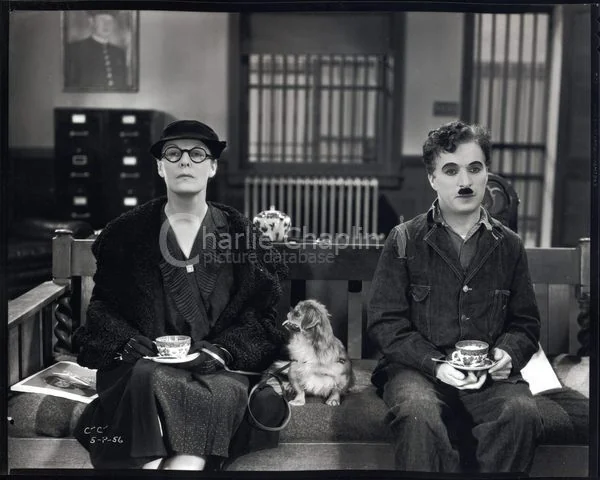
Then came the moment audiences had awaited for twenty years
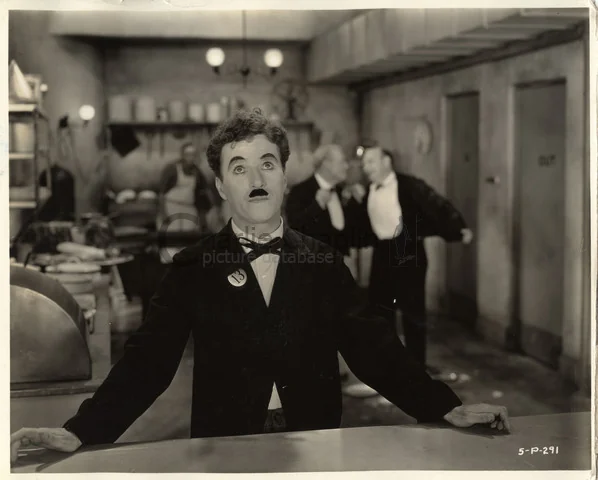
Near the end of Modern Times, the Tramp finds himself facing an audience in a restaurant.
He is supposed to sing.
He writes the lyrics on his cuff to remember them.
Then loses them.
Silence can no longer save him.
He begins to sing.
For the first time, the film audience hears the Tramp’s own voice.
Chaplin introduces it with a solution that almost sums up all his years of resistance:
The words belong to no real language.
Known as the Nonsense Song, or Titine, it is performed through a comic mixture of syllables that sound familiar from several languages without forming a text that can be translated conventionally. Instructions for foreign distribution explicitly stated that no translation was needed because the song was written in an imaginary language.
Here is a remarkably simple solution to the old problem.
The Tramp has spoken.
But he has not become English, American, French or Italian.
Sound is present.
Meaning still comes from the body.
Tone, face, dance, hands and the rhythm of a sentence we do not understand all tell us what is happening.
Speech itself becomes a vocal gesture.
Sound did not defeat the body; it became another body
This moment reveals something deeper about Chaplin’s relationship with sound.
For years, the Tramp’s power had come from a body functioning as a language.
In Modern Times, Chaplin does not abandon that idea even when he finally opens his mouth.
The voice itself becomes movement.
He raises its pitch.
Lowers it.
Stretches one syllable.
Cuts another short.
He creates meaning through the rhythm of speech rather than the dictionary meaning of words.
It is as if Chaplin found the one way the Tramp could speak without losing the quality that made him universal.
This also explains why calling the film ‘silent’ is less interesting than its reality.
Modern Times did not ignore the sound revolution.
It negotiates with it, scene by scene.
It allows sound in.
Then gives it limits.
The claimed connection with 1984 calls for greater caution
Some articles repeatedly claim that the surveillance screen in Modern Times directly inspired George Orwell’s 1984.
The visual and intellectual resemblance is certainly tempting: a large screen, an authority watching an individual, and technology bringing surveillance into everyday life.
Resemblance does not establish causation, however.
There is no strong primary evidence that would allow us to say Orwell took the idea directly from Chaplin. It is better not to turn a possibility into a fact.
More precisely, the scene can look strikingly close today to images of surveillance that would later become central to culture and dystopian fiction.
This is the difference between interpreting a film’s choices and establishing the history of its production.
We do not need Chaplin to have ‘predicted the future’ for the scene to be powerful.
It is enough that he took a technology and a workplace relationship present in his world, then enlarged them into an image whose meaning the viewer could understand.
Silence became an aesthetic position
Between City Lights in 1931 and Modern Times in 1936, Chaplin travelled a fascinating distance.
In the first film, he keeps the Tramp within an almost silent cinematic structure, using music and effects to add to the image without handing control to words.
In the second, he allows almost the entire surrounding world to enter the age of sound while keeping his character in a strange intermediate space.
Machines have voices.
Authority has voices.
Recordings speak.
Music continues.
The Tramp finally sings, but in a language that cannot be pinned down.
This is no longer simply an attempt to preserve the past.
It is a different way of using a new instrument.
It reveals why ‘Why did Chaplin reject sound?’ is itself an imprecise question.
He did not reject sound.
He refused to let sound erase the language he had spent his life building.
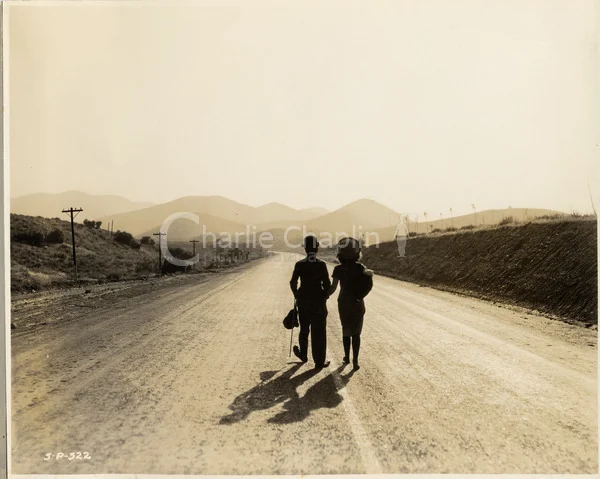
The Tramp had reached the end of the road
There is another reason Modern Times marks a turning point.
It was Chaplin’s last feature appearance as the Tramp. It was the farewell to the character that had accompanied him since 1914.
This almost makes sense from within the film itself.
The Tramp managed to live in a world of sound without surrendering to it completely.
He even managed to speak once without belonging to a language.
But the cinema waiting for Chaplin would not allow him to remain in that intermediate space.
The next phase would not require a character trying to make the world understand him through movement alone.
It would require definite words.
Definite names.
And satire that did not depend on gesture alone.
After years of protecting the Tramp from speech, Chaplin would make a film in which sound becomes the substance of the confrontation itself.
In The Great Dictator, the problem would no longer be:
How can the Tramp speak?
It would be:
What happens when Charlie Chaplin finally decides to say, in his own voice, what the image alone can no longer express?
That is where part four begins.
About this series
This special traces Charlie Chaplin’s cinematic origins, artistic independence, relationship with sound, public conflict, and legacy.
All parts of this series are now published.
All Cinema Journal articles