The review
Conrad Shows His Strength and Weakens His Position
Conrad's attack on Frankie's location gives him a prisoner and information, but forces the rest of the family to deal with a battle whose timing he chose himself. This exposes the problem with his leadership: the value he places on displaying strength takes priority over calculating the consequences of using it.
His appearance outside the room where Jojo is being tortured, followed by his talk about the operation's success, reveals the gap between how he sees himself and how Harry sees the situation. Conrad celebrates what he has taken from his enemy while Harry tries to determine the scale of the crisis now facing them. They are discussing the same operation, but measuring success by different standards.
The problem continues in his meeting with Kevin. Instead of a shared danger helping them organize a response, the conversation returns to provocation, humiliation and reinforcing the household hierarchy. Discussion becomes a way to defend status, while its practical purpose recedes.


Even his question about Brendan, before he is reminded of his death and corrects himself to Eddie, weakens the image he is trying to impose. The moment raises a question about his confusion without giving us grounds to establish its cause. What matters dramatically is that a man demanding everyone's acceptance of his decisions seems less capable of keeping track of everything around him.
This storyline works when it reveals the dysfunction through a particular action or a passing remark. Continuing the same arguments, however, sometimes comes close to proving a problem that is already clear all over again.
Harry's Lie and the Cost of Controlling the Story
Harry killing Jojo and then telling Conrad that he bled to death raises an important question because the concealment happens within the family itself. What is certain is that he chooses to present a different version of what happened. The motive behind that choice remains unresolved.
We can read this as an attempt to retain some independence in making decisions, or to end a situation he does not want to leave open for Conrad. But the episode offers no definitive explanation that would turn that reading into fact. The ambiguity draws attention, while still needing a later consequence to justify the emphasis placed on it.
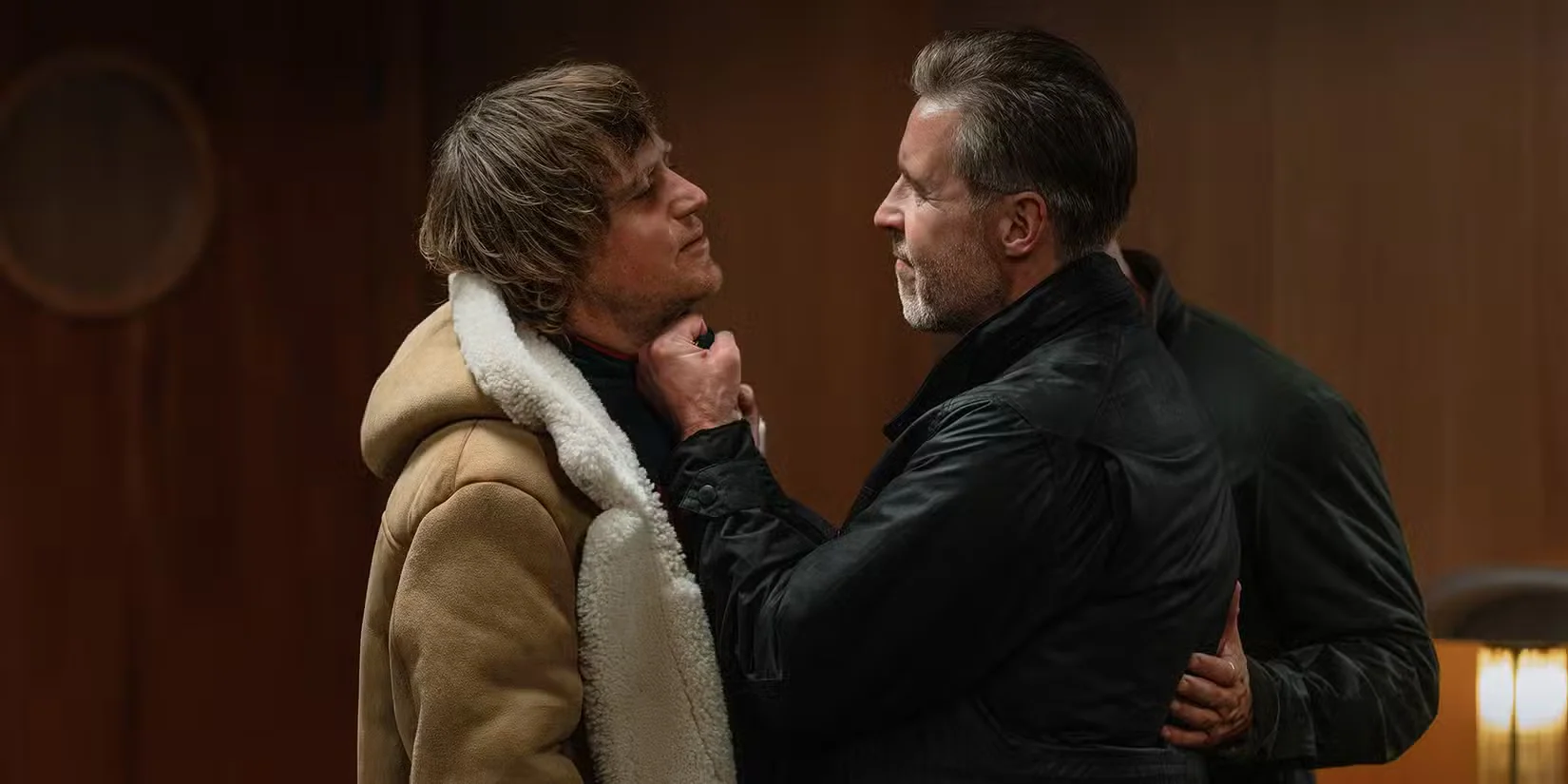
The purpose of shaping the story becomes clearer when he instructs Seraphina on what to tell Donnie. He tries to control both the information reaching the other side and the timing of its arrival, so the enemy will not know how much of its secrets has been exposed.
But Seraphina reveals that the family is meeting in one place. A genuine change occurs here: information emerging from a conversation that appears controlled gives their enemies an opportunity to attack. We do not need to decide whether she leaked it deliberately or accidentally to understand the danger of the result.
This is one of the episode's strongest causal connections. Frankie and his allies make their decision in response to specific information, so the move toward an attack grows out of what happened between the characters. It also exposes the limit of Harry's ability to manage deception: he can prepare the words, but cannot guarantee that everyone will stick to the role he has assigned them.
Maeve Pulls the Younger Generation into Her War
Assigning Eddie to assassinate Medusa reveals the nature of Maeve's relationship with the people she uses to carry out her wishes. She sets the target, while the young man she sends bears responsibility for entering a confrontation he does not seem equipped to handle.
His watching videos to learn how to use a gun sums up the gap between the mission and his preparation. The detail carries a degree of absurdity, but also makes his choice disturbing. There is a desire to prove himself alongside a clear lack of the experience such a risk requires.
Gina becomes the person paying for the information withheld from her. She enters the trip expecting to have a good time, then discovers that she has come close to an assassination. Her objection to Eddie therefore concerns her right to know the danger he is putting her in, and his ability to treat her as someone entitled to make her own decisions.

When she makes him choose between returning with her and continuing the mission, he chooses Maeve. This moment reveals his priorities more clearly than any declaration of loyalty. Even so, Gina's attempt to intervene when Eddie is in danger keeps their relationship from ending at the argument: her anger at him does not erase her concern for his fate.
This becomes even crueler when connected to the revelation that Seraphina was Maeve's intended target with the poison. A picture emerges of someone who redistributes danger within her family according to her own wishes, then demands that everyone remain inside her personal definition of loyalty.
This storyline gives the episode a conflict beyond completing the mission: what room does belonging to the family leave for conscience, choice and personal relationships?
Harry Faces a Crumbling Cover Story and Broken Trust
Alongside his attempts to manage the family, the cover Harry constructed around Finch's death begins to crack. Cavanagh determines that the death was a murder, turning what Harry wanted to be a closed ending into a new opening for investigation.
The development matters because it limits the idea that his expertise is enough to close off every problem. Getting rid of someone does not necessarily erase the questions they leave behind. Harry's network observing the investigation team shows an attempt to monitor this danger, but the episode does not settle how he will deal with it.

In his private life, he faces another kind of powerlessness. His warning to Jan about Donnie reaches her within a relationship that has lost the trust needed to believe him. She therefore receives the warning as another extension of his interference and threats, until Seraphina's call appears on Donnie's phone in front of her.
This clue does not explain every detail to Jan, but it is enough to make the family connection visible to her. The development works better than simply persuading her with another speech from Harry: it gives her a reason to reconsider her position based on something she sees for herself.
The combination of professional and private pressure explains the episode's sense that Harry cannot be everywhere he is needed. When he learns from Paul the truth about Eddie's mission and Gina being with him, his urgent response makes sense as a father, even if his departure seems mysterious to the others at headquarters.
Two Parallel Confrontations and Danger That Misses Its Targets
The final stretch builds its tension around two crises: Eddie and Gina facing Medusa, and the Harrigan family facing the attack on its headquarters. This structure gives the episode momentum because focusing on one front leaves the other moving toward an outcome Harry cannot control.
But the value of this arrangement diminishes when survival becomes easier than the scale of danger the episode has built. Harry's journey includes delays and a loss of communication, then ends with him arriving at exactly the right moment and eliminating the threat with decisive speed.
The problem is that the accumulated obstacles do not sufficiently affect the confrontation's outcome. They delay his arrival, then stop mattering at the moment the story needs him to appear. When he takes control of the fight so quickly, some of the earlier tension becomes little more than an extended wait.
The problem is clearer in the attack on headquarters. Every major character manages to reach the helicopter, while the casualties fall among those around them. Their collective survival is possible, but the scene needs to construct a convincing explanation for how it happens amid an attack of this scale.

The protection the writing gives its characters becomes too visible here. Frankie's focus on displaying his victory while allowing them to escape by air weakens the effectiveness of the moment he has waited for to strike them all together.
The episode raises the level of violence without making that escalation felt to the same degree in the fates of the characters we follow.
Losing Headquarters Changes the Balance of the Conflict
Even so, it would be unfair to consider the attack inconsequential simply because the main characters survived. The Harrigans leave the episode having lost their headquarters and members of their force, occupying a different position from the one in which they entered the meeting.
Headquarters gave them a place to gather family members, detain enemies and make decisions. Losing it reduces their ability to set the terms of the next encounter and makes regaining the initiative harder. The loss goes beyond leaving a building: it shakes a center of power whose possession had shaped the family's actions.
There is a strong irony in the timing of the fall: family members try to reach some understanding, but Seraphina's warning arrives while they remain trapped in their usual way of dealing with one another. The external danger arrives before the meeting can produce real unity.
The ending raises a question about their ability to work together after losing these advantages. The setback could become a test of leadership and loyalty, particularly after the episode has shown the damage caused by each unilateral decision. It gives us no basis for certainty about the response or the alliances that might emerge later.

Strengths and Weaknesses
The main strengths are the exposure of the characters' priorities, the conflict between Eddie and Gina, and the connection between the leaked meeting information and the decision to attack. The main weaknesses are the ease of some rescue solutions, the visible plot protection in the final confrontation, and arguments continuing after they have exhausted their meaning.
Final verdict
Final verdict
Episode five moves the conflict into a more difficult position for the Harrigan family and gives the rest of the season a crisis worth following. It achieves this shift with uneven effectiveness, however: the relationships and decisions are more convincing than some of the devices used to keep everyone alive. Its strongest impact is the fact that escape does not resolve the disagreement that led to the disaster. The family members have managed to leave the place, but they still have to decide who has the right to determine the next step.
Your turn
Will losing headquarters force the Harrigan family to unite, or open an even greater struggle over who leads it?
AUDIENCE VOTE
Do you agree with the MB rating?
Choose once from this browser. You can change your answer at any time.