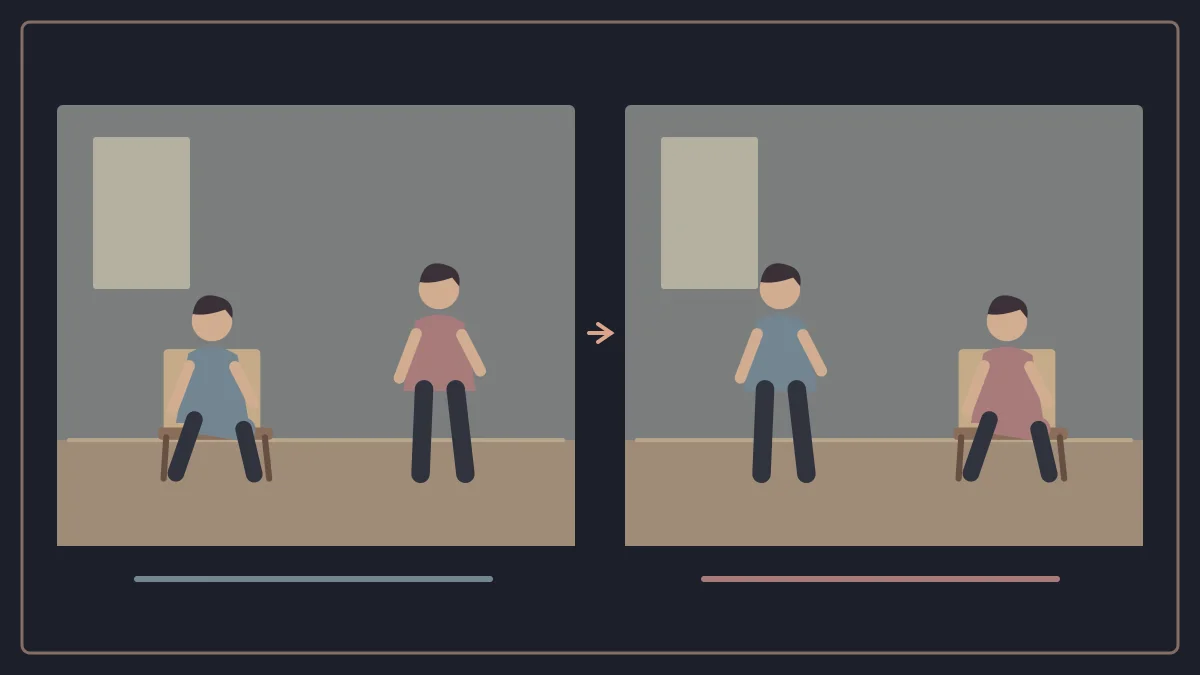
Put two people in a room.
One is sitting on a chair; the other is standing in front of them.
Keep the dialogue unchanged.
Now have the standing person sit down and the other person stand up.
The same dialogue.
The same room.
The same two characters.
But something has changed.
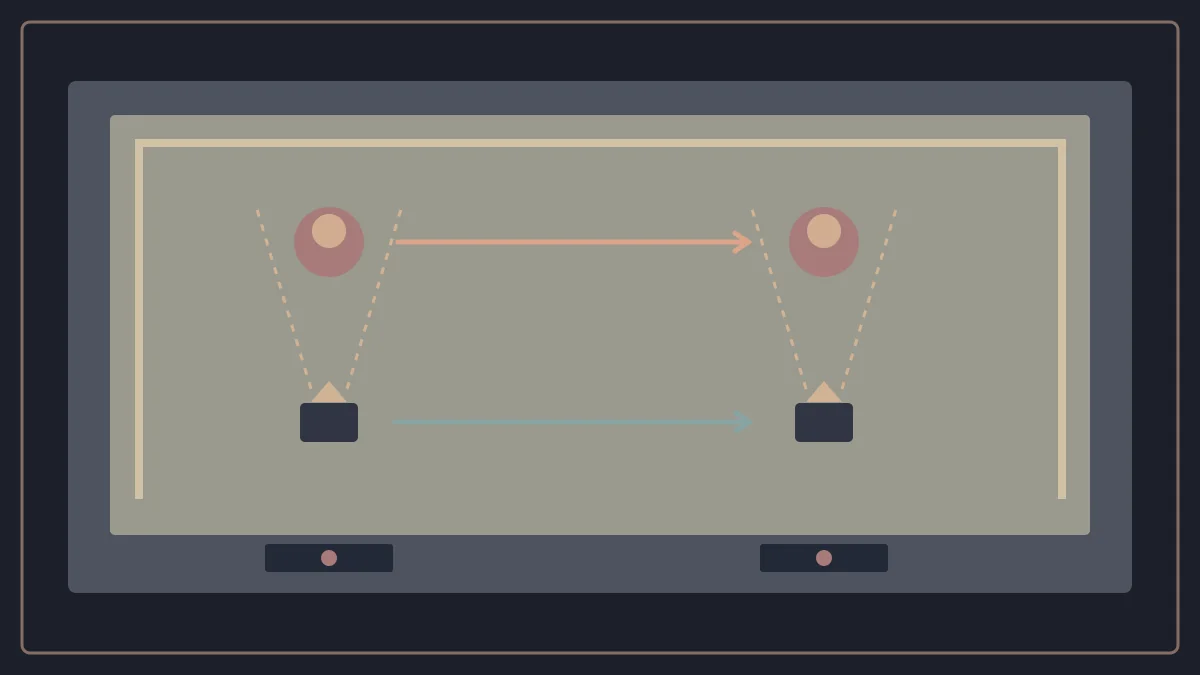
Then try having one of them take a step closer while the other retreats just half a step.
Or have one turn away while the other keeps talking.
Suddenly, distance is no longer merely distance.
It has become a relationship.
This is exactly what blocking does: it turns where an actor stands and how they move into part of the storytelling.
What Is Blocking?
In its simplest practical definition, blocking is the positioning, movement and relationships of actors within the space of a scene.
Where does each actor stand?
Who is closest to the camera?
Who occupies the centre?
Who is at the edge?
Who sits, and who remains standing?
Who moves closer?
Who withdraws?
Where are they looking?
And who needs to move for the relationship within the image to change?
These are all questions of blocking.
The concept therefore goes beyond “where should the actor stand to avoid blocking the light?” or “how do we keep two people from bumping into each other?”
That practical side is necessary, but it is only the beginning.
Blocking can become a visual way of writing the relationship between characters.
Space Itself Can Confer Authority
In an ordinary conversation, we tend to look for power in words.
Who talks more?
Who shouts?
Who gives the orders?
But an image can distribute power before the dialogue even begins.
Imagine a manager and an employee in an office.
If the manager sits behind an enormous desk while the employee stands in front of it, the space itself establishes a difference in power.
Change the arrangement.
Have the manager leave the desk and sit beside the employee on the same sofa.
Before a single sentence changes, the psychological distance between them has changed.
They are closer to being on the same level.
We should therefore avoid thinking of an actor’s position as merely a point on the floor.
That position carries potential dramatic value.
But its value is not fixed.
Standing does not always mean power.
Sitting does not always mean weakness.
The seated character may be the only one who feels no need to assert their presence, while the other remains standing out of anxiety or because they are waiting for permission.
Meaning comes from context.
Centre and Edge Are More Than Compositional Choices
In part two, we discussed the centre and the edge within visual composition.
Here, the question becomes more alive:
How did the character reach this position, and why did they remain there?
A character who always stands at the centre of a group may seem to be its social focal point.
But if that same character suddenly stands apart from the others, the empty space between them and the group begins to speak.
Distance may suggest a disagreement.
Or isolation.
Or a lack of belonging.
At other times, the character at the edge may be the most dangerous because they alone are watching everyone from the outside.
An actor’s position therefore does not carry meaning on its own.
Meaning comes from its relationship to everyone else’s positions.
Blocking is not a point.
It is a network of relationships.
The Royal Tenenbaums: Isolation Can Be a Position
The Royal Tenenbaums can be studied through this idea: placing a character in the background or at the edge can be read visually as an expression of isolation.
The idea here matters beyond the film itself.
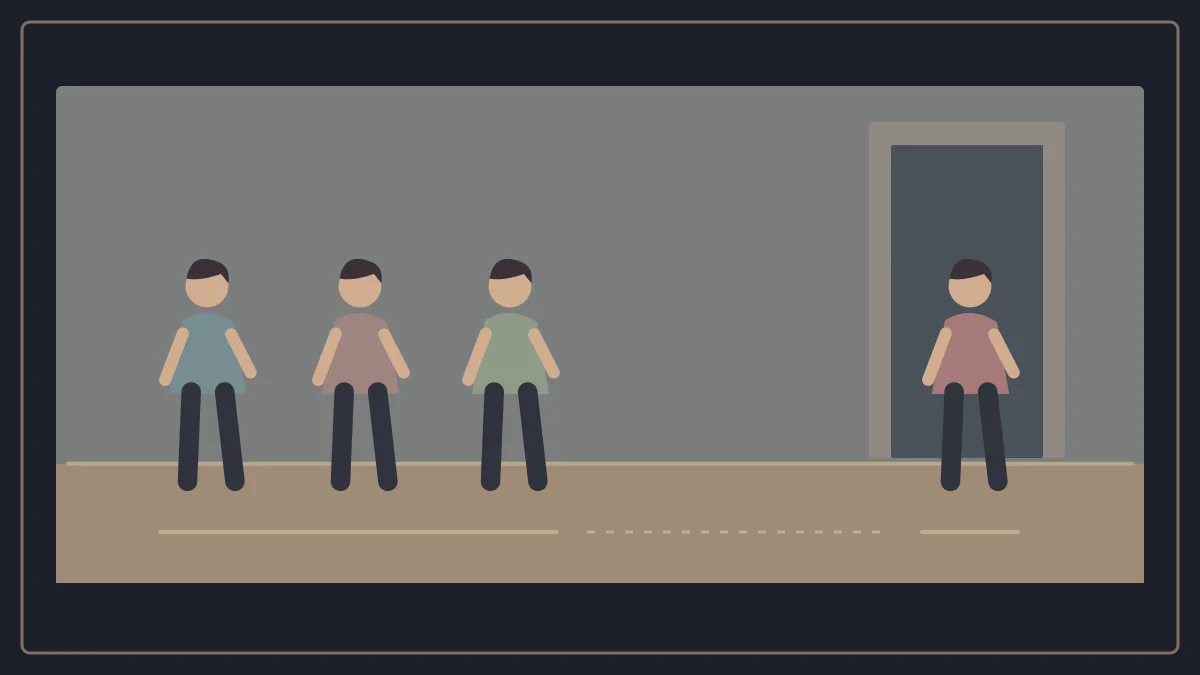
When several characters share a shot, you do not need to tell us that one of them “feels outside the family”.
You can let the image place that person outside its centre.
The group is close together.
That person is far away.
Everyone shares the same visual plane.
That person is separate.
Viewers may not consciously notice the arrangement, but they read it.
We understand distances between people all the time in daily life.
Who stands beside whom?
Who enters the circle of conversation?
Who remains outside it?
Cinema uses that same instinct, but deliberately arranges it within the frame.
Closeness Does Not Always Mean Love
It is easy to turn blocking into a simplistic dictionary:
Close = a good relationship.
Far apart = a bad relationship.
But cinema is more flexible than that.
Two people pressed together in a lift may hate each other.
Two people at opposite ends of a large room may share a deep connection, while something prevents them from approaching.
Sometimes, closeness itself is a threat.
When one character approaches another more closely than ordinary social distance allows, that approach begins to put pressure on the other person.
They may never touch them.
But they have entered a space that was unavailable to them a moment earlier.
The body registers this change before we need words to explain it.
Here, blocking becomes an excellent tool for building tension without much movement.
A single step can be an event.
Standing and Sitting: Who Needs to Move?
There is a reason confrontations can be visually compelling even when they take place in a single room.
The body gives the director dozens of possibilities.
One person sits while another circles them.
Two people are seated, then one stands up halfway through the conversation.
Someone stands at the door but does not leave.
Another remains standing although everyone else is sitting.
Each transition changes the balance of the scene.
The point is not to say “the standing person is stronger”.
The more precise question is:
What changed in the relationship when the body changed level?
If a character has been seated throughout the scene and stands for the first time, that transition itself may carry significance.
Movement gains meaning from the state that preceded it.
Higher and Lower Positions Are Not Only About Camera Angles
A character can be higher than another within the space itself before we even discuss the camera angle.
A staircase.
A platform.
A balcony.
A single step.
Even differences in furniture can create different levels within a scene.
This difference can make relationships readable in space.
But again, there is no equation that says:
Higher = more powerful.
The higher character may be trapped somewhere they cannot descend from.
The lower character may be the one controlling the entire situation.
The director is not looking for a ready made symbol.
They are looking for a relationship between body and space that serves the moment.
The Direction of the Body May Say More Than the Face
Where the actor stands is not the only thing that matters.
How they stand matters too.
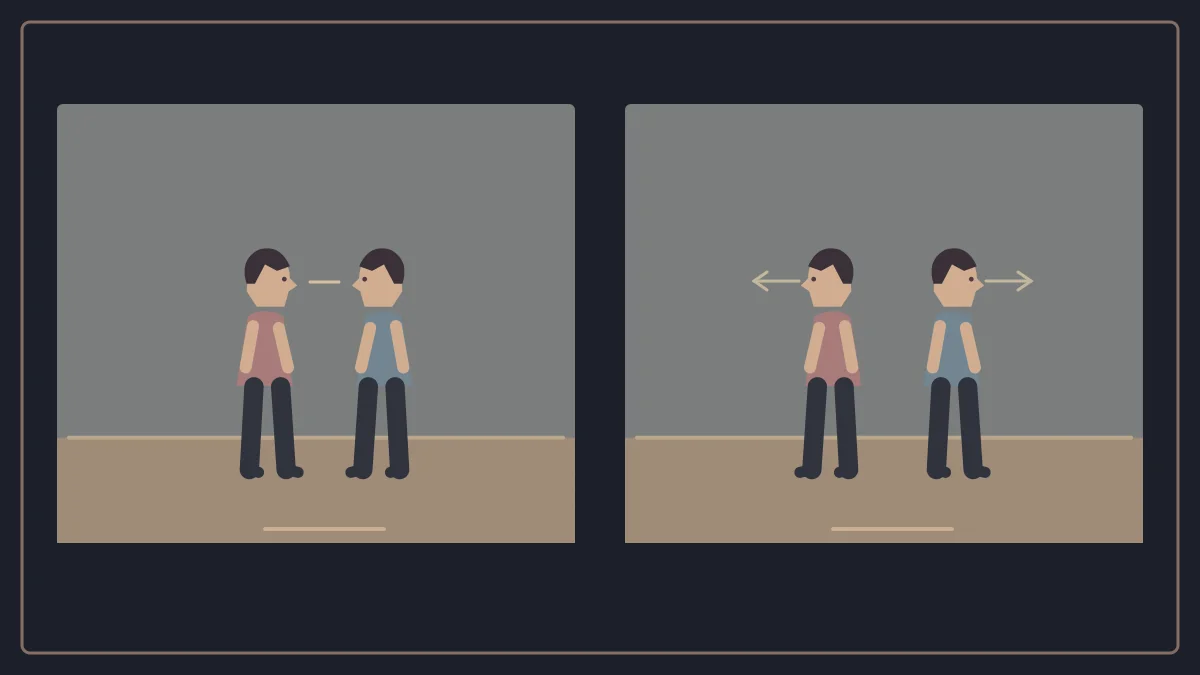
Two characters talking face to face create a different relationship from two characters talking while one has their back to the other.
A person who turns away but does not leave creates a different situation from someone who faces the other person directly.
The eyes work in the same way.
Two characters may stand beside each other, but if they look in different directions, we sense a separation that distance alone does not create.
The body, then, is more than something that carries a face.
A closed shoulder.
A tilted back.
A distant gaze.
A foot preparing to leave.
All of these can work within blocking.
Movement Is More Than Going from Mark to Mark
The weakest way to understand blocking is to imagine it as a technical map:
The actor starts here.
Then moves here.
Then stops here.
Done.
This information matters during production, but it does not explain why the movement exists.
The cinematic question is:
What happened because the character moved?
Did they get closer to someone?
Did they enter territory they did not control?
Did they cut off another person’s path?
Did they leave the group?
Did they reveal something their body had concealed?
Did the movement change who knows what within the scene?
If nothing changes in relationships, attention or knowledge, the movement may simply be a practical necessity.
Dramatic movement, however, changes the state of the scene.
A clear test follows: focus on movement that changes attention, power, distance or knowledge, rather than every step an actor takes.
Imagine a Scene That Begins with Distance
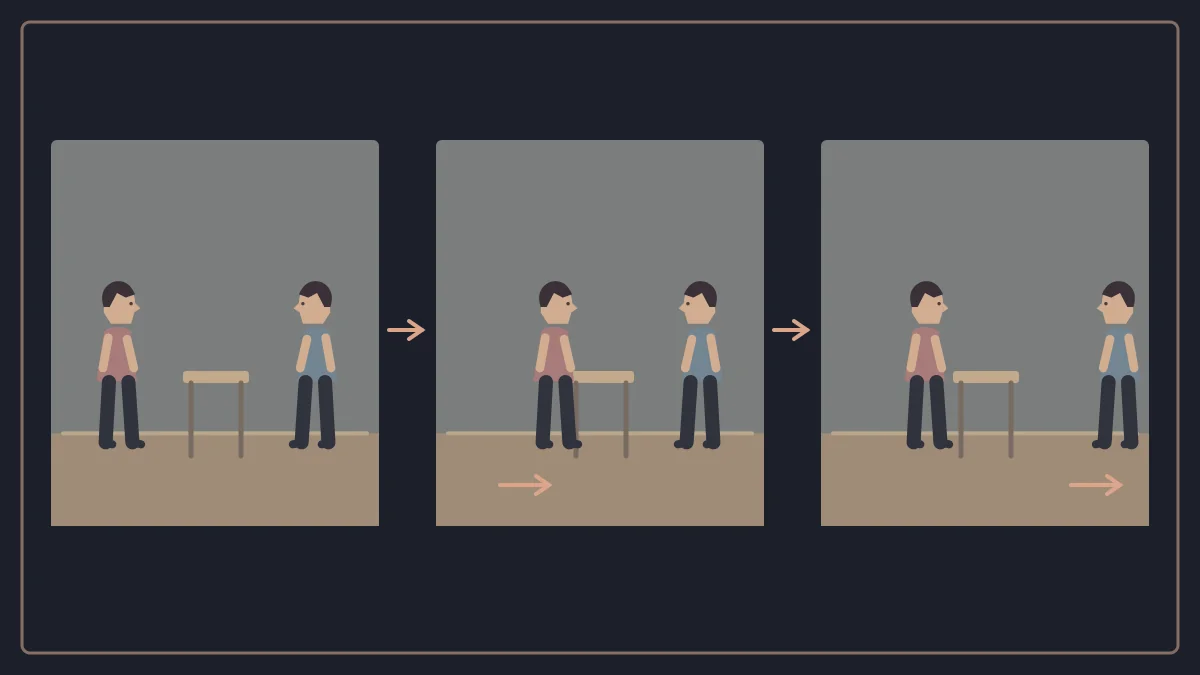
A man and a woman stand at opposite ends of a room.
They talk.
Neither moves.
The distance between them becomes part of the conversation.
Then, at a certain line, the woman moves towards the table in the middle of the room.
She has not reached the man.
But the distance between them has become smaller.
A few moments later, the man moves backwards.
Now this is more than “movement around a room”.
A second conversation is happening beneath the written dialogue:
She reduces the distance.
He restores it.
This may be the scene’s real conflict.
It is one reason blocking can be so powerful.
It can turn distance into action.
The Life Aquatic: Where Do You Sit Within the Group?
The arrangement of characters in confined spaces in The Life Aquatic can be read through their seating positions relative to the central character, as part of the emotional relationship between them.
This is a useful idea because it reveals that blocking does not require a scene full of walking.
Even sitting can be blocking.
Who sits beside whom?
Who has the position closest to the centre?
Who is separated from the rest?
Who looks towards the central character, and who looks away?
When space is limited, every distance matters.
In a group shot, the arrangement of people can function as a map of relationships.
Blocking Is Not Composition
They clearly overlap, but they are not the same thing.
Visual composition concerns the arrangement of relationships and elements within an image.
Blocking focuses on actors’ positions and movement within a scene. It is important to distinguish the two concepts rather than use the words interchangeably.
The difference becomes clear when an actor moves.
A frame may begin with a very balanced composition.
Then a character crosses from left to right.
An empty space opens.
Another character closes that space.
One person ends up in the foreground and another in the background.
The composition itself changes over time because the blocking has changed.
Cinema is not a static painting.
A scene can therefore begin with one image and end with an entirely different one without a single cut.
Nor Is It Production Design
Production design builds the physical world:
The location.
The furniture.
The objects.
The appearance of the space.
Mise en scène brings these visual and performative elements together in the arrangement of the scene.
Blocking asks:
What do people do within this world?
You can have the best set in the world, but flat positioning of the actors may prevent that space from serving any dramatic function.
Conversely, the room may be extremely simple: a table, two chairs and a door.
But one person moving around the table while another stands between them and the door can bring the entire space into the conflict.
Blocking is how space is activated through the body.
Theatre Is the Root… but the Camera Changed the Game
The idea of arranging actors within a space came from theatre before cinema.
But there is a crucial difference.
In theatre, the audience generally occupies a broadly fixed position relative to the stage.
In cinema, there is a camera.
An actor’s blocking therefore cannot be separated from the position of the viewer’s eye.
An actor moving three metres forwards on a stage is one thing.
The same actor approaching the camera lens until they fill the frame is another.
We therefore cannot transfer the “rules of theatre” literally to cinema.
Theatre remains a historical root of the concept, rather than proof of fixed cinematic rules.
What Happens When the Camera Moves Too?
Here, things become more complicated.
If the actor moves while the camera remains still, we see their body cross the space.
But what if the camera moves with them?
They may remain in the same position within the frame despite having crossed half the room.
Spatially, they have moved.
Compositionally, they may have stayed in place.
A very important question emerges:
Who follows whom?
Does the camera follow the character?
Or does the character enter a frame that is waiting for them?
Does the movement reveal something to us?
Or conceal it?
Does the camera leave one character and move to another?
These are more than technical questions.
They determine the viewer’s relationship to what is happening.
The interaction between blocking and the camera therefore becomes a central question: who follows whom, and who reveals whom?
We will return to camera movement in greater detail in part six, when we discuss putting a vision into practice.
The Godfather: Power Does Not Always Need to Announce Itself
Movement and positioning in The Godfather can be studied as ways of expressing shifts in power, while taking care not to turn analysis into an unsupported claim about the director’s intention.
This is an important point beyond the film itself.
When analysing blocking, we do not need to say:
“The director put him here because he wanted to tell us this.”
We may have a statement that proves it, or we may not.
It is more accurate to say:
This arrangement can be read in this way because its effect on screen is this.
A character who stood outside the centre of the group has become its centre.
Someone who used to sit beside another person now has everyone turning towards them.
A large distance has disappeared.
These are visible changes.
We can analyse them without claiming to know what was going through the filmmaker’s mind.
First, explain the effect of the decision within the scene, then why that choice might be dramatically useful, rather than presenting “the director wanted” as a fact without evidence.
Good Blocking Should Not Look Like a Dance
One of the biggest challenges in directing movement is making viewers feel that characters are behaving, rather than following instructions.
If every actor stands at precisely the perfect moment to fill a visual gap, the movement may become beautiful but artificial.
Convincing blocking therefore usually begins with a question about the character:
What do they want right now?
When angry, do they move closer or withdraw?
When embarrassed, do they lower their gaze or move to the edge of the space?
When they want to end the conversation, do they head towards the door before saying so?
The best movement is not always the most elegant.
It is movement that seems to arise from the character’s dramatic need while also building the image the scene requires.
Silence Can Be Blocking Too
Movement is not a requirement.
Sometimes, the strongest decision is for the actor not to move.
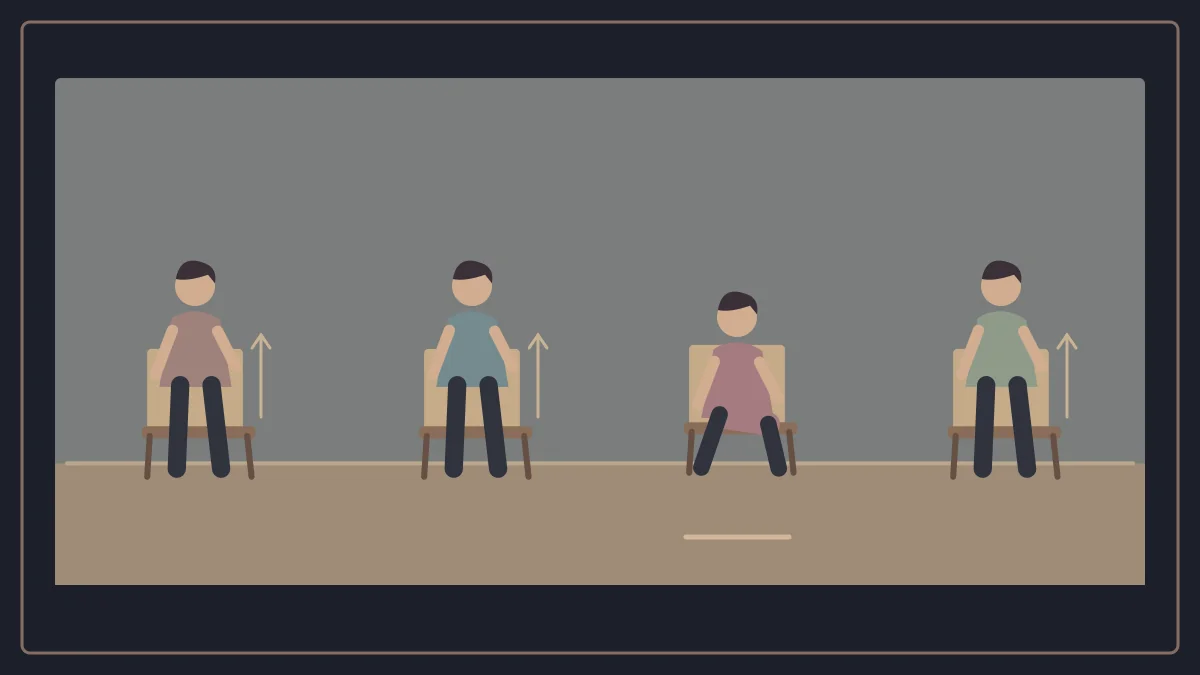
Imagine everyone standing up when someone enters a room.
One person remains seated.
They have done almost nothing.
But their lack of movement has become an action.
Because everyone around them moved.
Meaning comes from comparison.
Likewise, the only person remaining still amid chaotic movement may be the one with the most control.
Blocking therefore does not mean keeping actors constantly in motion.
It is the organisation of movement and stillness together.
How Can You Tell Whether Blocking Adds Anything?
Three tests can be applied to any example we want to analyse.
First: if we swap the characters’ positions, does the meaning of the relationship change?
If not, position may not be the dramatically important element at that moment.
Second: is the movement part of the storytelling, or merely practical movement?
Not every journey from a door to a chair needs analysis.
Third: can we describe the effect of the movement without inventing an intention for the filmmaker?
If we can describe what we see and what changed in our relationship to the scene, we are on firmer analytical ground.
The Director Rewrites Relationships in Space Through Bodies
This is the real reason blocking is one of the essential tools of directing.
The screenplay can say:
“They argue.”
But the screen needs answers to more specific questions.
Where?
At what distance?
Who starts close?
Who withdraws?
Is there a table between them?
Who controls the way out?
Who stands at the window?
Who has to cross the other person’s space?
Each answer makes the scene a slightly different version of itself.
This is where the value of thinking as a director becomes visible.
The goal is not to add movement simply to prevent the scene from being static.
It is to discover movement that reveals something about the relationship.
When the Body Moves… the Meaning of the Image Moves with It
In part three, we built the world before the camera.
The room.
The objects.
The clothes.
The light.
Then we brought the actor into it.
In this part, we have seen that the actor’s presence alone is not enough.
Their position, distance, orientation, movement and stillness can each redefine the relationship within the image.
But so far, we have discussed body and space more than how we see them.
We can keep exactly the same blocking…
Then change the light.
Or the colour.
Or the lens.
Suddenly, the same relationship shifts from intimacy to threat, from warmth to isolation, from an open space to somewhere that feels suffocating.
Here, we reach the next stage in the language of the image:
Not only where we place a person within the frame…
But how we make the frame itself feel something.
To Be Continued — Part Five
Light, Colour and the Lens: How Does an Image Create a Feeling?
About this series
This series begins with the origins of moving pictures, then explores framing, light, lenses, composition, and the choices that give an image meaning.
All parts of this series are now published.
All Cinema Journal articles