Imagine entering a room whose owner we do not know.
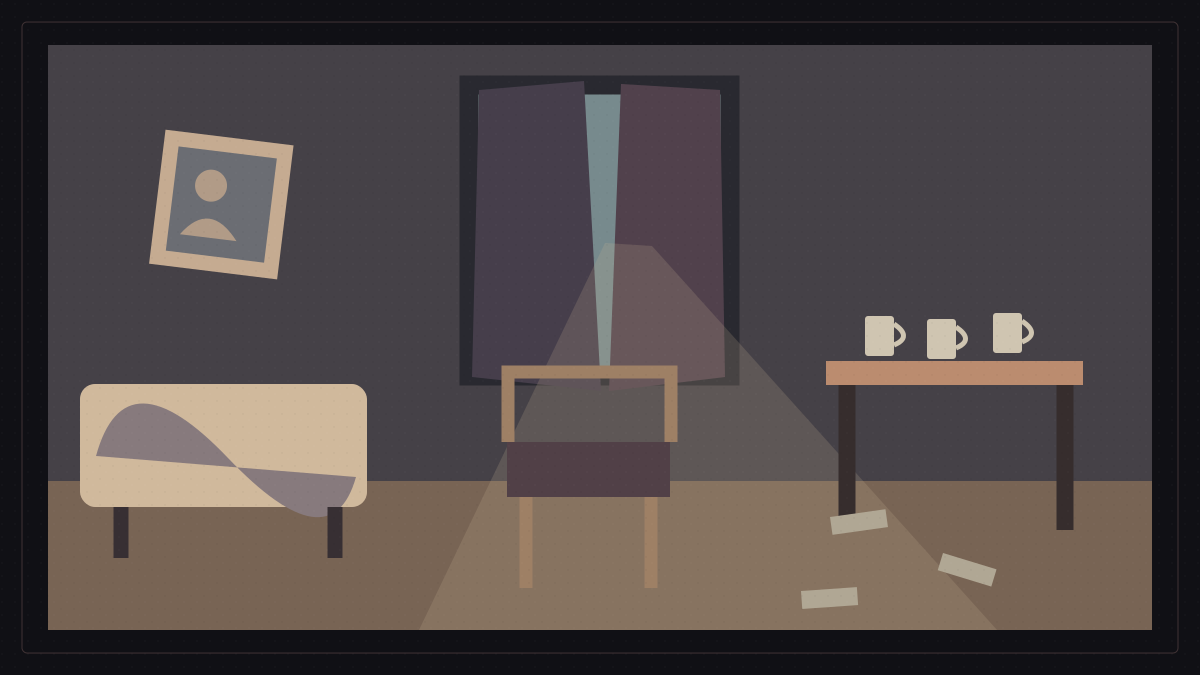
The bed is unmade. Three empty coffee cups sit on the desk. The curtains are closed although it is daytime. Clothes hang carefully on one side while papers accumulate on the floor on the other. A single chair faces the window in the middle of the room. On the wall, a family photograph hangs slightly crooked, and nobody has straightened it.
The owner has not appeared.
We have not heard a single word about them.
Yet we have already begun forming a mental picture.
Some of our conclusions may be wrong, but that is not the point. What matters is that the place spoke before the character.
This brings us to one of cinema’s broadest and most fascinating concepts:
Mise en scène.
What does mise en scène actually mean?
The term is French, with theatrical roots. It concerns placing and arranging objects and people within a scene before presenting them to an audience.
When the idea entered cinema, it became more complicated: the camera added another level of choice.
In this series, we use a clear, consistent definition so that the term does not become something that means everything and nothing at once:
Mise en scène is the organisation of the visible physical and performed content before the camera: setting, décor and objects, costume and makeup, lighting, and the placement and performance of actors within the scene.
Colour and framing can interact with it clearly, but we will not automatically include editing, effects or every camera movement simply because some critical definitions expand its boundaries. This consistent working definition prevents contradictions between the series’ parts.
Remembering the French name is not the most important thing.
What matters is understanding that what appears before the camera is not merely a background to the event.
It is part of the event.
The room is not an empty place waiting for the actor
Let us begin with space.
When a person enters a home, office, hospital or school, we read their surroundings as well as the character.
The size of the place.
Its condition.
Its degree of order or disorder.
Whether things are new or worn.
How much empty space there is.
The type of furniture.
What looks genuinely used and what looks placed for display.
These details can communicate time, class, taste, habits and the place’s previous history before the screenplay explains anything.
In good cinema, a setting should not look as if it came into existence on the morning of the shoot.
It should seem as if life happened there before the camera arrived.
A scratch on a door.
Books accumulated in a particular way.
An old photograph that stayed while the rest of the room changed.
A small detail like this can give a place a memory.
Citizen Kane: one window carries an entire relationship
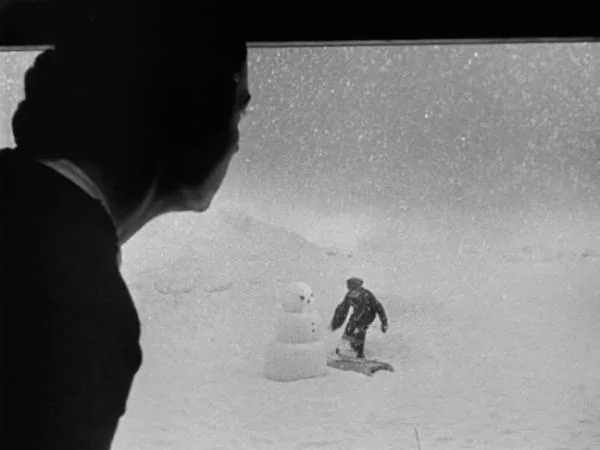
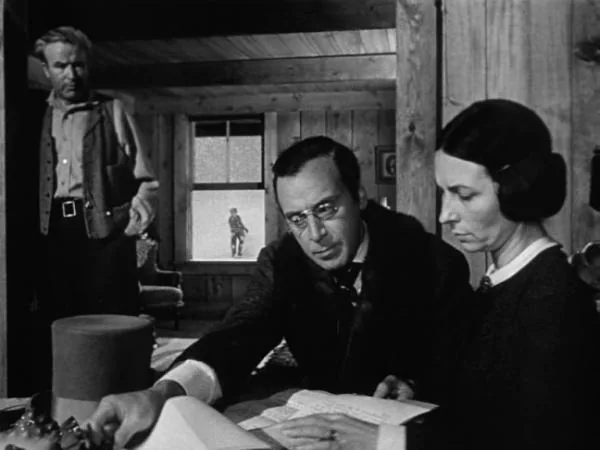
A famous example in Citizen Kane shows how far space and the arrangement of characters within it can carry the story.
In Charles Kane’s childhood scene, we see him playing in the snow outside while the adults sit indoors discussing his future. The shot begins with the child outside, then moves through the window into the room. Charles remains visible through it in the background as the decision about his life is made.
Consider what is happening visually.
The child does not need to stand in the middle of the room to be the scene’s focus.
He is outside the room altogether.
The window separates two worlds: a child still living his own moment outside and adults indoors rearranging his life.
Wall, window and distance between characters become dramatic elements.
If the same dialogue were filmed in an empty room with everyone seated at one table, the information would remain.
The relationship would not be the same.
This is the difference between a place containing the story and participating in its telling.
Small objects can become a character’s biography
Then come objects: props and the details filling the setting.
Not everything placed before the camera must become a mysterious symbol.
Sometimes a cup really is a cup.
A book is a book.
Choosing a group of objects together can nevertheless produce something larger.
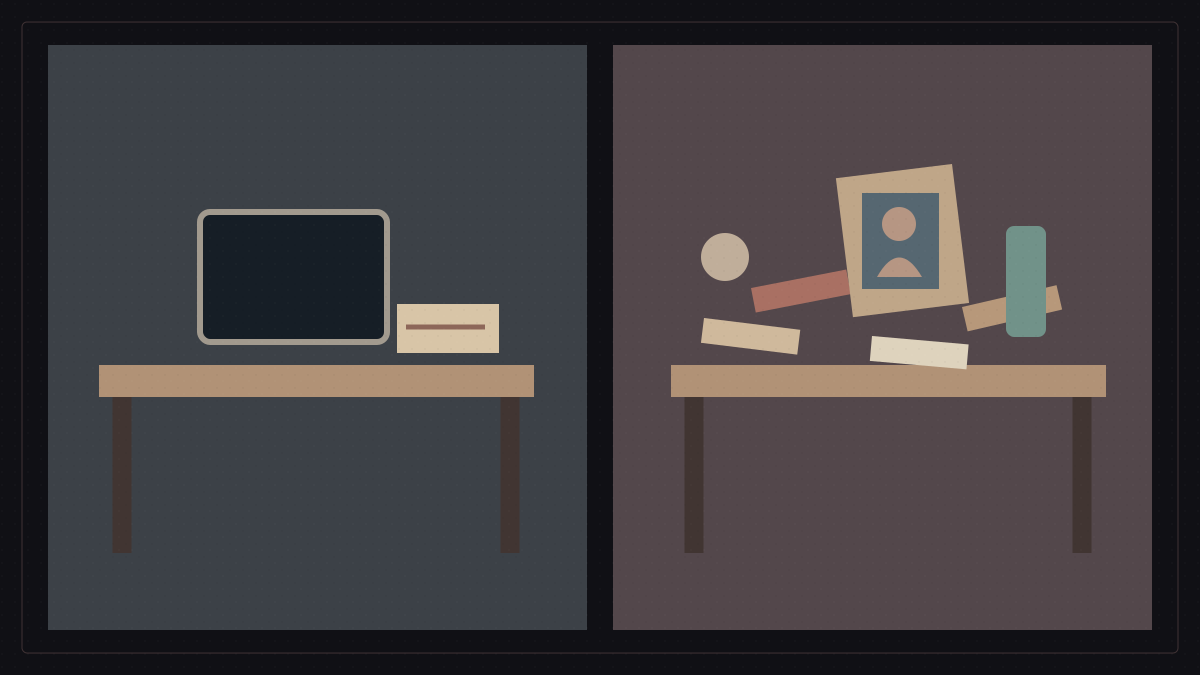
Imagine two desks.
The first holds only a computer, a notebook and a pen arranged in a straight line.
The second is full of folded papers, photographs, empty containers and personal belongings.
Before either owner appears, we already read the two people differently.
Objects can say:
This person keeps the past.
This person hides something.
This person likes control.
This person does not care how the place looks.
Or they may say something simpler: this place is lived in, rather than merely decorated.
The important thing is not to turn every item into an analytical puzzle.
The question remains: what do the details together add to our understanding of this world?
The Royal Tenenbaums: when the house becomes part of the family
In The Royal Tenenbaums, the family house was more than a convenient filming location.
Production designer David Wasco described the house as resembling ‘one of the film’s characters’. Rooms were carefully decorated to reflect their occupants, while the children’s rooms remained close to their childhood condition when they returned as adults. Wes Anderson also wanted each room to have an identity that helped distinguish its owner.
The idea works on two levels.
The first is direct: each character receives a visual world that suits them.
The second is deeper.
When an adult returns to a room still shaped like their former life, the place becomes a witness to something that has not advanced as quickly as time.
Walls, books and colours do not simply explain who the character was as a child.
They place the present beside the past within the same image.
This is a clear example of mise en scène building character rather than beautifying a frame.
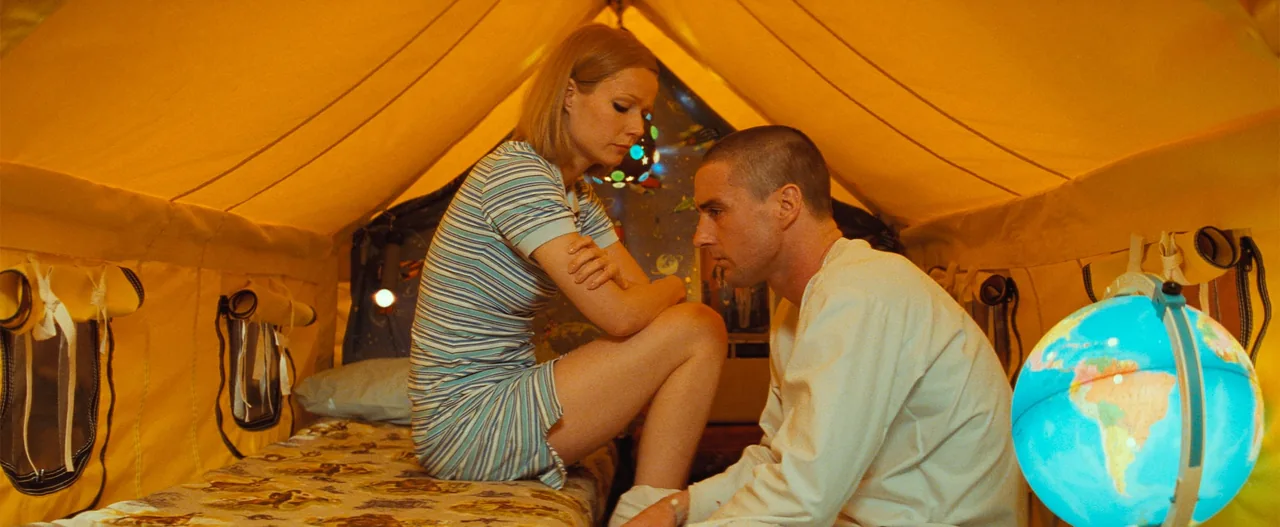
Clothes do more than cover the body
If a setting tells us where a character lives, clothing can tell us how they want to appear within that world.
Costume, makeup and hair are not additions made after a character has been constructed.
They are part of presenting the character.
Clothes can suggest social class, occupation, discipline, rebellion, group membership or even a determination not to change.
Repetition can give an outfit another meaning.
A character always dressed the same way may initially seem to have a clear identity. Later, that same consistency may reveal an inability to leave behind an older version of themselves.
In The Royal Tenenbaums, several characters were given remarkably consistent clothing identities. Costume designer Karen Patch described creating something like a recurring visual ‘uniform’ with limited variations.
We can sometimes recognise a character before reading their face.
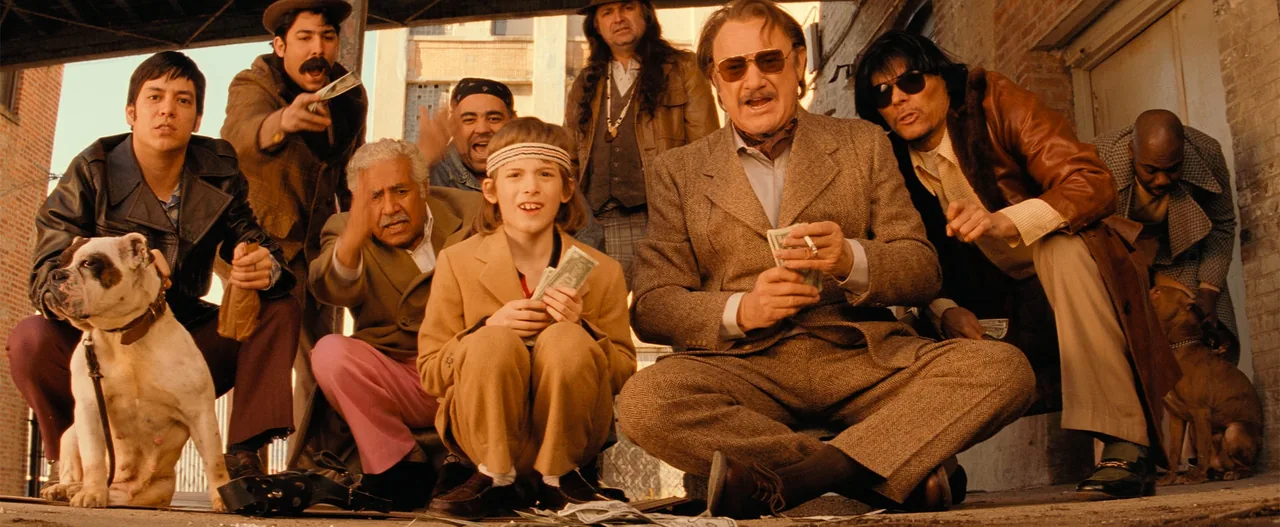
Makeup and hair can record time on the body
The same applies to makeup and hair.
They can suggest age, exhaustion, illness, neglect, self care or the passage of time.
Their power does not come from the amount of work put into them.
The most meaningful decision may make a face appear completely natural.
Mise en scène does not mean exaggeration.
It means organising the image to serve the world we want to believe.
A realist film may require a character to look as if nobody designed their appearance, even when achieving that simplicity involved a long sequence of decisions.
Light does more than reveal objects: it chooses which version we see
A later part is devoted to lighting, colour and lenses, so we will not discuss key light, fill light, low key and similar technical details here.
We cannot discuss mise en scène without light, however.
The reason is simple:
You can build the finest set, choose clothes carefully and put the actor in the ideal position…
Then light changes the meaning of everything.
Light decides what appears.
What remains incomplete.
And whether a room feels warm or cold, open or suffocating, ordinary or strange.
Here we consider its function within the world, leaving its detailed techniques to part five.
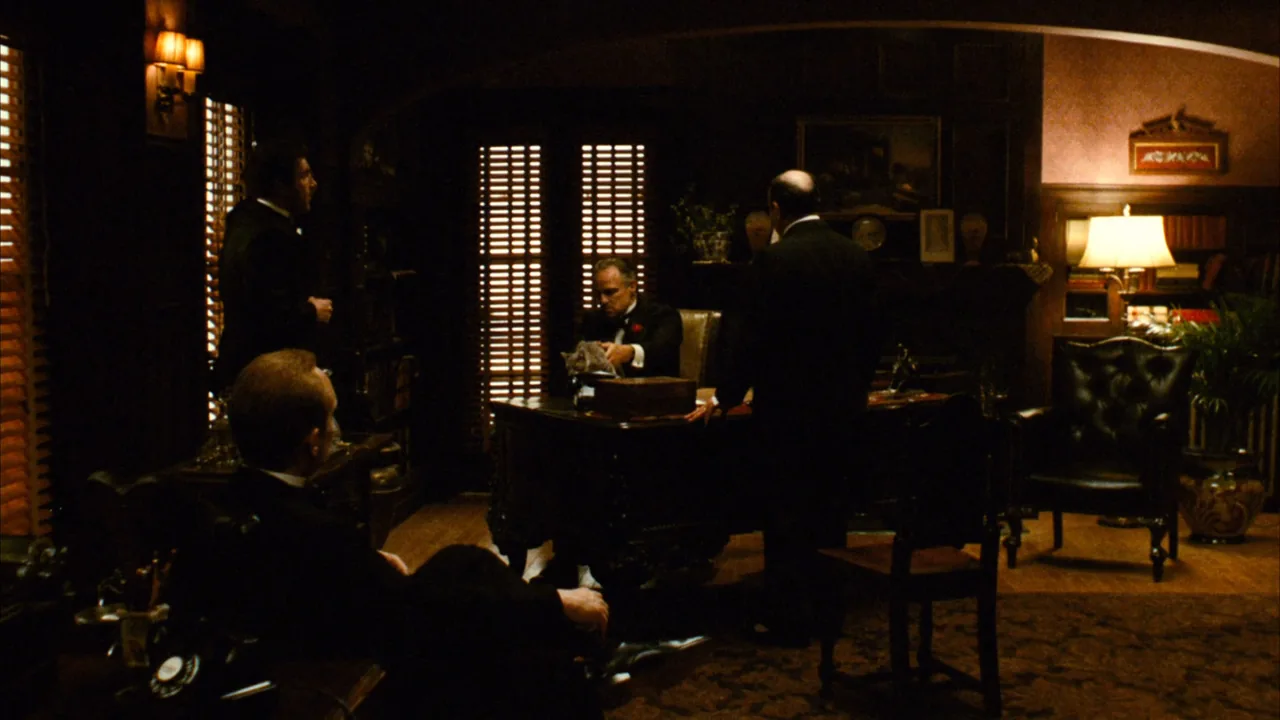
The Godfather: one family, two worlds on the same day
The opening of The Godfather offers an exceptionally clear example.
Inside Don Vito Corleone’s office, illumination is low, and faces can enter areas of shadow and emerge again.
Outside, the wedding is bright and open.
Cinematographer Gordon Willis later explained that the contrast between the bright wedding and dark office was deliberate. He and Francis Ford Coppola approached the two worlds with different visual rhythms. The transition from the shadowy interior to the intensely bright wedding makes that contrast clear in the opening.
We do not need to say ‘darkness means evil’ and close off the interpretation.
What is more interesting is that the two worlds exist at the same moment.
The family celebrates outside.
The family conducts another kind of relationship inside.
Two places.
Two levels of light.
One meaning more complicated than the dialogue alone.
The film does not explain its world’s duality in a sentence.
It makes us enter one face, then emerge into the other.
Barry Lyndon: when the light source becomes part of history
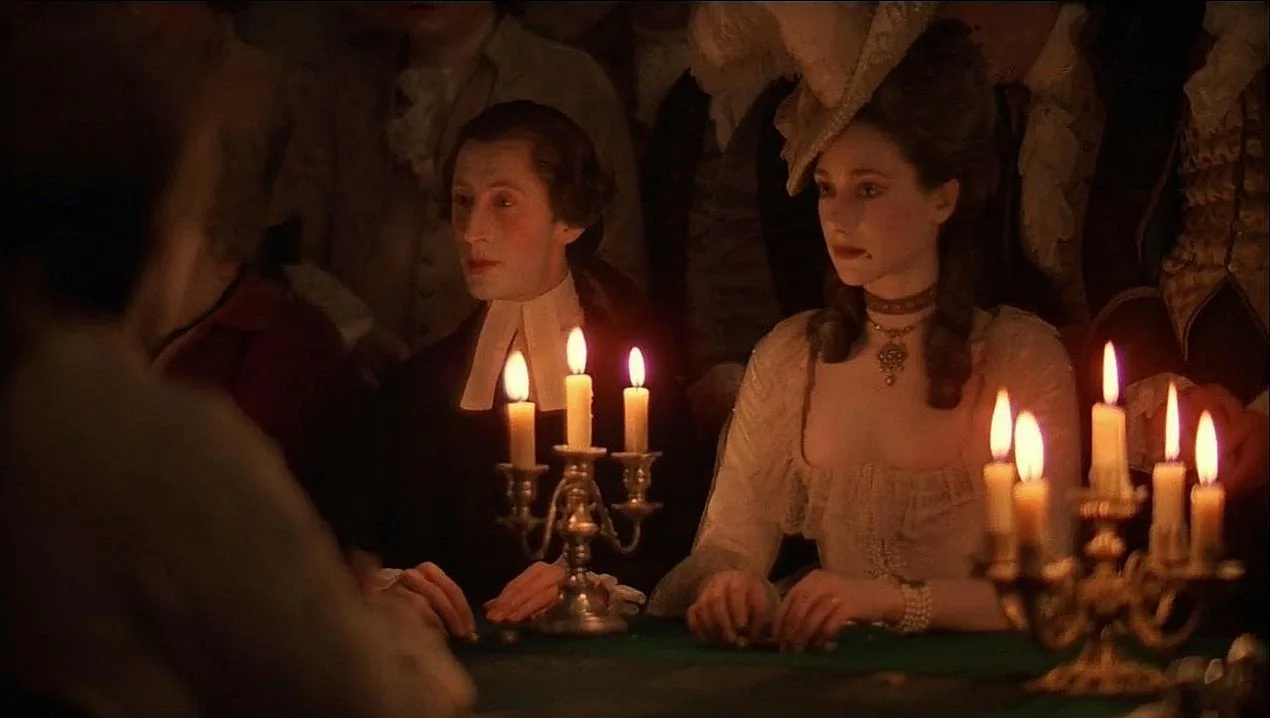
In Barry Lyndon, the connection between the visible world and lighting reached an unusual technical level.
Cinematographer John Alcott explained that several candlelit scenes were genuinely filmed using the candles themselves, with exceptionally fast Zeiss lenses specially adapted for the task. The aim was to preserve the character of illumination appropriate to interiors in the story’s period rather than add conventional film lights that would change the place’s feeling.
The distinction matters.
This is more than an interesting technical choice.
The technical choice becomes a servant of mise en scène.
The light source within the world itself, the candles, helps determine faces, the room’s depth, the character of colours and the viewer’s sense of time.
History is no longer confined to clothes and décor.
It has entered the light itself.
Colour does not live separately from objects
A common mistake is to imagine colour as a layer placed over a film after all the other decisions are finished.
Colour begins much earlier.
The wall’s colour.
The clothes’ colour.
Wood.
Skin.
Furnishings.
Light sources.
Image processing later connects these decisions or reshapes them.
In this part, colour is treated as something connected to space, clothing and light, rather than an independent ‘filter’.
A character wearing a colour that almost disappears into the setting creates a different relationship from one wearing a colour that clashes with everything around them.
Colour can merge a character into the world.
Or separate them from it.
The actor enters, and everything changes
We may have a precisely designed setting, coherent clothes, lighting and colours, but the image remains incomplete without the human body.
An actor is not an object placed before the décor.
How they stand is part of the image.
The direction of the face is part of it.
The gaze.
Stillness.
Distance from other people.
Is the character comfortable in the place, or do they seem not to belong?
Do they touch objects or avoid them?
Do they move freely while everyone else remains still?
All these belong to mise en scène because they change the relationship between a person and their surroundings.
There is one point we will resist expanding here.
The placement and movement of actors, or blocking, deserves a whole part of its own.
For now, it is enough to notice that the body does not enter a neutral image.
The moment it occupies a particular position, relationships begin to form.
Analyse the result, not the checklist
This is one of the easiest mistakes when studying mise en scène.
We stop the film and begin:
The décor is this.
The clothes are that.
The light is this.
The colour is that.
The objects are these.
Then we finish.
This is not a reading of mise en scène.
It is an inventory.
The real question is:
What do these elements say when they work together?
Suppose a character in meticulously formal clothing sits alone in a disorderly, dark room, with the only light arriving through a distant doorway.
Describing the clothes, room and light separately is not enough.
Meaning begins when we ask about the contradiction between them.
Why does the character seem more organised than their world?
Are they trying to control it?
Does the image reveal a fracture that their behaviour conceals?
This is where interpretation begins.
Mise en scène is not the objects.
It is the relationship between the objects.
Not everything in a film is mise en scène
The term’s breadth creates another problem.
We can easily include camera, sound, editing, colour, performance and everything else, then lose any usefulness in the word.
Critical approaches do differ about its boundaries, and some uses are broader than others. The series deliberately adopts a working definition preserving the concept’s core: the visible physical and performed world arranged before the camera, while recognising the interaction of elements such as framing and colour.
This distinction does not mean that filmmaking departments operate separately.
The opposite is true.
The strongest images usually emerge when production design, costume, lighting, performance and cinematography work together, rather than each department appearing to make a different film.
We separate concepts here to understand the function of each decision.
Before dialogue, a story is already there
Let us return to the room where we began.
The unmade bed.
The cups.
The curtains.
The chair.
The crooked photograph.
Then the character enters.
They may look at the family photograph and ignore it.
Straighten it.
Turn it face down.
In one moment, something that was merely part of the setting becomes part of the performance.
Here is the real power of mise en scène.
The world does not wait for the story.
The world is one of the ways the story is told.
Space carries the past.
Clothes carry the character.
Light decides what we are allowed to see.
Colour connects objects or separates them.
The body enters all of this and creates another relationship.
We have deliberately left one question open:
If two actors enter this room…
Who stands by the door?
Who occupies the centre?
Who sits and who remains standing?
Who approaches and who retreats?
What happens to meaning when one of them takes just one step?
Mise en scène moves from arranging the world to the geometry of relationships within it.
To be continued in part four: Blocking, when relationships become geometry within the frame.
About this series
This series begins with the origins of moving pictures, then explores framing, light, lenses, composition, and the choices that give an image meaning.
All parts of this series are now published.
All Cinema Journal articles