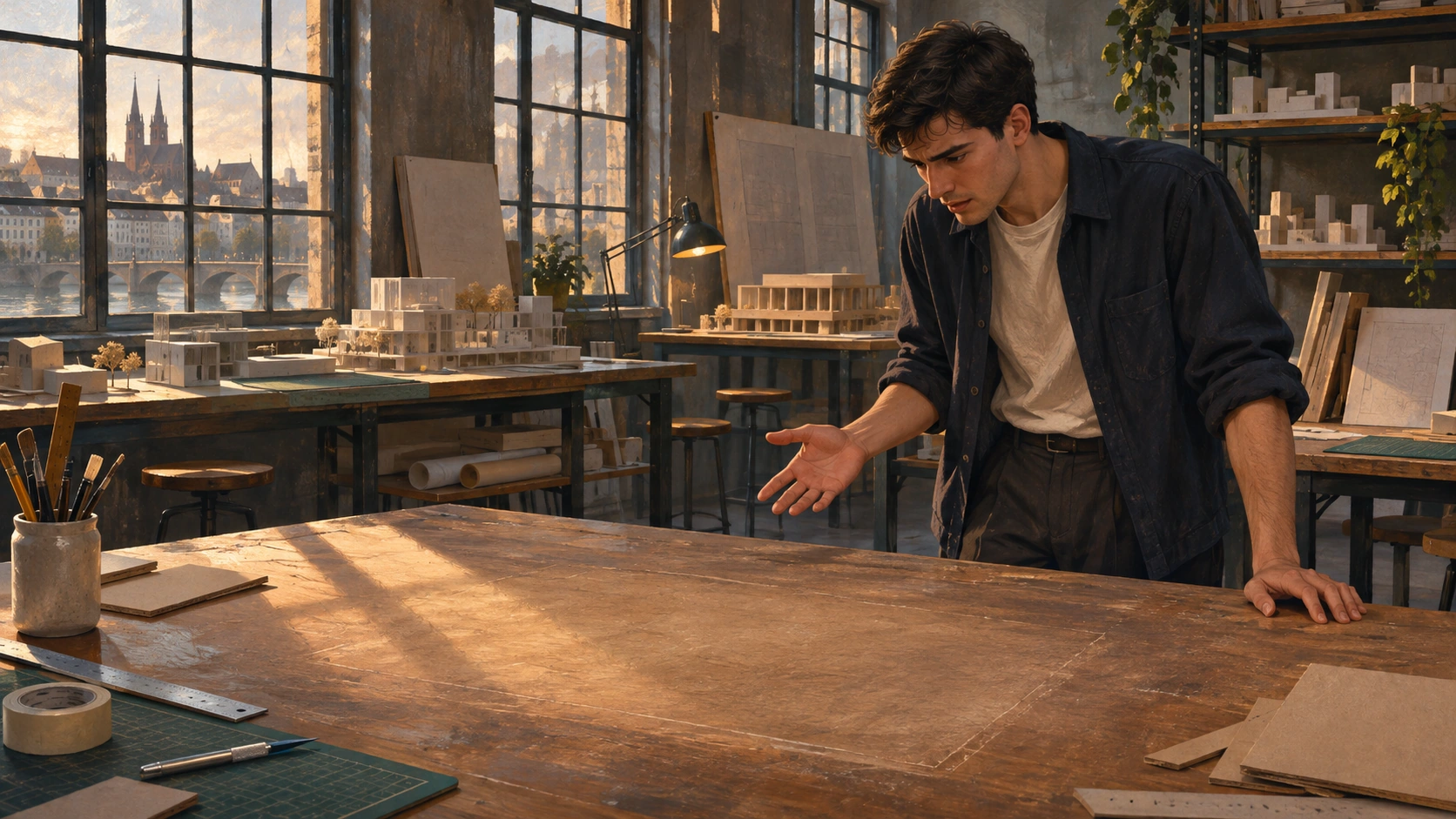
Imagine watching the opening of a short film set in a design workshop.
Basel enters before his final project presentation and heads straight for the table where he left a miniature city he spent weeks designing.
The table is empty.
He looks around, opens nearby cupboards and asks his classmates whether anyone has moved the model.
One of them shows him a photograph taken earlier. It shows his classmate Heba carrying the model out of the room.
Basel’s expression changes.
He rushes out to find her.
So far, we know almost exactly what Basel knows. His project has disappeared before the presentation, and a photograph suggests that Heba moved it.
We may suspect that she stole it, hid it or acted for a reason we do not yet understand.
But what if the film began in a completely different way?
We see the design workshop early in the morning. Water is leaking through the ceiling near the table holding the miniature city.
Heba enters and notices the water approaching the model.
She tries to move the table but cannot. She asks a classmate for help, and together they carefully carry the model to another room.
We then see Basel enter the workshop, discover that his project is missing and find the photograph of Heba carrying it.
This time, we understand the situation differently.
We know that she saved his project, while he thinks she may have caused its disappearance.
We may feel tense as he goes to confront her, expecting him to accuse her of something she has not done.
The essential events are the same, but changing their order changes what we know, whom we may sympathise with and the kind of tension we feel.
Here we move from constructing a single scene, which we explored in the previous part, to a larger question about the whole film: how do we arrange events and scenes to create a coherent story with its own rhythm and impact?
The Story as It Happened and the Story as We Tell It
When developing a film, it helps to distinguish between the chronological sequence of events and the way you choose to present them to the viewer.
Almost every story contains events that can be arranged according to when they happen within the film’s world.
Someone makes a decision, acts on it and then faces an unexpected consequence.
But the film does not have to show these events in that order.
It can begin with a later event and return to what preceded it. It may reveal an outcome before the cause, or move between characters experiencing simultaneous events.
This is where narrative structure matters: the way a film organises its events, information and dramatic relationships across time.
Plot is closely related. It involves more than arranging events: it also encompasses the connections through which one event leads to another, and the development of problems, choices and their consequences.
Let us return to the miniature city that disappeared from the workshop.
If we begin with the water leak and Heba rescuing the model, we give the viewer information that Basel does not have.
If we begin with Basel discovering its disappearance, we delay the explanation.
In the first version, the central question may be: what will happen when Basel confronts Heba and accuses her?
In the second, the question becomes: why did Heba take the model?
Both questions can engage us, but each creates a different experience.
We should therefore avoid choosing an opening simply because it contains the most spectacular images.
A noisy scene may be less useful than a quiet one that offers information allowing us to understand everything that follows in a new way.
The director, working with the writer and editor as the project requires, needs to consider the timing of this information, because its order affects how audiences understand the characters and events.
How Do Separate Scenes Become One Film?
In part ten, we learned that a scene can begin with a particular situation and develop towards a change in a character’s position or our understanding of the story.
But a film does not become coherent simply because each scene is well written.
You might create five moving scenes, place them together and discover that the film has no clear direction.
The problem may lie in the relationships between the scenes.
The first raises a question that the second ignores; the third introduces a character who does not affect the rest of the story; the fourth repeats information we already know; and the ending resolves a problem that has not been developed sufficiently.
Each scene may work alone, but the parts do not work together to create a single experience.
Imagine that the design workshop film consists of several scenes.
First, we meet Basel and learn why the model matters to him. Then we see him discover its disappearance and try to find out what happened.
His search leads him to Heba, but he approaches her on the assumption that she caused the problem.
When the truth about her actions emerges, he faces a new situation: will he admit that he misjudged her, or try to justify his accusation?
Notice that the story is no longer merely a search for a missing model.
It began with a problem involving the project, then revealed a problem in the way Basel treats other people.
This development gives the scenes a clear relationship.
The confrontation with Heba does not come from nowhere. It results from Basel’s incomplete information and his decision to accuse her before establishing the truth.
Likewise, discovering what happened to the model does not necessarily solve every problem, because it raises a question about his relationship with his classmate.
This kind of connection helps make a film more coherent.
We can think of groups of scenes as dramatic sequences, each serving a larger purpose than an individual scene.
One group might introduce the problem, another explore attempts to deal with it, and a third reveal consequences that change the story’s direction.
However, each group need not contain a fixed number of scenes.
A short film may communicate a complete change in two scenes, while a feature may need more to develop its relationships and situations.
What matters is that the scenes have an understandable dramatic relationship, and that moving from one to another develops the viewer’s experience rather than merely changing the location.
Beginning, Middle and End: Does Every Film Need Three Acts?
One of the best-known ways of studying and organising stories is the three-act structure.
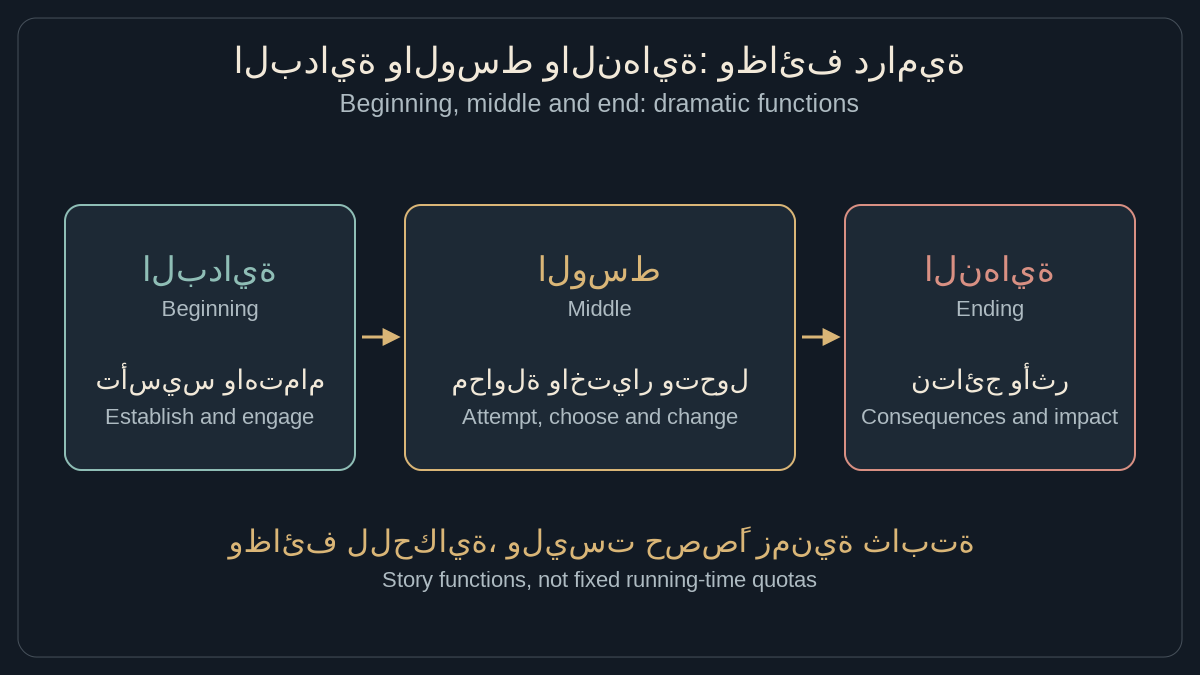
Its general principle is to divide the dramatic experience into a beginning that establishes the story, a middle that develops confrontations and choices, and an ending that brings events to their consequences.
This approach can help organise a narrative film, particularly when it has a clear goal and characters facing escalating obstacles.
But we should not treat it as a law every film must obey, or a template requiring every story to change at the same minute marks.
Let us consider the function each act can serve.
The beginning introduces the world, characters and circumstances that make us care about what happens. It may include an event that pushes the story in a new direction, sometimes called the inciting incident.
In our example, the model’s disappearance may be the event that prompts Basel to search and act.
The middle does more than extend the journey towards the ending. It gives characters opportunities to try, fail and reassess, and reveals information that changes our understanding of the problem.
Basel may try to locate the model, discover Heba’s photograph and decide to confront her on that basis.
The ending is the stage at which the main consequences of the journey we have followed become clear, whether the protagonist reaches his goal or fails, and whether he learns from the experience or clings to his position.
Basel might find the model intact but lose Heba’s trust because of his accusation.
He might apologise, and she might accept, refuse or ask him to demonstrate a change through his actions.
Each possibility gives the ending a different meaning.
Acts may contain turning points that move the story from one situation to another, but these need not follow a fixed timetable.
Some films begin after the event that changed a character’s life and gradually reveal its background.
Others avoid traditional construction or rely on everyday scenes and thematic connections rather than a plot with a single goal.
The three-act structure is therefore a useful tool for understanding and planning, but it is not the only measure of a good story.
What matters most is understanding why a film begins at a particular moment, how it develops what it has begun and what effect we want its ending to leave.
How Do We Create Expectations That Make Viewers Want to Continue?
A film does not need to provide a constant stream of answers.
A significant part of the pleasure of following a story comes from the questions it poses and the expectations we form while waiting for answers.
We may wonder whether a character will reach a destination, why someone has acted mysteriously, or what will happen when a person discovers a secret the viewer already knows.
Here we can distinguish between three related, but different, narrative effects.
Mystery arises when we need to learn something we do not yet know.
If the workshop film begins with the missing model, the question might be: who took it, and why?
Suspense may arise when we know that a danger or possible confrontation is approaching, and wait to see how the characters will respond.
If we know that Heba saved the model and then see an angry Basel heading to confront her, we may feel tense because we anticipate a painful misunderstanding.
Surprise occurs when the film introduces information or a development that differs from what we expected.
We may discover that the model was not stolen but moved to protect it from damage.
These definitions do not cover every use of these terms in film criticism, but they help us understand different ways viewers respond to information.
This does not mean that mystery is better than suspense, or that surprises make a film better.
A simple story whose ending audiences already know may be deeply affecting because their interest lies in how that ending is reached.
Conversely, a surprise may be worthless if it has no foundation within the story.
If we suddenly reveal that Heba is an invisible fantasy creature, without preparation or any connection to the film’s world, we may surprise the audience without offering a convincing development.
An effective surprise can change our interpretation of what we have already seen, prompting us to view events from a new angle.
A surprise added merely because the story needs a shock may weaken our trust in the film’s logic.
When writing a screenplay, it helps to ask: what question do we want viewers to carry from this section to the next? Have we given them enough information to form an expectation, or are we delaying everything without giving them a reason to care?
Narrative Pacing Is Not Editing Speed
We may watch a film full of rapid cuts and movement yet find it slow and boring.
Conversely, we may watch a film built around long takes and quiet scenes, and its running time passes without our losing interest.
How does that happen?
Because narrative pacing cannot be reduced to the speed of transitions between shots.
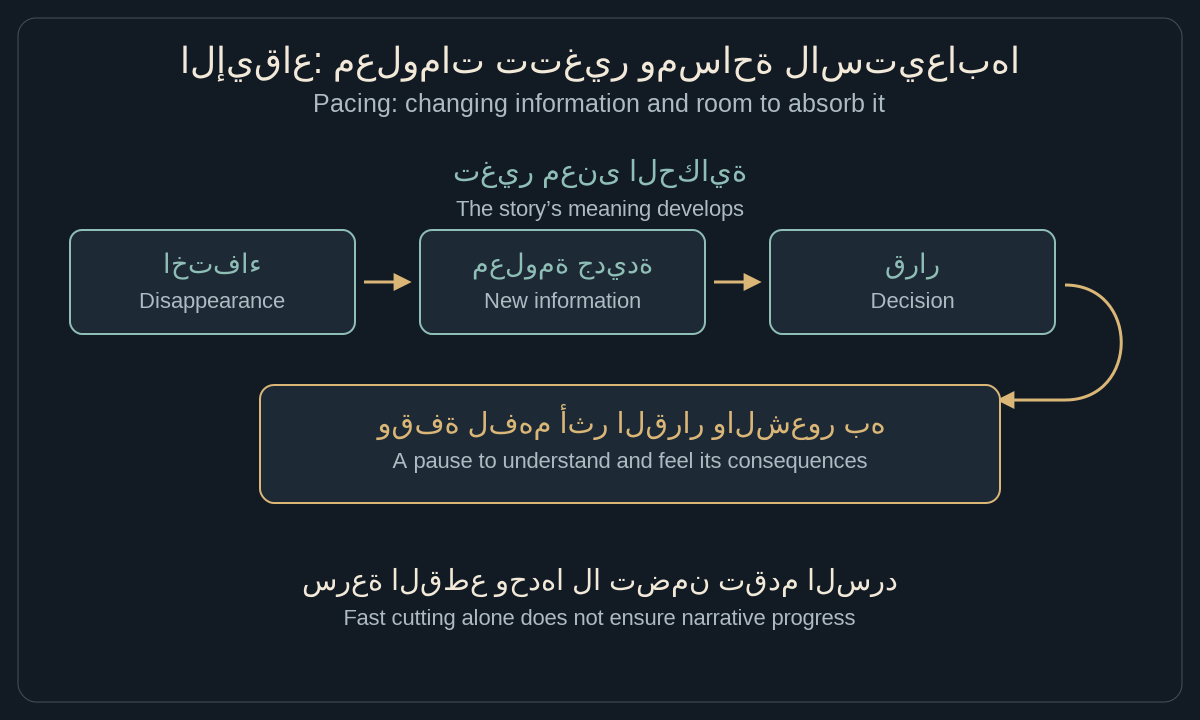
Editing certainly affects rhythm, but narrative pacing also depends on how information is distributed, problems develop, relationships change, outcomes are delayed and viewers are given time to understand what is happening.
Suppose we watch Basel searching for the missing model.
If the film keeps showing similar attempts that add no information or change, we may feel that it is dragging even if the shots change very quickly.
If each attempt reveals something new, however, we may remain engaged despite fewer shots.
Basel might begin searching the workshop, learn that Heba arrived early and then see the photograph showing her moving the model.
Each step changes his understanding of the situation and therefore our expectations of what he will do.
Here the narrative advances, rather than merely time passing on screen.
But constant progress without a pause can also become exhausting.
If we introduce a new problem every minute and a surprise after every sentence, we may leave viewers no opportunity to absorb the consequences or connect with the characters.
This is why a film sometimes needs quieter moments.
After Basel discovers what Heba actually did, it may help to stay with him briefly before he speaks.
Perhaps he tries to apologise but cannot find the right words.
No major event occurs during these seconds, but we see the discovery’s effect on him.
Removing this moment might make the apology seem rushed and automatic.
In another treatment, moving straight to a later scene might be more appropriate if the film wants to keep his reaction uncertain.
A moment’s duration is therefore not determined by a fixed rule.
A scene is not slow because it is quiet, or fast because it contains a great deal of movement. What matters is what happens to the viewer’s experience as time passes.
How Can Tension Escalate Without Turning the Story into a String of Disasters?
In part nine, we explored the importance of obstacles in generating dramatic conflict. When considering the film as a whole, however, we need to understand how to distribute those obstacles so that development does not feel random.
A film may begin with a simple problem whose consequences gradually emerge, making the character’s choices more difficult.
But escalation does not mean that every problem must be larger than the previous one in external scale.
Sometimes a situation matters more because we understand the character more deeply.
At the beginning of Basel’s story, we may think the greatest possible loss is the model disappearing before its presentation.
Once we understand how much he trusts Heba, losing that relationship may become a consequence as important as losing the project itself.
We have not needed to add a huge incident.
The nature of what the protagonist stands to lose has changed.
Escalation can occur when the available options diminish, old information gains a new meaning or a character must face the consequence of an earlier decision.
If we keep adding unrelated difficulties, however, the story may become a collection of incidents.
The model breaks, the electricity fails, the keys disappear and someone arrives with surprising news.
These events might suit a particular story, but placing them together does not guarantee dramatic escalation.
What matters is establishing connections that help us understand why the film moves from one problem to another and how this changes the characters’ circumstances.
It also helps to notice the rhythm between pressure and release.
Tension may rise during a confrontation, followed by a quiet moment revealing its effects, before a new problem appears or the story changes direction.
Release does not have to mean solving the problem.
It may simply provide a chance to breathe, reflect or understand something about a character, making what follows more effective.
Cinematic Time: Why Do We Not Need to See Everything?
A film’s events may span years while its running time remains under two hours.
Another story may take place over roughly one hour of fictional time and require a similar running time.
This difference leads to an important concept: time within the story’s world does not necessarily equal the time we spend watching it.
Cinema can compress time, dwell on a moment, return to the past or move between simultaneous events.
When following Basel’s search for the model, we do not need to film every minute he spends looking.
We might see him begin searching the workshop and then move to the moment when he discovers new information some time later.
If the omitted interval adds nothing important to the experience, compressing it may be better.
In another situation, however, we may need to watch the waiting itself.
Imagine Basel standing outside the room where Heba is, trying to decide whether to enter and apologise.
The duration of his hesitation may become essential to the scene’s meaning because we experience the difficulty of the step he is preparing to take.
A film can therefore compress hours while giving a few seconds great importance.
A flashback allows a return to an event earlier than the action we are following, when that return serves a purpose within the story.
We might watch Basel confront Heba, then return to the morning to see how she saved the model.
But this choice needs a reason.
If the return reveals information that changes our understanding of the confrontation, it may add value.
If we use it merely to show something that could easily have appeared at the beginning, we may complicate the narrative without a clear benefit.
The same applies to nonlinear stories, which do not present events in straightforward chronological order.
This structure can be appropriate when it gives viewers an experience connected to memory, mystery or multiple perspectives.
It is not more professional simply because it is harder to follow.
Complexity becomes an artistic virtue only when it serves a clear purpose.
How Does Dunkirk Use Three Time Frames Within One Film?
Christopher Nolan’s Dunkirk, released in 2017, offers an important example of temporal construction as part of the dramatic experience.
The film follows the evacuation of Allied forces from Dunkirk during the Second World War.
But it does not present that experience through a single timeline moving directly from beginning to end.
Instead, it offers three different strands.
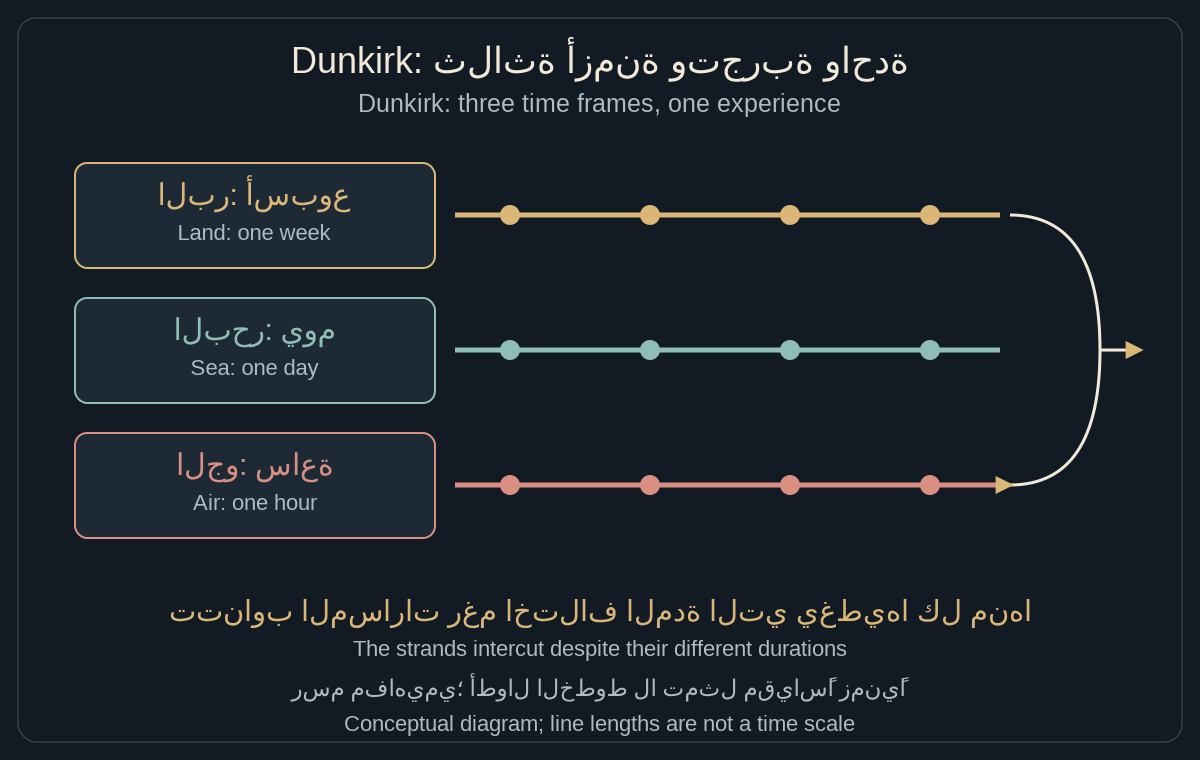
The first takes place on land over one week; the second covers one day at sea; and the third spans one hour in the air.
These durations are the time frames established by the narrative construction of the three strands.
The film moves between them despite the different lengths of time each covers.
As a result, viewers do not follow three entirely separate events. They experience different situations in which the sense of time and danger changes according to the participants’ circumstances.
Waiting for rescue on the beach has a different temporal quality from crossing the sea, just as both differ from the rapid decisions pilots face.
We can read this structure as a way of combining experiences of different durations into a shared sense of pressure and survival, then bringing their strands closer together as the film progresses.
It is important, however, not to reduce this choice to the idea that Nolan used three timelines because he likes complicated stories.
The lesson is that choosing how to organise time can affect our perception of events, not simply the order in which we watch them.
If the strands were shown separately, with the entire week followed by the entire day and then the hour, the film’s experience would change substantially.
The chronology might become easier to understand, but the relationship between parallel events and the pressure created by moving between them would change.
Some viewers, meanwhile, may initially struggle to grasp the different durations.
This is an important observation too: a complex structure may achieve a particular artistic effect, but it makes the film responsible for guiding the audience’s attention and helping them understand the essential relationships between events.
We should therefore avoid imitating this construction without understanding the function it serves.
A simple story told clearly may be more affecting than one divided into multiple time frames without a dramatic need.
How Can You Tell When a Scene Does Not Serve the Film’s Structure?
While developing a film, you may write a scene you love and then discover that it has no suitable place among the other scenes.
It may contain good dialogue, a moving performance or a visual idea you want to realise.
The problem arises when it does not contribute to the direction the story is taking.
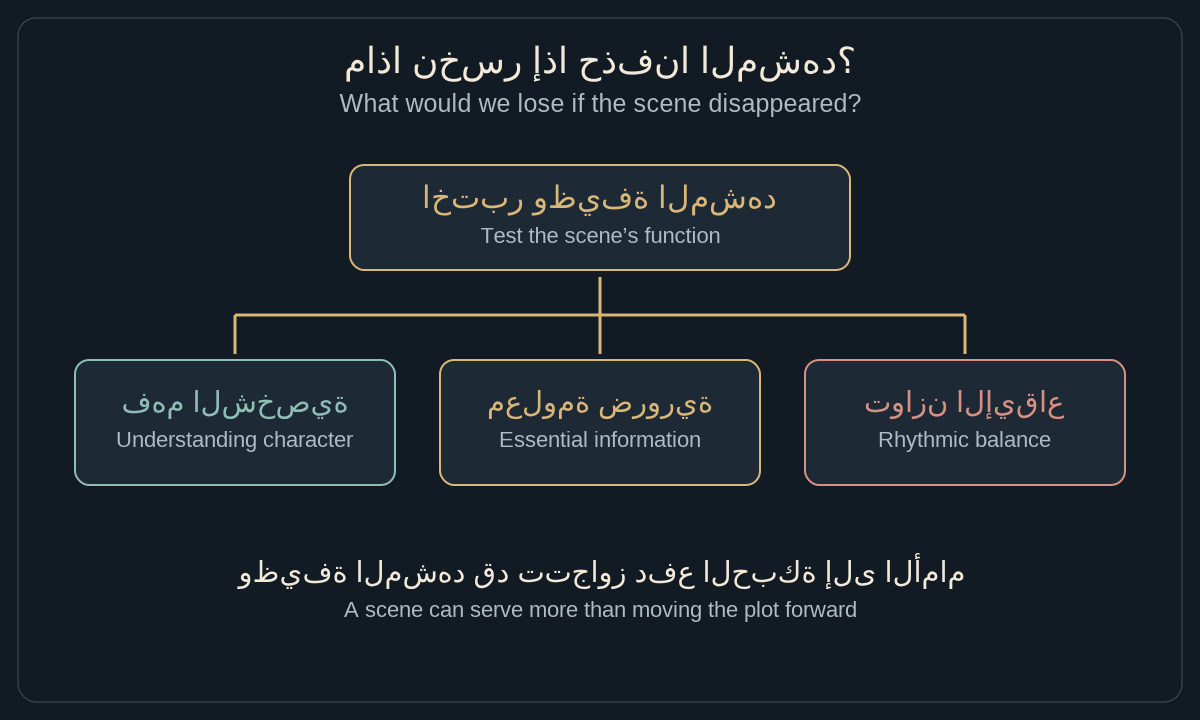
We can ask: what changes if we remove this scene?
We might lose an important aspect of a character, information needed to understand a later decision or a moment that balances tension and quiet.
In that case, its presence may be justified.
If it can be removed without changing our understanding of events or characters, and without affecting the intended rhythm, it may need reconsideration.
This does not mean that every scene must move the plot forward directly.
A film may make room to observe an everyday relationship between two characters, contemplate a place or reveal how a character’s world has changed after an event.
These functions may be essential to the film’s experience even without an obvious development in the main action.
It helps, however, to know why we are keeping the scene.
The opposite mistake is explaining too much.
We may fear that audiences will not understand a character’s motives, so we introduce a scene explaining the information, repeat it in later dialogue and confirm it a third time.
This may slow the story and suggest less confidence in the viewer’s ability to connect details.
Conversely, we may remove necessary information in the name of mystery, leaving audiences unable to understand the basic relationships on which the film depends.
This balance is difficult, but it can be tested and revised.
We can read the film’s outline with someone who did not help write it and notice the questions they ask along the way.
If they ask what will happen to the character, we may have succeeded in creating an expectation.
If they do not know why we have moved to this place or who a suddenly appearing character is, there may be a problem with structural clarity.
The distinction matters: intentional mystery is different from confusion caused by missing essential information.
Practical Exercise: Five Events, Two Different Stories
We will now apply this part’s central idea: how can viewers’ feelings change when we rearrange the same events without changing what happened within the story’s world?
Let us use the design workshop film from the opening.
We have five essential events:
• Water leaks into the design workshop early in the morning.
• Heba notices the danger and moves Basel’s model to another room to protect it.
• Basel arrives at the workshop and discovers that the model is missing from its place.
• He sees a photograph of Heba carrying the model, confronts her and accuses her of taking it without permission.
• Heba reveals what really happened. Basel finds his model intact and realises that he misjudged her.
This is the chronological sequence of events within the story.
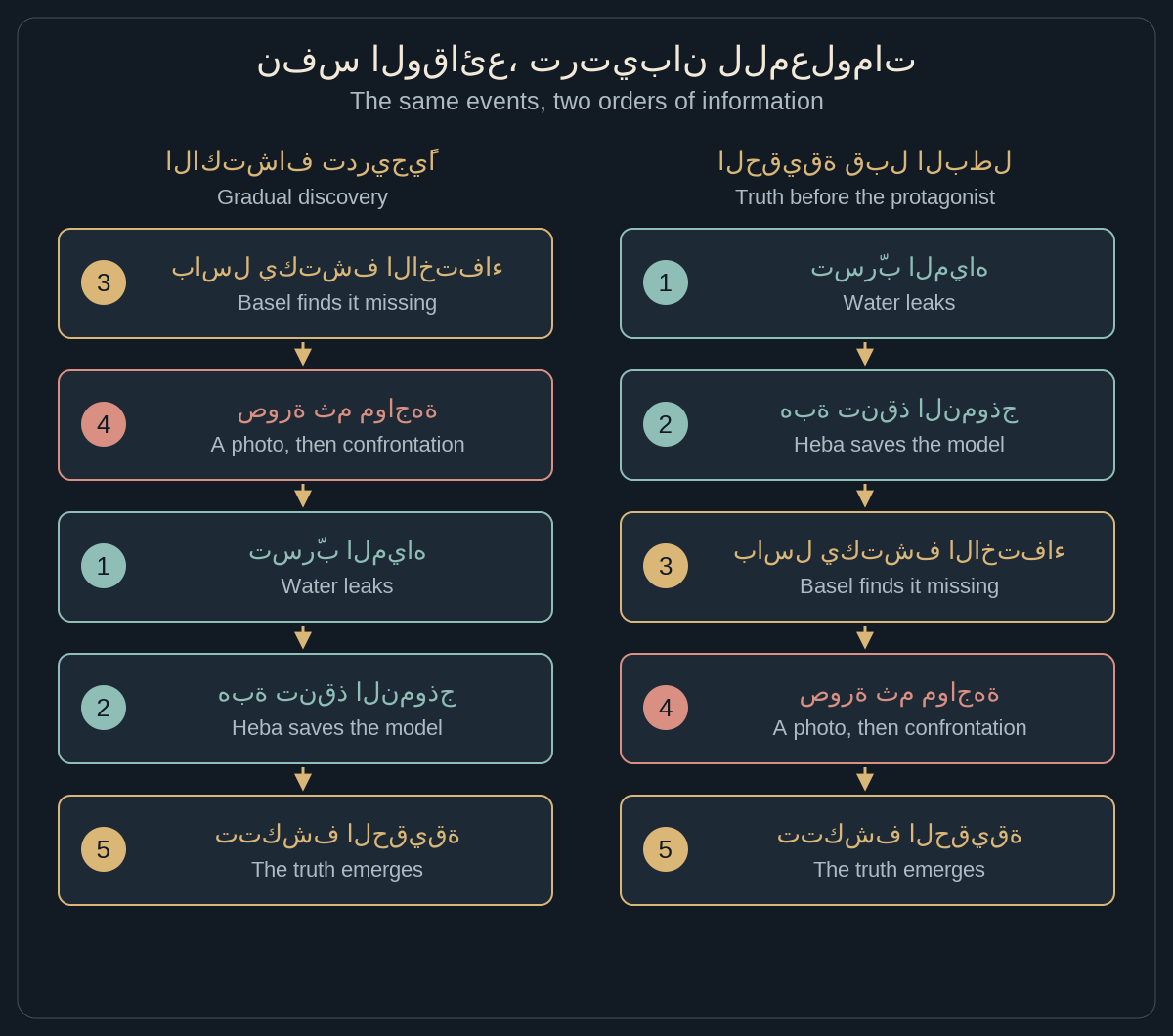
First treatment: the viewer knows the truth before the protagonist.
Arrange the events as they happened, from the first to the fifth.
Begin with the water leak, then show Heba saving the model.
When Basel arrives and discovers it is missing, we already know why.
In this version, our interest centres on how he responds to incomplete information.
Will he accuse Heba? Will he understand what happened before their relationship is damaged?
Second treatment: the viewer discovers the truth gradually.
Begin with the third event, as Basel enters and discovers the missing model.
Then move to the fourth event, as he sees the photograph and confronts Heba.
Return to the first and second events to reveal what happened that morning.
Finish with the fifth event, as Basel reaches the model and understands the truth.
In this version, viewers may initially share Basel’s confusion.
Their knowledge changes when they see the earlier events, and they begin to evaluate his accusation differently.
Notice that we have not changed the characters, outcomes or essential causes.
We have changed only the order in which information is presented.
The next step in the exercise: write a short paragraph about the feeling each version might create, then identify the moment when viewers know more than Basel or know as much as he does.
Ask yourself: which treatment gives Heba a stronger presence in the story? Which makes us watch Basel’s behaviour cautiously? Does the flashback in the second version add meaning that justifies returning to the past?
You can also try a third arrangement, provided it is understandable and serves a clear purpose.
You do not need to film the story. Write each event on a paper card, rearrange the cards and read the story aloud.
If you show both treatments to another reader, ask what they expected after each stage and what they understood about the two characters.
The aim is not for the nonlinear version to outperform the chronological version.
The aim is to recognise that order itself is a narrative decision that can be tested, and moving a single piece of information may change the entire experience of a film.
A Film Is Not a Collection of Events, but an Experience Shaped Through Time
Imagine Basel finally standing in front of the model he believed had disappeared.
He sees traces of water outside the room, then looks at Heba.
She says nothing.
He does not speak immediately either.
If we saw Heba save the model at the beginning, we may have been awaiting this moment for a long time. We know she did nothing wrong and may want Basel to realise that before accusing her.
If we discover the truth with him, the same moment may become a surprise that changes our understanding of what happened.
In a third version, we may have incomplete information about both characters, leaving their motives open to interpretation even after the confrontation ends.
All these possibilities begin with one story.
But the structure we choose determines the relationship that develops between viewers and events.
It determines what we know, what we anticipate, what we understand belatedly and when we need a quiet moment before moving to another event.
The director’s only question should therefore not be: do we have a beginning, middle and end?
The director should also ask: why do we begin at this precise moment? What do we want viewers to expect as they move to the next scene? What would change in their understanding if we revealed information now instead of delaying it?
The answer may lie in a simple, direct sequence, a more complex temporal treatment or alternation between several characters.
The choice derives its value from how well it serves the story, rather than from its strangeness or difficulty.
A film’s structure is how we give events meaning through time; its pacing is what allows us to experience that time in the measure the story needs.
In part twelve, we will return to the written text before it becomes images to learn a fundamental directing skill: how do you read a screenplay and discover what lies beyond the words?

About this series
A journey from understanding the director’s work and making a first decision to working with story, images and actors, then preparing, filming, editing and making a short film.
Further parts will be linked as they are published.
View the series in orderAll Cinema Journal articles