Stage Three: Learning to Think in Images
Two people can appear together within the frame while the distance between them still carries the scene’s question. The director chooses who stays close, who waits at the other end of the space, and what changes when one decides to approach.
After a small café closes, Nuha folds a cloth she has used to clean the tables. Iyad holds his coat and prepares to leave. She tells him, “Wait a minute.”
He stops, replies, “Okay,” and waits.
This is a simple imagined scene. Nuha wants him to hear her before he leaves, and he has agreed to wait. But we have not yet determined how that agreement appears within the space.
If he stands near her, the minute becomes an extension of a conversation that can begin easily. If he stays by the door while she remains at the other end of the room, distance stays a visible part of the waiting. We may feel that she needs to call for his attention across the space, even though he has not moved outside.
We can keep the words and performance, then rearrange the two characters to see how our understanding of the relationship changes. Distance becomes a directorial choice we can test.
How do we see depth on a flat screen?
We see the image on a flat surface, but infer a space extending into it. Overlap, differences in apparent size, the lines of floors and walls, and what movement reveals about how near or far elements are all help us do this.
When Iyad’s body overlaps part of a table, we understand that he is closer to the camera than the table. When rows of chairs extend behind him, we can judge that the room continues farther back. If he moves toward Nuha, the relationship between their positions becomes visible over the time he takes to cross the space.
To make these relationships easier to describe, we use three terms: foreground for what lies close to the lens, middle ground for the area between near and far, and background for what extends deeper into the frame.
These are relative areas, determined by the camera’s position and what appears before it. A chair might be in the foreground, Nuha in the middle ground, and Iyad by the door in the background. From another camera position, their places within these relationships may change.
Two clear planes can be enough to create a strong meaning, such as a close face and a distant person. There may be more planes if the action requires us to follow events distributed through the space.
The directorial decision begins when we identify what this arrangement does. In Nuha and Iyad’s scene, we want to understand how her request reaches him and whether his staying feels like being present with her or pausing on his way out.
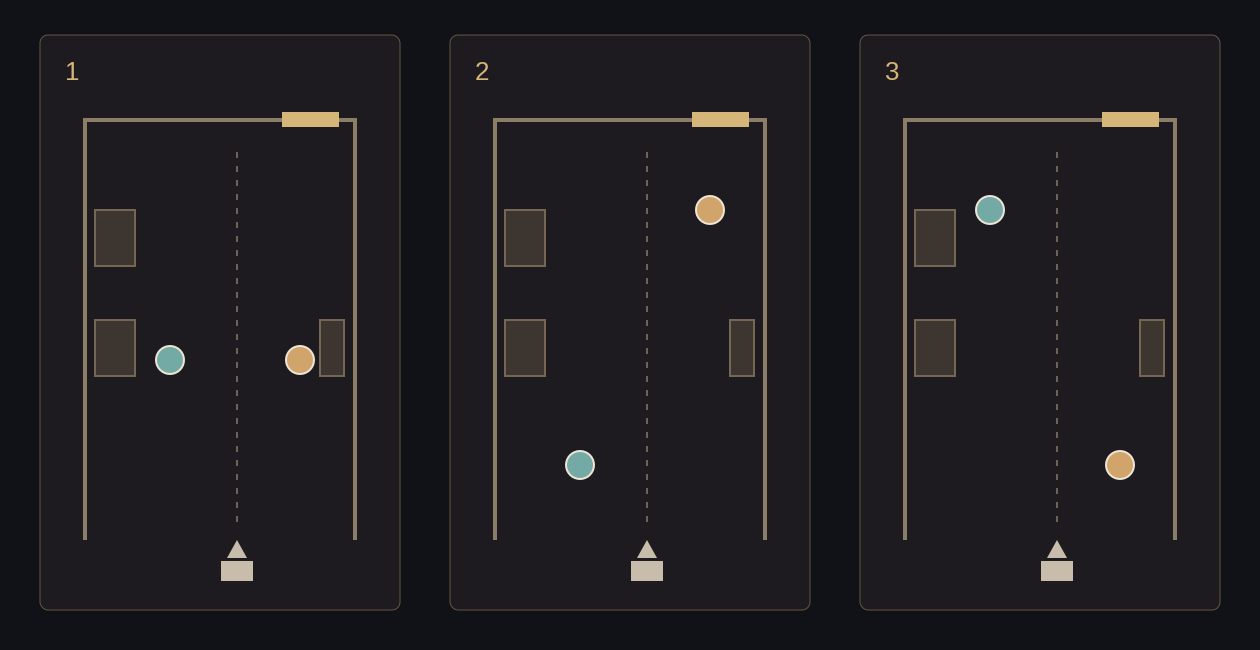
The same dialogue in three spatial arrangements
Let’s try three treatments of the situation, keeping the lines, the quiet way they are spoken, and the wait afterward as consistent as possible.
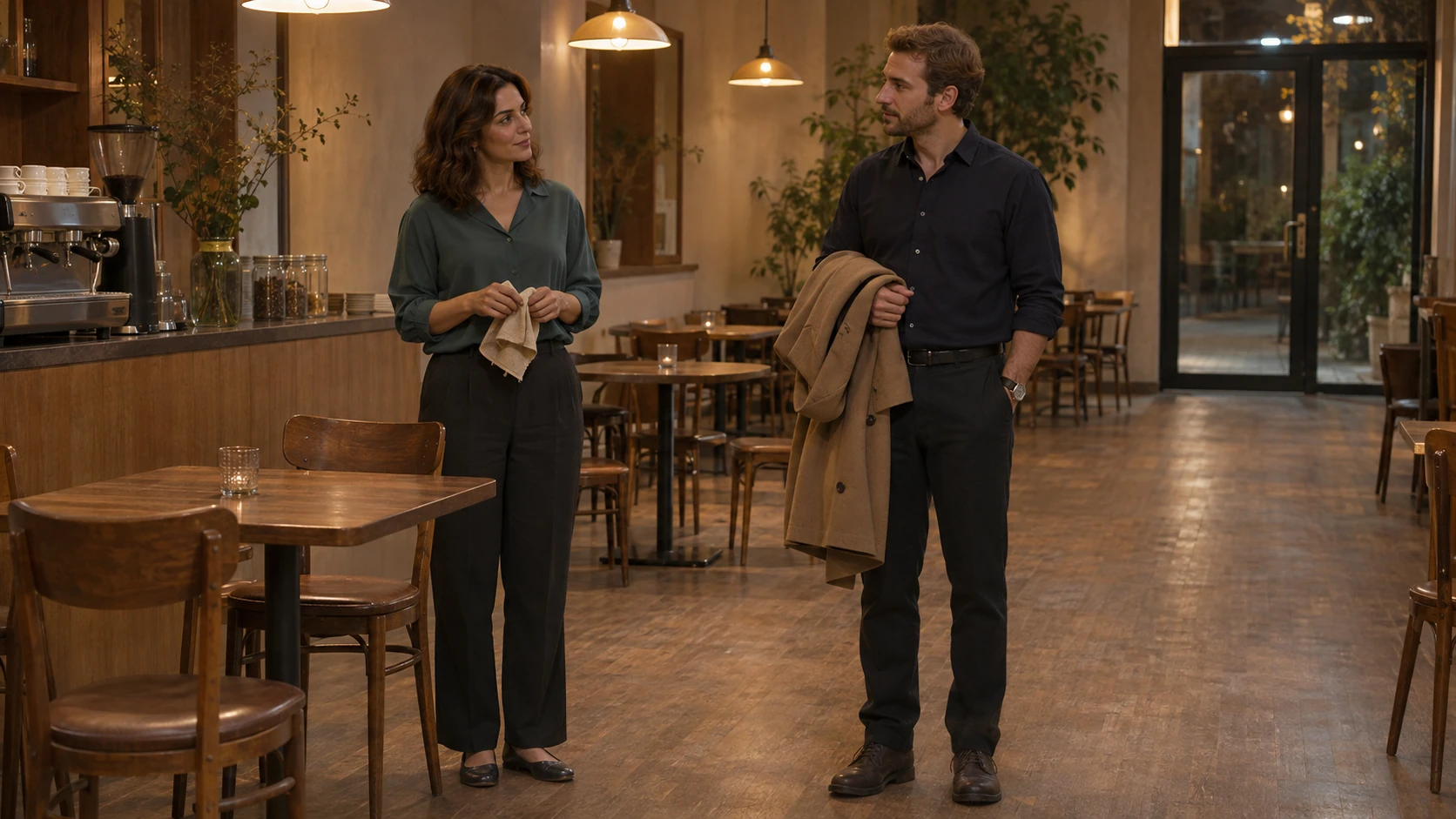
First arrangement: both characters share a space at a similar distance from the camera.
Nuha and Iyad stand near a table. They appear at similar sizes, and we can follow the speaker’s face and the listener’s face in the same shot. The café extends behind them, but attention settles on the interaction between two people available to one another.
When she says, “Wait a minute,” Iyad can stop where he is and wait. Beginning the conversation does not require crossing a new stretch of space, and Nuha does not appear to have to catch up with him.
This arrangement serves a moment in which we want their shared relationship to be clear. We may feel that they share the same time within the space, even if the subject of the conversation remains difficult.
In return, the possibility of leaving becomes less prominent unless something clearly connects Iyad to it. The coat helps remind us what he was preparing to do, while their physical proximity gives the conversation a relative ease.
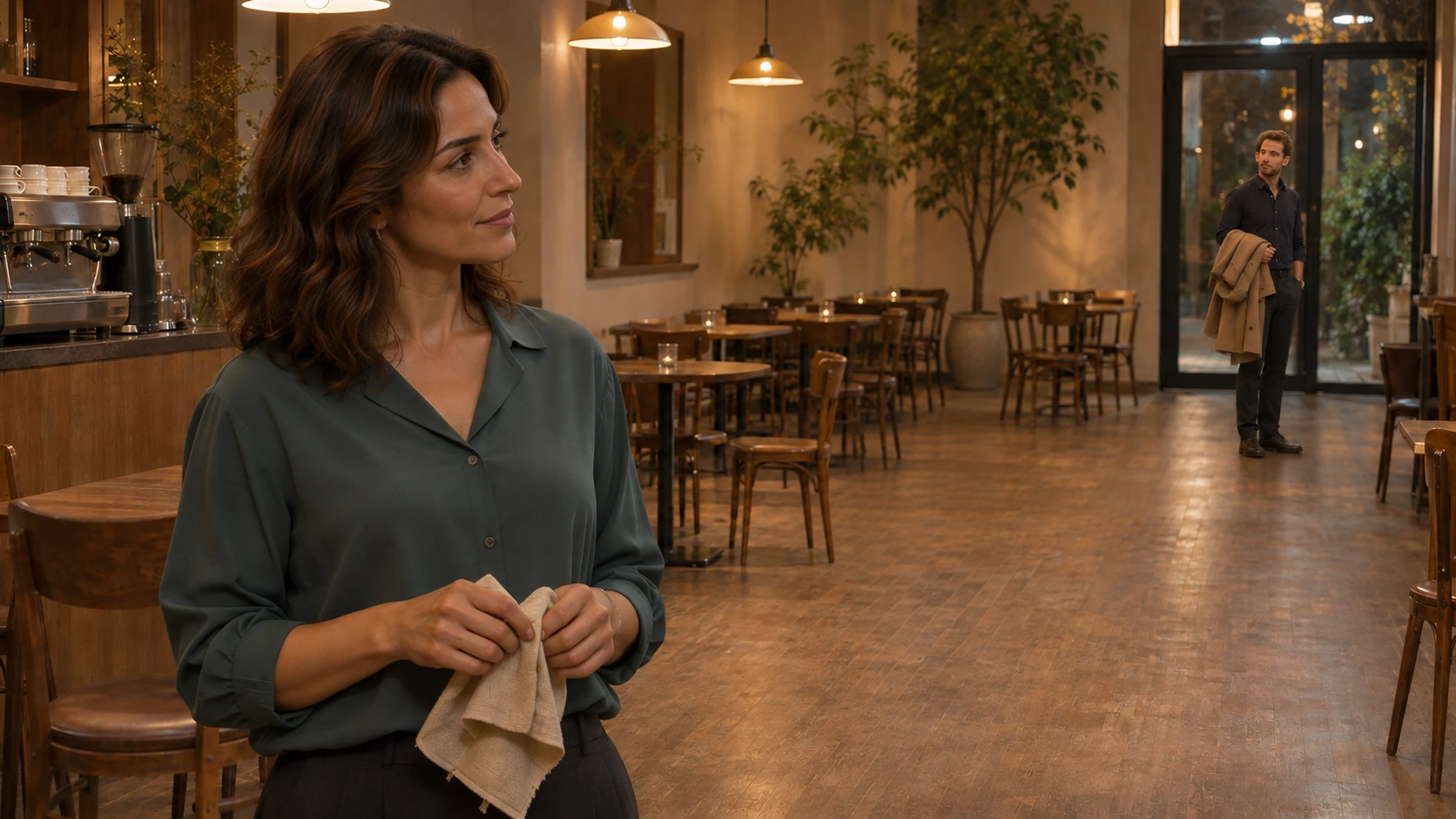
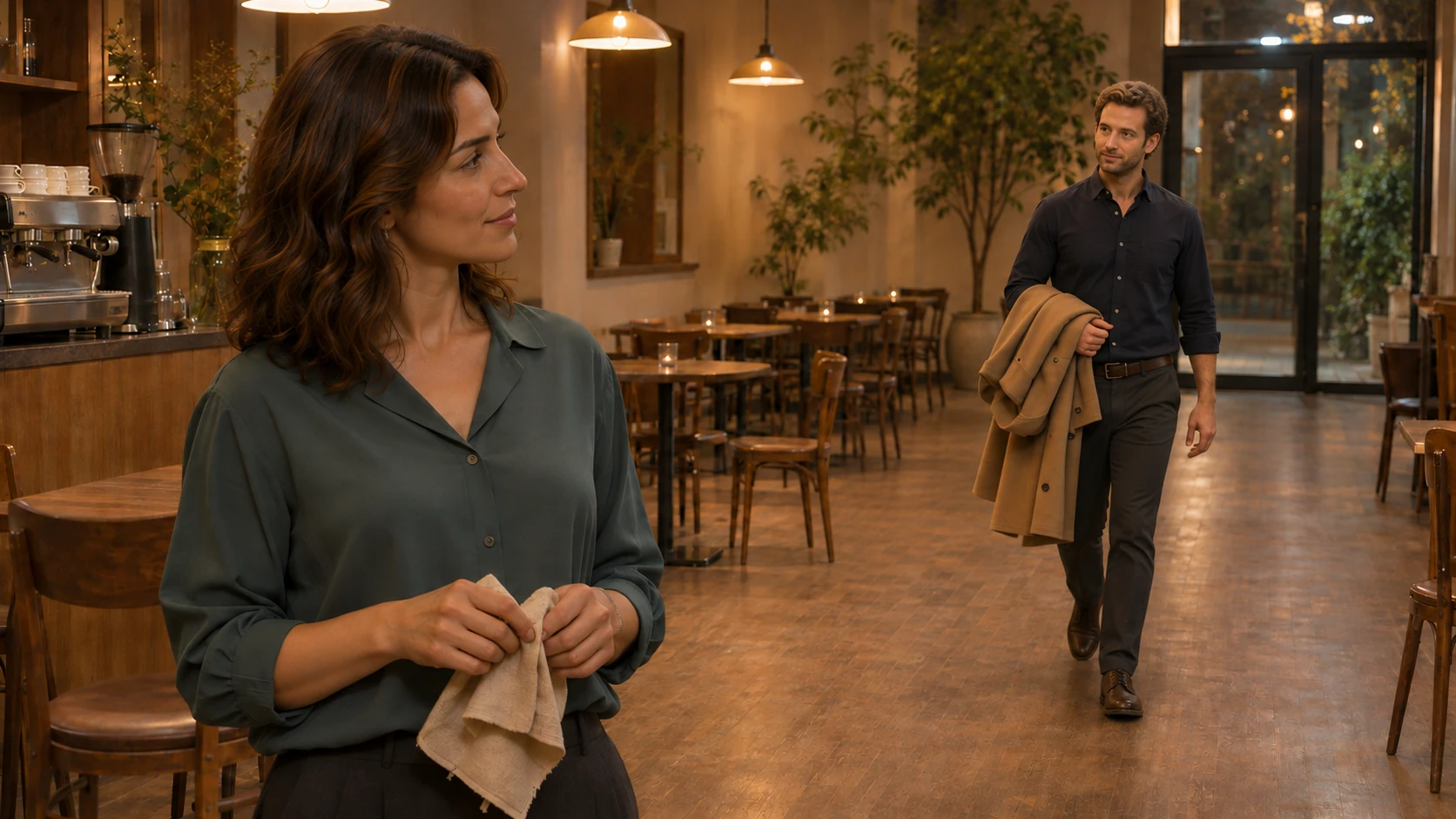
Second arrangement: Nuha is closer to the camera, and Iyad is farther away near the door.
We see Nuha finish folding the cloth, then look up toward Iyad. Her body occupies more of the image, while he appears smaller at the other end of the room. We can see some of the floor and chairs between them.
The distance her request crosses becomes tangible. She says, “Wait a minute,” and we register Iyad stopping at a point from which he could have left.
We can watch Nuha wait for his answer more clearly, while his response reaches us from farther away. This approach may give the moment some hesitation, particularly if he keeps the coat in his hand and his body remains partly turned toward the door.
We gain a clear spatial separation and its connection to the possibility of leaving. We may lose some fine detail in Iyad’s face. His performance therefore needs to remain understandable at the size he appears, through his pause, body orientation, and response to the words.
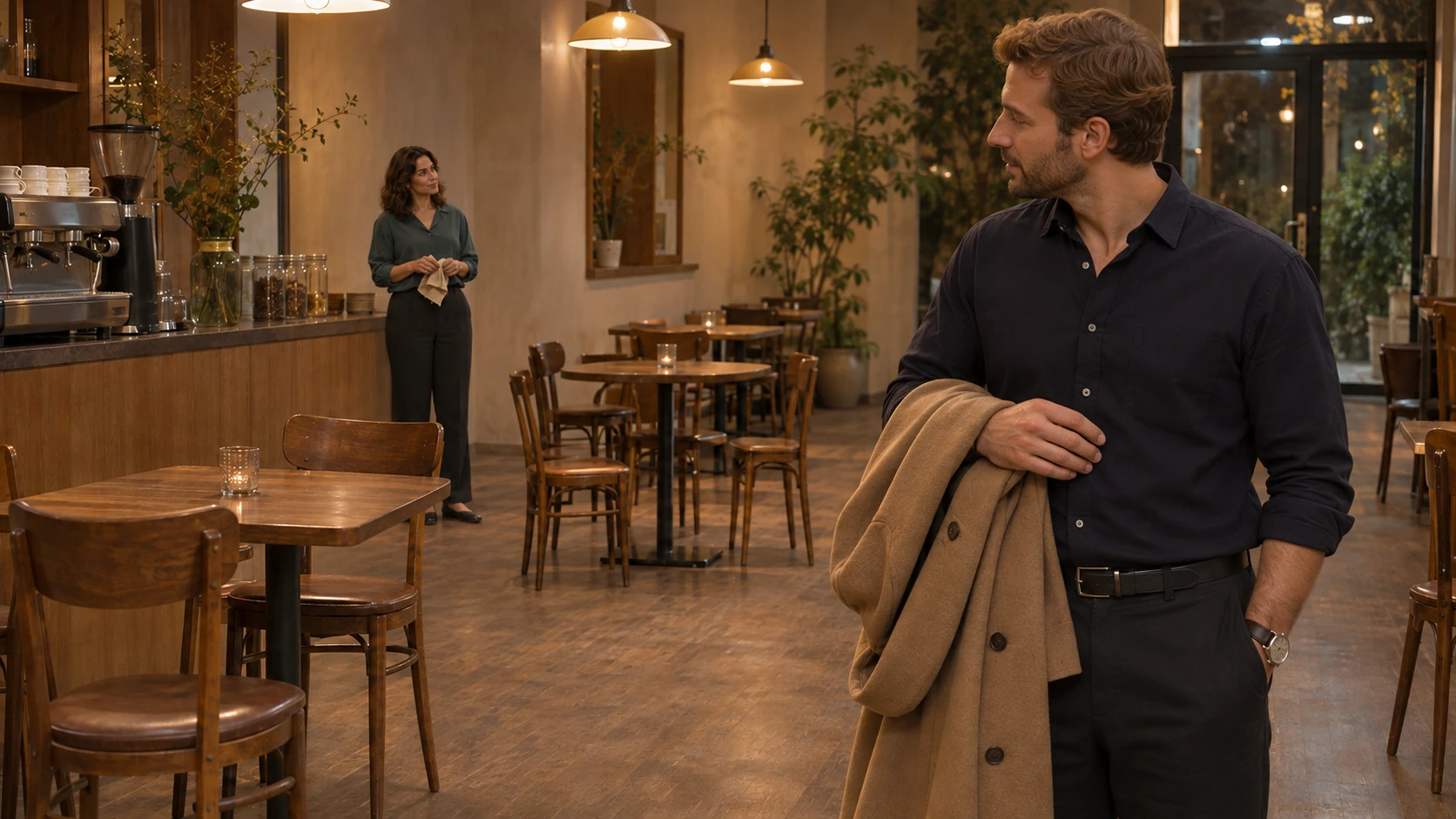
Third arrangement: Iyad is closer to the camera, and Nuha is farther inside the café.
We rearrange the scene so that Iyad appears close, holding his coat, with Nuha farther away. When she calls to him, we can notice his hand stop putting on the coat and see how he receives her request, while her presence reaches us from within the place he is preparing to leave.
Here, the image gives us more detail about his response. The wait can become connected to what he does with her request: does he turn toward her fully? Does he let the coat settle on his arm? Does he remain ready to move?
Nuha’s waiting, meanwhile, may become less detailed in the face and depend more on her stance, gaze, and remaining where she is.
This approach serves our wish to follow the effect of the request on Iyad. In return, our ability to read some of Nuha’s small changes recedes.
In all three treatments, Iyad agreed with the same word. Each arrangement, however, let us follow a different aspect of that agreement and gave the distance between them a different weight within the experience.
Distance has its effect through behavior
Iyad may stay far away and give Nuha his full attention. He turns toward her, abandons his preparations to leave, and listens from where he stands. Distance can then make his response readable as allowing her time, especially if she needs a moment before speaking.
Or he may stand near her but continue putting on his coat and looking toward the door. Physical closeness is accompanied by clear signs that he is preoccupied with leaving.
This is why we read the characters’ arrangement together with what they do. Distance makes some actions possible and puts obstacles in the way of others; behavior then reveals how the character deals with it.
The distant person can also carry the center of the scene. If Nuha in the foreground is waiting for Iyad’s answer, our interest may turn to him despite his smaller size. His pause or turn becomes the event we are looking for.
Here, we build on the lesson about guiding attention. First we identify where the important action occurs within the depth, then give it enough clarity and time to register. Apparent size alone does not determine a character’s importance in the moment.
The boundaries of the space can reinforce the separation. The door where Iyad stands connects him to leaving, while the cleaning cloth connects Nuha to finishing work. The distance between them carries a difference in readiness: one is about to leave, while the other is trying to begin a conversation.
When depth changes during the shot
The characters’ arrangement can develop while the camera stays still.
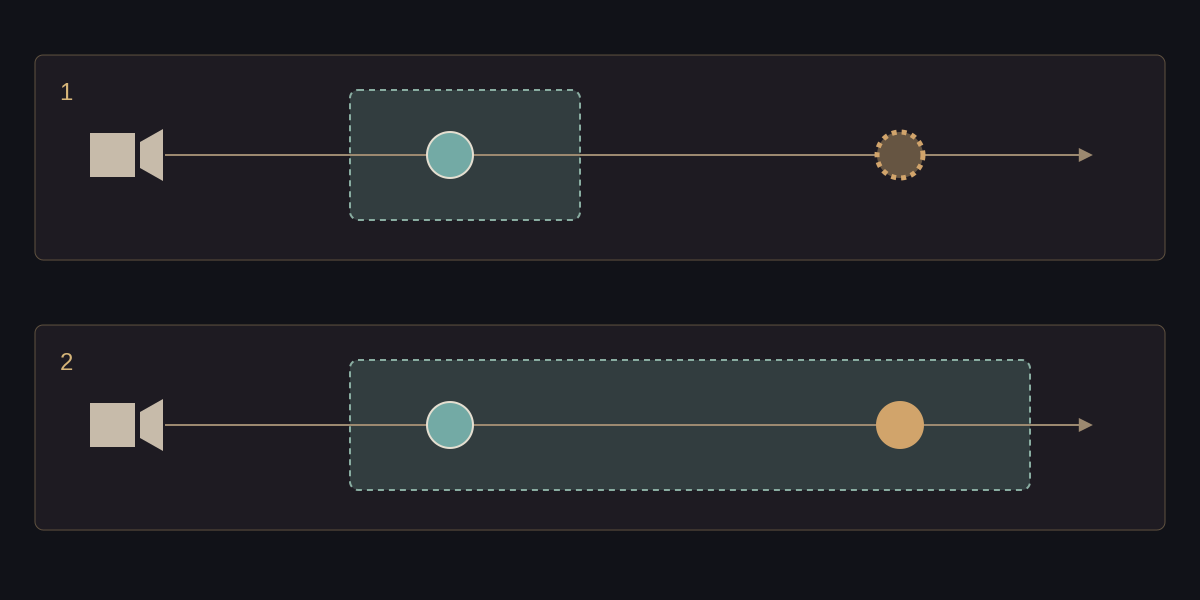
After Iyad says, “Okay,” he can stay by the door or begin walking back toward Nuha. In the second case, crossing the distance becomes an action we see and wait to be completed.
Nuha might raise her head and follow him with her eyes as he approaches. When he reaches a space close to her, lowering her voice may become natural, and the conversation for which she asked him to wait can begin. Approaching has changed what they can do within the space.
Staying in place has an effect too. If Nuha waits for him to return and he remains by the door, the duration of the pause can become part of the tension. Each has words to say, but their positions keep the question of communication open.
Before filming a movement like this, identify the moment when the relationship changes. Does the shift begin when Iyad turns, when he takes his first step, or when he reaches her side? The answer depends on what we want to notice about his response.
We will return to designing actors’ movements in more detail later. What we are testing here is the effect of a character moving from one spatial relationship to another and the changes that movement makes possible within the scene.
Staging the characters and making them visually readable
We need to distinguish between staging action in depth and depth of field.
Staging in depth concerns where people and objects are in relation to the camera and the relationships between them. Depth of field is the range of distances within which details appear acceptably sharp.
Nuha’s near face might appear clear while Iyad farther away is less sharp. His position, movement, and relationship to the door remain part of the image even if we cannot read every detail in his face.
The scene may need both characters to be clear. If its meaning depends on seeing Nuha wait while catching a small change in Iyad’s face at the same moment, being able to read both becomes an important requirement in choosing how to film.
The director identifies the information and performance the viewer needs to follow and discusses with the cinematographer the appropriate way to show them. We will explore the effects of lenses and perspective in the next part.
During the recce, look at the recording at the size you will watch it. A distant person’s features may seem readable while you are in the room with them, then become difficult details to read on a screen.
If what matters is a turn of the body, the available size may be enough. If what matters is a very small change in the eyes, we will need to reconsider our choice. The required action determines the degree of clarity that serves it.
Practical exercise: two characters in three arrangements
Choose a room with a position close to the phone and another farther away. You need two people who agree to be filmed, a fixed phone, and a coat or piece of clothing to represent preparing to leave.
Use the lines “Wait a minute” and “Okay.” After the answer, both people stay where they are for a few moments so that you can compare the effect of the arrangement itself.
Choose the camera position. Select framing that accommodates both characters in all three approaches. Keep the phone’s height, direction, and lens setting the same as far as possible.
Film the first approach. Both people stand at a similar distance from the camera, with space that lets us read each one’s response.
Film the second approach. Bring the person asking the other to wait closer to the camera and place the other farther inside the room. Leave enough lateral separation for both to appear, then repeat the dialogue with roughly the same timing.
Film the third approach. Reverse the depth relationship. The person preparing to leave is closer, and the person asking them to wait remains farther away. Let each person’s apparent size change with their position and notice the effect on how clearly the performance reads.
Compare the full recordings. Note what you could observe in the face and body and what made the wait seem easy, hesitant, or pressuring. Connect each reading to a visible detail, such as the body’s orientation toward the door or a completed turn toward the speaker.
If you show the versions to someone else, ask them to describe the relationship between the characters and identify the moment on which they based that description. They might interpret the distant stance as respect for space while you see hesitation. Together, examine what the actor did and what the frame made visible.
Then choose one of the two arrangements that separate the characters in depth and add a slow approach toward the other person after “Okay.” Watch how the meaning of waiting changes when the reply is accompanied by crossing the distance.
The aim is to be able to justify your choice. If you wanted to show the listener’s response in greater detail, did bringing them closer achieve that? If you wanted the distance between them to remain tangible, could it be seen and understood during the action?
In Nuha and Iyad’s scene, “Okay” may be enough to stop him leaving, while Nuha needs him to take another step before she can begin speaking. The shot can preserve that difference and let us see the moment when he decides to cross the space between them.
Once we choose where the characters stand, we still need to understand how camera position and lens choice affect the way these relationships appear on screen. This is the subject of part eighteen, “Lenses and Perspective: Why Does Our Sense of a Scene Change?”
About this series
A journey from understanding the director’s work and making a first decision to working with story, images and actors, then preparing, filming, editing and making a short film.
Further parts will be linked as they are published.
View the series in orderAll Cinema Journal articles