
A woman says to her brother as he prepares to leave:
“It’s all right. You can go.”
He smiles at her and closes the door behind him.
She remains standing for a few moments, then returns to the dining table, picks up the plate she had set out for him and puts it in the cupboard.
This is a brief hypothetical scene that could be written in a few lines.
But when a director begins reading it, questions emerge that the dialogue alone cannot answer.
Did the woman really want her brother to leave? Is she disappointed that he did not stay for a meal? Or was she preparing for an important conversation but could not find the courage to begin it?
Perhaps “It’s all right” carries no hidden meaning in itself, while the action that follows reveals something we did not know about the relationship.
If the director asks the actor to deliver the line with obvious sadness, that may lead viewers towards a particular interpretation from the outset.
If she delivers it naturally and we then watch her return the plate to the cupboard, the movement itself may become an opportunity to discover what she did not say.
Neither choice is right in every situation. The context preceding the scene and what follows may make one more appropriate than the other.
The example nevertheless reveals the fundamental difference between ordinary reading and a director’s reading.
The reader wants to know what happened.
The director also needs to understand what the characters are doing through their words and actions, what viewers should understand, and how to make that clear without explaining everything verbally.
The screenplay is not the film itself. It is the dramatic material the director and crew will work to transform into a visual and aural experience.
Why Is Understanding the Story Not Enough for a Director?
In previous parts, we learned how an idea becomes a story, how a character is built, what makes conflict affecting, and how scenes develop and connect within a film.
We now reach a different stage.
We are no longer looking only for a way to write a story, but for a way to read one that already exists and understand what it needs to become a film.
Imagine that you have a complete screenplay about someone returning to the family home after a long absence.
You may read it and understand that the character arrives, meets the family, disagrees with them about an old decision and then leaves.
That is an accurate understanding of the essential events.
But it does not provide enough to make every directing decision.
Has the character returned seeking reconciliation, or because they need something from the family? Are they concealing anger, or behaving aggressively because they fear revealing vulnerability?
What about the other characters? Do the family members genuinely want them to stay, or do some fear a return to the earlier conflict?
The answers may change how almost every scene is approached.
A line such as “It’s good that you’re back” might convey a sincere welcome, an attempt to ease tension or a desire to end the conversation quickly.
But a director is not entitled to choose a random meaning simply because it seems more interesting.
They must look for evidence within the text: what happened before the line, what is the relationship like, and how does the character behave afterwards?
Does the interpretation also fit the overall direction of the story?
A director’s reading is therefore a process of investigation and testing, rather than an attempt to invent hidden meanings behind every word.
The director first tries to understand the text as it is, then explores the possibilities it allows and identifies what needs clarification or development in collaboration with the writer and actors.
First Reading: Watch the Film in Your Imagination
When approaching a new screenplay, it is best to begin by reading it all the way through, as far as possible, without stopping at every sentence to make technical notes.
During this first reading, approach it as a story you want to discover.
Which character interested you? When did your understanding of events change? Was there a relationship that made you curious or an action you could not explain?
Try also to notice the overall feeling the text leaves.
Does it feel like a tense story heading towards confrontation, a quiet relationship drama, or a work that uses mystery to make us reconsider the information we receive?
These impressions are not final judgments on the screenplay. They help the director understand the experience it offers before beginning to analyse its parts.
Some scenes may be unclear on a first reading.
Do not rush to regard them as mistakes.
The uncertainty may be intentional, later information may be needed, or there may be a real gap requiring discussion.
What matters is distinguishing between something you do not understand because the text deliberately withholds information and something unclear because the relationship between events is not established.
If you eventually learn why a character behaved strangely at the beginning, that mystery may be part of the narrative structure.
If the film ends without giving you information needed to understand a crucial decision, that point may need reconsideration.
After reading, try to describe the story in one short paragraph.
The aim is not to summarise every event, but to identify the central experience: whom do we follow, what changes in their life, and what question does the story leave us with?
This overall view will later help you understand each scene’s function within the film.
You should not treat a single page in isolation, because its meaning may depend on earlier information or a consequence revealed afterwards.
Second Reading: What Actually Happens Before the Camera?
A screenplay usually contains information about a scene’s location and time, descriptions of visible actions and the characters’ dialogue, alongside other elements depending on the writing style and the project’s requirements.
But not every sentence in it can be filmed directly.
Suppose you read the following description:
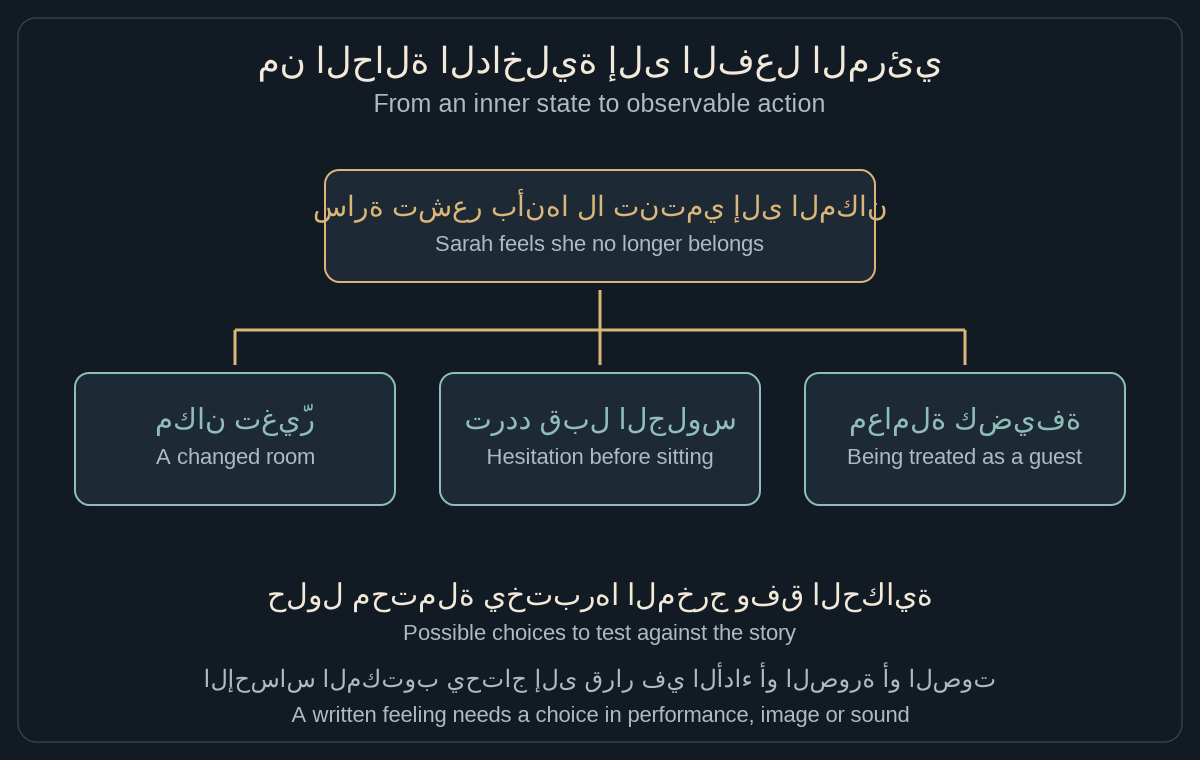
“Sarah enters the room and feels that she no longer belongs here.”
The meaning is understandable, but it raises an important directing question.
How will viewers know that she does not feel she belongs?
Have things in the room changed? Does she try to sit in her usual place, then stop when she sees it occupied by someone else’s belongings? Does another character treat her like a guest?
More than one solution is possible, but it should emerge from the story.
If the director treats the sentence as a direct instruction for the actor to “feel that she doesn’t belong,” the actor may have no specific action to perform.
A feeling written in a screenplay does not transfer automatically to the screen.
Describing an inner state is different from offering behaviour, an image or a sound that allows viewers to understand it.
During the second reading, it therefore helps to identify the information audiences can see or hear directly.
If the text says that a character places a key on a table, that is a clear action.
If it says that she hesitates before touching the key, we have behaviour that can be observed and tested in performance.
If it says that she puts the key down because she has lost trust in the person opposite her, that is an explanation of a motive that may need establishing within the scene or elsewhere in the film.
This does not mean writers should remove every reference to emotion or inner state from a screenplay.
Some such references may help communicate a dramatic intention to the crew.
But the director needs to know what must become a visible or audible action and what can remain knowledge that helps guide the performance.
One Screenplay Page: What Do We See, and What Do We Understand?
Let us try this with a short original scene written specifically for this lesson.
INT. PARTLY EMPTY APARTMENT – EVENING
Two closed boxes stand near the door. A family photograph is still hanging on the wall.
Nada places a book inside a third box.
Omar enters carrying his coat and puts the apartment key on the table.
OMAR:
The landlord will be here at six.
NADA:
The photograph is still up.
Omar points to the open box.
OMAR:
We’ll put it here.
NADA:
The glass is fragile.
Omar takes a cotton shirt from one of the bags and spreads it across the bottom of the box.
OMAR:
It’ll be safe like this.
Nada takes the photograph down from the wall.
A rectangle lighter than the rest of the wall appears in its place.
She puts the photograph inside the box but does not close it.
The doorbell rings.
Omar reaches towards the key on the table.
Nada gets there first and picks it up.
NADA:
Let me hand it over.
She walks towards the door.
END OF SCENE.
An ordinary reading of this page tells us that two people are preparing to leave an apartment and return its key, and that Nada is slow to remove a family photograph before the landlord arrives.
Reading it through a director’s eyes, however, reveals different layers.
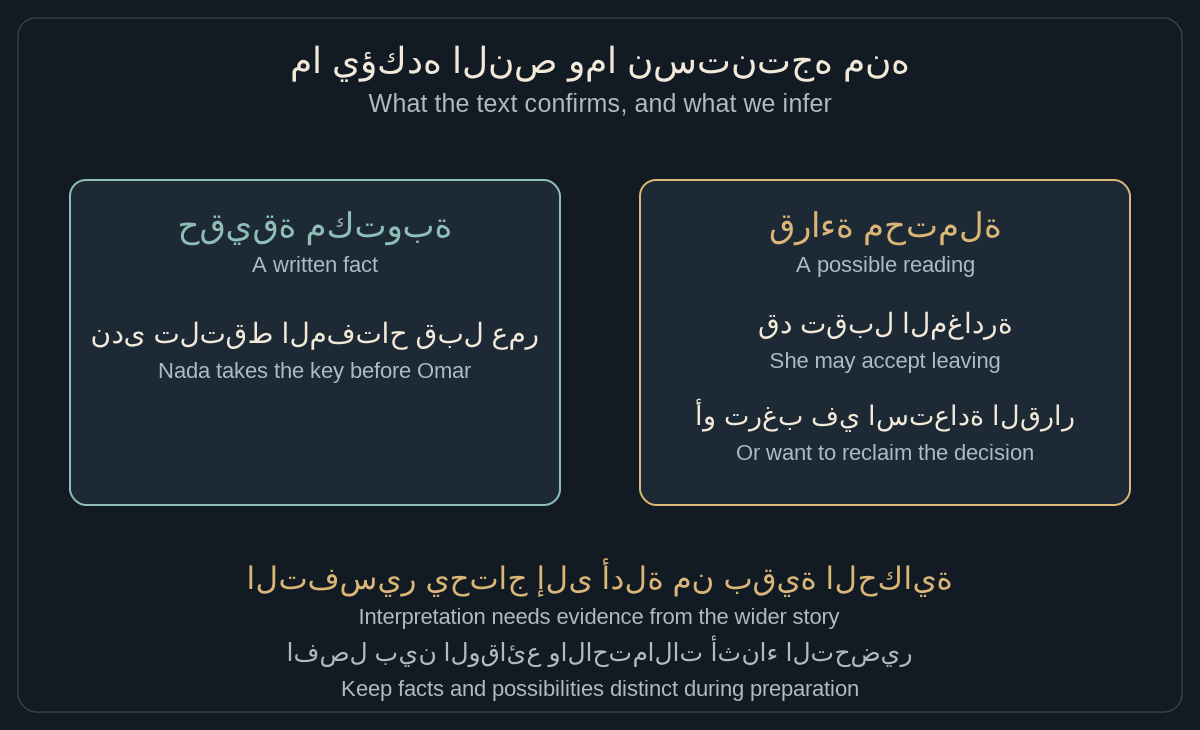
First, there are clearly written actions: Nada is packing, Omar mentions the handover time, the photograph is still hanging, the doorbell rings and Nada decides to take the key herself.
These are facts presented directly by the text.
Second, there are possible meanings: Nada may be trying to delay leaving the apartment for the last time. Perhaps it is not only about the place, but also about wanting to make the decision herself instead of letting Omar manage the handover.
One reading may fit, or both meanings may overlap, but this short text alone does not provide enough evidence for a final interpretation.
This brings us to one of the most important principles of reading as a director:
Do not confuse what the screenplay confirms with what you infer from it.
We can confidently say that Nada takes the key before Omar at the end of the scene.
Saying that she is rejecting his control or overcoming her grief remains an interpretation requiring knowledge of the rest of the story.
The better a director maintains this distinction, the better they can discuss the text without imposing ideas for which it has provided no foundation.
Dialogue Is More Than Information: It Is Action
A beginner may read dialogue as the means by which characters tell us what they think.
But dramatic dialogue serves a wider function.
People sometimes speak to obtain something, change someone’s position, avoid a question, test a reaction or conceal information.
We can therefore think of dialogue as verbal action.
Consider Omar’s line:
“The landlord will be here at six.”
Directly, it tells Nada when another person will arrive.
But what is he doing with that information within the scene?
Perhaps he is trying to make her hurry with the packing.
He may be anxious about being late and want to ensure she knows how much time remains.
Or he may be using the deadline to end an earlier discussion about leaving.
We cannot choose among these possibilities without considering the context.
Once we identify the line’s possible objective, however, we have a direction to discuss with the actor.
If Omar wants Nada to hurry, he may use the information differently from someone who fears upsetting her and wants to remind her gently.
The difference need not lie in speaking more loudly or softly.
It may emerge in the line’s timing, whether he waits for her response, or how he reacts when she says that the photograph is still hanging.
The same applies to Nada’s line:
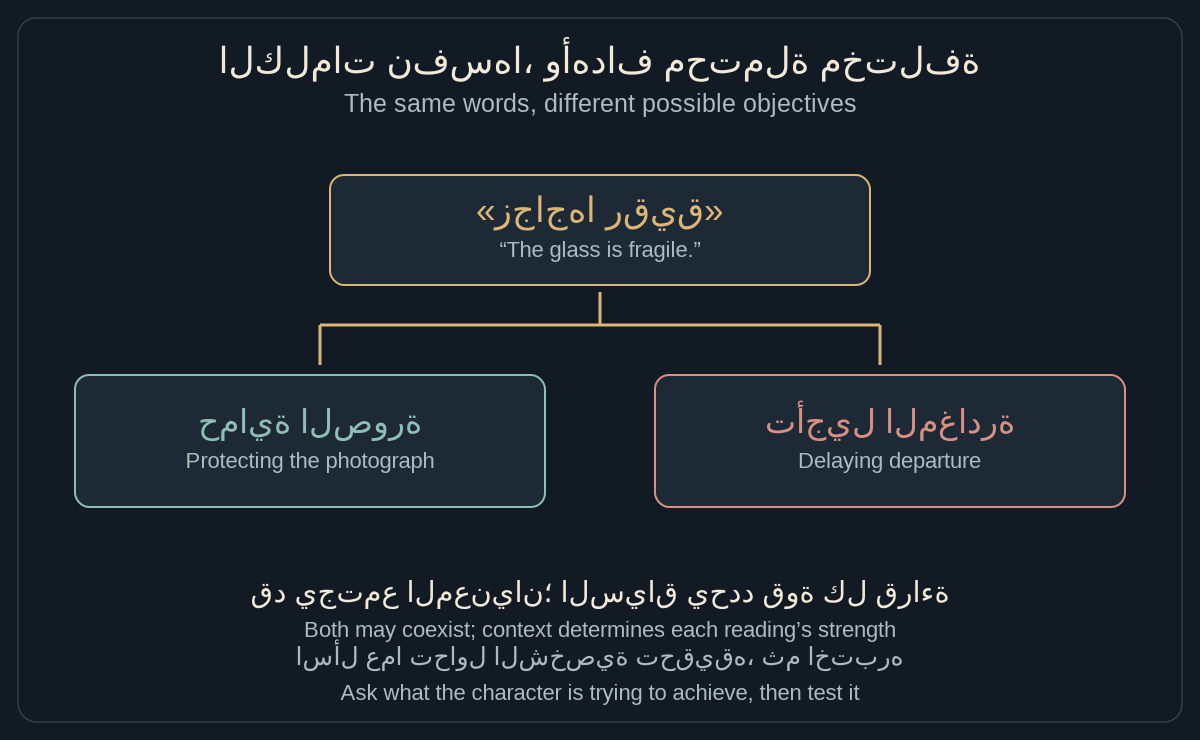
“The glass is fragile.”
She may genuinely fear that the frame will break.
But she may also be looking for another reason to delay putting the photograph in the box.
The line can carry both meanings.
A character does not have to be lying for their words to conceal another desire.
They may tell the truth while choosing one part of it because they cannot express the deeper reason for their behaviour.
When studying dialogue, asking what the words mean is not enough.
It also helps to ask: what is the character trying to achieve by saying them?
Subtext: What Do Characters Say Without Speaking It?
Subtext refers to ideas, feelings or motives we can understand behind dialogue and actions even though they are not stated directly.
But subtext is not necessarily a secret message the writer places within every line.
Some dialogue means exactly what it says. Some combines a direct meaning with another that emerges through context.
Let us return to Nada’s line about the photograph’s glass.
If the story has already shown that the frame has great emotional value for her, we may understand her concern about breaking it as part of her relationship with her memories.
If Nada and Omar’s relationship is strained, we may read the delay as resistance to his desire to finish moving quickly.
In another treatment, concern for the photograph may genuinely be her only reason, with no additional hidden meaning.
These are all possibilities, but we should not treat them as equally strong once we know the complete film.
Context may support one reading and weaken another.
This is why reading the screenplay more than once matters.
A line may seem ordinary when it first appears, then acquire a different meaning once we learn something about the characters’ relationship.
We may return to an earlier scene and discover that an action we overlooked was preparing for a later choice.
But searching for subtext should not become an attempt to prove that every character is hiding something all the time.
A good scene may sometimes rely on an explicit confrontation in which everyone clearly says what they want.
The director needs to recognise when clarity is the stronger choice and when a scene needs room for what the words leave unsaid.
How Do We Discover the Real Turn Within a Scene?
In part ten, we explored dramatic beats: shifts that change a character’s understanding or position, or the direction of the action within a scene.
When reading a screenplay, we can use this concept to discover moments that need attention during preparation.
In the apartment scene, Omar initially seems more ready to finish moving.
He mentions the deadline, suggests putting the photograph in the box and offers a solution to the problem of the glass.
Nada seems more concerned with the photograph and how it will be stored.
But the doorbell brings a clear change in the action.
Omar reaches for the key; Nada gets there first and takes it herself.
That change deserves attention.
Until then, Omar has been moving the process forward. Now Nada wants to hand over the key.
We may understand this as readiness to face the departure, a desire to reclaim the decision or a combination of the two.
What is certain, however, is that her final action differs from her earlier hesitation.
The director can therefore ask: what changed within Nada between the beginning and the end of the scene?
Was placing the photograph in the box the moment she accepted leaving? Or did the landlord’s arrival make further delay impossible, prompting her to take charge herself?
Each interpretation may lead to a different treatment.
These possibilities can be tested with the actors instead of fixing rigid emotional instructions from the outset.
We do not need to tell the actor that she must move from sadness to courage in ten seconds.
It is better to understand what the character is doing at each moment and what makes her change her behaviour.
From Words to Performance: What Do We Ask of the Actor?
A screenplay may say that a character “feels upset,” but this phrase does not always provide usable direction for an actor.
The actor needs to understand the situation, motives and actions the character is trying to undertake.
Take Omar as an example.
If the director asks him to look angry because Nada is packing slowly, the result may be visibly emotional but inconsistent with their relationship.
Discussing the character’s objective may lead them in a different direction.
Perhaps Omar wants to finish moving on time but does not want to pressure Nada directly.
The actor can therefore try persuading her that the photograph can be protected inside the box, rather than expressing anger at her delay.
He is doing something specific: looking for a solution that persuades her to leave.
When her response changes, he can change his approach too.
This is more useful than mechanically assigning emotions to lines.
The same applies to Nada.
She may want to delay handing over the apartment without saying so directly.
Instead, she can focus on the photograph’s details, then pause before the mark it left on the wall.
These actions give the actor material to work with without imposing a single expression.
The director should not decide in advance that emotion must appear through tears, trembling or a long silence.
A restrained performance may better suit a character trying to control her feelings.
The text may instead require a more overt performance.
What matters is that the choice emerges from an understanding of the relationship and objective, and is tested with the actors rather than treated as a guaranteed outcome.
Later, we will explore directing actors, conducting rehearsals and working with reactions in greater depth.
For now, it is enough to understand that a good directorial reading gives an actor an interpretation they can test, rather than a list of emotions to display with every line.
What Can a Director Learn from 12 Angry Men?
12 Angry Men, released in 1957, directed by Sidney Lumet and written by Reginald Rose, offers a clear example of the importance of distinguishing between what a character says and what they are trying to achieve.
The story follows twelve jurors discussing a murder case.
In the first vote inside the deliberation room, eleven vote guilty, while Juror Eight alone votes not guilty.
We might understand his position as a conviction that the defendant is innocent.
But the dialogue reveals something more specific.
He does not claim to know the whole truth. He believes that the case deserves discussion and thought before a grave decision is made about a human life.
It therefore matters to understand what he is trying to achieve at this stage.
Initially, he does not need to prove the defendant’s innocence conclusively. He needs to persuade the others to stop treating the decision as a settled matter requiring no discussion.
This distinction affects our understanding of the character.
If a director treats Juror Eight as someone who knows the truth from the beginning, the presentation of his calmness and confidence may change.
If he is approached as someone who rejects haste and asks for the evidence to be reconsidered, his behaviour becomes an attempt to open a space for dialogue before a majority seeking a conclusion.
This does not mean that every other juror wants to end the discussion for the same reasons.
Some are convinced of guilt, while others are influenced by their experiences or preconceptions. Their motives may differ despite their initial agreement in the vote.
That is the point that concerns us when reading a screenplay.
Several characters may say the same thing without necessarily pursuing the same objective.
When a director understands these differences, dialogue becomes a confrontation between different intentions, rather than merely conflicting lines distributed among actors.
The director does not need to reveal every character’s motives at the beginning of the film.
They can emerge gradually as positions change, prompting viewers to reconsider people they thought they understood.

When Should a Director Ask the Writer Instead of Inventing an Answer?
There is an important difference between interpreting a text and changing its facts.
A director may discover that a scene allows more than one meaning. That is not necessarily a problem.
They may also discover that essential information is missing, making the action a character must perform difficult to understand.
Let us return to the apartment.
The doorbell rings, and Nada picks up the key and walks towards the door.
We may assume that the landlord has arrived because Omar previously mentioned the expected arrival time.
But the short text does not explicitly confirm who is behind the door.
If the visitor’s identity is essential to what happens next, it is better to establish it by returning to the rest of the screenplay or discussing it with the writer.
We should not independently add that the visitor is a family member, or that Nada has awaited this arrival for years, simply because it would make the scene more exciting.
Nor should we assume that the family photograph depicts someone who has died, or that the apartment was sold because of a family dispute.
These are possibilities for another fictional project, but they are not information contained in the page we are reading.
The reading may reveal that the scene needs a genuine revision.
Perhaps we do not understand why Nada takes responsibility for returning the key, or the shift seems abrupt compared with her earlier behaviour.
We can then discuss adding a small action, changing a line or clarifying earlier information, in collaboration with the writer and within the director’s responsibilities on the project.
If the ambiguity is intentional and serves the story, however, it may be better preserved.
The director’s task is not to explain everything to audiences, but to identify what needs clarity and what can remain open to interpretation.
The Screenplay Does Not Always Tell You Where to Put the Camera
After understanding the scene dramatically, a director may begin imagining how to present it visually.
An important distinction arises here: reading a screenplay as a director does not mean immediately turning each sentence into a shot.
If the screenplay says that Nada looks at the mark left by the photograph on the wall, that is not an automatic instruction to use a close-up of the mark.
The moment can be presented in different ways.
We may see Nada and the wall in the same frame, understanding her relationship with the place through her behaviour.
We may see the mark separately if the film needs to direct our attention towards it more explicitly.
The scene may not need to emphasise it at all if the dramatic relationship between the two characters matters more at that moment.
These visual choices require an understanding of what the director wants viewers to know or feel.
We will not settle them now. Shot sizes, composition, actor and camera movement, and shot breakdown will be studied in later stages of the series.
What matters here is reaching those stages with a clear understanding of the scene.
If we do not know what changed within Nada when she picked up the key, the shot will not become more affecting merely because it was filmed with a particular lens.
If we do not understand why Omar is helping her pack, we may choose an attractive camera movement that reveals nothing about the relationship.
A visual decision serves the dramatic action; it does not compensate for a failure to understand it.
This does not diminish the image’s role in creating meaning. It makes the choice more deliberate.
A Director’s Notes: How Do We Turn Reading into a Plan for Thinking?
After reading and understanding a scene, the director can keep brief notes to help during preparation.
The aim is not to write a lengthy explanation of every line or impose a final interpretation of every movement on the actors.
It is better to focus the notes on what requires a decision or an experiment.
Let us apply this to Nada and Omar’s scene.
The first note might be:
Scene function: moving from the practical preparations for leaving the apartment to a moment when one person takes responsibility for completing the farewell.
But this is a proposed interpretation whose relationship to the rest of the film needs confirming.
The second note concerns Nada’s objective: does she want to delay leaving, or preserve a family photograph without damage?
Both objectives may be present.
The third note concerns Omar: is he helping because he understands the difficulty of the situation, or because he wants to finish the task quickly?
This question can be discussed with the actor and connected to what we know about the character in other scenes.
A fourth note may concern the central turn: what does it mean that Nada picks up the key before Omar?
Has she become ready to return the apartment, or does she want to make the decision at the last moment?
Another note concerns the viewer’s knowledge: should we understand why Nada clings to the photograph from the beginning, or leave that open until the end?
These notes are not yet shooting instructions.
They are questions that help identify decisions affecting performance and visual construction.
The answers may change in rehearsal when the director and actors discover that a particular action has a stronger effect than they anticipated while reading.
It also matters to distinguish this directorial analysis from a production script breakdown.
Directorial analysis explores meaning, objectives, changes and artistic choices.
A production breakdown identifies practical requirements such as locations, actors, props, costumes and other needs involved in production planning.
The two processes may overlap, but they do not serve the same function.
We will explore turning a screenplay into a production and shooting plan in later stages.

Practical Exercise: Read One Page as Though You Will Direct It Tomorrow
You can now test what you have learned without a camera or actors.
Choose a short scene you wrote, or use Nada and Omar’s scene from this part.
First, read it without stopping and try to understand what happens as though watching a film for the first time.
Then return to it with paper and a pen.
Begin by identifying the actions clearly presented in the text. What can we actually see or hear? Who moves, who speaks, and which objects affect the situation?
Next, put a question mark beside any line you believe carries an indirect meaning.
Do not write down one interpretation as a fact.
Try to find two possibilities where the text allows them, then ask which has greater support in the actions and dialogue.
Next, identify each character’s objective within the scene.
Use clear verbs such as persuade, delay, prevent, reassure, conceal, request or confront.
Avoid settling for statements such as “the character is sad” or “the character is angry.” These describe a possible state without specifying what the character is trying to do.
Choose the moment when an important change occurs.
In the apartment scene, it might be Nada picking up the key.
Ask what changes before and after it, and what information viewers need to understand its importance.
Finally, write three directing questions you want to discuss before filming.
One might concern the relationship between the characters, another the meaning of a particular action, and a third what audiences should know at this stage.
Additional test:
Choose one line of dialogue and try reading it with two different interpretations without changing its words.
For example, Omar’s “It’ll be safe like this” might be a sincere attempt to reassure Nada about the photograph, or a gentle attempt to bring her delay to an end.
Consider how his behaviour before and after the line might change in each case.
Decide which interpretation best suits the story you want to build and what evidence supports your choice.
The aim is not to discover a secret answer hidden within the screenplay, but to learn to make a conscious decision that can be explained and tested.
Afterwards, keep your notes alongside the original text.
This page will provide a useful starting point when we later move to working with actors, designing movement and choosing how to film a scene.
When Words Become the Beginning of the Image
Nada approaches the apartment door with the key in her hand.
She has not closed the box containing the family photograph.
Omar stands behind her, having left her the decision to return the key.
We can imagine this moment in several ways.
It may seem like a quiet ending to a long farewell, the beginning of a confrontation yet to happen, or a moment when Nada tries to regain control of a situation from which she felt excluded.
Before choosing a treatment, however, we should know what the text supports and what we need to discover from the rest of the story.
That is the distinction this lesson has sought to establish.
A director who reads a screenplay well does not look for an opportunity to add a camera movement to every line or turn every word into a complex psychological symbol.
They first look for the human being within the situation: what they are trying to achieve, what stands in their way and what changes when they fail or succeed.
Then they ask how that experience can reach viewers through performance, image, sound and time.
Reading may reveal that some words do not need direct illustration, and that a single silence can have more impact than a long speech.
A small detail, such as a key on a table or a photograph removed from a wall, may reveal something about the relationship between the characters.
But these details do not gain value merely by existing.
Their value comes from their place within the story, the actions connected to them and how we understand the characters as they interact with them.
We have now reached the end of the second stage of our learning journey.
We began by searching for ideas, then learned to develop stories, characters, conflict, scenes and film structure, and ended by reading a screenplay through the eyes of the person who will transform it into a cinematic experience.
We now have the foundation for the next stage: learning to think in images.
The screenplay gives us what happens within the story. Directing begins when we ask how to make viewers see that event, understand it and feel its effects.
In part thirteen, we will begin with one of cinema’s most exciting challenges: how does a director tell a story without the characters speaking?

About this series
A journey from understanding the director’s work and making a first decision to working with story, images and actors, then preparing, filming, editing and making a short film.
Further parts will be linked as they are published.
View the series in orderAll Cinema Journal articles