Stage Three: Learning to Think in Images
An image may contain everything the viewer needs to understand a moment, yet the crucial detail can still go unnoticed. A director learns to arrange people, objects, and movement so that attention reaches what carries meaning at the right time.
Behind the curtain at a small theater, Salim waits for his first appearance before an audience. He sits at a table while Dalia stands beside him holding the show’s program. She tells him, “You’re on.”
He raises his head, smiles, and replies, “I’m ready.” At the same moment, his fingers press into an empty paper cup, denting it slightly.
This is an imagined scene through which we want to see the effort Salim makes to appear calm. His face offers Dalia a smile, while his hand reveals tension he is trying to contain.
We can put both characters and the cup in a single clear shot. Even so, the viewer might remember the smile and the line and miss what happened to the cup. Or the hand’s movement might catch their attention, leading them to read the smile as an effort to find courage.
Part of this difference depends on how elements are arranged in the image and what captures attention as the character speaks.
What does the image give priority to?
Composition is the arrangement of people, objects, shapes, light, and space within the boundaries of the image. Its fundamental decisions include determining what stands out, what recedes, and the relationships the eye can follow between elements.
In the previous two parts, we chose how much of the action to show and the direction from which to see it. Now we assume that Salim’s face, hand, and cup are already visible, and explore how to make us notice one before another or connect them while watching.
Our interest might begin with his face because he is speaking, shift to his hand when it moves, and return to his face to understand the smile in light of what we have seen. Or the face might hold our interest throughout the moment if the hand’s movement is not given enough clarity.
This is an ordering of visual priorities. The director can favor a path for attention while leaving room for differences in viewers’ experience and expectations. Someone who already knows Salim is nervous might look for signs of it, while another viewer follows Dalia because she brings the news that the show is starting.
This is why it matters to state the intention before arranging the image. In our scene, the intention could be: we want the viewer to hear Salim’s assurance and then notice what contradicts his apparent calm. That statement helps us make specific decisions about the face, the hand, and the cup.
“We want a beautiful frame,” on the other hand, leaves the scene’s essential questions open.
What draws the eye within the frame?
Contrast can give a small detail a clear presence. A light hand against a dark surface may be easier to distinguish than the same hand among pale papers and objects of similar colors. A dark patch in a mostly bright image can catch our attention just as a bright patch can within shadow.
Contrast is a relationship between an element and its surroundings. If we want the cup to be noticed, we examine what appears behind its edges and whether Salim’s fingers are distinct around it. Simplifying the area around the hand may help us more than adding light to the entire scene.
Color works in the same way. An element with a distinct color can stand out among similar colors. But the attention-grabbing color might belong to a secondary object, such as a coat hanging near Salim’s head. That object then deserves as much scrutiny as the prop carrying the main action.
Visual masses are the areas occupied by bodies and objects in the image, and the weight their sizes, colors, and density of detail give them. If Dalia occupies a large area and keeps moving a busy program, she will compete with Salim’s fingers for our attention. That may be appropriate if her response is the subject of the moment.
Movement can redirect attention, especially when it appears in an otherwise still area. If Dalia’s hand settles after she finishes speaking and the cup then begins to dent between Salim’s fingers, the small movement gets a clearer opportunity. If the hands, program, and head all move at once, we are asking the viewer to divide their attention among several actions.
Gaze can invite us to follow something else. If Dalia looks toward Salim’s hand, we might follow her eyes to the cup and then return to her face to read what she has understood. This choice also changes the scene because it makes her noticing his tension a visible part of their relationship. We therefore use gaze when it fits what the character actually notices.
Each means has an effect connected to the characters’ behavior and the context. A little contrast, carefully judged movement, and suitable timing can work together, rather than asking a single means to carry all the attention.
One face and one hand, in two treatments
Let’s film Salim and Dalia’s situation in two ways, keeping the dialogue, action, shot size, and camera position as consistent as possible.
In the first treatment, we give Salim’s face priority.
His face appears clearly against a simple area, while the hand and cup sit against a pale surface close to their own color. We can still see the cup, but its edges do not stand out strongly from its surroundings.
We readily receive his smile and answer, and can follow the exchange with Dalia as a moment of preparation to appear onstage. The tension in his hand remains available to anyone who catches it, but it is less insistent within the image.
This approach may serve a wish to let us believe his calm for a while, or to keep his tension a faint detail. In return, we risk the sign of anxiety passing unnoticed and never entering the viewer’s reading of the situation.
In the second treatment, we separate the hand’s movement more clearly from its surroundings.
We try a simple dark surface around the hand and cup, making it easier to distinguish the fingers and the change in the paper’s shape. The face remains visible at the same size, and the same movement happens after the line.

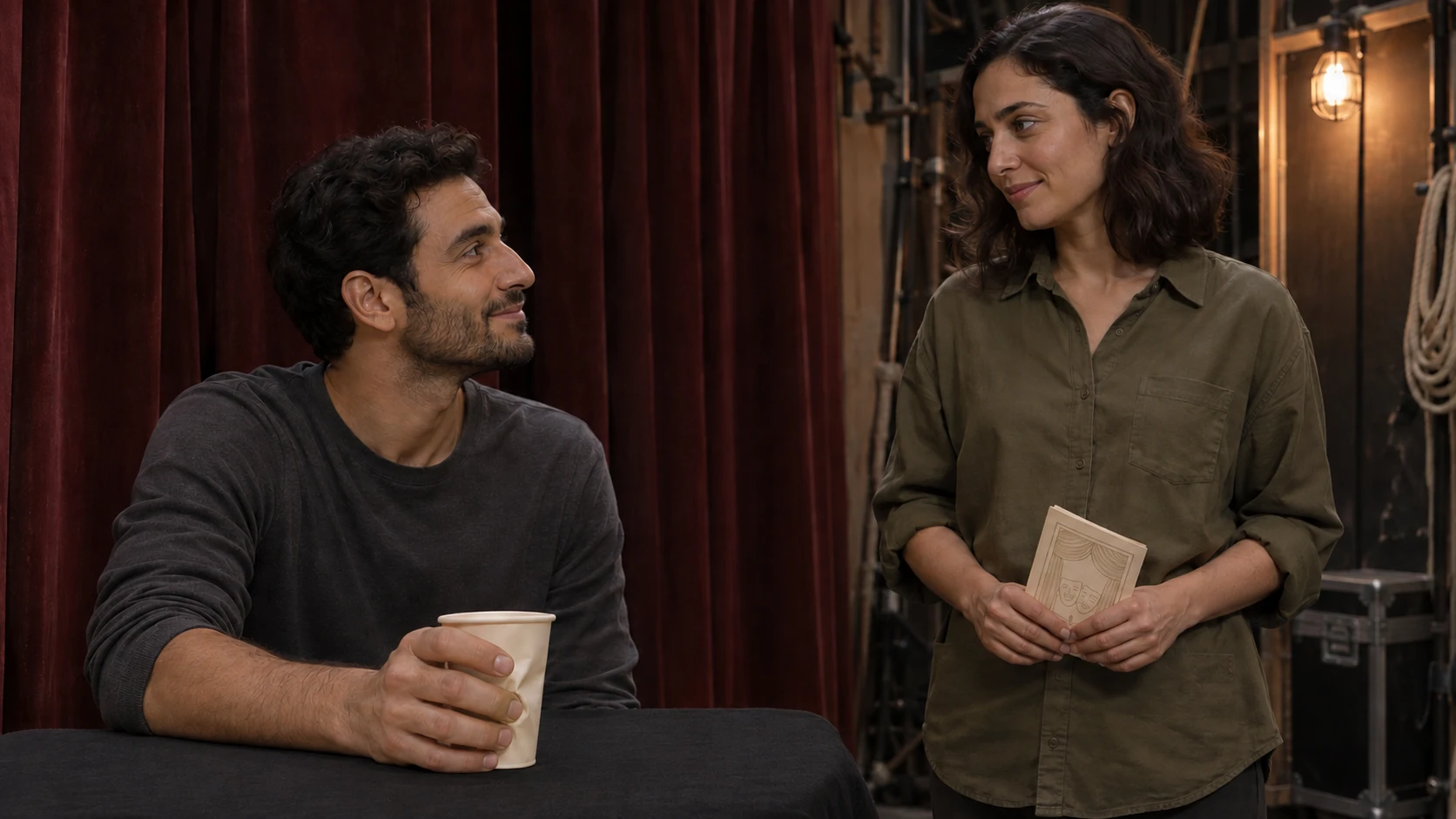
Here, we want the viewer to begin with the speaking face, then catch the fingers pressing as the cup changes shape. The viewer receives information that invites them to reconsider what they have just heard. They might return to the smile and see it as an effort to hold on to courage in front of Dalia.
We gain a clearer contradiction between speech and action. We reduce the chance that anxiety remains a quiet observation that not everyone picks up. If we emphasize the cup too strongly, we may announce Salim’s tension before his smile has a chance to make an impression.
Experiment helps us determine the right degree. We want the detail to register while the scene retains the spontaneity of a brief exchange between two people.
Space and placement change the reading
We can make the hand clearer by leaving a simple area around it. When Salim’s fingers crowd together with the table edge, program pages, and curtain lines, the viewer needs more effort to distinguish the action. Moving a small object may separate the hand’s edges without changing the shot size.
Space has another use when connected to the direction of a gaze. If Salim looks toward an empty area near the edge of the frame, our interest may begin moving there in anticipation of something appearing or happening. That area gains its importance from his gaze and from our knowledge that his time to appear has come.
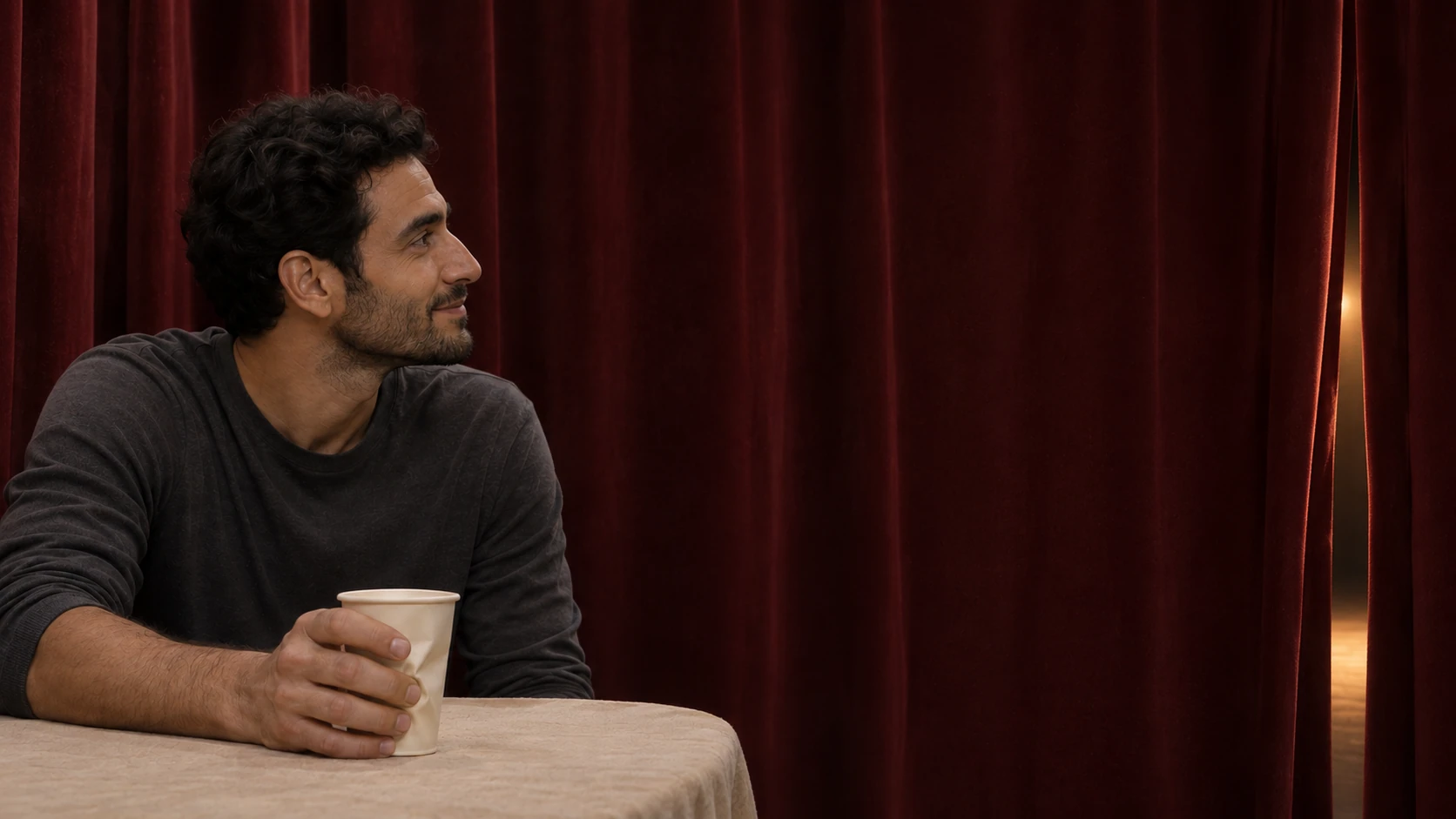
The center of attention may lie near an edge even if the character’s face occupies the middle of the image. This happens when action, contrast, or expectation gives that edge enough weight. It is therefore useful to examine the edges of the frame too, where an unintended movement or detail may compete with what you want to emphasize.
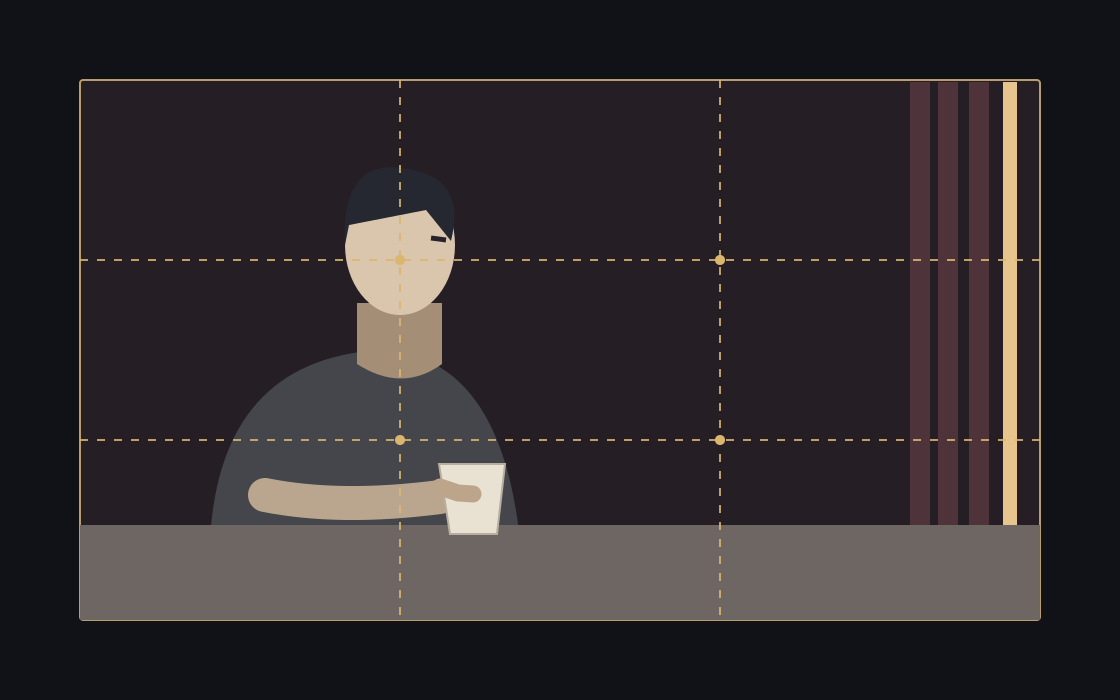
The rule of thirds offers a starting point for trying out arrangements. It divides the image into three parts horizontally and three vertically, and considers placing elements near the dividing lines or their intersections. Central placement can serve a direct presence, confrontation, or symmetrical arrangement if those relationships suit the scene.
When testing any arrangement, look at what happens between elements. Salim’s face might benefit from a slight shift if it gives the hand clearer space, but its new position may become distracting if it brings more detail behind him. The effect of the change determines the value of the choice.
Composition develops over the duration of a shot
A still image lets us examine the arrangement of elements at leisure. In a shot, however, there is a specific moment when Salim speaks, a moment when his fingers begin pressing, and a duration in which we can notice the change.
If the cup dents while Dalia is finishing a broad movement with the program, we may follow her movement and miss the smaller detail. A short interval between the actions can allow attention to pass from one to the other.
That interval must fit the characters’ behavior. Dalia might settle because she is waiting for his answer, and he might grip the cup as he tries to reply. Here, the order of attention grows out of the rhythm of their interaction.
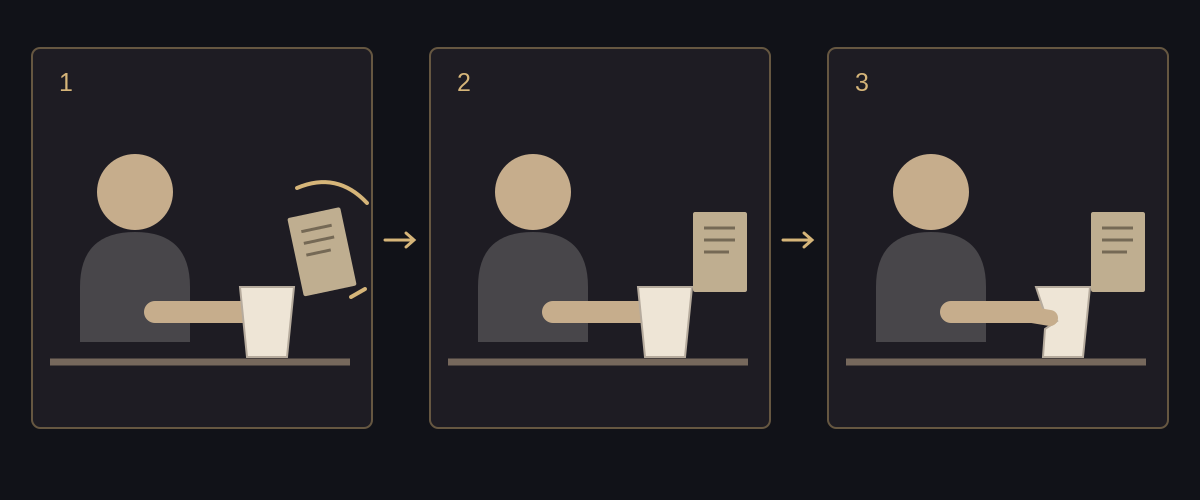
A visual sign also needs time in which it can be perceived. If the cup is small within a crowded shot, a slight change in its shape may be hard to catch. It may become clearer if it stands apart from its surroundings, the action lasts a little longer, or a preceding glance draws attention to it. We test the solution that preserves the nature of the situation.
Sound also helps guide the eye. The sound of paper may alert us to the hand, and Dalia’s line may invite us to look toward the exit. We can therefore examine the composition first in a silent image, then consider what changes when it works with sound.
Throughout this process, it helps to distinguish two things in our notes. “I saw his fingers pressing the cup” describes what reached attention. “I felt he was afraid to go onstage” interprets that action in context. If the sign never registered, we reconsider its clarity and timing. If it registered but produced a different reading, we examine its relationship to the rest of the scene.
Practical exercise: design two frames with different priorities
You need a fixed phone, someone who agrees to be filmed, an empty paper cup, a table, and two pieces of cloth or paper that differ in lightness and darkness. You can simplify Salim’s situation so that he appears alone, directing his line to someone offscreen.
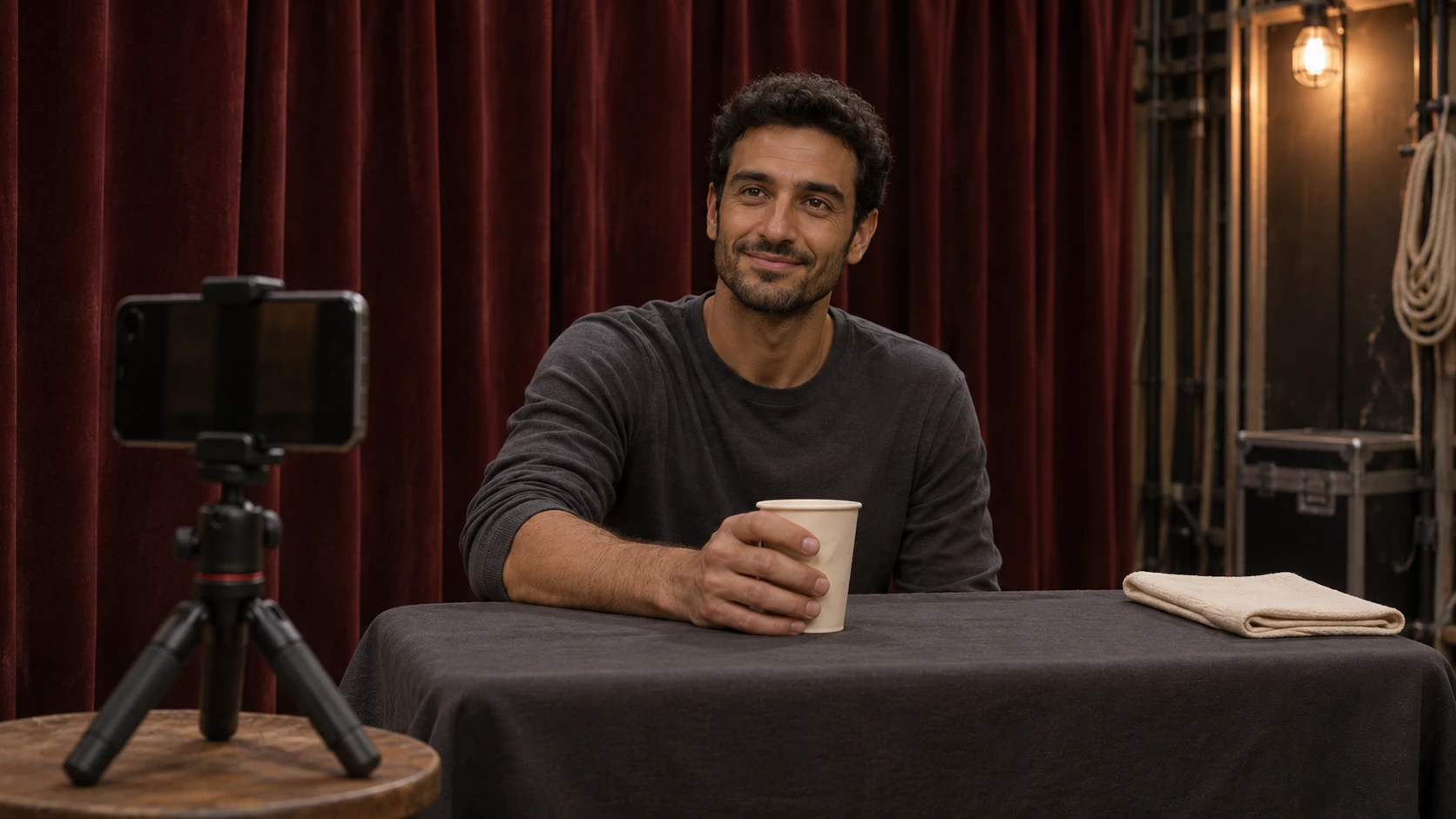
The aim is to design one version in which the face stands out and another in which the hand and cup have a clearer presence, keeping the essential elements visible in both.
Fix the phone position and framing. Choose a shot that lets us see the face, hand, and cup reasonably clearly. Keep the height, angle, and shot size the same in both versions.
Design the first arrangement and take a picture. Watch how the hand relates to its surroundings and how much detail surrounds the face. Note which element you expect to catch the eye first and the visible reason for that expectation.
Change one factor to make the second arrangement. You can change how light or dark the surface around the hand is, or simplify nearby details. Take the second picture before adding another change so that you can connect the result to what you altered.
Show both pictures to someone else. Ask them to describe what caught their attention and what they remember from each. Compare their answer with the intention you recorded, then reconsider the area that needs adjustment.
Test both arrangements in short clips. The person says, “I’m ready,” and presses the cup slightly. Keep the performance, timing of the movement, recording length, and sound as consistent as possible. Watch each version through before pausing to inspect details.
After watching, note what was seen of the action and what was understood from it. If the viewer noticed both the face and the hand, ask at what moment the hand caught their attention. If they did not notice the cup, consider what was competing with it at that time.
You may find that changing the surface alone was not enough because another movement kept commanding attention. You then have a specific reason to try adjusting the timing or simplifying the surrounding area, and to test again.
This exercise lets you see composition at work. The cup that was a small part of the setting can become an action we read, and that action can then redirect our gaze toward the face.
So far, we have tested the order of attention within a space close to the characters. When one moves away from the other, distance itself becomes part of the relationship we see. This is what we explore in part seventeen, “Image Depth: How Does Distance Become a Dramatic Tool?”
About this series
A journey from understanding the director’s work and making a first decision to working with story, images and actors, then preparing, filming, editing and making a short film.
Further parts will be linked as they are published.
View the series in orderAll Cinema Journal articles