
In a broad square, a young woman holds a kite while an older man holds the spool of string.
She raises the kite above her head and waits for a suitable gust. But the man pulls the string before she is ready to launch it.
The kite falls to the ground.
She tries again and turns to signal with her hand that he should wait. He repeats the same action, and the kite falls once more.
She lowers her arms, leaves the kite on the ground and walks towards a nearby bench.
The man remains standing, looking at the kite and then at the young woman, who no longer wants to try.
After a few moments, he approaches and places the spool in her hand.
He steps back towards the kite and lifts it himself this time.
He waits.
She looks at him, then at the spool now in her hand.
When she feels the wind is right, she gently pulls the string.
The man releases the kite, and it rises above the square.
Neither says anything.
Yet we can understand that their relationship has changed during the encounter.
Initially, the man was trying to control the process, while the young woman had no real chance to decide when to launch. By the end, he is willing to leave that decision to her and follow her signal.
We may read this as a moment in which he learns to trust her ability, or discovers the value of cooperation instead of imposing control.
We do not need him to say: “I’ve realised I was controlling everything, and I should trust you.”
We have seen the change through actions.
This is one of cinematic language’s most important capacities: what a character does, and how they interact with other people and the space, can become a story viewers understand without direct explanation.
Before Characters Speak, What Can the Image Say?
When a beginner starts making a film, they may rely on dialogue to communicate most information.
If a character is afraid, they have the character say so. If angry, they ask them to express that anger verbally. If a relationship changes, they add dialogue explaining why.
Using dialogue is not inherently a mistake.
Words can reveal character, alter relationships and create conflict. Dialogue itself may be the principal source of a scene’s strength.
The problem arises when speech becomes the film’s only means of communication.
Instead of using image, performance, movement and sound to convey information, scenes become people standing before a camera explaining what viewers should understand.
Imagine that we want to show someone feeling unwelcome in a home they used to visit regularly.
We could have them say: “I feel like a stranger here now.”
The line is clear and may be appropriate if admitting that feeling is an important part of the confrontation.
But what if we want to discover the feeling before the character admits it?
They may enter and automatically approach their usual seat, only to find the space changed and someone else’s belongings occupying the seat and nearby table.
They pause, then choose a chair farther away.
A little later, someone who lives there enters and welcomes them without noticing that they have moved to a new place.
We can see a difference between what the character used to do and what they now have to do.
This action alone cannot prove that they feel alienated; the change may be entirely ordinary. But if we know their earlier relationship with the place, the movement may acquire deeper meaning.
This brings us to an essential point:
An image derives its meaning from more than the appearance of objects. It also depends on context and what we knew about the character before that moment.
A chair is not a fixed symbol of isolation, and sitting farther away does not always signify rejection.
But when a film connects a place, a character’s history and their present behaviour, a simple choice such as changing seats can become part of the story.
Visible Action: Knowing Characters Through What They Do
In previous parts, we learned that dramatic characters need desires and motives, and that the actions they choose when facing obstacles help reveal their nature.
We will now use this knowledge visually.
If we want to show someone’s generosity, another person does not necessarily need to describe them as generous.
We can place them in a situation where they must choose between keeping something they need and sharing it with someone else.
But the action should not become merely a display of a trait we want to establish.
A character may be generous in one situation and refuse to help in another for reasons the story makes understandable.
The aim is not to turn behaviour into a fixed moral label, but to use it to reveal priorities and motives.
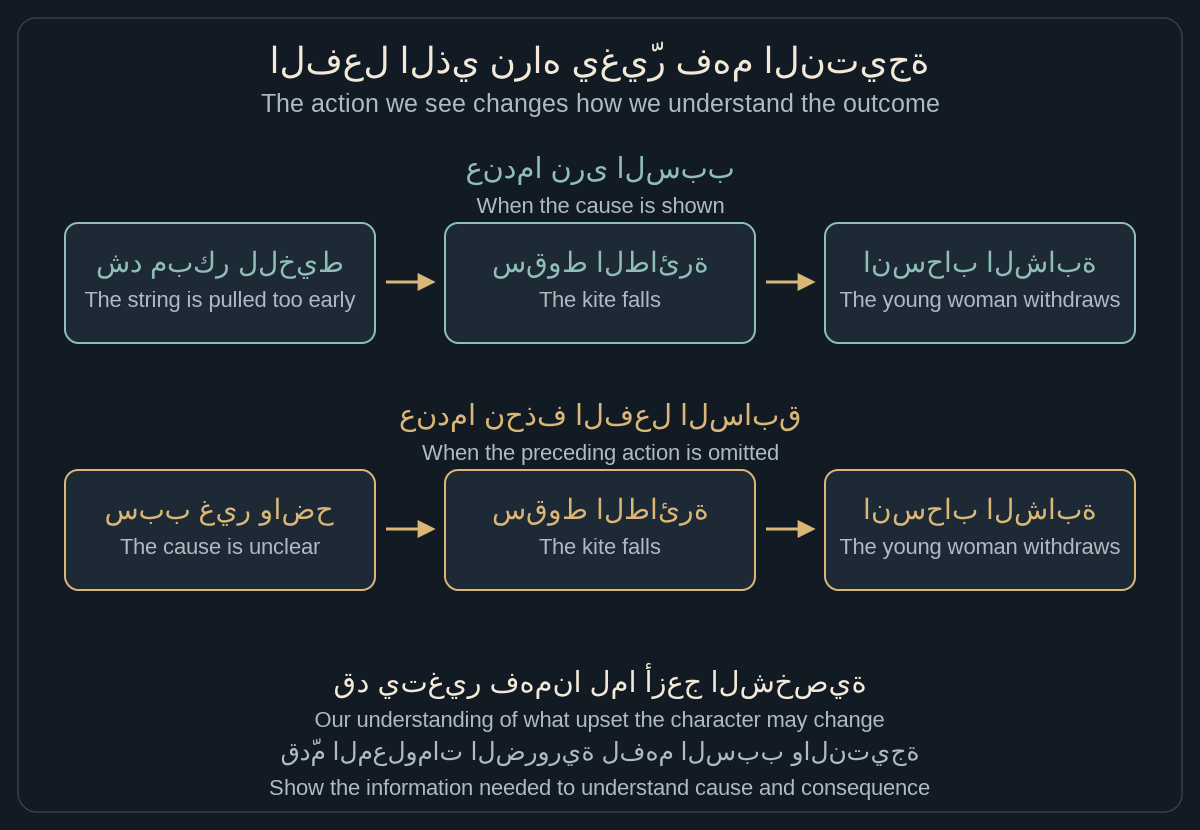
Let us return to the man trying to launch a kite with the young woman.
At the beginning, he does not need to tell us that he likes control.
We see him pull the string before she is ready, then repeat the action despite the failed attempt.
To understand what is happening, however, the relationship between his action and its consequence must be clear.
If we do not see that he pulled too early, we may think the kite fell because the wind was weak or the young woman made a mistake.
We will then fail to understand why she left the kite and walked away.
This is an important directing point.
Viewers need not register every technical detail of kite flying, but they must receive the information needed to understand why a character’s behaviour changes.
The director chooses which actions viewers need to see and which they can infer without direct presentation.
Omitting one small action may cause the entire meaning to be lost.
If the young woman suddenly walks away without our understanding what upset her, her response may seem unjustified.
If we have seen the repeated attempts, her withdrawal may become an understandable consequence.
Movement therefore becomes more than activity filling the frame. It becomes an action with a cause and a consequence.
The Distance Between Two People Can Become Part of the Dialogue
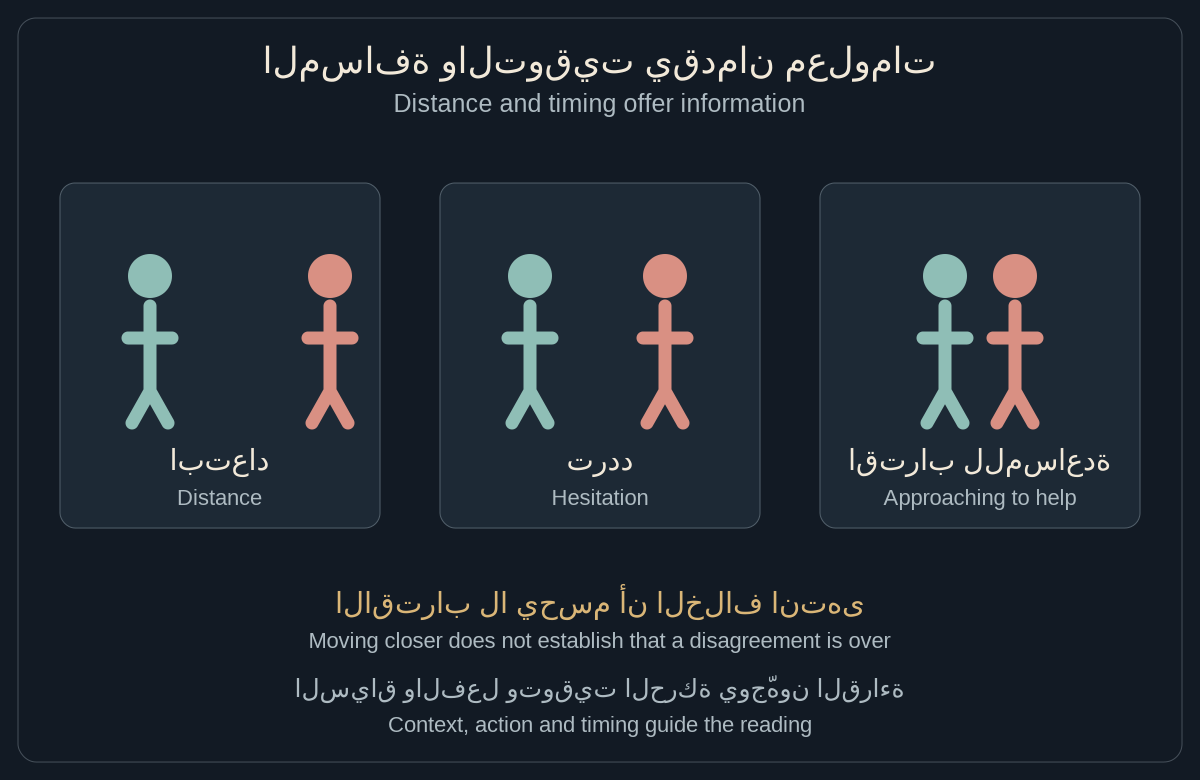
A director can use characters’ positions within a space to reveal the nature of their relationship.
Two people may stand close together while one avoids the other’s gaze. They may be physically distant yet show a strong connection through their attention and interaction.
Distance alone does not determine meaning.
But a change in distance during a scene may matter, especially when connected to an action or decision.
Suppose two people are preparing to tidy a room after a family gathering.
They work in different parts of the room and avoid approaching each other.
An earlier scene has shown us that they argued bitterly during the gathering.
A box falls, scattering its contents across the floor.
The first person stops and tries to gather everything alone.
The other looks over, then approaches and begins helping.
They may continue working without dialogue.
Simply moving from one side of the room to the other person’s position may indicate a change in the relationship.
We should not assume, however, that approaching means the disagreement is over.
Perhaps they have decided to help despite remaining angry, want to prevent damage to the objects, or are responding to a third person’s presence.
We return here to the importance of context.
Positioning and movement offer material for viewers to interpret, but they do not impose a fixed psychological meaning.
From a directing perspective, the timing of the approach may be crucial.
If the second person moves immediately when the box falls, we may see the response as spontaneous.
If they remain still for a few moments before helping, we may perceive hesitation or conflict within the decision.
Keeping both characters in a shared composition may help us notice the distance between them, instead of constantly cutting to separate images of each face.
Each choice gives viewers different information.
Later, we will study how a director arranges actors’ positions and movement in greater detail. For now, what matters is recognising that characters’ relationship with the surrounding space can be part of the narrative itself.
Objects Within the Frame: How Do Details Become a Story?
A cinematic space may contain dozens of objects, but some can communicate information about characters and their world without anyone explaining it.
Imagine entering a small workroom.
There is a carefully organised desk, tools stored in clearly labelled boxes and a board displaying precisely written appointments.
We may infer that the person who uses the room values organisation, but these details cannot establish their entire personality.
We then see them hurry in, put their bag somewhere other than its usual place and leave several papers scattered across the desk.
If the story has accustomed us to their meticulous habits, this new behaviour may suggest that something unusual is occupying their mind.
Notice that the details gain value through a difference viewers can recognise, rather than through being strange.
The same applies to clothes, personal belongings and ways of using a space.
A family photograph on a desk may tell us little.
If we see a character try to hide it before a particular person enters, however, the object may become a dramatic element that raises a question.
Why are they hiding it? What do they fear the visitor will discover?
Showing the photograph later may answer the question, or the film may reveal an entirely different meaning for what happened.
We should therefore distinguish between an object serving a function within the story and a symbol we assume has a fixed meaning.
Not every closed door symbolises fear, every window freedom, or every mirror an identity crisis.
These things can acquire different associations through context, or simply remain ordinary parts of the setting.
When a director chooses to emphasise an object, it helps to ask: what will viewers learn from seeing it? Does its meaning change when it appears again?
If the answer is clear, a small detail can become a powerful visual storytelling tool.
Facial Expressions: Why Do We Not Need Exaggeration to Understand?
The human face can powerfully attract viewers’ attention, especially when a change in expression is connected to important information or action.
But there is a common belief that emotions must be displayed very clearly for audiences to understand them.
A sad character must cry, a surprised one must open their eyes wide, and anger must immediately appear on the face.
This approach may produce a performance more explicit than some scenes need.
People do not always express their feelings as expected. They may try to conceal or control them.
Imagine a character learning that they did not get a job they had been waiting for.
They might cry immediately, which could suit their personality and the circumstances.
They might instead thank the person who delivered the news, end the call and return to sorting the papers in front of them.
They try to continue but put one sheet in the wrong place.
They pause, correct it and resume working.
These actions may let us read the news’s effect without needing an exaggerated facial expression to explain it.
But this does not mean that a small filing mistake always expresses sadness or shock.
The meaning depends on what we knew about the character’s desire for the job and how they behaved before hearing the news.
It also matters to attend to the character who listens, not only the one speaking or moving.
The listener’s reaction may matter more than the words they hear because we want to know how their relationship with the speaker has changed.
The crucial information may even lie in a moment with no obvious facial change, leaving viewers to wonder what the person is concealing.
Silence here becomes part of the performance, rather than its absence.
A director need not force an actor to display a single feeling clearly at all times. They need to understand what the character is experiencing and trying to do at that moment.
Does the Absence of Dialogue Mean the Absence of Sound?
There is a substantial difference between a scene in which characters do not speak and one entirely without sound.
Sound can play an important narrative role even when no word is spoken.
We may hear footsteps approaching a particular place, a machine stopping, or a noise from outside the frame that makes us anticipate something’s appearance.
Let us return to the kite scene.
With natural sound, we might hear wind, the movement of the string, the kite scraping the ground as it falls and the young woman’s footsteps as she leaves.
These sounds do more than make the setting realistic. They also guide our attention towards important actions.
The sound of the string suddenly tightening may help us notice that the man intervened too soon.
Her footsteps stopping at the bench may signal her decision to withdraw from the attempt.
When we hear the wind strengthen during the final attempt, we may realise that a suitable moment to launch has arrived.
There is a difference between sounds belonging to the scene’s world, such as wind and footsteps, and music added from outside that world.
Music can support a feeling or create a contrast with the image, but it does not automatically replace clear action.
If the characters’ relationship is unclear, placing sad music over it will not necessarily turn it into a moving story.
The music may instead impose a feeling for which the image provides insufficient foundation.
Sometimes omitting music is useful because natural sounds give viewers a chance to attend to the details the director wants to emphasise.
Reducing sounds or withholding some may also serve a dramatic purpose, but this needs deliberate treatment: total silence differs from quiet environmental sounds.
The absence of speech does not make a film silent. Sounds may continue to communicate information and shape the scene’s feeling.

How Can an Image Pose a Question and Then Answer It?
Visual storytelling gains strength through the relationship between what we see first and what follows, rather than through separate beautiful images.
Information may appear in one image, requiring another before we understand its meaning.
Watching someone look at an object may make us wonder why it interests them, with the next movement providing an answer.
Imagine a woman entering a room and finding a chair placed before the window.
She pauses but does not approach it.
Soon, another person appears carrying two cups of tea. They place one beside the chair, then notice the woman at the door.
Viewers may begin wondering about their relationship, why there are two cups and whether the seat is intended for a particular person.
These details alone, however, cannot explain the situation.
If the second person sits in one chair and gestures towards the other, we gain new information about their desire to sit together.
If they instead take the second cup back to the kitchen on seeing her, a very different reading of the relationship may emerge.
The story changes without a single line of dialogue.
But the order in which information is presented is crucial.
If we begin with the person returning the cup without first showing that there were two, we may not understand what changed.
The director’s role here is to determine what viewers must see, and when they should see it.
They may need to show an entire action or keep information outside the frame until the appropriate moment.
Information can pass between different shots or emerge within a single shot as the characters move and attention shifts.
The aim is not to use as many shots as possible, but to make the relationship between actions as clear as the story requires.
We will study connecting shots, continuity and cutting later. Already, however, we need to understand that a new image may change our interpretation of an earlier one.
WALL·E: Discovering a Whole World Without Lengthy Explanation
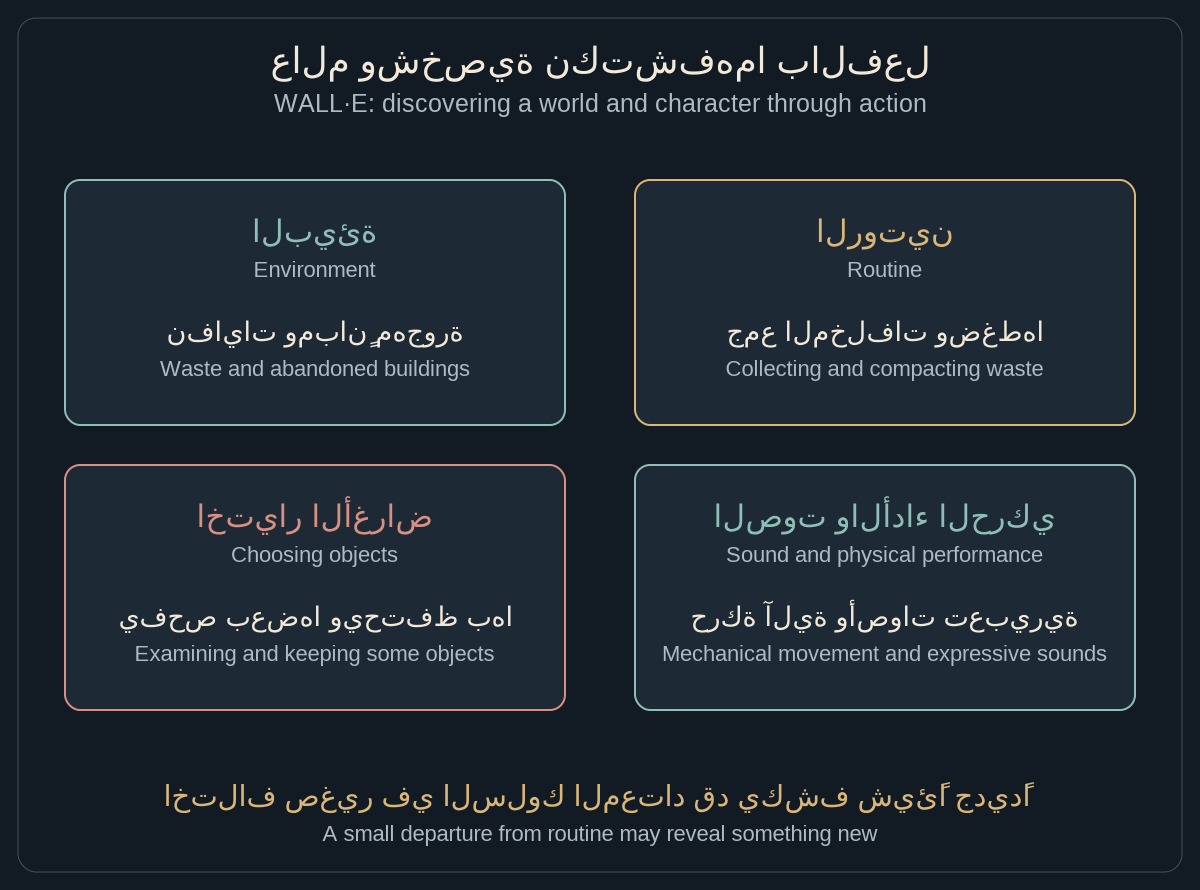
WALL·E, released in 2008, directed by Andrew Stanton and produced by Pixar, clearly demonstrates visual storytelling’s ability to introduce a world and character through actions and details.
In the opening, we see an Earth covered in rubbish, seemingly abandoned buildings and a small robot continuing its daily work of collecting waste and compacting it into cubes.
We do not immediately need a human character to explain in detail how the world reached this condition.
The environment itself gives us information about the place and raises questions about what happened to its inhabitants.
We then begin noticing the robot and how it handles the objects it finds.
It does more than collect rubbish mechanically. It takes an interest in certain objects, keeps them and has a private space for things that attract its attention.
A cockroach companion also reveals another aspect of its daily life.
These details let us discover the character without conventional dialogue explaining its traits.
The robot does not need to tell us it is curious. We can observe its curiosity in how it pauses before objects and examines them.
Nor does it need to explain its loneliness in a long speech. The vast abandoned world and repetitive routine allow us to understand the circumstances of its existence.
We should remember, however, that the film is not without sound.
Electronic sounds, mechanical movements, music and the surrounding sound design play an important role in shaping the experience.
Even the robot’s own sounds help it express itself and communicate, although they are not conventional human dialogue.
This approach reveals the importance of collaboration between image, sound design and the character’s physical performance.
The film’s production materials have explained that the filmmakers used daily routine and the surrounding environment to present the world’s history visually, rather than relying on direct verbal exposition.
What can a beginner learn from this example?
They do not need to create an enormous world or a robot character to tell a story without speech.
The central principle is that repeated behaviour can introduce a character, and a small difference within that behaviour may reveal something new about them.
The same principle can apply to someone working in an ordinary room, someone tending a place, or two characters trying to perform a simple task.
Once we know what a character usually does, we can more readily notice when they behave differently.
That difference may be the beginning of the story.
When Images Are Beautiful but Tell Us Nothing
A director may create a series of visually attractive shots and then discover that viewers do not understand their relationship.
We might watch someone stand before a window, touch a wall, walk down a long corridor and sit alone in a dark room.
The images may give a general feeling of isolation or reflection without necessarily forming a clear dramatic story.
Quiet or abstract images are not inherently weak. Rather, we do not know whether the actions are connected to a goal, change or relationship the film needs to communicate.
This treatment may suit an experimental film or poetic work seeking to create a sensory experience more than a traditional story.
If our goal is for viewers to understand that someone is trying to reach another person or make a difficult decision, however, more information may be needed.
Another mistake is relying on stock expressions.
We might ask an actor to put a hand on their head whenever anxious, look at the floor whenever sad, or gesture violently whenever angry.
These actions may suit some situations, but they do not become a fixed universal language everyone interprets identically.
The same applies to music and colour.
No sad music makes every scene moving, and dark lighting does not turn any situation into profound psychological drama.
Meaning emerges from the relationships between the film’s elements and the context that allows us to understand them.
Withholding too much information may create the opposite problem.
If every character behaves mysteriously and we hide their reasons without providing context, viewers may feel unable to understand rather than curious.
There is a difference between posing an intriguing question and concealing the basic information audiences need even to ask it.
Good visual storytelling does not require explaining everything. It gives viewers enough to follow the story, form expectations and discover relationships themselves.
Practical Exercise: Tell a Complete Situation in Three Shots Without Dialogue
It is time to put what we have learned into practice.
We will take a small situation and try to present it in only three shots, without dialogue, voice-over or explanatory text.
The aim is not to make a professional film, but to test your ability to communicate information, development and an outcome through images.
You can sketch an initial idea with paper and a pen or film on your phone in a suitable, safe place, with people who consent to appear if you need participants.
Suggested situation:
Two people sit at the same table. One is trying to repair a small bag’s handle, which has come loose.
The first person keeps trying unsuccessfully.
The second notices the problem and reaches out to offer help.
Initially, the first refuses, then discovers the need to cooperate.
Let us establish how to present this visually.
First shot: establish the relationship and goal.
We clearly see both people, the table and the bag.
The first tries to reattach the handle while the other watches.
We should understand that someone wants to accomplish something and that the attempt has not yet succeeded.
Second shot: show the resistance.
The second person reaches out to help.
The first pulls the bag away, tries to repair the handle again and fails.
We now see that the problem involves more than the handle. It also concerns how the character responds to offered help.
Third shot: show the change.
After a brief hesitation, the first person pushes the bag towards the other.
One holds the handle in place while the other helps secure it.
The shot may end when the repair is complete or with a small change in how they interact after succeeding.
Neither needs to say: “I’ve learned the importance of cooperation.”
The change has appeared through the bag passing from one person to the other, then through their completing the task together.
There is, however, a directing choice worth considering.
What if we want the initial refusal to seem motivated by anger? What if we want it to seem connected to embarrassment at being unable to complete the task?
Both treatments can be tried without changing the dialogue, since there is none.
The timing of pulling the bag away may change, as may the first person’s way of looking at the other or the time taken before accepting help.
One attempt may not communicate your intended meaning clearly.
That does not mean you must immediately add a line explaining the motive.
First, consider whether an action is missing, information has not been presented, or a response has not been given enough time for viewers to notice it.
Afterwards, watch the three shots in sequence, then show them to someone who did not participate in making them.
Ask what they understood and what changed between the two characters.
Do not begin by explaining your intention.
If the viewer understands that the first person refused help and then accepted it, you have communicated the essential event successfully.
If they interpret the reason for that change differently from your intention, consider whether this is a legitimate difference in reading the scene or the result of missing essential information.
The most important test: can someone who has heard no explanation understand what the character tried to do, what prevented them and what changed at the end?
If you can achieve this, you have begun using images to present clear dramatic action.

What Changes When You Stop Explaining Everything?
Let us return to the square where the story began.
The kite rises, and more string passes through the young woman’s hands.
The man stands at a distance, having left her control of the spool.
He does not tell her that he now trusts her.
She does not thank him for giving her the chance.
They watch the kite moving above them.
The story could end here.
But imagine another choice.
As the kite begins descending again, the man takes a quick step forward, ready to intervene as he did at the beginning.
Then he stops.
He looks at the young woman and sees her still holding the spool and adjusting the string herself.
He takes a step back.
This small movement may express the change more strongly than the kite’s successful flight.
Completing the task tells us that they managed to launch it. His decision not to intervene in the next attempt may reveal that his new choice was more than a passing gesture.
He can now leave her room even when another difficulty arises.
The director does not have to present this meaning as an explicit moral lesson.
They can leave it within the action and allow viewers to discover it.
This makes visual storytelling a skill extending beyond the selection of beautiful images.
A director needs to understand what a character wants to do, how they move towards it, what their behaviour reveals and what information must appear for viewers to follow the change.
They then choose what we see and hear, and what can be left to understanding and inference.
Dialogue may be necessary in another scene, and may even become more powerful after a long period without speech.
Our goal is not to dispense with words at all times, but to avoid relying on them alone to create meaning.
When you learn to let action, image and sound carry the story, dialogue becomes an artistic choice you use when needed, rather than a compulsory way of explaining everything that happens.
In part fourteen, we will look more closely at a fundamental visual decision: shot sizes, when to move closer to a character, and when greater distance may be more affecting.

About this series
A journey from understanding the director’s work and making a first decision to working with story, images and actors, then preparing, filming, editing and making a short film.
Further parts will be linked as they are published.
View the series in orderAll Cinema Journal articles