Stage three: Learning to think in images
We can see a character’s face clearly and miss what explains the expression. Frame the character from farther away and we may discover how they relate to the people around them. Shot size determines how much we know, which details we can notice, and the distance from which we experience an event.
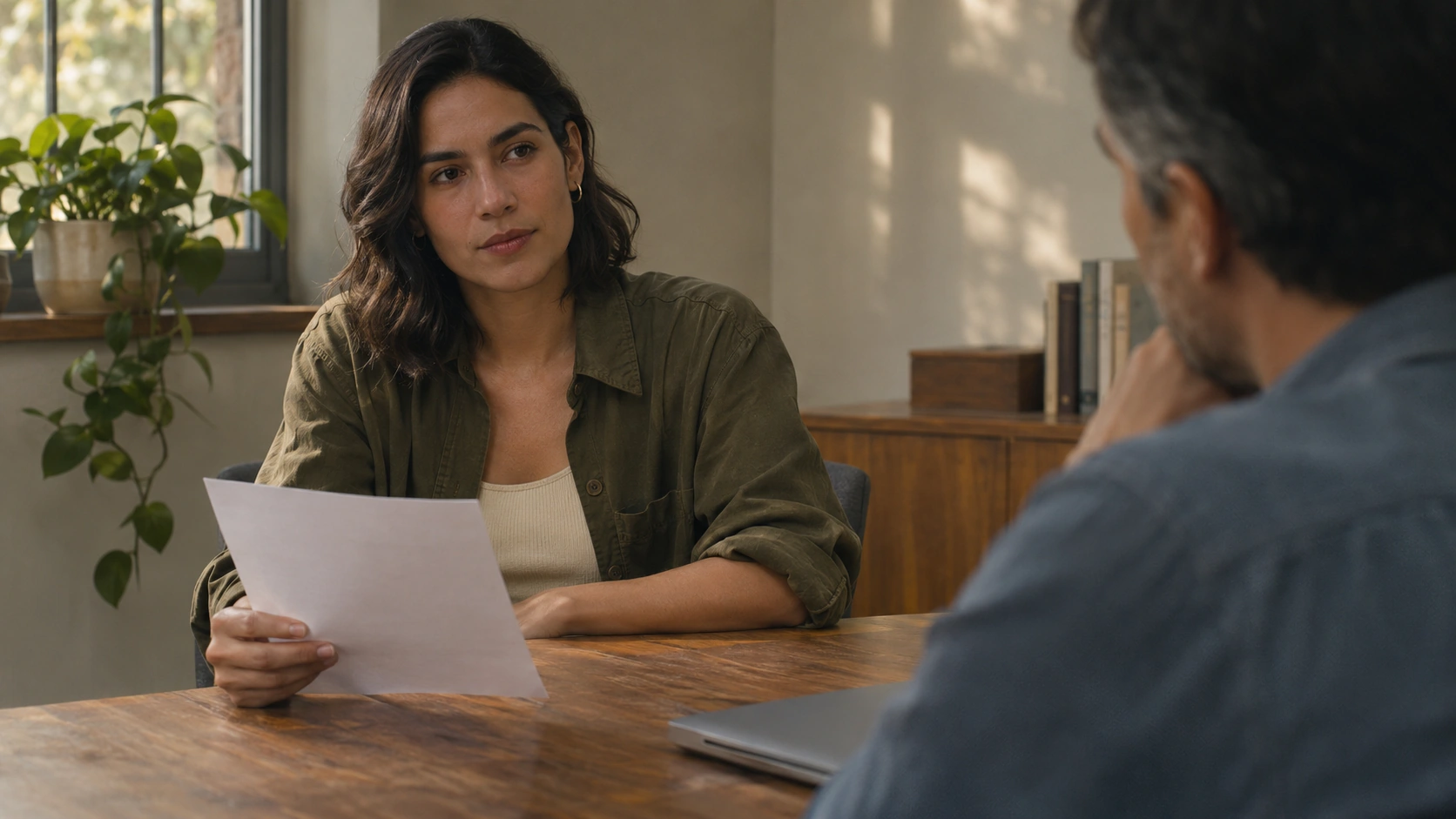
Imagine a scene. Mira, the newest member of a small team, sits across from a more experienced colleague. She pulls her sheet of paper toward her, hesitates for a moment, and says, “I think we need to change the plan.”
While she searches for her next words, her colleague closes his laptop, pushes it aside, and leans forward to listen.
We can film this moment so that we see both people and the table between them. We can also keep only Mira’s face in view. Then we notice the brief pause before she speaks, the movement of her eyes, and the effort it takes her to keep going.
The event is the same, but the evidence available to the viewer changes. In the first frame we can follow the colleague’s response. In the second we get a finer view of Mira’s face, while his response stays outside the frame.
This is where thinking about shot size begins: Which part of the event does the viewer need to see now, and how clearly?
What does shot size mean?
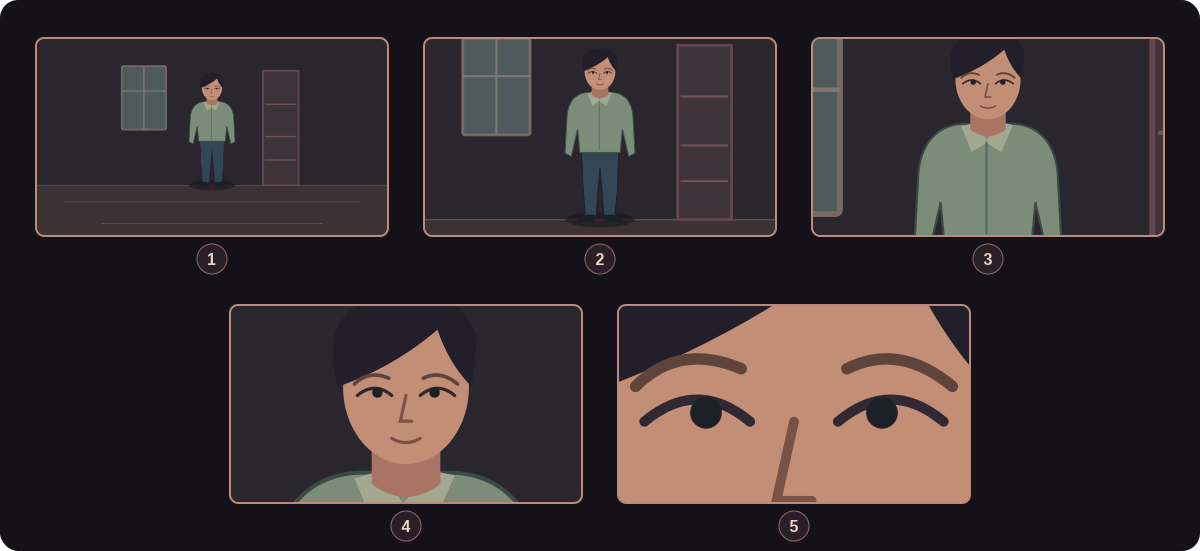
Shot size is how much of the subject appears within the frame and how large it appears in relation to that frame. When a character is small in a wide space, we see more of their relationship to their surroundings than the details of their face. When the face fills the frame, its small changes are easier to notice and more of the space disappears.
We often use the human body to name shot sizes because it gives the crew a familiar reference. Here are the main terms we need to start with:
| Shot size | What we usually see when filming a person | What the framing lets us see |
|---|---|---|
| Wide Shot | The person and a clear view of their surroundings, in which they may appear small | Their relationship to the place and to other people |
| Full Shot | The body from head to feet | The full posture, movement, and physical action |
| Medium Shot | Usually from around the waist up | Facial expression together with a useful view of gestures |
| Close-Up | The face, usually with a small part of the shoulders | Subtle changes in expression |
| Extreme Close-Up | Part of the face or a specific detail filling the frame | A small detail made clear and hard to miss |
These are approximate terms for communicating, and some names vary among practitioners. It helps to add a concrete description: we want the face and shoulders, we want the hands with the face, or we need to see the feet throughout the movement.
Size is relative to what we are filming. You might frame a close view of part of a building’s façade from much farther away than you would frame a person from head to feet. The number of metres between the camera and the subject isn’t enough to name the shot.
We should also distinguish four related things. Shot size describes the framing we see. Camera distance tells us how far the camera is from the character. Camera angle and height determine the direction and level from which we see them. Focal length is a property of the lens that affects how much it takes in from the same position.
Different arrangements of camera and lens can produce a similarly sized face with different visual results. We’ll explore those differences later. For now, when we say “get closer to the character,” we mean giving them more space in the frame. That alone doesn’t tell us how to achieve it technically.
One scene, two kinds of knowledge
Let’s return to Mira and her colleague and design two treatments of the same situation. We’ll keep the line, the hesitation, the laptop movement, and the duration of the event. We’ll change how tightly it is framed.
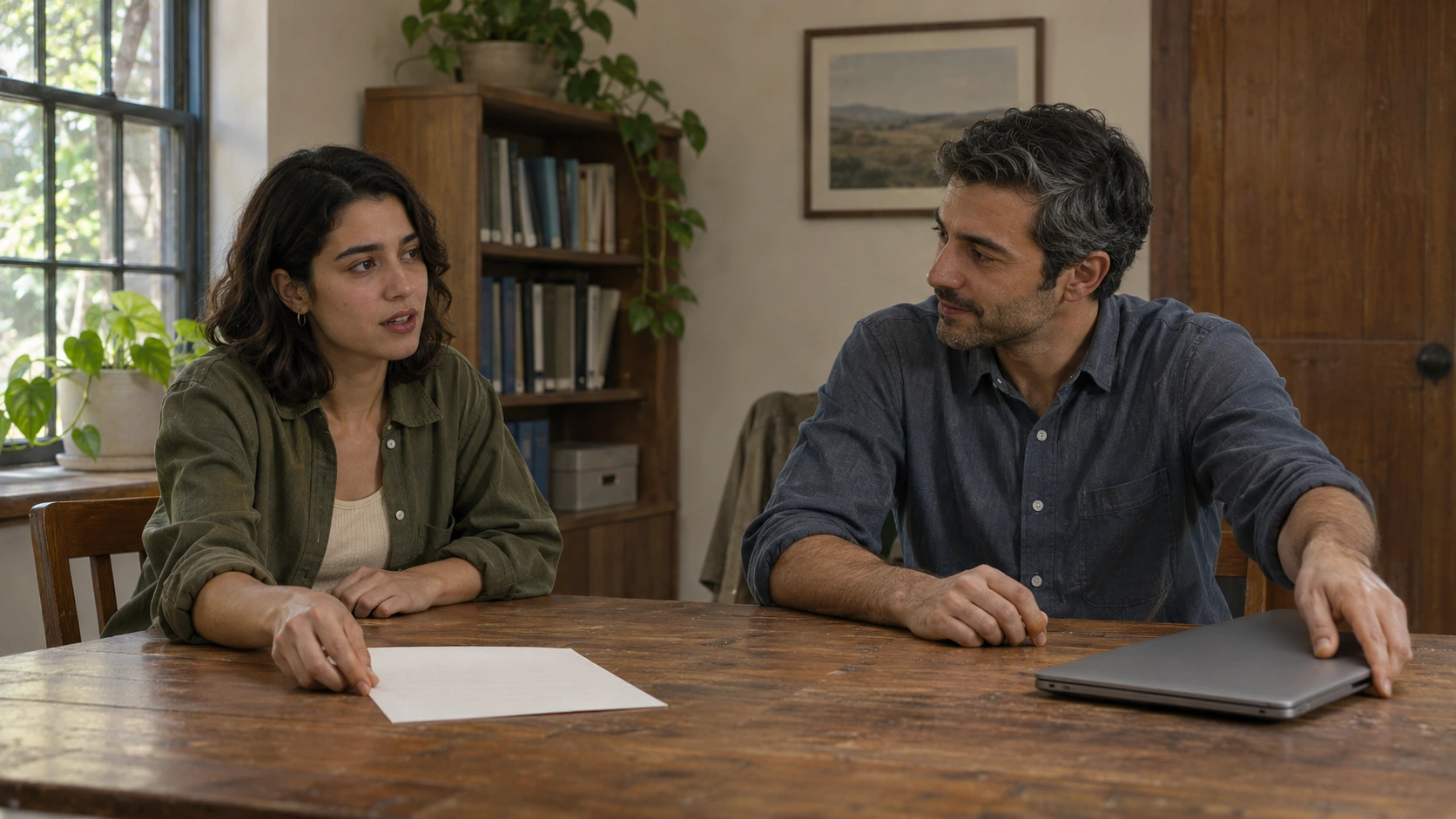
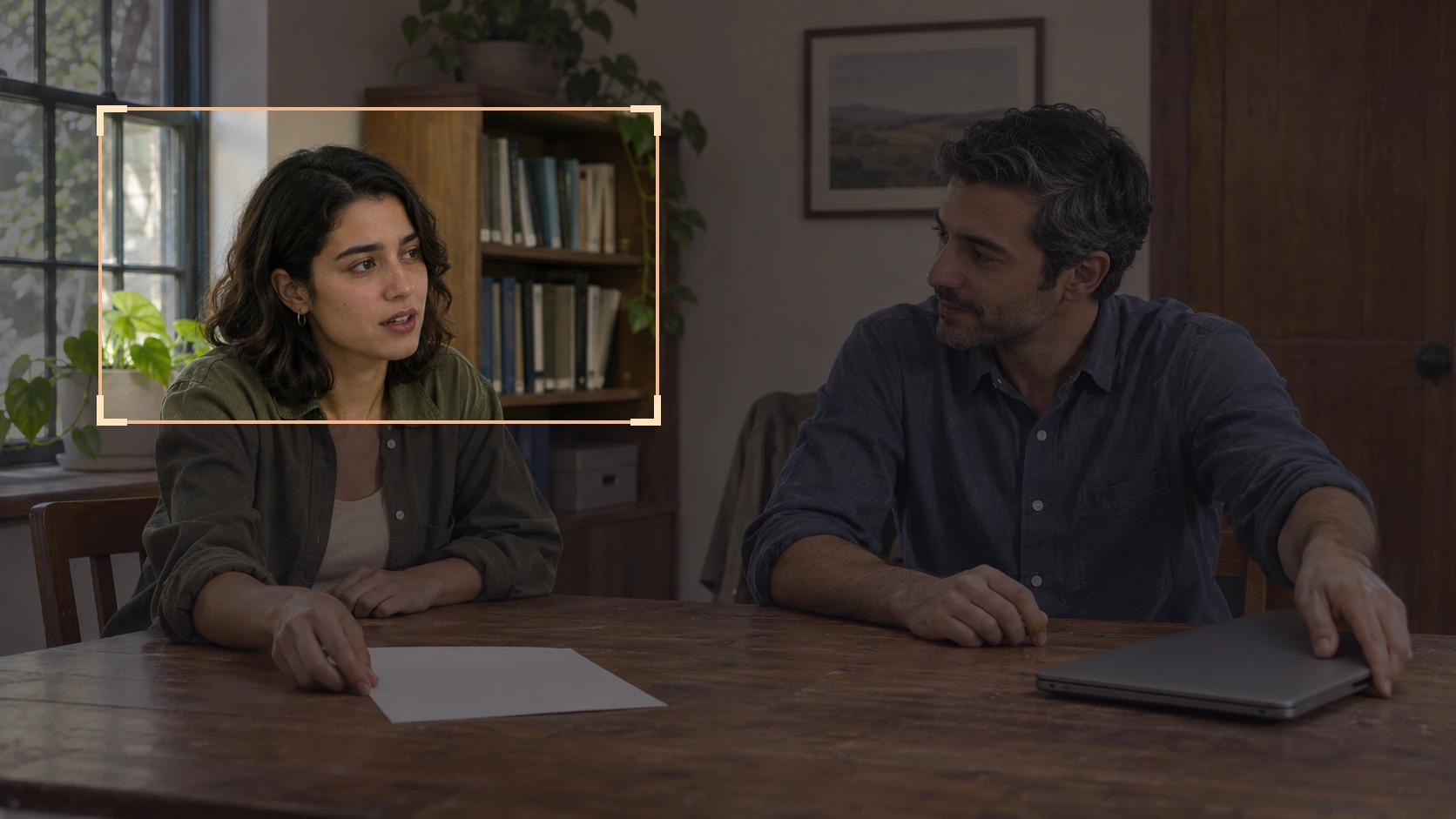
First treatment: A wide shot of both people and the table.
We see Mira pull the paper toward herself, then lift her head to speak. At the same time, we can follow her colleague as he sets the laptop aside and gives her his attention.
This treatment places Mira’s effort within a relationship we can observe. She is afraid to object, but the person across from her is visibly willing to listen. We may feel reassured before she does, because we see his response while she is still occupied with the difficulty of speaking.
What we gain is the relationship between two actions: one person gathering the courage to speak and another making room for her. What we lose, or see less clearly, are some of the small details on Mira’s face. We might notice the pause, but the movement of her lips or the change in her gaze won’t read as clearly as they would in a closer shot.
A wide shot doesn’t work simply because both people are in it. The colleague’s action has to be easy to notice. If the room’s details swallow it up, the viewer may miss the information we meant to give them.
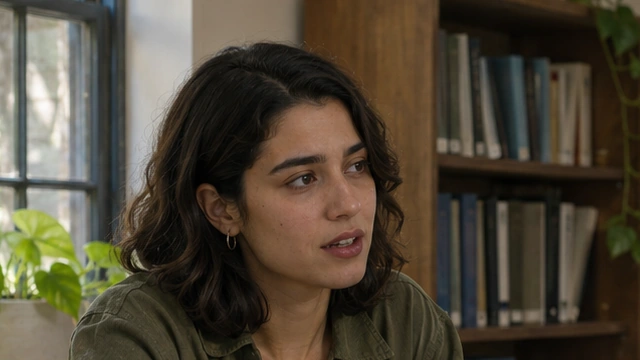
Second treatment: A close-up of Mira’s face.
We hear the same line and stay with her through the short pause that follows. Her eyes move from the paper to the person across from her, and we can see the moment she decides to keep speaking.
The centre of the experience changes. We focus on what Mira can bring herself to say and how she works through her hesitation. We no longer see her colleague close the laptop and push it away. A faint sound might reach us, but it can’t communicate the action as clearly on its own as seeing it did.
We gain the details of the face and lose direct visual evidence of the other person’s response. The question can remain open: is he listening attentively? Is he tired of what she’s saying? Is Mira the only one who feels that the situation is difficult?
This gap can be useful if we want viewers to share Mira’s uncertainty. It can hurt the scene if we need them to see from the beginning that her colleague is more receptive than she expects.
The choice begins with what the moment needs to do. Do we want to follow the relationship between the two people, or watch the effort it takes Mira to speak? Each choice gives us something and asks us to set something else aside for a time.
Getting close to the face doesn’t guarantee closeness to the character
A close-up can seem like a direct route to emotion because it makes details visible that we might miss from farther away. A clear view of a face, on its own, doesn’t decide how we feel about the person.
If we trust Mira and know how difficult the situation is for her, her hesitation might make us more sympathetic. If the story has given us reason to doubt her honesty, we might watch that same hesitation for a sign that she’s evading something. The size of the face stays similar; what we know and the context in which we see her change the reading.
Sometimes closeness can make us feel as if we’re scrutinising a person rather than accompanying them. Their discomfort is plain to see, but we don’t know enough to understand it. The framing can then create awkwardness, suspicion, or pressure.
A wide shot can also feel warm. Seeing one person make room for another may convey the relationship more strongly than a face on its own. In other situations, the detail that carries the emotional weight is one body moving away from another, or two people remaining in the same place despite their disagreement.
That’s why we should ask: Where is the evidence on which the viewer will build that feeling?
It may be in the eyes, in the hands, or in an action between two people. If we need to see a hand pull back from a handshake, an extreme close-up of the face can’t make up for losing that action. If the whole change is in a fleeting glance, a wide view might let it pass unnoticed.
Shot size makes some evidence clearer and other evidence harder to see.
How do you choose the size that serves the moment?
Before choosing the technical name, state what you need in a simple sentence. For Mira’s scene you might say, “I want viewers to notice that her colleague is willing to listen to her objection.” That points us toward framing in which we can see how he behaves with her.
You might also say, “I want viewers to stay with her effort to overcome her hesitation without yet knowing how her colleague has taken her words.” Then the close-up is worth trying.
This is something you can discuss with the cinematographer and test with the actors. It is clearer than asking for “a more powerful shot,” because you’ve defined the effect you’re after and can check for it.
Putting a detail in the frame doesn’t guarantee that viewers will register it. It needs to be large and clear enough, and they need a chance to notice it. A hand holding a sheet of paper might be easy to see from farther away, while a small word on the same sheet is impossible to read.
Getting very close gives a detail more weight. When we give an eye movement or a fingertip a large share of the frame, we invite the viewer to pay attention to it. If the context doesn’t justify that attention, they may wait for a meaning that never comes.
Using the same size too often affects how well it distinguishes one moment from another. If everyday details and important changes are framed equally close, we’ll need other ways to help the viewer feel the shift in importance.
This doesn’t require a fixed distribution of sizes or oblige us to move gradually closer as a scene intensifies. A return to a wider shot might be the decisive choice because it reveals information missing from the face we’ve been following.
The practical test is whether you can explain your choice. What did it make visible? What went out of view? Do both changes serve the moment?
Practical exercise: Test what each size reveals
Recreate Mira’s situation in a simple form. You’ll need a phone on a stable support, a table, a sheet of paper, and two friends who agree to take part. A notebook can stand in for the laptop. What matters is that putting it aside is clear.
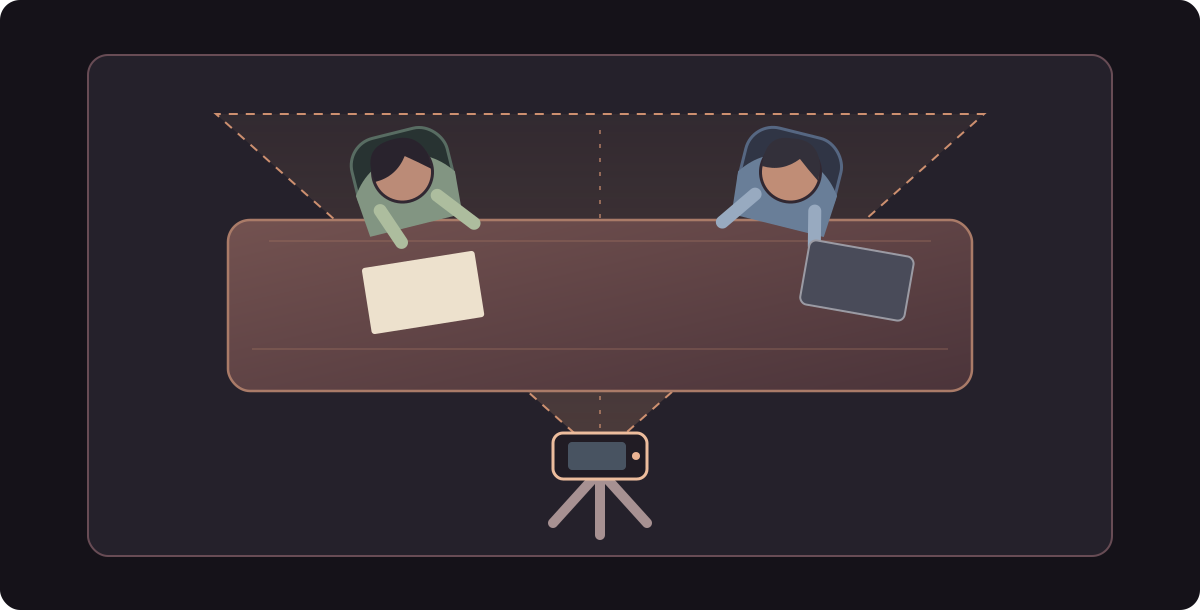
The event takes about twenty seconds. The first character hesitates, says she proposes changing the plan, and gives a short explanation. While she speaks, the listener sets his notebook aside and gives her his attention.
Decide on your intention before you film. Write one sentence, such as, “I want the listener’s response to come across as more welcoming than the speaker expects.”
Film a wide version. Keep both people and the table in view, and let the entire event play out in one fixed shot.
Film a close version of the speaker. Keep the performance, timing of the line, lighting, sound, and recording length as similar as you can. Try to keep the direction of the shot and camera height the same.
Check the effect of how you changed the size. If you can tighten the framing from the same position, you will have fewer variables. If you have to move the phone, note that the viewpoint has also changed and that the comparison is approximate.
Show both versions at the same size on screen. Ask each viewer: what did you understand about the listener’s response? Which visible detail helped you understand it?
For a more controlled comparison, you can make a close version by cropping the wide recording itself, if the image quality allows. This keeps performance, timing, and sound constant and lets you test more clearly what happens when you leave the rest of the frame out. It is a useful way to experiment, bearing in mind that cropping may reduce image clarity.
If possible, show the wide version first to one person and the close version first to another. Someone who has already seen the listener’s response will carry that knowledge into the version that hides it.
After viewing, answer two questions: What changed in what the audience knew? Did that change serve the intention you wrote down?
Then record what you noticed with a specific piece of evidence. “The wide shot feels warmer” becomes more useful if you add, “because we see the listener put down what was occupying him and turn his attention to the speaker.” “The close-up is more tense” also needs support, such as how clearly we see the hesitation while the other person’s response is out of view.
You don’t need everyone to agree on a feeling. The aim is to learn to connect your reading with what the frame actually makes available.
When you choose a shot size, you give viewers a particular way to understand the character. They may need to see her face, the person she faces, or the two together to understand what is happening between them.
Once we’ve decided how much to see, another question remains: from what height and direction do we see it? We’ll turn to that in the next part, “Camera Angles and Height: How Does Our Relationship to the Characters Change?”
For now, look at Mira once more. Her hesitation may be in a face that fills the image. A reason to feel reassured about her may be in a laptop that someone else puts aside. Shot size is what lets us notice one piece of evidence or the other.
About this series
A journey from understanding the director’s work and making a first decision to working with story, images and actors, then preparing, filming, editing and making a short film.
Further parts will be linked as they are published.
View the series in orderAll Cinema Journal articles